
Maximize your score with these resources:
- Albert.io AP® Environmental Science question banks
- Free AP® Environmental Science study guides
- Free AP® Environmental Science score calculator
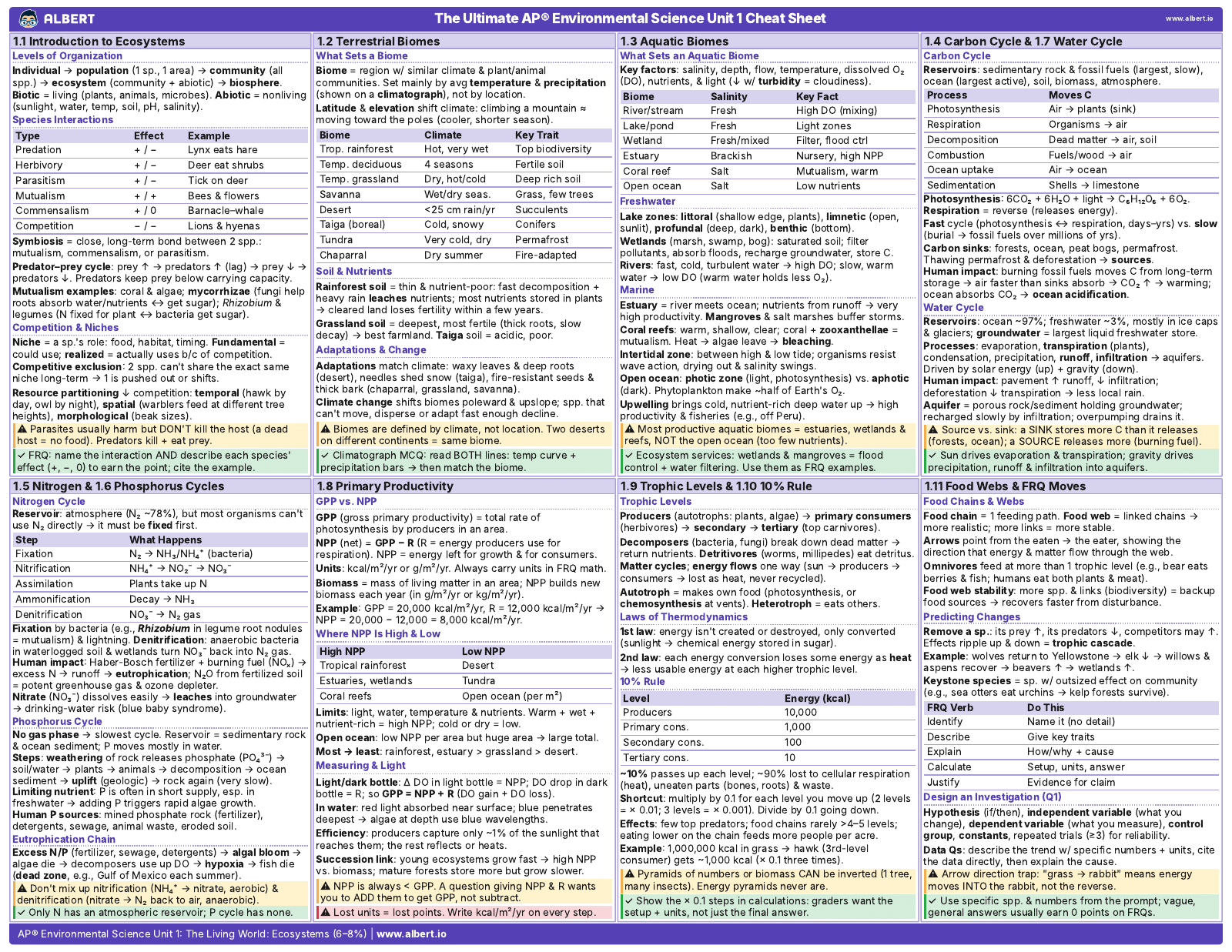
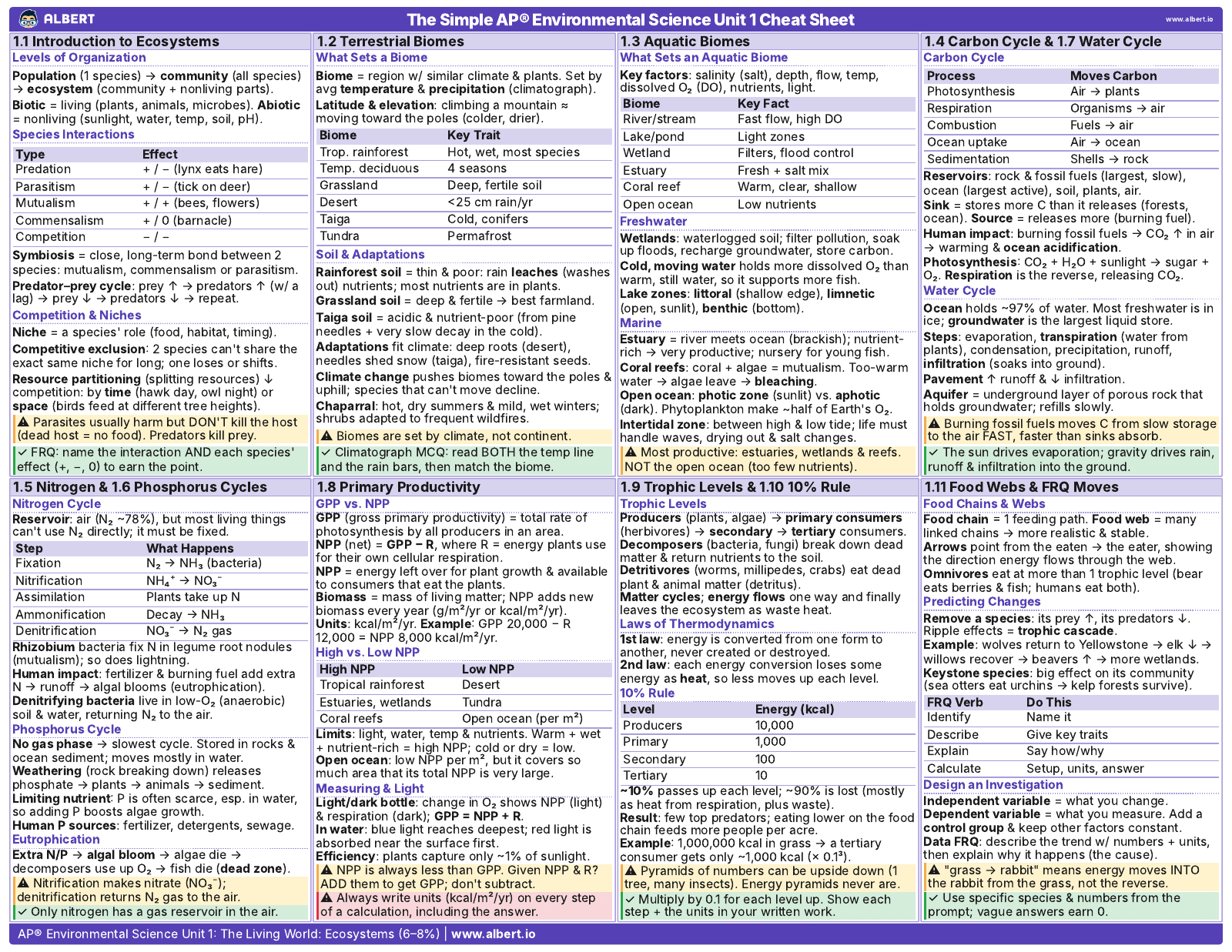
Need The Living World: Ecosystems on one page? This APES Unit 1 cheat sheet covers species interactions, biomes, the carbon, nitrogen, phosphorus and water cycles, primary productivity and energy flow, a unit worth 6–8% of the AP® Environmental Science exam. It comes in a Simple version and an Ultimate version.
Practice AP® Environmental Science Unit 1 questions on Albert
What’s on the APES Unit 1 Cheat Sheet?
This APES Unit 1 cheat sheet comes in two versions. Both fit all eleven CED topics onto one landscape page, grouped into eight cards.
The Simple version is for your first pass through the unit, or for a fast review before a unit quiz. It covers the core of each topic: species interactions, the major biomes, the four biogeochemical cycles, GPP and NPP, and the 10% rule. New terms get a few words of explanation the first time they appear.
The Ultimate version is for students aiming at a 4 or 5. It adds the details that turn a partial FRQ answer into a full one: fundamental vs. realized niches, lake zones, upwelling, carbon sinks turning into sources, nitrate leaching, the light/dark bottle method, chemosynthesis, and a full list of FRQ task verbs. It also packs in more traps and calculation tips.
Start with Simple if ecology is new to you. Switch to Ultimate once you can explain every card without looking. Together they work as a one-page AP® Environmental Science Unit 1 review and a study guide for The Living World: Ecosystems.
AP® Environmental Science Unit 1 at a Glance
Unit 1 is worth 6–8% of the multiple-choice section, according to the AP® Environmental Science Course and Exam Description. That’s about five or six of the 80 questions. Its ideas come back in almost every later unit, from biodiversity to pollution to climate change, so it also supplies a lot of FRQ material.
| Topic | Name | Focus |
|---|---|---|
| 1.1 | Introduction to Ecosystems | Species interactions, niches, resource partitioning |
| 1.2 | Terrestrial Biomes | How temperature and precipitation shape biomes |
| 1.3 | Aquatic Biomes | Salinity, depth, flow, light, and nutrients |
| 1.4 | The Carbon Cycle | Sources, sinks, and how humans speed up carbon release |
| 1.5 | The Nitrogen Cycle | Fixation, nitrification, denitrification, fertilizer runoff |
| 1.6 | The Phosphorus Cycle | A slow cycle with no gas phase; P as a limiting nutrient |
| 1.7 | The Hydrologic (Water) Cycle | Reservoirs and processes; runoff vs. infiltration |
| 1.8 | Primary Productivity | GPP, NPP, and where productivity is high or low |
| 1.9 | Trophic Levels | Producers, consumers, decomposers |
| 1.10 | Energy Flow and the 10% Rule | Laws of thermodynamics and energy pyramids |
| 1.11 | Food Chains and Food Webs | Reading webs and predicting ripple effects |
Key Concepts in Unit 1: The Living World: Ecosystems
Species Interactions and Niches (Topic 1.1)
Every interaction between two species can be written as a pair of effects. Predation, herbivory, and parasitism are +/−. Mutualism is +/+. Commensalism is +/0. Competition is −/−. Mutualism, commensalism, and parasitism all count as symbiosis: a close, long-term relationship between two species.
A species’ niche is its role: what it eats, where it lives, and when it is active. Two species can’t share exactly the same niche for long (competitive exclusion). Species that live side by side often reduce competition through resource partitioning: splitting a resource by time (hawks hunt by day, owls by night), by space (warblers feed at different heights in the same tree), or by body shape (finches with different beak sizes eat different seeds).
Worked example: A prompt describes fungi growing on plant roots. The fungi help the roots absorb water and minerals, and the plant gives the fungi sugar. You would answer: “This is mutualism (+/+), because both the fungi and the plant benefit.”
Exam tip: On a “describe the relationship” question, name the interaction and give the effect on each species. Naming it alone often misses the point.
Terrestrial and Aquatic Biomes (Topics 1.2–1.3)
A biome is a region with a similar climate and similar plant and animal communities. On land, average temperature and precipitation decide the biome, which is why the exam leans on climatographs. Deserts get less than about 25 cm of rain a year; tundra is cold and dry with permanently frozen subsoil (permafrost); tropical rainforests are hot, wet, and hold the most species.
Soil is a frequent test point. Rainforest soil is thin and nutrient-poor because heavy rain leaches nutrients away and most nutrients are locked in plants. That is why cleared rainforest land loses its fertility within a few years. Grassland soil is deep and fertile, which makes grasslands prime farmland.
In water, the key factors are salinity, depth, flow, temperature, dissolved oxygen, nutrients, and light. Estuaries, where rivers meet the ocean, get nutrients from runoff and are among the most productive ecosystems on Earth. Wetlands filter pollutants and absorb floodwater. Coral reefs depend on a mutualism between coral and algae; when water gets too warm, the coral expel the algae and bleach.
Worked example: A climatograph shows average temperatures below 0°C for most of the year and about 20 cm of precipitation. The answer is tundra, not desert: both are dry, but only tundra is that cold.
Exam tip: Remember that the open ocean has low productivity per square meter because nutrients are scarce in its sunlit surface water.
The Biogeochemical Cycles (Topics 1.4–1.7)
The carbon cycle moves carbon between the air, organisms, oceans, soil, and rock. Photosynthesis pulls CO₂ out of the air; respiration, decomposition, and combustion put it back. The largest reservoir is sedimentary rock and fossil fuels, which normally release carbon very slowly. Burning fossil fuels moves that carbon into the air much faster than sinks like forests and the ocean can absorb it, which drives climate change and ocean acidification.
The nitrogen cycle has its largest reservoir in the atmosphere, but most organisms can’t use N₂ gas. Bacteria (and lightning) fix it into ammonia; other bacteria convert ammonium to nitrate (nitrification); plants absorb it (assimilation); decomposers return it as ammonia (ammonification); and anaerobic bacteria return it to the air (denitrification).
The phosphorus cycle has no gas phase, so it is the slowest. Phosphate is released when rock weathers, and it often limits plant and algae growth. The water cycle is driven by the sun and gravity: evaporation and transpiration move water up, precipitation brings it down, and it either runs off or infiltrates into groundwater.
Worked example: A farm field next to a lake is heavily fertilized, and the lake later has a fish kill. The chain to write: excess nitrogen and phosphorus run off into the lake → algal bloom → algae die → decomposers use up dissolved oxygen → hypoxia → fish die. This is eutrophication.
Exam tip: Nitrification and denitrification are easy to swap. Nitrification makes nitrate; denitrification removes it, returning N₂ to the air.
Primary Productivity (Topic 1.8)
Gross primary productivity (GPP) is the total rate of photosynthesis in an area. Producers use some of that energy for their own respiration (R). What’s left is net primary productivity: NPP = GPP − R. NPP is the energy available for plant growth and for every consumer above.
Worked example: A forest has a GPP of 20,000 kcal/m²/yr and loses 12,000 kcal/m²/yr to respiration. NPP = 20,000 − 12,000 = 8,000 kcal/m²/yr. If a question gives you NPP and R instead, add them to get GPP.
NPP is highest where light, water, warmth, and nutrients are all plentiful: tropical rainforests, estuaries, wetlands, and coral reefs. It is lowest in deserts, tundra, and the open ocean (per square meter).
Exam tip: Write units on every line of the calculation. Graders look for them.
Trophic Levels, the 10% Rule, and Food Webs (Topics 1.9–1.11)
Energy enters through producers and passes to primary, secondary, and tertiary consumers. At each step, only about 10% of the energy moves up; the rest is lost, mostly as heat from respiration. This follows from the laws of thermodynamics: energy is never destroyed (first law), but every conversion loses some as heat (second law). Matter cycles; energy flows one way.
Worked example: Producers hold 50,000 kcal. Primary consumers get about 5,000 kcal, secondary consumers about 500 kcal, and tertiary consumers about 50 kcal. Show each ×0.1 step.
In a food web, arrows point from the organism being eaten to the one eating it, in the direction energy flows. Removing one species ripples through the web: its prey tend to increase, and its predators decline. When wolves were brought back to Yellowstone, elk numbers dropped and willows along streams recovered, a classic trophic cascade.
Exam tip: The 10% rule explains why top predators are rare and why eating lower on the food chain feeds more people from the same land.
How Unit 1 Shows Up on the Exam
The AP® Environmental Science Exam has 80 multiple-choice questions (60% of the score) and 3 free-response questions (40%). Unit 1 shows up in multiple-choice sets built on climatographs, food webs, cycle diagrams, and productivity data.
All three FRQ types can draw on it. Question 1 asks you to design an investigation, so expect to name an independent variable, a dependent variable, and a control. Question 2 asks you to analyze an environmental problem and propose a solution, such as low dissolved oxygen in a stream below a fertilized field. Question 3 does the same with calculations, and NPP or 10% rule problems are a natural fit. Scorers reward specific, accurate vocabulary, a clear cause-and-effect chain, and calculations with the setup and units shown.
Common Mistakes in Unit 1
- Mistake: Drawing food web arrows from predator to prey. Fix: Arrows follow energy, from the eaten to the eater.
- Mistake: Saying NPP is larger than GPP, or subtracting when you should add. Fix: NPP = GPP − R, so GPP = NPP + R.
- Mistake: Giving the phosphorus cycle an atmospheric step. Fix: Phosphorus has no gas phase; it moves through rock, soil, water, and organisms.
- Mistake: Calling the open ocean highly productive because it is large. Fix: Its total is large, but its productivity per square meter is low.
- Mistake: Stopping the eutrophication chain at “algae grow.” Fix: Finish it: algae die, decomposers use up oxygen, fish die.
Frequently Asked Questions
Can I use this cheat sheet on the exam?
No. You can’t bring notes into the AP exam. This APES Unit 1 cheat sheet is a study tool for review before quizzes, unit tests, and the May exam.
Should I start with the Simple or Ultimate version?
Start with Simple if you are learning the unit for the first time. Move to Ultimate when you’re ready for the extra detail that earns full FRQ credit.
How much of the APES exam is Unit 1?
About 6–8% of the multiple-choice section, or roughly five or six questions. Its ideas also appear in later units and in the free-response section.
Do I need to memorize the 10% rule?
Yes. It is one of the most common calculations in the course, and you’ll need to apply it quickly, often across several trophic levels.
Which cycle shows up most often?
The nitrogen and phosphorus cycles come up often because they connect to eutrophication, which reappears in the pollution units. Make sure you can describe each step of the nitrogen cycle by name.