
Maximize your score with these resources:
- Albert.io AP® European History question banks
- Free AP® European History study guides
- Free AP® European History score calculator
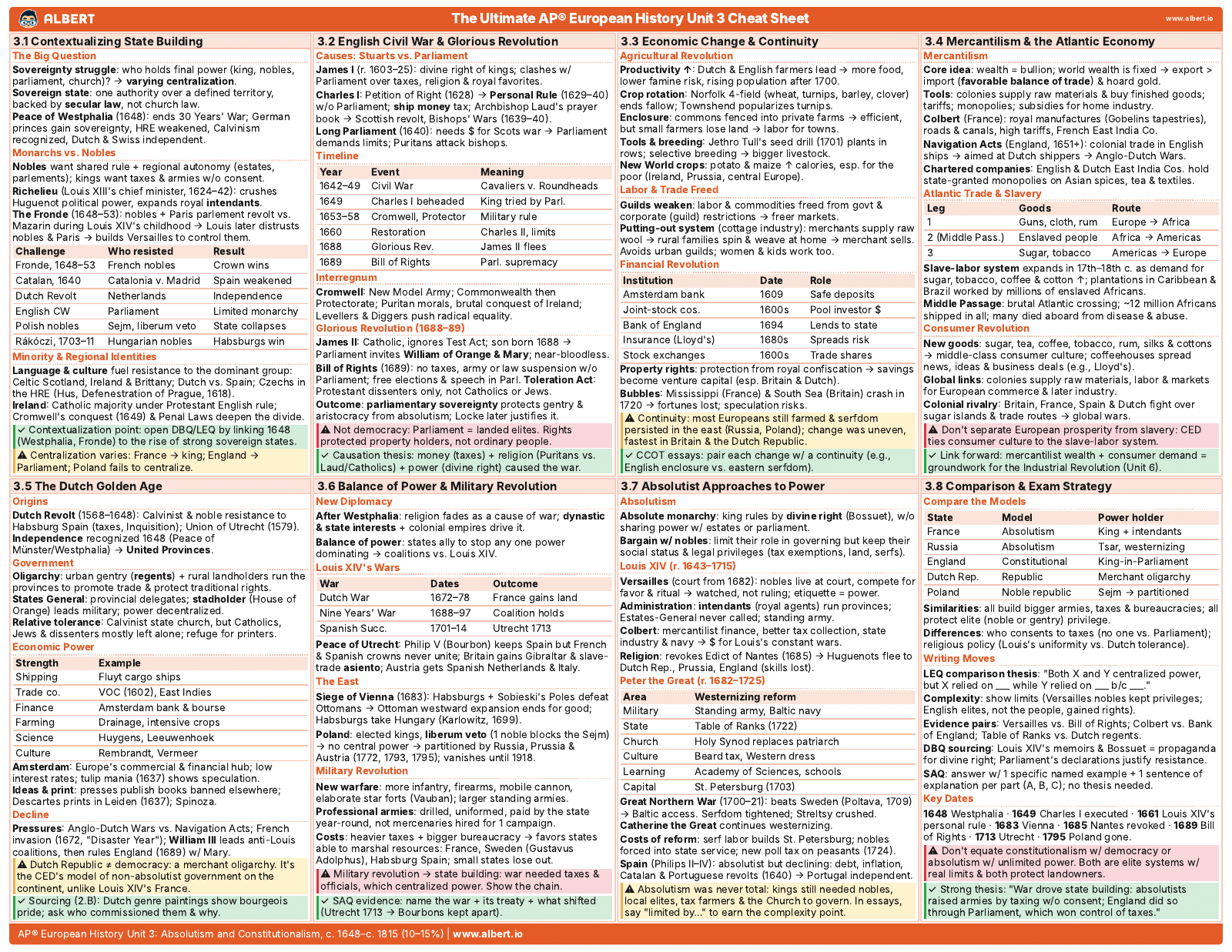
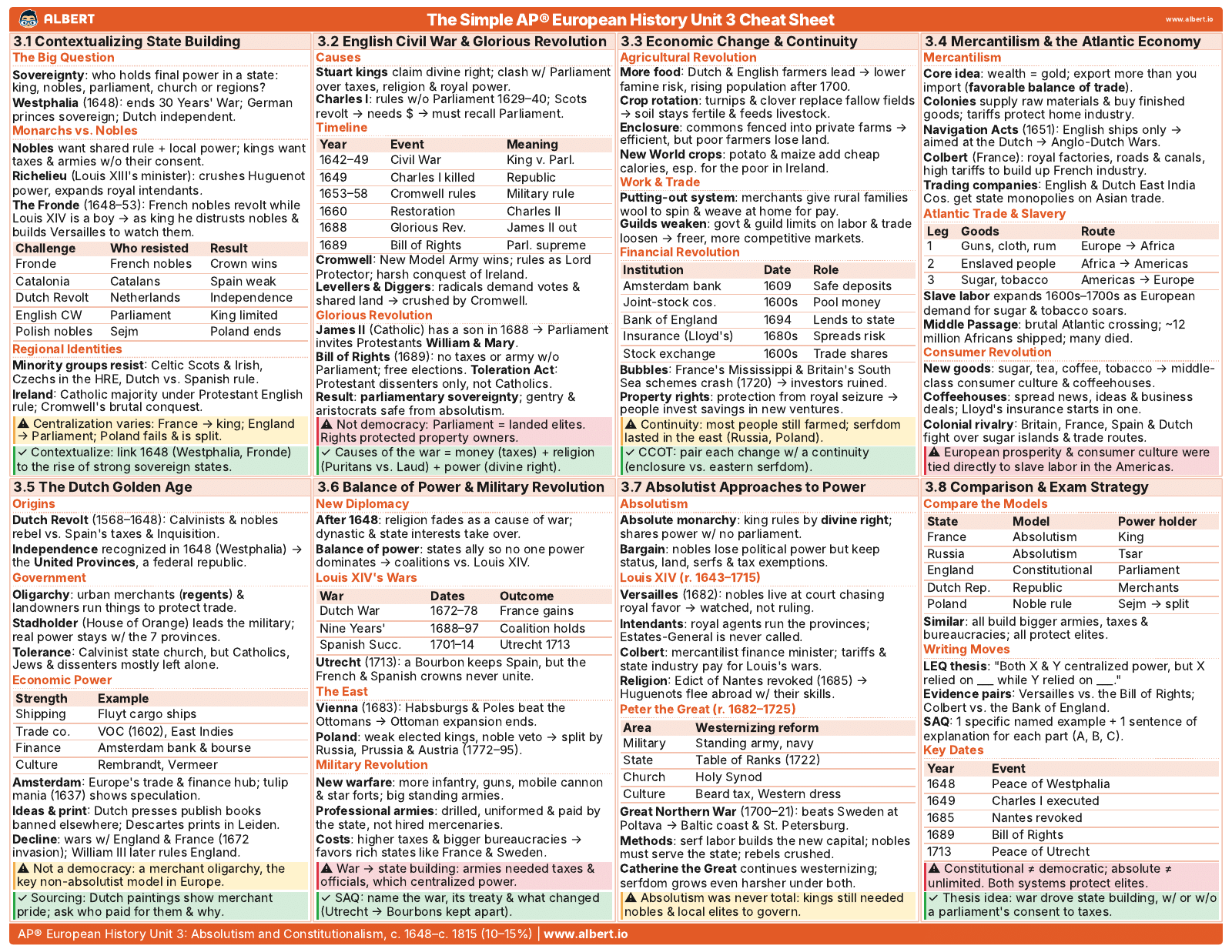
This AP Euro Unit 3 cheat sheet covers how European states built power between 1648 and 1815: absolutism in France and Russia, constitutional government in England and the Dutch Republic, mercantilism, and the balance of power. Unit 3 is 10–15% of the exam. Pick the Simple version for the core story or the Ultimate version for the full set of examples and essay moves.
Practice AP® European History Unit 3 questions on Albert
What’s on the AP Euro Unit 3 Cheat Sheet?
Both versions follow the eight topics of Unit 3 in the College Board’s AP® European History Course and Exam Description, one card per topic: the context of state building, the English Civil War and Glorious Revolution, economic change, mercantilism and the Atlantic economy, the Dutch Golden Age, the balance of power and the military revolution, absolutist approaches to power, and a final card comparing the models with writing strategies.
The Simple version gives you the main causes, people and outcomes for each topic, a short timeline of the English revolutions, the triangle trade, Peter the Great’s reforms in a table, and one key warning per card. Start here if absolutism and constitutionalism are new to you.
The Ultimate version adds the evidence that wins essay points: the Fronde and other noble revolts, the Petition of Right and Bishops’ Wars, the financial revolution’s institutions, Colbert’s policies, the Peace of Utrecht’s terms, Poland’s liberum veto, the military revolution’s costs, and paired evidence for comparison essays.
AP Euro Unit 3 at a Glance
| Topic | Name | Focus |
|---|---|---|
| 3.1 | Contextualizing State Building | Sovereignty struggles between monarchs, nobles and minority groups |
| 3.2 | The English Civil War and the Glorious Revolution | How Parliament defeated royal absolutism |
| 3.3 | Continuities and Changes to Economic Practice and Development | Agricultural revolution, cottage industry, new financial institutions |
| 3.4 | Economic Development and Mercantilism | Colonies, the transatlantic slave-labor system, consumer culture |
| 3.5 | The Dutch Golden Age | A merchant republic built on trade |
| 3.6 | Balance of Power | Louis XIV’s wars, the Ottoman retreat, Poland’s partition, the military revolution |
| 3.7 | Absolutist Approaches to Power | Louis XIV, Colbert, Peter the Great |
| 3.8 | Comparison in the Age of Absolutism and Constitutionalism | Comparing the forms of political power |
Exam weight: 10–15% of the AP® European History exam, covering roughly 1648 to 1815. Unit 4 (the Scientific Revolution and Enlightenment) covers the same years, so expect essay prompts that mix the two.
Key Concepts in Unit 3: Absolutism and Constitutionalism
State Building and the Struggle for Sovereignty (3.1)
After the Peace of Westphalia in 1648, the central question in European politics was who held final authority inside a state. Kings wanted to raise taxes and armies without asking anyone. Nobles wanted to keep their old share of power through estates, parlements and regional courts. Minority and regional groups, such as Celtic peoples in Scotland and Ireland or Czechs in the Holy Roman Empire, resisted rule by a dominant national group.
The answer varied. France centralized power in the king, England in Parliament, and Poland never centralized at all.
Worked example: The Fronde (1648–1653) was a series of revolts by French nobles and the Paris parlement while Louis XIV was a child. If a DBQ document describes the young king fleeing Paris, use it as context: the experience explains why Louis later moved the court to Versailles and kept nobles close where he could watch them.
Exam tip: for the contextualization point, connect 1648 (Westphalia and the Fronde) to the rise of strong sovereign states in the decades that followed.
England’s Path to Constitutional Monarchy (3.2)
The Stuart kings believed in divine right. Charles I governed without Parliament from 1629 to 1640 and collected ship money without its consent, but a Scottish revolt over religion forced him to recall it. The conflict became civil war in 1642, ending with Charles’s execution in 1649 and a decade of rule by Oliver Cromwell. The monarchy returned in 1660, but when the Catholic James II had a son in 1688, Parliament invited William of Orange and Mary to take the throne.
Worked example: The English Bill of Rights (1689) declares that levying money for the crown “without grant of Parliament” is illegal. Sourcing it: the authors are members of Parliament, the purpose is to justify replacing James II and lock in their power over taxation, and the audience is the political nation of landholders. That is why it protects Parliament’s rights, not those of ordinary people.
Exam tip: don’t call the Glorious Revolution democratic. It protected the gentry and aristocracy from absolutism by making Parliament sovereign.
Economic Change and Mercantilism (3.3–3.4)
New crop rotations and enclosure raised farm output in England and the Dutch Republic, while potatoes and maize from the Americas added calories. The putting-out system moved textile work into rural homes, outside guild control. A financial revolution produced the Amsterdam exchange bank, joint-stock companies, insurance and the Bank of England (1694).
Governments followed mercantilism: they used colonies for raw materials and markets, set tariffs, and tried to export more than they imported. Demand for sugar, tobacco and coffee expanded the transatlantic slave-labor system, and those goods fed a new consumer culture in European cities.
Worked example: On a continuity and change question, pair each change with a continuity. Enclosure and the seed drill changed farming in England, while serfdom continued, and even tightened, in Russia and Poland.
Exam tip: the CED explicitly links Europe’s consumer revolution to slave labor in the Americas. Make that connection in essays rather than treating them as separate topics.
The Dutch Golden Age (3.5)
The Dutch Republic won independence from Habsburg Spain, which was recognized in 1648. Instead of a king, it was run by an oligarchy of urban merchants (the regents) and rural landholders, with the stadholder from the House of Orange commanding the military. Its fluyt ships, the Dutch East India Company (1602) and Amsterdam’s banks made it Europe’s commercial center, and its relative religious tolerance drew refugees and printers.
Worked example: A Dutch genre painting of a prosperous merchant family at home reflects the painter’s audience: wealthy burghers who bought art for their houses. Explaining that audience earns the sourcing point.
Exam tip: the Dutch Republic is your best continental example of a non-absolutist government, but call it an oligarchy, not a democracy.
Absolutism and the Balance of Power (3.6–3.7)
Louis XIV ruled France without calling the Estates-General. He brought nobles to Versailles, governed the provinces through royal intendants, relied on Colbert to raise revenue, and revoked the Edict of Nantes in 1685. Peter the Great westernized Russia through a new army and navy, the Table of Ranks, state control of the church and a new capital at St. Petersburg.
After 1648, wars were fought for dynastic and state interests rather than religion. Louis XIV’s wars provoked coalitions to keep any one state from dominating, a principle called the balance of power. The Peace of Utrecht (1713) let a Bourbon keep the Spanish throne but barred France and Spain from ever uniting. Meanwhile the military revolution (larger armies, firearms, cannon and fortifications) raised costs so high that only states with strong tax systems could compete. Poland, whose nobles could block any law, was partitioned out of existence by 1795.
Exam tip: show the chain from war to taxes to bureaucracy to centralized power. It explains both absolutism and its limits.
How Unit 3 Shows Up on the AP Euro Exam
Multiple-choice questions come in sets built around a source, often a royal decree, a parliamentary declaration, a map of Europe after a treaty, or a painting. They ask you to identify context, compare forms of government or explain causes.
Short-answer questions frequently ask for one specific piece of evidence and an explanation, such as a difference between English and French government in the late 1600s. The document-based question and long essay may ask you to compare absolutism and constitutionalism or to evaluate how far war drove state building.
Scorers reward a defensible thesis with a line of reasoning, specific named evidence (the Bill of Rights, Versailles, the Table of Ranks), sourcing that explains a document’s purpose or audience, and complexity, such as showing that absolute monarchs still had to bargain with nobles.
Common Mistakes in Unit 3
- Calling England or the Dutch Republic democratic. Fix: describe them as governments of landholding and merchant elites.
- Treating absolutism as unlimited power. Fix: show what kings still depended on, such as nobles, local officials and tax farmers.
- Vague evidence. Fix: name the specific act, treaty or reform and give its date.
- Leaving slavery out of economic essays. Fix: connect mercantilism and consumer culture to the transatlantic slave-labor system.
- Mixing Unit 3 and Unit 4 rulers. Fix: enlightened absolutism (Frederick the Great, Joseph II) and Prussia’s rise belong mainly to Unit 4; Louis XIV and Peter the Great anchor Unit 3.
Frequently Asked Questions
Can I use this cheat sheet on the exam?
No. The AP® European History exam doesn’t allow notes. The cheat sheet is a study tool for review and practice before test day.
Should I start with the Simple or Ultimate version?
Start with the Simple AP Euro Unit 3 cheat sheet if you are learning this period now. Move to Ultimate once you know the main events and want more evidence and essay strategies.
Which comparisons come up most?
France versus England is the classic pairing, with Russia under Peter the Great and the Dutch Republic as strong alternatives. Focus on who approved taxes and how each ruler handled the nobility.
What is the best AP Euro Unit 3 review strategy?
Build a two-column chart for absolutism and constitutionalism, then practice short-answer questions using one named example per part. Check each answer against the AP Euro Unit 3 cheat sheet to make sure your evidence is specific.