

Maximize your score with these resources:
- Albert.io AP® Psychology question banks
- Free AP® Psychology study guides
- Free AP® Psychology score calculator
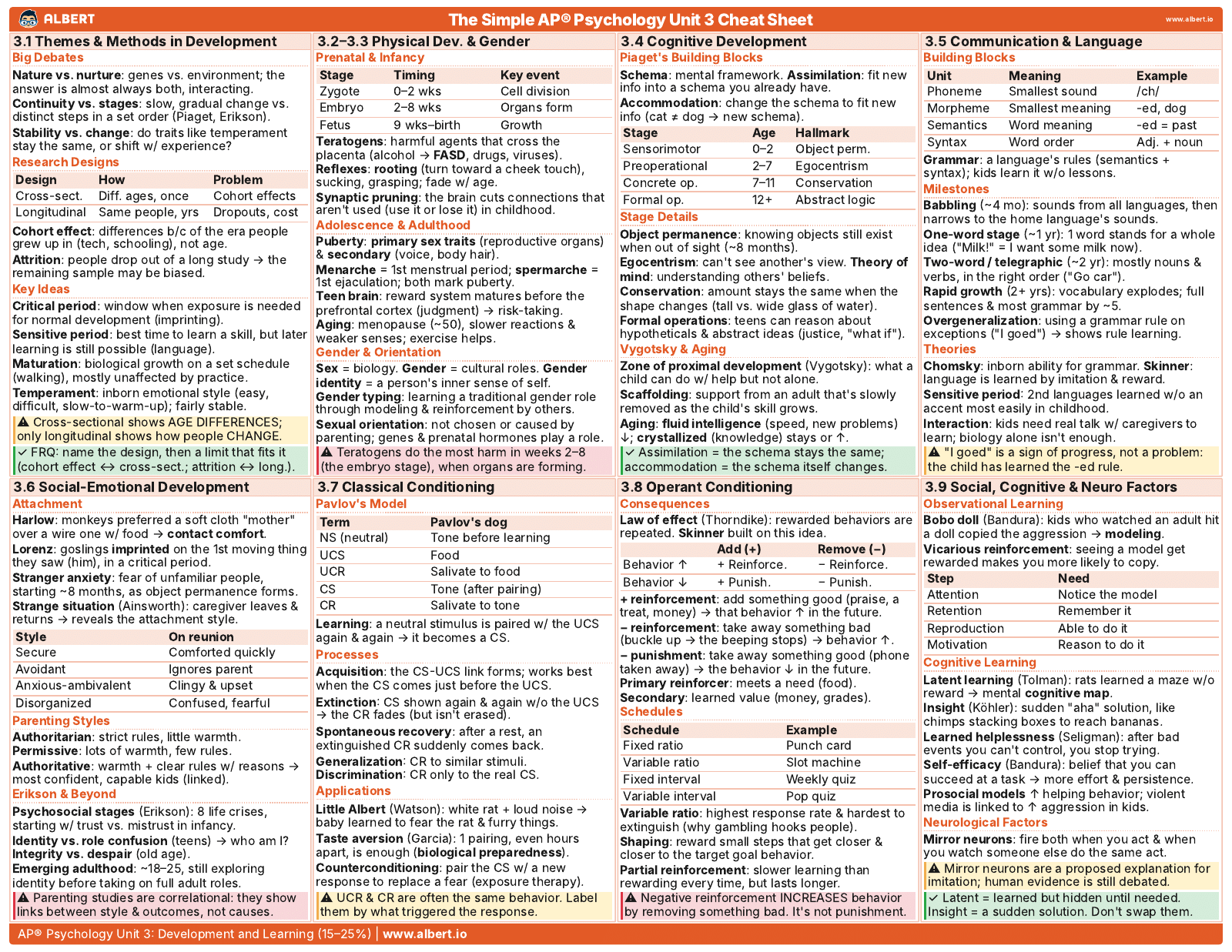
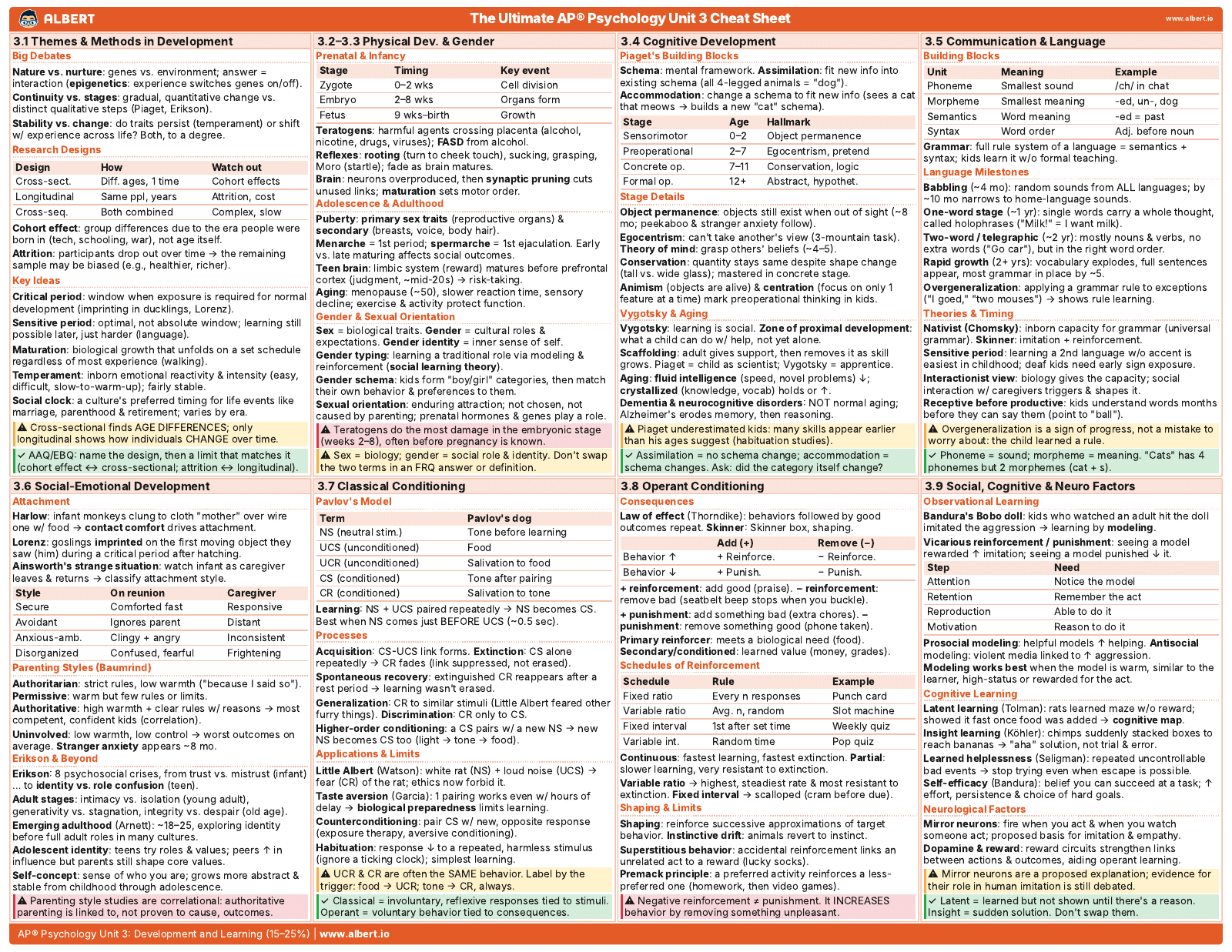
This AP Psych Unit 3 cheat sheet covers Development and Learning: how people change from the womb to old age, and how we learn through conditioning and by watching others. Unit 3 is worth 15–25% of the AP® Psychology exam score. Pick the Simple version for a fast first review or the Ultimate version for every theorist, term, and trap.
Practice AP® Psychology Unit 3 questions on Albert
What’s on the AP Psych Unit 3 Cheat Sheet?
Both versions follow the nine topics in the College Board’s AP® Psychology Course and Exam Description, from 3.1 Themes and Methods in Developmental Psychology through 3.9 Social, Cognitive, and Neurological Factors in Learning. Topics 3.2 and 3.3 share a card, so the sheet fits on one page.
The Simple version is for your first pass or a quick check before a quiz. It keeps the core terms (Piaget’s stages, attachment styles, parenting styles, the parts of classical conditioning, the four operant consequences) with one clear example each.
The Ultimate version is for students who know the basics and want the details that show up in tricky multiple-choice options: cohort effects and attrition, teratogen timing, Vygotsky’s scaffolding, overgeneralization, higher-order conditioning, the Premack principle, and Bandura’s four steps of observational learning. Every card ends with a tip or a warning about a common mistake.
AP Psych Unit 3 at a Glance
Unit 3 is one of five units, each weighted at 15–25% of the exam. On a 75-question multiple-choice section, that usually means roughly 11 to 19 questions, and development or learning concepts often appear in the free-response questions too.
| Topic | Name | Focus |
|---|---|---|
| 3.1 | Themes and Methods in Developmental Psychology | Nature and nurture, stages vs. continuity, cross-sectional and longitudinal designs. |
| 3.2 | Physical Development Across the Lifespan | Prenatal stages, teratogens, reflexes, puberty, the teen brain, aging. |
| 3.3 | Gender and Sexual Orientation | Sex vs. gender, gender typing, and what research shows about orientation. |
| 3.4 | Cognitive Development Across the Lifespan | Piaget’s stages, Vygotsky, fluid and crystallized intelligence. |
| 3.5 | Communication and Language Development | Phonemes, morphemes, milestones, overgeneralization. |
| 3.6 | Social-Emotional Development Across the Lifespan | Attachment, parenting styles, Erikson, emerging adulthood. |
| 3.7 | Classical Conditioning | Pavlov’s terms, extinction, generalization, taste aversion. |
| 3.8 | Operant Conditioning | Reinforcement, punishment, schedules, shaping. |
| 3.9 | Social, Cognitive, and Neurological Factors in Learning | Observational, latent, and insight learning; learned helplessness. |
Key Concepts in Unit 3: Development and Learning
Studying Development: Debates and Research Designs
Developmental psychology keeps returning to three questions. Nature vs. nurture asks how much comes from genes and how much from environment; the answer is nearly always an interaction. Continuity vs. stages asks whether development is gradual or happens in distinct steps. Stability vs. change asks whether traits like temperament last across a lifetime.
Two designs answer age questions. A cross-sectional study compares people of different ages at one time. A longitudinal study follows the same people over years. Each has a typical weakness: cross-sectional studies suffer from cohort effects, and longitudinal studies suffer from attrition as participants drop out.
Worked example: A researcher tests memory in 20-, 50-, and 80-year-olds in 2026 and finds the 80-year-olds score lowest. That shows an age difference, but the oldest group also grew up with less schooling and different technology. Without following the same people over time, the researcher can’t say memory declines with age.
Exam tip: When an AAQ asks about a study’s limitation, match it to the design. Cohort effects go with cross-sectional; attrition goes with longitudinal.
Physical Development, Gender, and Sexual Orientation
Prenatal development runs from zygote (weeks 0–2) to embryo (weeks 2–8, when organs form) to fetus (week 9 to birth). Teratogens such as alcohol, nicotine, and some viruses cross the placenta; alcohol can cause fetal alcohol spectrum disorder. Newborns arrive with reflexes like rooting, and the infant brain overproduces connections, then trims unused ones through synaptic pruning. In adolescence, puberty brings primary and secondary sex characteristics, and the reward-driven limbic system matures before the prefrontal cortex, which helps explain teen risk-taking.
Sex refers to biological traits; gender refers to the roles and expectations a culture attaches to being male or female. Gender typing happens through modeling and reinforcement. Research finds that sexual orientation is not chosen and is not caused by parenting style, and that biological factors such as genes and prenatal hormones play a role.
Worked example: A pregnant woman drinks heavily during weeks 3 to 6, before she knows she is pregnant. Because this is the embryonic stage, when major organs and facial structures form, the risk of lasting damage is at its highest.
Exam tip: Keep sex and gender separate. A response that uses them as synonyms usually loses the point.
Cognitive Development: Piaget and Vygotsky
Jean Piaget argued that children build schemas and update them in two ways. Assimilation fits new information into an existing schema; accommodation changes the schema. His four stages are sensorimotor (object permanence), preoperational (egocentrism, pretend play), concrete operational (conservation, logic about real objects), and formal operational (abstract and hypothetical reasoning). Lev Vygotsky stressed social learning: the zone of proximal development is what a child can do with help but not yet alone, and scaffolding is help that fades as skill grows. In adulthood, fluid intelligence declines while crystallized intelligence holds steady or grows.
Worked example: A 4-year-old watches juice poured from a short, wide glass into a tall, thin glass and says there is now more juice. The child lacks conservation and is focusing on one feature (height), a sign of the preoperational stage.
Exam tip: To tell assimilation from accommodation, ask whether the category itself changed. If it did, it is accommodation.
Language Development
Language is built from phonemes (smallest sound units), morphemes (smallest units of meaning), semantics (meaning), and syntax (word order). Children move from babbling (around 4 months) to the one-word stage (around 1 year) to two-word, telegraphic speech (around 2 years), then to rapid vocabulary growth. Noam Chomsky argued for an inborn capacity for grammar; B. F. Skinner argued language is learned through imitation and reinforcement.
Worked example: The word “unhappily” has three morphemes: un- (not), happy, and -ly (in a manner). When a 3-year-old says “I runned,” the error shows the child has learned the past-tense rule and is applying it to an irregular verb, which is overgeneralization.
Exam tip: Phonemes are sounds; morphemes carry meaning. “Cats” has four phonemes but two morphemes.
Social-Emotional Development
Harry Harlow’s monkeys preferred a soft cloth “mother” to a wire one that gave food, showing the power of contact comfort. Konrad Lorenz’s goslings imprinted on him during a critical period. Mary Ainsworth’s strange situation sorts infants into secure, avoidant, anxious-ambivalent, and disorganized attachment. Diana Baumrind described authoritarian, permissive, and authoritative parenting, with authoritative parenting (warm, with clear rules) linked to the best outcomes. Erik Erikson proposed eight psychosocial crises, including identity vs. role confusion in adolescence.
Worked example: When her mother returns to the room, a toddler runs to her, calms quickly, and goes back to playing. That is secure attachment. A toddler who looks away and ignores the returning parent shows avoidant attachment.
Exam tip: Parenting style research is correlational. Say “is associated with,” not “causes.”
Classical and Operant Conditioning
In classical conditioning, a neutral stimulus paired with an unconditioned stimulus (UCS) becomes a conditioned stimulus (CS) that triggers a conditioned response (CR). Key processes are acquisition, extinction, spontaneous recovery, generalization, and discrimination. John Garcia’s taste-aversion studies showed one pairing can be enough, a sign of biological preparedness.
In operant conditioning, consequences shape voluntary behavior. Reinforcement increases a behavior; punishment decreases it. “Positive” means adding something and “negative” means removing something. Partial reinforcement schedules make behavior resistant to extinction, and the variable-ratio schedule produces the highest, steadiest response rates.
Worked example: Your phone buzzes (neutral) right before a text from a friend you’re excited to hear from. Soon the buzz alone makes you feel a rush of excitement: the buzz is the CS and the excitement is the CR. Separately, a driver buckles up to stop the car’s beeping. Removing the beeping makes buckling more likely, which is negative reinforcement.
Exam tip: Negative reinforcement is not punishment. If the behavior goes up, it is reinforcement.
Social, Cognitive, and Neurological Factors in Learning
Albert Bandura’s Bobo doll study showed observational learning: children copied an adult model’s aggression. Learning by watching requires attention, retention, reproduction, and motivation, and vicarious reinforcement makes imitation more likely. Edward Tolman’s rats showed latent learning by forming a cognitive map of a maze without reward. Wolfgang Köhler’s chimps showed insight learning. Martin Seligman described learned helplessness, giving up after repeated uncontrollable events. Mirror neurons are a proposed brain basis for imitation.
Worked example: A student rides as a passenger along the same route to school for a year. When she finally drives herself, she knows every turn without ever being rewarded for learning it. That is latent learning.
Exam tip: Latent learning stays hidden until there is a reason to show it; insight is a sudden solution.
How Unit 3 Shows Up on the Exam
The AP® Psychology exam has 75 multiple-choice questions in 90 minutes (about two-thirds of the score) and two free-response questions in 70 minutes (about one-third). The free-response section has an Article Analysis Question (AAQ), built around a summary of one study, and an Evidence-Based Question (EBQ), built around three sources.
Unit 3 is a natural fit for both. Development studies give AAQs plenty to ask about: research design, the operational definition of a variable, and limits like cohort effects. Learning scenarios fill multiple-choice sets, where you must label the CS and CR or decide whether a consequence is reinforcement or punishment. Scorers reward answers that apply the term to the specific scenario. “The beeping is removed, so buckling increases, which is negative reinforcement” earns credit; a definition alone does not.
Common Mistakes in Unit 3
- Calling negative reinforcement a punishment. Reinforcement always increases behavior; “negative” only means something is taken away.
- Mixing up UCR and CR. They are often the same behavior. Label them by the trigger: the UCS produces the UCR; the CS produces the CR.
- Swapping assimilation and accommodation. Assimilation keeps the schema; accommodation changes it.
- Claiming parenting styles cause outcomes. The research is correlational.
- Assuming cross-sectional studies show change. They show age differences at one time; only longitudinal studies track change within people.
Frequently Asked Questions
Can I use this cheat sheet on the AP® Psychology exam?
No. Notes and reference sheets aren’t allowed on the AP® Psychology exam. Use the cheat sheet while studying, doing homework, and reviewing before your unit test or the exam.
Should I start with the Simple or the Ultimate version?
Start with Simple if Unit 3 is new to you or you need a quick refresher. Switch to Ultimate once the main terms feel easy; it adds the examples and traps that tricky multiple-choice questions rely on.
How much of the AP Psych exam is Unit 3?
Unit 3 is weighted at 15–25% of the exam, the same range as each of the other four units. Learning concepts also come up in Unit 5’s treatments, such as exposure therapy, so the payoff extends beyond this unit.
What is the fastest way to master operant conditioning terms?
For each scenario, ask two questions: did the behavior go up or down, and was something added or removed? The answers give you the term. Then practice on exam-style questions until the labels come automatically.