
Maximize your score with these resources:
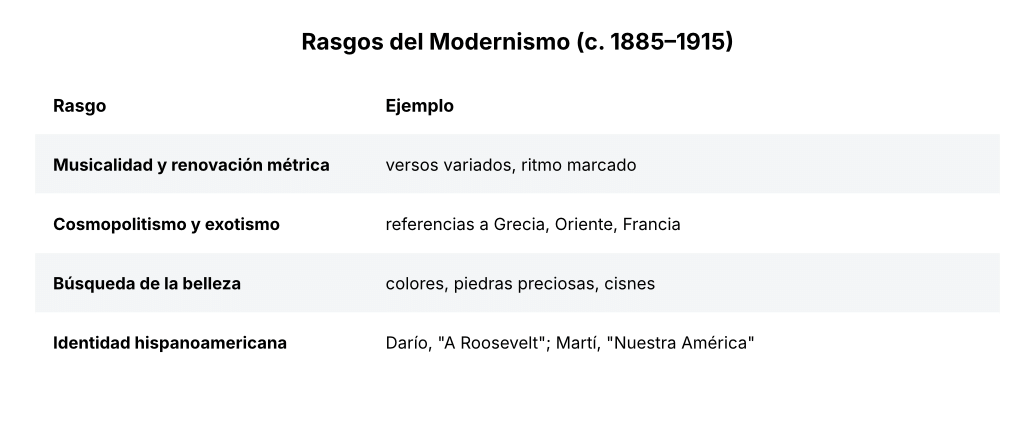
“Nuestra América” is José Martí’s clarion call for Latin American self-determination and unity. Published in 1891, this essay responds to growing U.S. expansionism in the Western Hemisphere, in the wake of the 1889–90 Pan-American conference in Washington. On the AP® Spanish Literature exam, this text exemplifies the Modernist movement and the broader concerns of La Generación del 98 y el Modernismo — a period of intense cultural introspection, nationalistic fervor, and literary innovation across the Spanish-speaking world.
Understanding Martí’s historical position is essential for the exam. Martí was a Cuban poet, journalist, and independence fighter who spent much of his life in exile, observing U.S. expansion firsthand. “Nuestra América” is not a dry political tract; it’s a passionate essay infused with Modernist techniques — metaphor, parallel structure, rhetorical questions, and vivid imagery — that transform an argument about imperialism into a literary work worthy of close study. The essay appears on the AP exam because it demonstrates how Modernist writers used language strategically to address urgent historical questions about Latin American identity, sovereignty, and self-knowledge.
Essay Summary: The Central Argument
Martí’s core thesis is straightforward but powerful: Latin America must know and trust itself. The essay opens with the famous line “Cree el aldeano vanidoso que el mundo entero es su aldea” (The vain villager believes the whole world is his village) — a critique of the provincial Latin American who, absorbed in local concerns, is blind to the giants in seven-league boots (the outside threat). Martí argues that this provincial blindness, like the imitation of foreign models, leaves Latin America exposed.
The essay’s four interconnected arguments: (1) Latin America must reject imported solutions — a constitution written in France or a government model borrowed from Washington will fail because it doesn’t account for Latin America’s unique geography, history, populations, and needs; (2) Indigenous identity and mestizaje are sources of strength, not shame — understanding and honoring Indigenous peoples and mixed-race identities is essential to authentic Latin American identity; (3) Pan-American unity is both moral and strategic — divided, Latin American nations fall prey to imperial pressure; united, they can maintain independence; (4) The U.S. threat is real and imminent — though Martí doesn’t always name the United States directly, his argument is clearly directed at checking American expansion. The essay concludes with a return to the theme of self-knowledge: Latin America must “conocerse” (know itself) before it can govern itself or resist external pressures.
Themes: Self-Knowledge, Unity, and Anti-Imperialism
| Theme | How It Appears in the Text | Significance for the AP Exam |
|---|---|---|
| Self-knowledge and authentic identity | The essay repeatedly emphasizes knowing (“conocerse”) and understanding Latin America’s actual conditions and history; the opening anecdote about the vain villager immediately establishes this as the central problem; Martí contrasts authentic self-knowledge with blindly imitating others’ solutions | When you see Martí reference Latin America’s geography, Indigenous peoples, or historical experience, recognize these as evidence of this theme; AP questions about how a passage develops sovereignty arguments expect you to show that self-knowledge is the prerequisite — generic imported systems fail because they lack this |
| Latin American unity against imperialism | Martí calls for Spanish American nations to unite, strengthen economic interdependence, and present a unified front against external interference; he frames this unity as both moral (Latin Americans are brothers) and strategic (united they are stronger than divided) | AP questions test whether you can explain not just that Martí wants unity, but why: because divided nations fall prey to imperial pressure; this connects to broader Modernist concerns about national identity in an age of imperialism — Martí’s response is solidarity, not isolation |
| Indigenous identity as a source of legitimacy and strength | Rather than treating Indigenous heritage as primitive or backward, Martí valorizes it; he argues that authentic, rooted governance requires understanding and incorporating Indigenous contributions; passages celebrating Andean peoples, Aztec heritage, and mestizo identity exemplify this | This is crucial for understanding Modernist ideology — unlike earlier Latin American writers who saw Indigenous identity as an obstacle to “progress,” Martí sees it as an asset; when analyzing passages about Indigenous peoples or mestizaje, connect them to this theme: Martí is building a case for inclusive, authentic identity |
Literary Devices: How Martí Persuades
| Device | Example from the Essay | Effect |
|---|---|---|
| Extended metaphor | Latin America as a child learning to walk — vulnerable but capable if it trusts its own legs; the recurring “aldeano vanidoso” (vain villager) as a figure for provincial, self-deceived thinking | Transforms abstract political ideas into concrete, emotionally immediate images; each metaphor reveals Martí’s view of Latin America’s maturation as natural and organic — not a radical break but a growth process; AP questions about metaphor should connect the image to this view of self-determination |
| Parallel structure and anaphora | Repeated “Hay que…” constructions listing what Latin America must do; the rhythm of these repetitions builds momentum and urgency throughout the essay | Creates a sense of oratory — the essay feels designed to be read aloud and to persuade through cadence as well as content; parallel structures transform a policy argument into a rousing call to action; AP questions on structure should show that the form itself enacts the urgency of the message |
| Rhetorical questions | Martí asks, for example, how rulers can come out of the universities if no university in America teaches the rudiments of governing, the analysis of America’s own peoples; direct challenges to the reader’s assumptions | Invite the reader to think alongside the argument rather than receive it passively; create complicity and engagement; each rhetorical question challenges an assumption before offering Martí’s answer, making the reader feel like an active participant in the argument |
| Antithesis and contrast | Authentic Latin American solutions vs. borrowed European models; organic growth vs. artificial imitation; indigenous identity vs. European mimicry; unity vs. division | Clarifies the argument by showing what Latin America must reject as well as what it must embrace; binary structure makes the choice seem both obvious and morally urgent; when you see contrast in the essay, identify which side Martí is endorsing and which he is critiquing |
| Exhortation | Impersonal “hay que” constructions — “hay que hacer,” “hay que conocer” — state what must be done, shifting from argument to exhortation | Moves the essay from analysis to call-to-action; positions the reader as a participant in the Latin American project, not just an observer; creates moral obligation and urgency; when the exam asks about exhortation, explain that it signals the shift from persuasion to mobilization |
AP Exam Connections: How This Topic Is Tested
“Nuestra América” is part of Unit: La Generación del 98 y el Modernismo, alongside Rubén Darío, Antonio Machado, and Unamuno. Multiple-choice questions typically provide 4-8 lines from the essay and test: comprehension (what does Martí argue here?); literary devices (what rhetorical function does the villager anecdote serve?); tone and attitude (Martí’s tone toward imported European solutions is best described as…); word choice (why “vanidoso” rather than simply “ignorant”?); and thematic connections (which theme does this passage most clearly develop?).
Free-response questions typically ask you to analyze how Martí develops an argument or theme. A strong response must: identify the argument or theme clearly; cite 2-3 specific pieces of textual evidence; explain how each supports your interpretation; consider how form (literary devices, structure) reinforces content; and connect Martí’s Modernist style to his political purpose of persuading Latin America to reject imperialism and embrace self-knowledge.
Test-Taking Strategies
Mnemonic — SUI: Remember Martí’s three core arguments with SUI: Self-knowledge (Latin America must know and trust itself); Unity (Latin American nations must stand together); Indigenous identity (Latin America’s indigenous heritage is a strength, not a weakness). When reading any passage from “Nuestra América,” ask which of these three arguments it supports — this immediately connects the passage to the larger thematic framework.
Cross-topic AP exam connections:
- Compare Martí’s nationalism to Machado’s or Unamuno’s — Spanish writers dealing with Spain’s identity crisis after 1898; while Martí argues for Latin America’s independence from European models, the Generation of ’98 writers argue Spain must also rediscover its authentic identity after imperial collapse
- Connect Martí’s use of metaphor and rhythm to Darío’s Modernist poetry — both writers use elaborate literary language to make political arguments feel emotionally inevitable, not merely rational
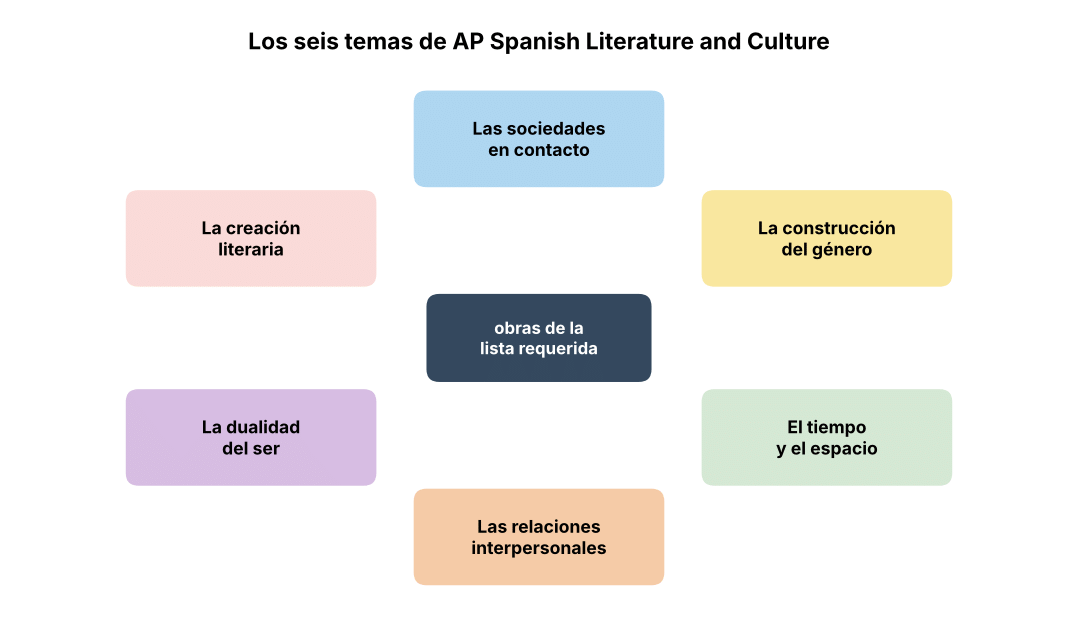
- For Las sociedades en contacto synthesis essays, pair “Nuestra América” with the Romance de la perdida de Alhama — both argue that colonized peoples possess legitimate identities and histories that deserve recognition and preservation, separated by four centuries but making the same essential claim
Common question formats and how to approach them:
- “Analyze how Martí uses metaphor to develop his argument for Latin American self-determination” — Identify the controlling metaphor (Latin America as a living organism finding its natural form), explain how it makes the political argument feel organic rather than imposed, then connect to specific metaphorical language in the passage
- “What is the rhetorical function of the ‘aldeano vanidoso’ opening?” — Establishes immediately that the problem is intellectual colonization (believing your parochial viewpoint is universal); positions Martí as the clear-eyed observer who can see the villager’s error; creates the contrast between false confidence and genuine self-knowledge that structures the entire essay
- “How does Martí’s use of anaphora contribute to the essay’s persuasive effect?” — The “Hay que…” repetitions build momentum, create urgency, and transform analysis into mobilization; the form enacts the call to action
Frequent student mistakes:
- Treating the essay as primarily about politics, not literature — your task is to analyze how Martí makes his argument through language and structure, not just what he argues
- Assuming Martí is simply “anti-American” or “pro-indigenous” — his argument is more nuanced: he’s not against any system in principle but against mindless imitation of systems designed for different contexts
- Not connecting specific passages to larger themes — when you see a passage about mestizaje, don’t just note “Martí mentions it”; ask how this detail supports his argument about authentic Latin American identity
Test-day shortcuts and time management:
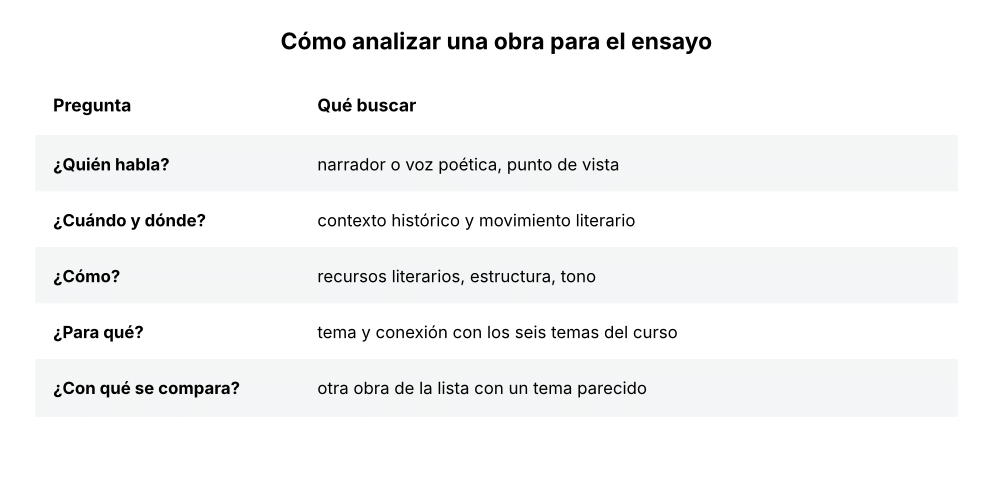
- Scan for SUI markers in the first 60 seconds. As soon as you receive the passage, mark: S (conocerse / self-knowledge language), U (unity / solidarity language), I (indígena / mestizaje language). At least one of these will dominate any excerpt. Once you’ve tagged it, you know which argument Martí is making and can answer theme, purpose, and attitude questions without re-reading from scratch.
- Use SUI as your FRQ scaffold. Decide which 2 of the 3 your thesis will connect. Most AP prompts on this essay require engaging the self-knowledge/unity axis OR the self-knowledge/indigenous axis — pick the one supported by the passage, build your thesis from it, and let the specific devices (metaphor, anaphora, rhetorical questions) serve as evidence for how Martí constructs that argument rhetorically.
- MCQ: locate the controlling metaphor in 30 seconds. If the passage uses organic or developmental language (growing, learning, maturing, roots, soil), the metaphor is Latin America as a living organism — that’s the self-knowledge theme. If it uses oratory language (“Hay que…”, direct address, repeated imperatives), it’s the unity/mobilization move. Identifying the metaphor eliminates at least two answer options instantly.
- FRQ: lead with the rhetorical strategy thesis, not the political claim. A weak thesis says “Martí argues that Latin America should be independent.” A strong thesis says “Martí uses Modernist literary techniques — extended metaphor, anaphora, and direct address — to transform a political argument for self-determination into an emotional call to action that bypasses rational objection and speaks directly to Latin American identity.” Lead with how he argues, not just what he argues.
Check for Understanding
Think you’ve got it? Complete the quiz below to make sure. Download your results at the end.