

Maximize your score with these resources:
- Albert.io AP® Biology question banks
- Free AP® Biology cheat sheets
- Free AP® Biology score calculator
What We Review
Introduction
Knowing which monomer belongs to which macromolecule is one of the most fundamental — and most frequently tested — concepts on the AP® Biology exam. Every time you encounter a question about DNA structure, protein folding, enzyme catalysis, or carbohydrate metabolism, the answer traces back to the specific monomers involved. This review covers the four categories of biological monomers in detail: nucleotides, amino acids, monosaccharides, and the fatty acid/glycerol components of lipids.
Overview of Macromolecule Monomers
Each of the four major biological macromolecules is assembled from characteristic building blocks. The identity of the monomer determines the polymer’s properties, and the specific sequence or arrangement of monomers determines its function. Here’s the complete reference:
| Macromolecule | Monomer | Bond Type | Key Elements | Primary Functions |
|---|---|---|---|---|
| Nucleic acids (DNA, RNA) | Nucleotides | Phosphodiester | C, H, O, N, P | Genetic storage, protein synthesis |
| Proteins | Amino acids | Peptide | C, H, O, N, (S) | Catalysis, structure, transport, signaling |
| Carbohydrates | Monosaccharides | Glycosidic | C, H, O | Energy, structural support, recognition |
| Lipids | Fatty acids + glycerol | Ester | C, H, O, (P) | Energy storage, membranes, signaling |
Nucleic Acid Monomers
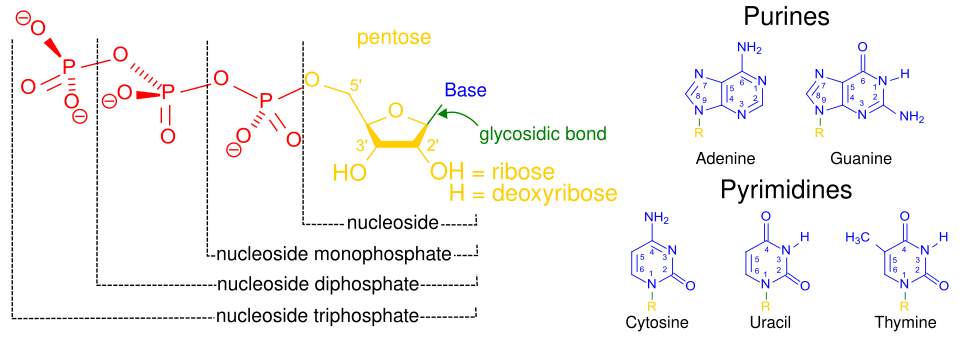
Nucleotides are the monomers of nucleic acids. Each nucleotide consists of three components: a five-carbon sugar (deoxyribose in DNA, ribose in RNA), a phosphate group, and a nitrogenous base.
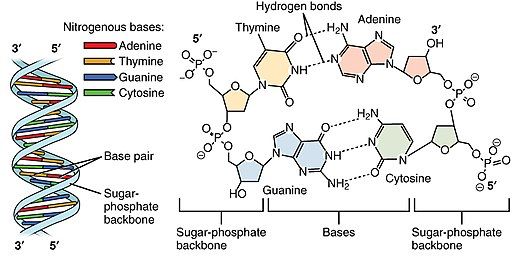

As shown in the figure, the four DNA nucleotides differ only in their nitrogenous base. The bases fall into two categories:
- Purines (double-ring structure): adenine (A) and guanine (G)
- Pyrimidines (single-ring structure): cytosine (C), thymine (T, in DNA only), and uracil (U, in RNA only)
DNA vs. RNA — key differences:
| Feature | DNA | RNA |
|---|---|---|
| Sugar | Deoxyribose (missing one oxygen) | Ribose |
| Strands | Double-stranded (double helix) | Typically single-stranded |
| Bases | A, T, G, C | A, U, G, C |
| Base pairing | A-T (2 H-bonds), G-C (3 H-bonds) | A-U, G-C (in secondary structures) |
| Function | Long-term genetic storage | Protein synthesis (mRNA, tRNA, rRNA), regulation |
Nucleotides link via phosphodiester bonds — the phosphate group of one nucleotide bonds to the 3′ hydroxyl of the next nucleotide’s sugar, creating a directional sugar-phosphate backbone (5′→3′). This directionality is critical for DNA replication and transcription.
Protein Monomers
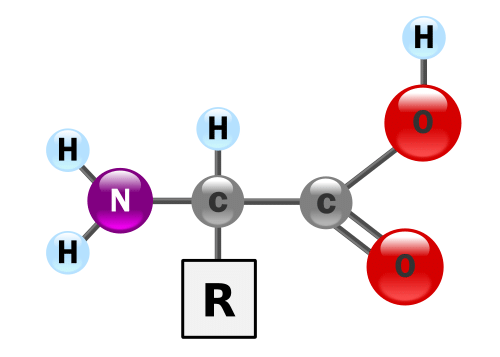
Amino acids are the monomers of proteins. All 20 amino acids share a common core structure: a central alpha carbon bonded to an amino group (-NH₂), a carboxyl group (-COOH), a hydrogen atom, and a variable R group (side chain). The R group is what makes each amino acid unique — it determines the amino acid’s polarity, charge, and chemical reactivity.
How R groups determine protein function:
- Nonpolar R groups (e.g., leucine, valine) — hydrophobic, tend to cluster in the protein’s interior away from water.
- Polar R groups (e.g., serine, threonine) — hydrophilic, often found on the protein’s surface interacting with the aqueous environment.
- Charged R groups (e.g., glutamic acid is negative, lysine is positive) — form ionic bonds that stabilize tertiary structure.
- Cysteine — contains a sulfhydryl (-SH) group that can form disulfide bridges with other cysteines, covalently stabilizing protein folds.
Amino acids link via peptide bonds, formed when the carboxyl group of one amino acid reacts with the amino group of the next through dehydration synthesis. The resulting chain is called a polypeptide, and its specific amino acid sequence (the primary structure) determines how it folds into a functional protein.
Carbohydrate Monomers
Monosaccharides are simple sugars that serve as carbohydrate monomers. The most important monosaccharides for AP® Biology are glucose (C₆H₁₂O₆), fructose, and galactose — all of which share the same molecular formula but differ in their ring structure (structural isomers).
Monosaccharides link via glycosidic bonds to form larger carbohydrates:
- Disaccharides — two monosaccharides: maltose (glucose + glucose), sucrose (glucose + fructose), lactose (glucose + galactose).
- Polysaccharides — many monosaccharides linked into long chains with distinct properties:
| Polysaccharide | Monomer | Bond Type | Function | Found In |
|---|---|---|---|---|
| Starch | Glucose | α-1,4 glycosidic | Energy storage | Plants |
| Glycogen | Glucose | α-1,4 with α-1,6 branches | Energy storage (rapid release) | Animals (liver, muscle) |
| Cellulose | Glucose | β-1,4 glycosidic | Structural support | Plant cell walls |
The critical insight: starch, glycogen, and cellulose are all made of glucose, but the type of glycosidic bond (α vs. β) determines their 3D shape and biological function. This is a high-yield AP® exam concept — expect questions testing whether you understand why the same monomer produces such different polymers.
Lipid Monomers
Lipids are not true polymers, but they are assembled from smaller components: fatty acids and glycerol.
A fatty acid is a long hydrocarbon chain with a carboxyl group (-COOH) at one end. Fatty acids differ in two important ways:
- Saturated — no carbon-carbon double bonds; hydrocarbon chains are straight; pack tightly → solid at room temperature (butter, animal fat).
- Unsaturated — one or more C=C double bonds; chains have kinks → can’t pack tightly → liquid at room temperature (olive oil, fish oil).
Phospholipids are the most important lipid type for AP® Biology. Each has a hydrophilic head (glycerol + phosphate group) and two hydrophobic tails (fatty acid chains). This amphipathic structure drives spontaneous bilayer formation in water — the molecular basis of all cell membranes.
Fatty acids attach to glycerol through ester bonds via dehydration synthesis. Three fatty acids + one glycerol = a triglyceride (the main form of stored fat in organisms).
Types of Bonds Connecting Monomers
All monomer-to-polymer bonds are covalent bonds formed through dehydration synthesis and broken through hydrolysis. Here is the complete summary:
| Bond Type | Connects | Found In | Formed Between |
|---|---|---|---|
| Peptide bond | Amino acids | Proteins | Carboxyl group + amino group |
| Phosphodiester bond | Nucleotides | DNA and RNA | Phosphate + 3′ sugar hydroxyl |
| Glycosidic bond | Monosaccharides | Carbohydrates | Hydroxyl groups on adjacent sugars |
| Ester bond | Fatty acids to glycerol | Lipids (fats) | Carboxyl group + hydroxyl group |
The nature of these bonds affects macromolecule stability. Peptide bonds are strong enough to maintain protein primary structure under normal conditions but can be hydrolyzed by proteases during digestion. Phosphodiester bonds create the remarkably stable DNA backbone that preserves genetic information across generations. Glycosidic bonds in cellulose are resistant to most animal enzymes (humans can’t digest cellulose), while glycosidic bonds in starch are readily broken by amylase.
Test-Taking Strategies
Key Mnemonics
- “SPB” for nucleotide components — Sugar, Phosphate, Base. If you can name these three, you can answer any nucleotide identification question.
- “ACR” for amino acid structure — Amino group, Carboxyl group, R group. The R group is what makes each amino acid different.
- “PUR-ines are PURe” (double-ring, A and G) — purines have the bigger name for the bigger ring structure. Pyrimidines (C, T, U) have the longer name for the smaller ring — a useful contrast.
- “ATGC for DNA, AUGC for RNA” — the only difference is thymine (DNA) vs. uracil (RNA).
- “Alpha stores, Beta structures” — α-glycosidic bonds create storage polysaccharides (starch, glycogen); β-glycosidic bonds create structural polysaccharides (cellulose).
Cross-Topic Connections
- Monomers + DNA replication (Unit 6): DNA polymerase adds nucleotide monomers to the 3′ end of the growing strand, reading the template 3′→5′. Understanding nucleotide structure is essential for replication questions.
- Monomers + protein structure (Unit 1): The amino acid R group determines polarity, charge, and bonding — which determines secondary, tertiary, and quaternary protein structure. Mutations that change one amino acid can cascade into complete loss of function.
- Monomers + cell membranes (Unit 2): Phospholipid structure (hydrophilic head + hydrophobic tails) explains why membranes self-assemble in water and why they’re selectively permeable.
- Monomers + metabolism (Unit 3): Glucose enters glycolysis; fatty acids undergo beta-oxidation; amino acids can be deaminated and fed into respiration pathways.
Common Question Formats and Pitfalls
- “Identify the monomer from this description” — Look for telltale components: five-carbon sugar + phosphate + base = nucleotide; amino group + carboxyl group + R group = amino acid; ring-shaped sugar with multiple -OH groups = monosaccharide.
- “Compare DNA and RNA nucleotides” — Three differences: sugar (deoxyribose vs. ribose), thymine vs. uracil, typically double-stranded vs. single-stranded.
- “Explain how bond type affects polymer properties” — e.g., β-1,4 glycosidic bonds in cellulose create straight chains that hydrogen-bond into rigid fibers, while α-1,4 bonds in starch create helical chains suitable for compact energy storage.
Frequent student mistakes:
- Confusing “monomer” with “polymer” — glucose is a monomer; starch is the polymer. Amino acids are monomers; proteins are polymers.
- Misidentifying the sugar in nucleotides — deoxyribose is in DNA (“deoxy” = missing an oxygen); ribose is in RNA.
- Forgetting phospholipid polarity — heads are hydrophilic (polar, face water); tails are hydrophobic (nonpolar, avoid water). This dual nature is why membranes form spontaneously.
- Mixing up bond types across macromolecules — peptide bonds are ONLY in proteins; phosphodiester bonds are ONLY in nucleic acids; glycosidic bonds are ONLY in carbohydrates.
Time Management on Test Day
- Monomer identification questions are typically worth 1 point on the rubric — answer them in 30–60 seconds and move on.
- The higher-value questions ask you to connect monomer structure to polymer function, so save your time for those explanations.
- For element-based identification: contains P → nucleic acid or phospholipid; contains N but not P → protein; only C, H, O → carbohydrate or simple lipid.
- For structure identification on diagrams: look for the sugar-phosphate backbone = nucleic acid; look for R groups branching off a backbone = protein; look for ring sugars = carbohydrate.
- On FRQs, always name the specific bond type being formed or broken — this demonstrates precise knowledge and earns rubric points.
- If you see a table-based question comparing monomers, fill in the easy cells first (bond type, elements), then tackle the trickier function descriptions.
This quiz requires JavaScript to be enabled.