
Maximize your score with these resources:
- Albert.io AP® Human Geography question banks
- Free AP® Human Geography cheat sheets
- Free AP® Human Geography score calculator
Every state has forces pulling it together and forces pushing it apart. A shared language, a national sports team, or a highway linking distant regions can build unity. Ethnic divisions, religious conflict, or a wealthy region resentful of a poor one can tear a country apart. Earlier Unit 4 topics look at the forces themselves, like devolution and challenges to sovereignty. This topic asks what happens when one side wins. On the AP® Human Geography exam, you’ll need to connect specific outcomes, from failed states to stronger national identity, to the forces that caused them.
This article covers Topic 4.10: Consequences of Centrifugal and Centripetal Forces in Unit 4, Political Patterns and Processes. The topic asks you to explain how centrifugal forces can lead to failed states, uneven development, stateless nations, and ethnic nationalist movements, and how centripetal forces can lead to ethnonationalism, more equitable infrastructure, and greater cultural cohesion.
By the end, you should be able to:
- Distinguish centrifugal and centripetal forces and name examples of each.
- Explain four consequences of centrifugal forces with real cases.
- Explain three consequences of centripetal forces with real cases.
- Recognize that the same factor, like nationalism, can unify or divide depending on the situation.
Two Kinds of Forces
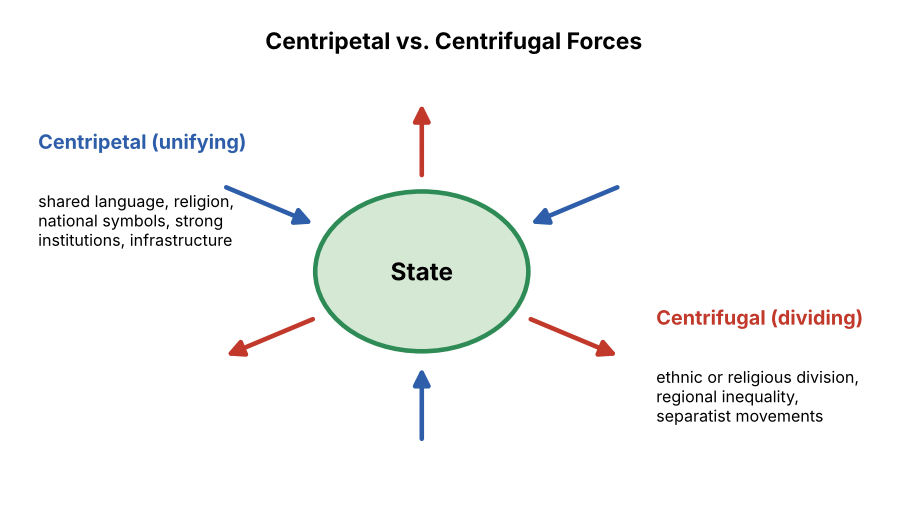
- Centrifugal forces divide a state. Examples include ethnic and religious divisions, language differences, economic inequality between regions, weak or corrupt governments, and physical barriers that isolate regions.
- Centripetal forces unify a state. Examples include a shared national identity, a common language or religion, strong and trusted institutions, national symbols, transportation and communication networks, and sometimes a shared external threat.
Every state has both. What matters is the balance between them, and how governments respond. For the basics, see our review of centripetal and centrifugal forces.
Consequences of Centrifugal Forces
When dividing forces outweigh unifying ones, the results range from regional tension to the collapse of the state itself.
Failed States
A failed state is one whose government can no longer provide basic services, maintain order, or control its territory. Somalia is the classic example. After its central government collapsed in 1991, rival clans and militias controlled different regions for years. Warlords, famine, and piracy followed. Parts of the country, like Somaliland in the north, declared independence, though it isn’t widely recognized. Other states, including Yemen and South Sudan, have faced similar breakdowns during civil wars.
Uneven Development
When one region is far richer than another, resentment can build on both sides. Poorer regions may feel neglected by the national government. Wealthier regions may resent sending tax money elsewhere. In Italy, the industrial north has long been richer than the south, and northern parties have at times called for greater autonomy. In Spain, Catalonia is one of the wealthiest regions, and complaints about taxes flowing to Madrid have fed its independence movement.
Stateless Nations


A stateless nation is a people with a shared identity and a homeland but no state of their own. The Kurds are the largest example, numbering an estimated 30 million or more, with populations divided among Turkey, Iraq, Iran, and Syria. Borders drawn after World War I split their homeland, and Kurdish movements for autonomy or independence have produced decades of conflict. Iraqi Kurds now govern an autonomous region, but no Kurdish state exists. Other examples include the Palestinians and the Basques. See our review of stateless nations.
Ethnic Nationalist Movements
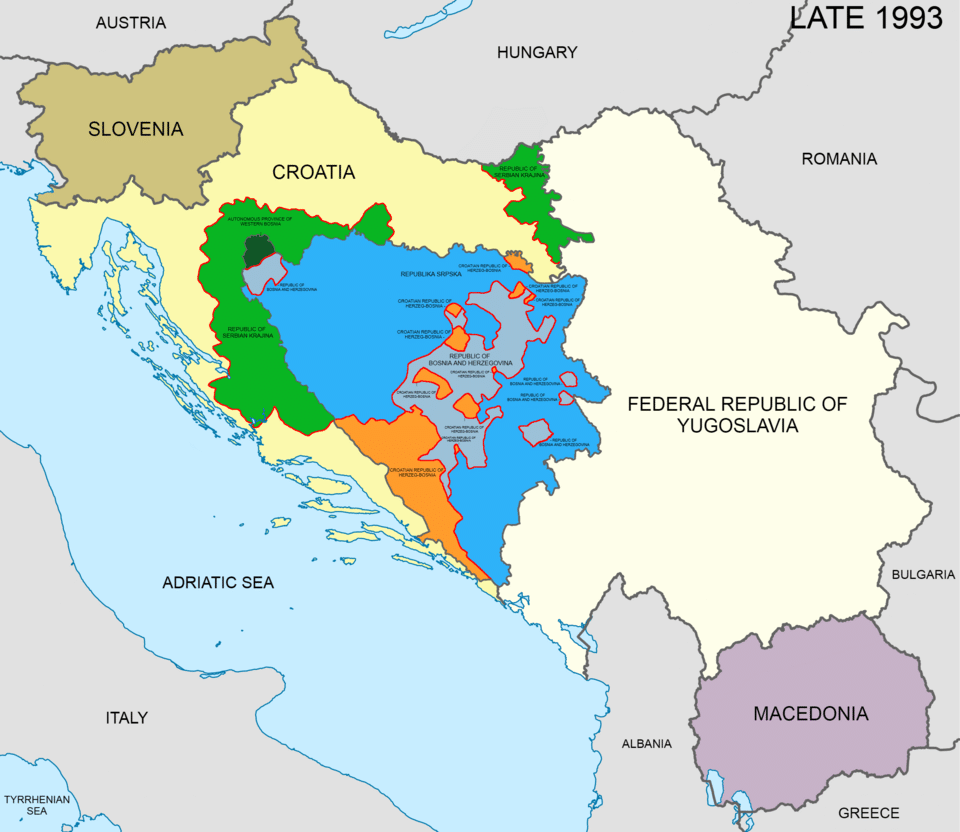
Ethnic groups concentrated in one region often push for autonomy or independence. Quebec held independence referendums in 1980 and 1995. The second failed by less than one percentage point. The Basque separatist group ETA waged a violent campaign in Spain for decades before disbanding in 2018. In the most extreme cases, these movements break states apart entirely. Yugoslavia broke into seven countries between 1991 and 2008, a process called balkanization, and the wars that followed killed more than 100,000 people. See our review of balkanization.
| Consequence | What It Means | Example |
|---|---|---|
| Failed state | The government can’t control territory or provide services. | Somalia after 1991 |
| Uneven development | Economic gaps between regions create resentment. | Northern vs. southern Italy; Catalonia |
| Stateless nation | A nation without its own state. | Kurds in Turkey, Iraq, Iran, and Syria |
| Ethnic nationalist movement | A regional group seeks autonomy or independence. | Quebec; the Basque Country; the breakup of Yugoslavia |
Consequences of Centripetal Forces
When unifying forces are strong, states become more stable and cohesive. The results aren’t always positive for everyone, though.
Ethnonationalism
Ethnonationalism is a strong sense of national identity based on shared ethnicity, language, or culture. It can unify a state by giving citizens a common identity. It can also exclude people who don’t fit the dominant group. Myanmar’s government, for example, has long treated the Muslim Rohingya minority as outsiders, denying most of them citizenship. A military campaign in 2017 drove hundreds of thousands of Rohingya into Bangladesh. National unity for one group came at the expense of another.
More Equitable Infrastructure
Governments build roads, railways, and communication networks partly to tie regions together. The U.S. Interstate Highway System linked every region of the country. China’s high-speed rail network, the largest in the world, connects its coastal cities with the interior. Brazil moved its capital from Rio de Janeiro to the new inland city of Brasília in 1960, partly to encourage development and settlement of its interior. Brasília is an example of a forward capital.
Increased Cultural Cohesion
Shared language, education, and symbols can build a common identity. After independence, Tanzania’s first president, Julius Nyerere, promoted Swahili as a national language to unite more than 100 ethnic groups, and Tanzania has seen less ethnic conflict than many of its neighbors. Indonesia adopted Bahasa Indonesia as a national language across thousands of islands and hundreds of local languages. National holidays, flags, anthems, and sports teams reinforce this sense of belonging.
Why does this matter? The same factor can work in either direction. Nationalism unified Germany in the 1800s and tore Yugoslavia apart in the 1990s. Religion unites some states and divides others. On the exam, don’t label a factor centrifugal or centripetal automatically. Explain how it works in the specific place described.
Test-Taking Strategies
Mnemonic Devices and Memory Shortcuts
- “Centrifugal flees, centripetal pulls in.” Centrifugal forces push a state apart. Centripetal forces pull it together.
- “FUSE” for centrifugal consequences. Failed states, Uneven development, Stateless nations, Ethnic nationalist movements.
- “ICE” for centripetal consequences. Infrastructure, Cultural cohesion, Ethnonationalism.
Cross-Topic Connections
- Topic 4.8: Devolutionary factors like ethnic separatism and economic inequality are the centrifugal forces behind many consequences here. See our review of devolution.
- Topic 4.7: Federal systems and devolution are common government responses to centrifugal forces. See our review of forms of governance.
- Topic 4.4: Superimposed colonial boundaries grouped rival groups together and divided others, creating centrifugal pressure.
- Topic 3.6: Language policy can be a force for cohesion or a source of conflict.
Common Question Formats
- Classification MCQ. A description of a national highway project or a separatist referendum asks whether it reflects a centrifugal or centripetal force.
- Map-based MCQ. A map of the Kurdish region asks you to identify the concept, a stateless nation.
- FRQ with a stimulus. A description of a region with a distinct language and higher income asks you to explain why it might seek independence.
- No-stimulus FRQ. You define a failed state, give an example, and explain a centrifugal force that contributed to it.
Frequent Student Mistakes
- Treating nationalism as only centripetal. National identity unifies a majority but can divide a state if minorities have their own nationalist movements.
- Confusing a stateless nation with a failed state. A stateless nation is a people without a state. A failed state is a state whose government has collapsed.
- Listing forces without consequences. This topic is about outcomes. Explain what happened because of the force, not only what the force is.
- Forgetting the positive side of centrifugal pressure. Demands for autonomy sometimes lead to peaceful devolution rather than conflict, as in Scotland.
Test-Day Shortcuts
- Ask whether the state is holding together. If a region is breaking away or the government is collapsing, look for centrifugal consequences.
- Look for infrastructure and language policy. Highways, rail networks, and national languages usually signal centripetal forces.
- Name a specific place. Somalia, the Kurds, Quebec, and Tanzania make abstract answers concrete.
Time Management Tips
- Multiple choice: Classification questions should take about 30 seconds. Save time for map-based questions about divided regions.
- Free response: Budget about 25 minutes per FRQ. Use cause-and-effect sentences: “Because the region is wealthier and speaks a different language, residents support independence.”
- Prepare one case per consequence. Having FUSE and ICE examples ready lets you answer almost any version of this question quickly.
Check for Understanding
Think you’ve got it? Complete the quiz below to make sure. Download your results at the end.