

Maximize your score with these resources:
- Albert.io AP® Biology question banks
- Free AP® Biology cheat sheets
- Free AP® Biology score calculator
Introduction
Diffusion and osmosis are two of the most fundamental transport mechanisms in biology, appearing repeatedly throughout your AP® Biology course—from cellular biology to physiology to ecology. Mastering these concepts is essential not only for exam success but also for understanding how organisms maintain homeostasis and interact with their environments. In this guide, we’ll explore the mechanics of diffusion, delve into the specifics of osmosis, examine how water potential drives molecular movement, analyze the effects on different cell types, and equip you with the strategies needed to ace AP® Biology questions on these topics.
What is Diffusion?
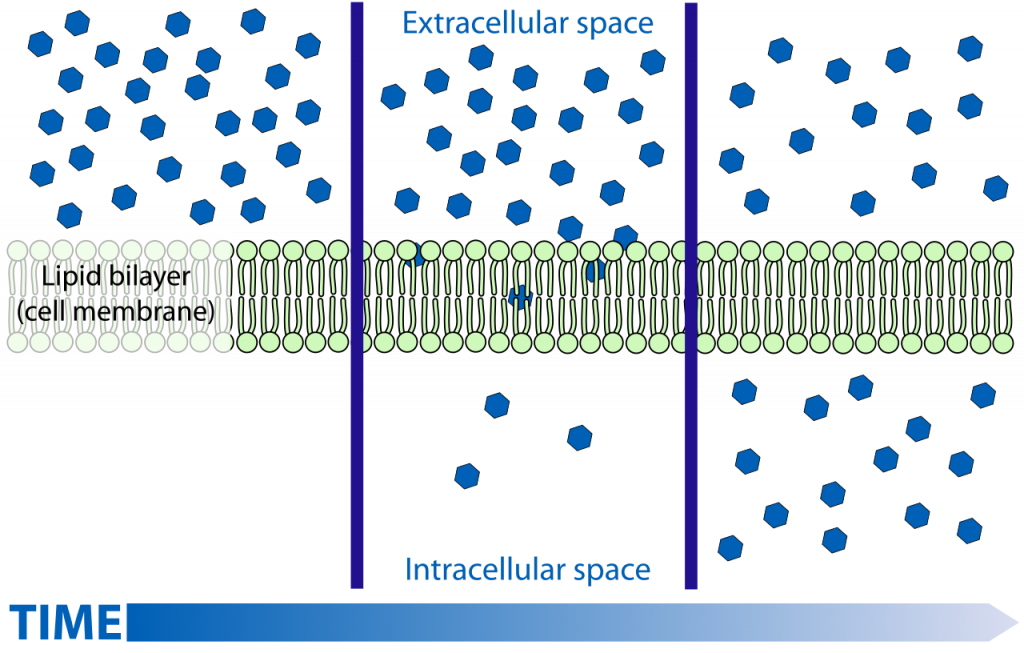
Diffusion is the passive movement of molecules from an area of high concentration to an area of lower concentration. This process occurs spontaneously and requires no energy input from the cell. You encounter diffusion constantly in everyday life: the spread of fragrance in a room, sugar dissolving in coffee, or ink dispersing through water. All these examples showcase molecules moving down their concentration gradient—the difference in concentration between two regions.
Key characteristics of diffusion:
- Passive process: Requires no ATP or cellular energy
- Spontaneous: Driven by molecular motion and the second law of thermodynamics
- Continuous: Occurs until equilibrium is reached (equal concentrations on both sides)
- Selective: Dependent on molecular size and membrane composition
When molecules move against the concentration gradient (from low to high concentration), energy is required. This is called active transport and contrasts sharply with diffusion’s passive nature.
Membranes and Permeability
Not all molecules can diffuse freely across cell membranes. The cell membrane exhibits selective permeability (also called semipermeable), meaning it allows some substances to pass while blocking others.
The cell membrane’s structure determines its permeability:
- Lipid bilayer: Composed of hydrophilic heads (water-loving, outside) and hydrophobic tails (water-fearing, inside)
- Small nonpolar molecules (O₂, CO₂, lipids): Diffuse freely through the lipid bilayer
- Large polar molecules and ions (glucose, sodium, chloride): Cannot pass through unaided
- Water: Crosses via diffusion and through aquaporins (channel proteins)
For molecules that cannot pass through directly, the membrane provides ion channels and carrier proteins that facilitate movement. When molecules move through these proteins down their concentration gradient, the process is called facilitated diffusion—still passive (no energy required), but “aided” by proteins.
A classic AP® Biology example is the blood-brain barrier (BBB), one of the body’s most selective membranes. It protects the central nervous system by blocking most pathogens and large molecules while allowing essential nutrients through. This selectivity also explains why many drugs cannot cross into the brain, making neurological disease treatment particularly challenging.
What is Osmosis?
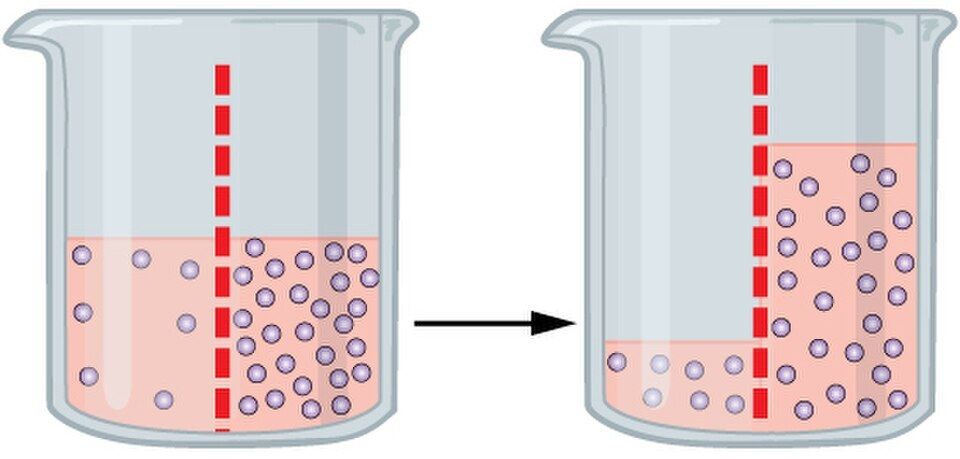
Osmosis is a specialized form of diffusion: the passive movement of water molecules across a semipermeable membrane from an area of higher water concentration (lower solute concentration) to an area of lower water concentration (higher solute concentration). Unlike general diffusion, osmosis specifically refers to water movement.
A helpful way to remember osmosis: water molecules “follow” dissolved solutes. Water is attracted to areas with higher solute concentrations and moves toward them. Think of it as water molecules rushing toward salt—they move from where there is more free water (fewer dissolved particles) to where there is less free water (more dissolved particles).
Water Potential (ψ) is a quantitative concept crucial for understanding osmosis, especially for the AP® Biology exam. Water potential describes the tendency of water to move and is calculated as:
ψ = ψs + ψp
- ψs (solute potential): Affected by solute concentration. Higher solute concentration = more negative ψs
- ψp (pressure potential): The physical pressure on a solution. In plant cells, the rigid cell wall creates positive pressure potential
Key principle: Water always moves from higher water potential (less negative) to lower water potential (more negative). Understanding this is often the key to solving AP® Biology free-response questions about plant wilting and cell behavior.
There are three solution types describing osmotic relationships:
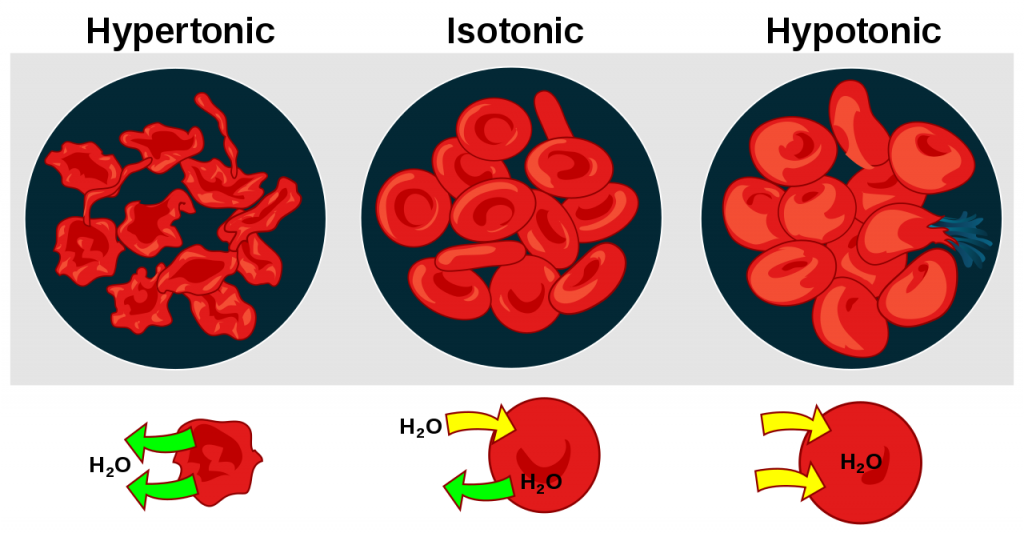
- Isotonic: Equal solute concentration inside and outside the cell. Water moves in and out equally (dynamic equilibrium)—cell volume remains stable
- Hypotonic: Lower solute concentration outside the cell (more water). Water enters the cell, causing it to swell
- Hypertonic: Higher solute concentration outside the cell (less water). Water leaves the cell, causing it to shrink
Osmosis and Cells
Cells thrive in isotonic environments, but organisms often encounter hypotonic or hypertonic conditions. The consequences differ dramatically between plant and animal cells.
Effects on Plant Cells
Hypotonic environment: Water enters the cell, pushing the cytoplasm against the rigid cell wall. This creates turgor pressure, which keeps plants firm and upright—this is why a well-watered plant stands tall. The cell undergoes turgidity.
Hypertonic environment: Water leaves the cell, and the cytoplasm shrinks away from the cell wall. This process is called plasmolysis. The plant wilts, and if plasmolysis continues, the cell dies. Historically, armies salted enemy fields to prevent crop growth by creating a hypertonic environment.
Effects on Animal Cells
Hypotonic environment: Water enters the cell, causing it to swell. Without a rigid cell wall to contain the pressure, animal cells will burst—a process called lysis. When red blood cells lyse, the specific term is hemolysis. This is why drinking only distilled water can be dangerous: it’s hypotonic relative to blood cells.
Hypertonic environment: Water leaves the cell, causing it to shrivel in a process called crenation. Drinking seawater causes crenation in blood cells, leading to dehydration faster than drinking nothing at all.
Isotonic environment: Water moves equally in and out; the cell maintains its normal shape and function. This is why isotonic solutions like normal saline (0.9% NaCl) and 5% dextrose are used in IV fluids for dehydrated patients.
Many aquatic animals have evolved osmoregulation—physiological mechanisms to maintain internal osmotic balance despite external conditions. Saltwater fish, for example, constantly lose water to their hypertonic environment but compensate by drinking seawater and excreting excess salt mainly through their gills, producing only small volumes of urine.
Comparison Table: Transport Mechanisms and Tonicity
| Mechanism | Energy Required? | Direction of Movement | Examples |
| Simple Diffusion | No (passive) | High → Low concentration | O₂, CO₂, lipids |
| Facilitated Diffusion | No (passive) | High → Low concentration | Glucose (via GLUT1), ions via channels |
| Osmosis | No (passive) | High water potential → Low water potential | Water across cell membranes |
| Active Transport | Yes (active, ATP) | Low → High concentration | Na⁺/K⁺-ATPase pump, proton (H⁺) pumps |
| Tonicity | Solute Concentration Outside | Effect on Plant Cells | Effect on Animal Cells |
| Isotonic | Equal to inside | Cell normal; slight turgidity | Cell maintains normal shape |
| Hypotonic | Lower than inside | Turgid (swollen, firm) | Lysis (bursts) |
| Hypertonic | Higher than inside | Plasmolysis (shrinks away from wall) | Crenation (shrivels) |
Test-Taking Strategies
The AP® Biology exam frequently tests diffusion and osmosis in multiple-choice questions, free-response sections, and lab-based scenarios. Here are proven strategies to maximize your score:
Memory Mnemonics
- “Hypo = Hippo = swells up (or bursts):” Hypotonic solutions cause cells to swell. Imagine a hippo drinking from a watering hole and swelling up.
- “Hyper = drying out”:” Hypertonic solutions cause cells to shrink and dry out.
- “Iso = same”:” Isotonic means equal concentrations—the cell stays “the same.”
- “Passive = free-pass”:” Passive transport (diffusion, facilitated diffusion, osmosis) requires no energy—molecules get a “free pass” to move.
Cross-Topic Connections
Water Potential → Plant Physiology: Understand why plants wilt in drought (water potential decreases in soil) and why wilting reduces the surface area for water loss. This connects to transpiration and adaptation.
Osmosis → Kidney Function: The kidney’s ability to concentrate urine depends on osmotic gradients in the collecting duct. ADH (antidiuretic hormone) increases aquaporin expression, enhancing water reabsorption. High AP® Biology free-response questions test this explicitly.
Tonicity → Medical Applications: IV solutions must be isotonic to prevent hemolysis (hypotonic) or crenation (hypertonic). This real-world application frequently appears in AP® Biology scenarios and connects to human physiology.
Diffusion → Gas Exchange: Oxygen diffuses across the alveolar membrane and into red blood cells down its concentration gradient. Understanding simple diffusion is essential for respiratory physiology.
Common AP Question Formats
- Scenario-based questions: “A plant’s roots are placed in a hypertonic solution. Predict what happens and explain using water potential.” Answer: Water leaves root cells, plasmolysis occurs, roots cannot absorb water, plant dies. Root water potential becomes more negative than soil water potential, so water moves away from the plant.
- Graph interpretation: AP exams show graphs of cell volume over time in different solutions. You must identify isotonic (flat line), hypotonic (increasing volume), or hypertonic (decreasing volume) conditions.
- Free-response essays: Explain diffusion across a membrane barrier. Always reference concentration gradient, semipermeable membrane selectivity, and passive vs. active transport distinction.
- Experimental design: “Design an experiment to test the tonicity of an unknown solution using plant or animal cells.” Key: Observe cell behavior (turgidity, plasmolysis, lysis, crenation) to infer tonicity.
Common Student Mistakes to Avoid
- Confusing the direction of water movement: Water moves toward higher solute concentration (hypertonic), not away from it. Remember: water follows salt.
- Forgetting isotonic ≠ no movement: Isotonic solutions experience dynamic equilibrium—water still moves in and out, just equally. Concentrations remain constant, but movement continues.
- Applying animal cell outcomes to plant cells: Plant cells have cell walls; animal cells don’t. This fundamentally changes osmotic outcomes. Plants are protected from lysis but can plasmolyze.
- Ignoring water potential calculations: For AP® Biology, you may need to calculate ψ = ψs + ψp. Don’t skip this; it often determines exam question answers.
- Misidentifying facilitated vs. simple diffusion: Both are passive, but facilitated requires channel/carrier proteins. Both move down concentration gradients without ATP.
Quick Shortcuts
- Draw concentration gradients: Sketch the setup (inside and outside the cell) with solute concentrations labeled. This visual clarifies which way water moves.
- Use arrows for water movement: Always draw arrows showing water flow. Arrow direction toward higher solute concentration (hypertonic side) prevents mistakes.
- Label solutions, not cells: When reading a question, label the external solution as isotonic/hypotonic/hypertonic relative to the cell. This prevents confusion.
- Connect to real life: Think of raisins in water (hypotonic—they plump up) or sliced apples in salt water (hypertonic—cells lose water and shrink). These memory anchors work on test day.
Check for Understanding
Test your mastery of diffusion and osmosis with the quiz below. Download your results to identify areas for additional review.