
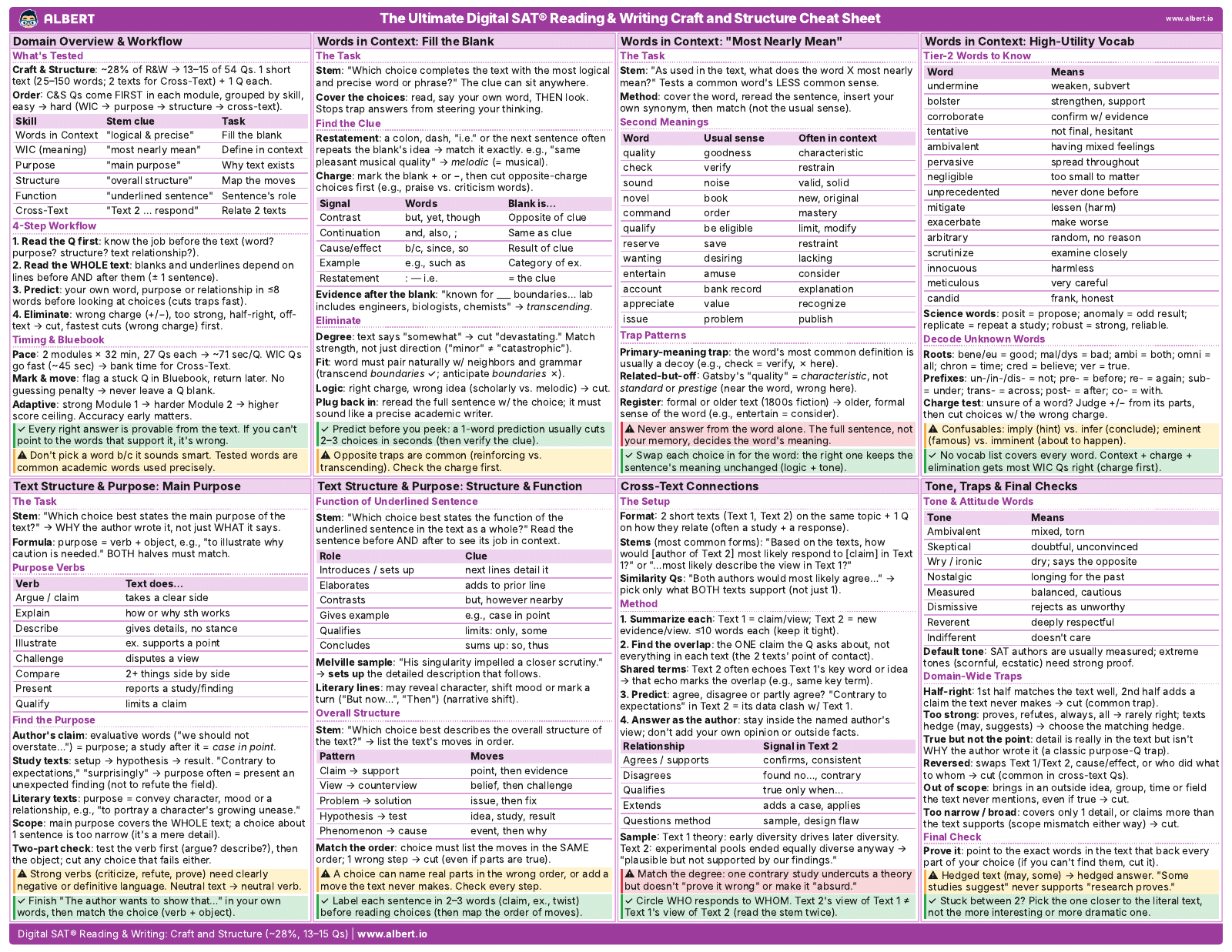
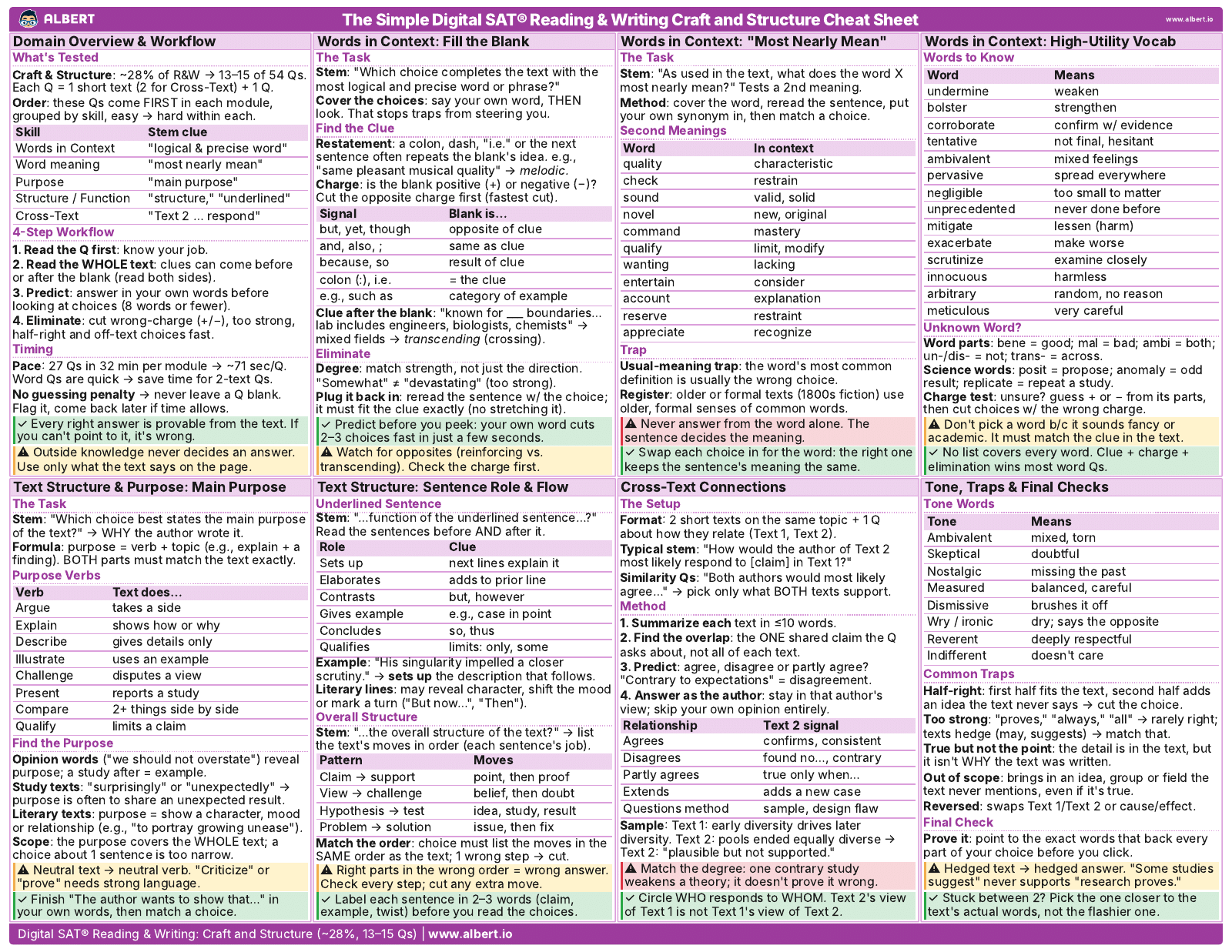
The SAT Craft and Structure cheat sheet covers the domain that opens every Reading and Writing module: Words in Context, Text Structure and Purpose, and Cross-Text Connections. Craft and Structure makes up about 28% of the section, or 13 to 15 scored questions. Pick the Simple version for a clean first pass, or the Ultimate version for every trap and stem pattern on one page.
Practice Digital SAT® Reading & Writing questions on Albert
What’s on the Digital SAT Reading & Writing Craft and Structure Cheat Sheet?
Both versions use the same eight cards in the same order: a domain overview and workflow, two cards on Words in Context (fill-the-blank and “most nearly mean”), a card of high-utility vocabulary, two cards on Text Structure and Purpose, one on Cross-Text Connections, and a final card on tone words and the traps that show up across all three skills.
The Simple version is for students who are new to the Digital SAT® or who want the core moves without the edge cases. It keeps the four-step workflow, the signal-word tables, the purpose verbs, and one key warning per skill, with a few extra words of context the first time a concept appears.
The Ultimate version is for students aiming at the top of the score range. It adds second-meaning words for “most nearly mean” questions, word roots for decoding unfamiliar vocabulary, the full list of sentence-function roles, overall-structure patterns, similarity questions on paired texts, and more of the specific traps that make hard Module 2 questions hard. Start with Simple, then switch to Ultimate once the basics are automatic.
SAT Craft and Structure at a Glance
The College Board’s Assessment Framework for the Digital SAT Suite lists three skills in this domain. Every question is a single short passage (25 to 150 words) followed by one multiple-choice question; Cross-Text Connections questions use two short passages instead of one.
| Skill | What it asks | Typical stem |
|---|---|---|
| Words in Context | Pick or define a high-utility academic word so it fits the passage precisely | “Which choice completes the text with the most logical and precise word or phrase?” / “As used in the text, what does the word … most nearly mean?” |
| Text Structure and Purpose | Identify the main purpose of a text, its overall structure, or the function of one underlined sentence | “Which choice best states the main purpose of the text?” |
| Cross-Text Connections | Draw a reasonable connection between two texts on the same topic | “Based on the texts, how would the author of Text 2 most likely respond to …?” |
Exam weight: about 28% of operational Reading and Writing questions, or 13 to 15 of the 50 scored questions (the section has 54 in all, including 4 unscored pretest questions). The section runs in two 32-minute modules of 27 questions each, and Craft and Structure questions come first in each module, grouped together and ordered from easier to harder.
Key Concepts in Craft and Structure
Words in Context: Completing the Text
Most Words in Context questions put a blank in the passage and ask for the most logical and precise word. The tested words are common academic words, the kind you meet in textbooks and articles, not obscure vocabulary. The skill being tested is reading the clue, not memorizing a dictionary.
Read the whole passage before you look at the choices. The clue that defines the blank is often after it: a colon, a dash, or the next sentence restates the idea in plainer words. Decide whether the blank is positive or negative, then predict a word of your own.
Worked example: “Critics expected the novelist’s second book to be a modest effort, but it proved ______: within a year it had been translated into thirty languages and taught in college courses across the country.” The word but signals a contrast with “modest,” and everything after the colon describes huge success. Your prediction is something like “a huge hit.” Among choices such as tentative, derivative, influential, and obscure, only influential matches.
Exam tip: cut opposite-charge choices first. Test writers like to include a word that would be right if you missed the contrast signal.
Words in Context: “Most Nearly Mean”
The second version of the question underlines a word already in the passage and asks what it most nearly means. These almost always test a familiar word used in a less familiar sense, so the word’s everyday meaning is usually a trap.
Cover the word, reread the sentence, and say a synonym that keeps the sentence’s meaning. Then find the choice closest to your synonym. If the passage is older fiction or formal nonfiction, expect an older or more formal sense of the word.
Worked example: “The committee’s report was sound: every conclusion followed from data the authors had checked twice.” Here sound has nothing to do with noise. The rest of the sentence describes careful, reliable reasoning, so it means “valid” or “well-founded.” Other words that shift meaning this way include check (restrain), novel (new), qualify (limit), wanting (lacking), and entertain (consider). The cheat sheet’s Ultimate version has a table of these.
Exam tip: substitute each choice back into the sentence. The right answer leaves the sentence saying exactly what it said before.
Text Structure and Purpose: Main Purpose
A main purpose question asks why the author wrote the text, not what it is about. Good answers have two parts, a verb and an object: “to illustrate why caution is needed when drawing conclusions about X.” Both parts have to match.
Look for the author’s own voice. Evaluative language such as “we should not overstate,” “remarkably,” or “this view overlooks” shows the author taking a position, and any study that follows is usually evidence for that position. In science passages, words like “surprisingly” or “contrary to expectations” often mean the purpose is to present an unexpected finding. In literary passages, the purpose is usually to convey something about a character, a mood, or a relationship.
Worked example: A passage says many people assume city parks mainly benefit wealthy neighborhoods, then describes a study showing that new parks in lower-income areas increased visits by nearby residents more than parks elsewhere. The purpose is to challenge a common assumption with evidence. A choice that says the text “describes the history of urban parks” names the topic but misses the purpose.
Exam tip: match the strength of the verb to the strength of the text. A neutral, descriptive passage does not “criticize” or “refute” anything.
Text Structure and Purpose: Function and Overall Structure
Some questions underline one sentence and ask for its function in the text as a whole. Read the sentence before and the sentence after; function is about the relationship. Does the sentence set up what follows, elaborate on what came before, introduce a contrast, give an example, qualify a claim, or draw a conclusion?
Overall structure questions ask you to describe the sequence of moves in the passage. Label each sentence in two or three words as you read (“claim,” “example,” “twist,” “result”). Then choose the answer that lists the same moves in the same order.
Worked example: “Many gardeners prune roses in fall. Horticulturists recommend waiting until late winter, however. Fall pruning encourages new growth that frost can kill.” The first sentence presents a common practice, the second gives an expert recommendation that differs, and the third explains the reason. An answer like “describes a practice, presents an alternative, then explains the reasoning behind the alternative” fits. An answer with the same pieces in a different order does not.
Exam tip: a choice can name a real part of the passage and still be wrong if it adds a move the text never makes.
Cross-Text Connections
These questions pair two short texts on the same topic. Most ask how the author of one text would respond to a claim or finding in the other, or how one author would describe the other’s view. Some ask what both authors would agree on.
Summarize each text in ten words or fewer. Then find the exact point of overlap: the one claim the question asks about. Decide whether Text 2 supports, contradicts, qualifies, or extends that claim, and answer from inside the named author’s point of view.
Worked example: Text 1 argues that students learn vocabulary best from explicit word lists. Text 2 reports a study in which students who read widely, without lists, gained just as many new words. How would the author of Text 2 likely view Text 1’s claim? Not as “absurd” and not as “fully confirmed.” The study suggests reading alone works at least as well, so the author would likely say the claim overstates the need for word lists.
Exam tip: match the degree. One contrary study weakens a theory; it doesn’t prove the theory false.
How Craft and Structure Shows Up on the SAT
Every Craft and Structure question is a discrete multiple-choice question with four options, and every one can be answered from the passage alone. You never need outside knowledge of the topic or the work being quoted.
Because these questions open each module, they set your pace. Words in Context questions are the quickest in the section, and many students can answer them in under a minute. Use that time to slow down on paired-text and structure questions, which take more reading. The test is adaptive by module: a strong Module 1 sends you to a harder Module 2, where the vocabulary is less familiar and the purpose and structure distinctions are finer.
Scoring is simple: one point for each correct answer, no penalty for wrong ones. That means you should answer every question, using Bluebook’s flag feature to mark ones you want to revisit. What earns the point is precision: the right choice fits every part of the passage, not most of it.
Common Mistakes in Craft and Structure
- Choosing the word that sounds most impressive. Fix: predict your own plain word first, then pick the choice that means the same thing, even if it is the simplest option.
- Using the everyday meaning on a “most nearly mean” question. Fix: cover the word and define it from the sentence, not from memory.
- Confusing topic with purpose. Fix: ask why the author wrote the passage and make sure the answer’s verb matches.
- Accepting half-right answers. Fix: check every phrase of the choice; if one part goes beyond the text, cut it.
- Mixing up the two texts. Fix: before reading choices, write down who is responding to whom.
Frequently Asked Questions
Can I use this cheat sheet on the exam?
No. The SAT does not allow notes or reference materials in the Reading and Writing section. The cheat sheet is a study tool: use it while you practice so the workflow and traps become automatic by test day.
Should I start with the Simple or Ultimate version?
Start with Simple if Craft and Structure questions still feel unfamiliar, or if you are early in your prep. Move to Ultimate once you can explain the four-step workflow from memory and want more vocabulary, more structure patterns, and more trap types.
How many Craft and Structure questions are on the SAT?
About 13 to 15 scored questions, roughly 28% of the section’s 50 operational questions (54 including pretest). They appear first in both modules.
Do I need to memorize SAT vocabulary lists?
Not long ones. Words in Context questions test common academic words in context. Knowing high-utility words helps, but reading the clue and checking the charge will get you further than memorizing rare words.
How should I practice Craft and Structure?
Work in short sets of one skill at a time and say your prediction before looking at the choices. Keep the SAT Craft and Structure cheat sheet beside you as a quick review, and check every miss against it: find the exact words in the passage that prove the right answer and the trap you fell for. The College Board’s Reading and Writing overview describes the section format.