
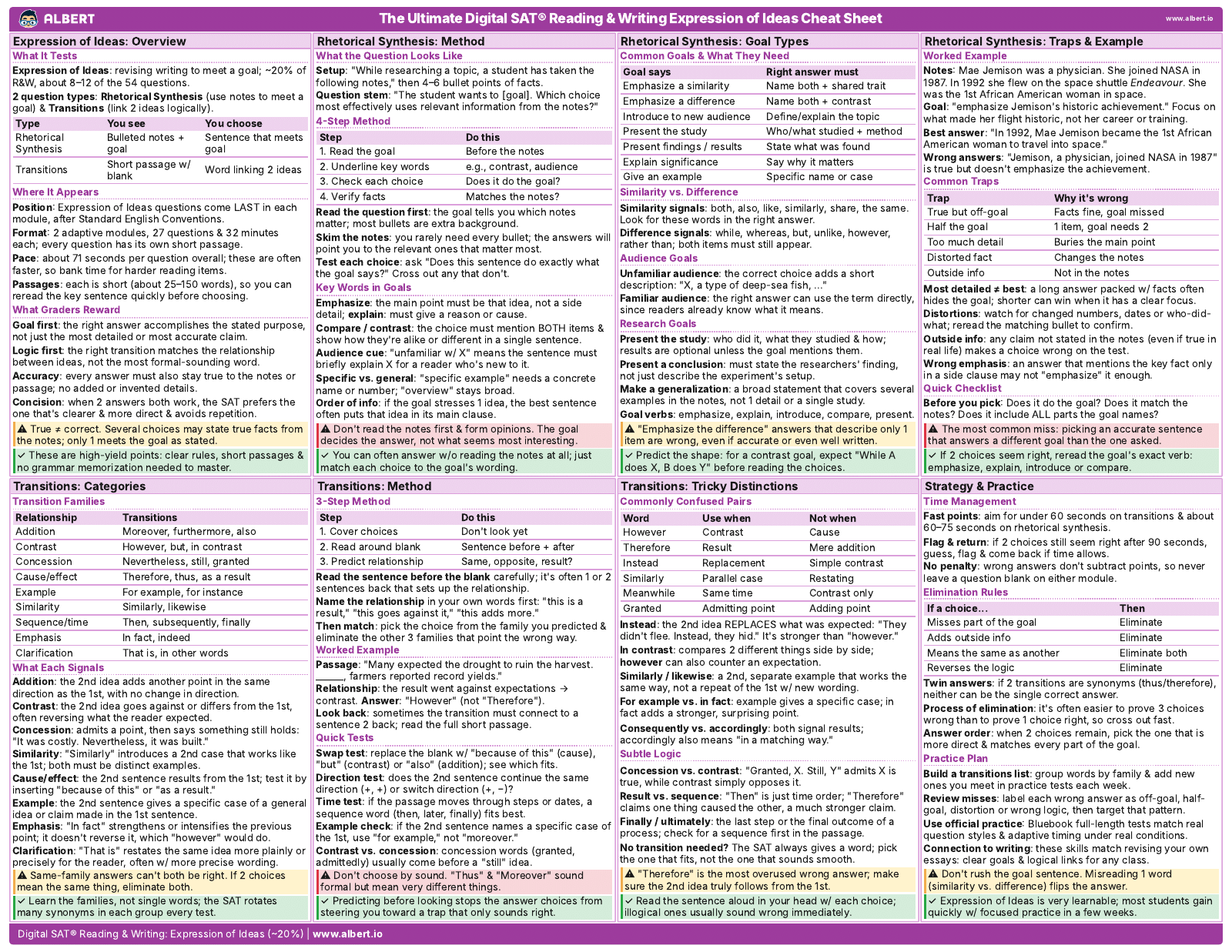
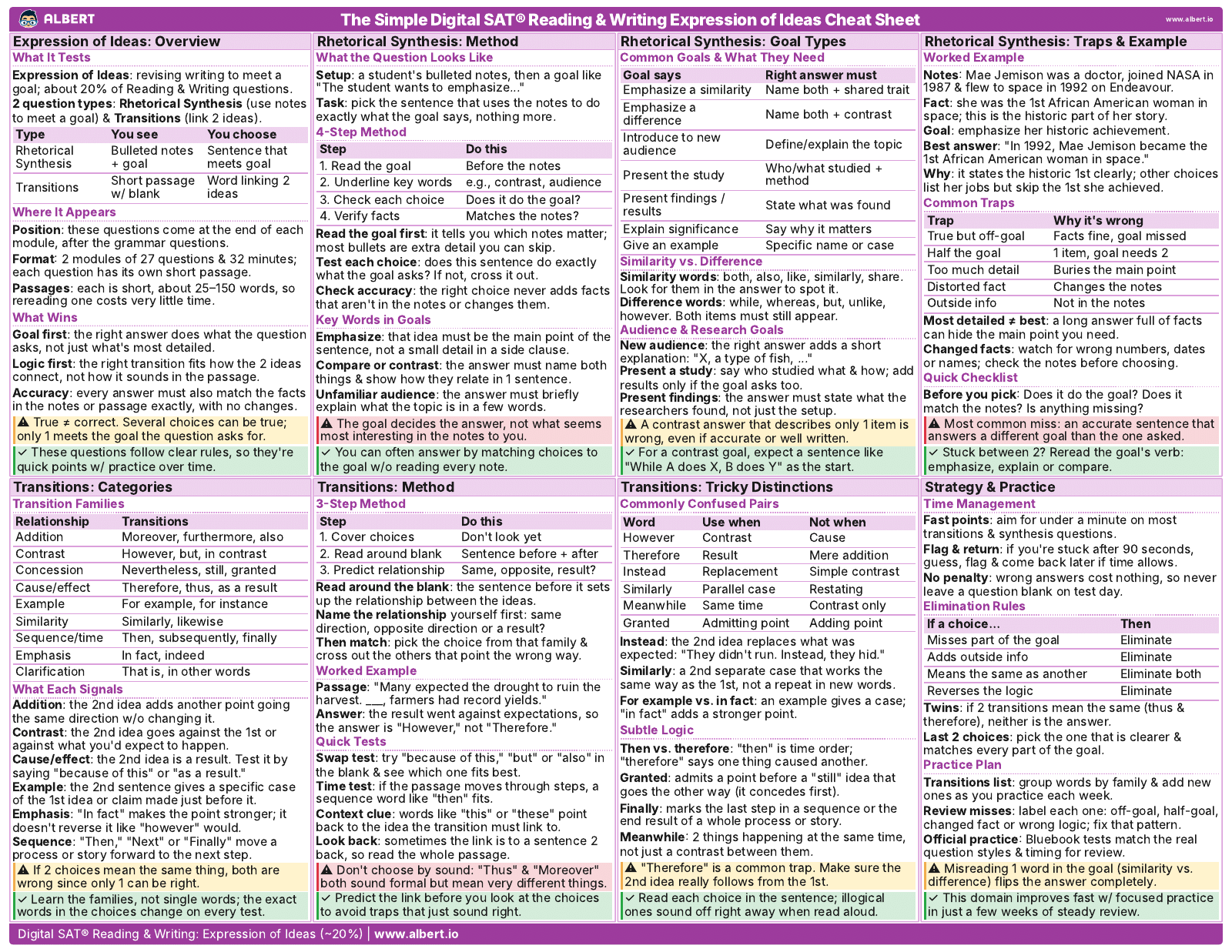
This Digital SAT Reading and Writing Expression of Ideas cheat sheet covers the two question types in the domain: Rhetorical Synthesis and Transitions. Expression of Ideas makes up about 20% of the Reading and Writing section, roughly 8 to 12 questions. The Simple version reviews the core method for each type; the Ultimate version adds goal types, trap answers, tricky transition pairs, and practice strategy.
Practice Digital SAT® Reading & Writing questions on Albert
What’s on the Digital SAT Reading and Writing Expression of Ideas Cheat Sheet?
The sheet follows the Expression of Ideas domain as the College Board describes it in the SAT Reading and Writing specifications. The domain tests whether you can revise writing so it does what the writer intends. Eight cards cover the two skills, plus an overview and a strategy card.
The Simple version keeps the essentials: what each question looks like, a short step-by-step method, the main goal words, the transition families, and a worked example for each question type.
The Ultimate version adds what separates fast, accurate scorers: a full table of goal types and what the right answer must include, the five most common Rhetorical Synthesis traps, commonly confused transition pairs such as “however” and “therefore,” subtle logic words like “granted” and “meanwhile,” elimination rules, and a practice plan.
Both versions are free to download as a PDF. Use the Simple version for a quick review the night before the test, and the Ultimate version when you are still building the skill.
Expression of Ideas at a Glance
| Topic | What you need to know |
|---|---|
| Share of section | About 20% of Reading and Writing, roughly 8 to 12 questions |
| Section format | 54 questions in 2 modules of 27 questions and 32 minutes each |
| Where it appears | Near the end of each module, after the grammar questions |
| Rhetorical Synthesis | Pick the sentence that uses a student’s notes to meet a stated goal |
| Transitions | Pick the word or phrase that shows how two ideas are logically connected |
| Passage length | Short, about 25 to 150 words per question |
| Guessing | No penalty for wrong answers, so never leave a question blank |
Key Concepts
1. Rhetorical Synthesis: Read the Goal First
Every Rhetorical Synthesis question shows a list of bulleted notes and then a goal, such as “The student wants to emphasize…” or “The student wants to introduce the study to an unfamiliar audience.” Your job is to pick the sentence that uses the notes to do exactly what the goal says, nothing more and nothing less.
The fastest approach is to read the goal before the notes. The goal tells you which notes matter. Most of the bullets are extra detail that the right answer will leave out. Underline the key words in the goal, such as “similarity,” “contrast,” “emphasize,” or “audience,” and then test each answer choice against them.
Worked example: The notes say that Mae Jemison was a doctor, joined NASA in 1987, flew to space in 1992 on the shuttle Endeavour, and was the first African American woman in space. The goal is to emphasize her historic achievement. The best answer is “In 1992, Mae Jemison became the first African American woman in space.” Other choices may list her jobs or the name of the shuttle, but they skip the historic first, so they miss the goal.
Exam tip: You can often answer without reading every note. Match each choice to the goal first, then check the one that fits against the notes for accuracy.
2. Rhetorical Synthesis: Know the Goal Types
A small set of goals shows up again and again. Each one tells you what the right answer must contain:
- Emphasize a similarity: name both items and the trait they share.
- Emphasize a difference: name both items and show how they contrast.
- Introduce to a new audience: briefly define or explain the topic, such as “X, a type of fish, …”
- Present a study: say who studied what and how.
- Present findings or results: state what the researchers found, not just the setup.
- Explain significance: say why something matters.
- Give an example: include a specific name or case.
Worked example: If the goal is to contrast two species of birds, a sentence that only describes one species is wrong, even if every fact in it is accurate. Look for a sentence shaped like “While A does X, B does Y.”
Exam tip: When a goal has two parts, such as “compare the two studies’ methods,” check that the answer covers both parts. Half the goal is still wrong.
3. Rhetorical Synthesis: Spot the Traps
Wrong answers in this question type follow clear patterns. The most common trap is a sentence that is true but off-goal: every fact matches the notes, but it does a different job than the one the question asks for. Other traps include:
- Half the goal: covers one item when the goal needs two.
- Too much detail: crams in so many facts that the main point gets buried.
- Distorted facts: changes a number, date, or name from the notes.
- Outside information: adds a claim that is not in the notes at all.
Exam tip: The longest and most detailed answer is not automatically the best one. If you are stuck between two choices, reread the verb in the goal: emphasize, explain, compare, or introduce.
4. Transitions: Learn the Families
Transition questions give a short passage with a blank and ask which word or phrase best connects the ideas. The answer depends on logic, not on which word sounds most formal. Transitions fall into families that signal the same relationship:
| Relationship | Common transitions |
|---|---|
| Addition | Moreover, furthermore, also |
| Contrast | However, but, in contrast |
| Concession | Nevertheless, still, granted |
| Cause and effect | Therefore, thus, as a result |
| Example | For example, for instance |
| Similarity | Similarly, likewise |
| Sequence or time | Then, subsequently, finally |
| Emphasis | In fact, indeed |
Exam tip: If two answer choices mean the same thing, such as “thus” and “therefore,” both are wrong, since only one answer can be correct. This rule can eliminate two choices at once.
5. Transitions: Predict Before You Look
The most reliable method has three steps. First, cover the answer choices. Second, read the sentence before the blank and the sentence after it. Third, name the relationship in your own words: same direction, opposite direction, or a result? Then pick the choice from that family.
Worked example: “Many expected the drought to ruin the harvest. ___, farmers had record yields.” The second idea goes against what people expected, so the answer is a contrast word like “However.” “Therefore” is wrong because record yields are not a result of the drought.
Exam tip: Try the swap test. Say “because of this,” “but,” or “also” in the blank and see which one makes sense. That tells you which family you need.
6. Transitions: Tricky Distinctions
The hardest Transition questions use words that look similar but signal different logic:
- “However” vs. “therefore”: “however” signals a contrast; “therefore” signals a result. Mixing these up is the most common error.
- “Instead”: the second idea replaces what was expected, as in “They didn’t run. Instead, they hid.”
- “Similarly”: introduces a separate case that works the same way, not a repeat of the first idea in new words.
- “For example” vs. “in fact”: an example gives a specific case; “in fact” adds a stronger point.
- “Granted”: admits a point before a “still” idea that goes the other way.
- “Then” vs. “therefore”: “then” shows time order; “therefore” says one thing caused another.
Exam tip: Before choosing “therefore,” make sure the second idea truly follows from the first. If it only adds information, you need an addition word instead.
How Expression of Ideas Shows Up on the Digital SAT
Expression of Ideas questions come at the end of each Reading and Writing module, after the Standard English Conventions questions. Each question has its own short passage, so you never have to keep a long text in mind. Rhetorical Synthesis questions always show bulleted notes, while Transition questions show a short paragraph with a blank.
Because these questions follow clear rules, they are some of the most learnable points on the test. Aim to spend under a minute on most of them. If you are stuck after about 90 seconds, guess, flag the question, and come back later if time allows. There is no penalty for wrong answers.
Your Reading and Writing score combines with Math for a total score from 400 to 1600. To see how your practice results translate, try the SAT score calculator.
Common Mistakes on Expression of Ideas Questions
- Picking a true answer that misses the goal. On Rhetorical Synthesis, accuracy is required but not enough. The sentence must do what the goal asks.
- Choosing the most detailed sentence. Extra facts often hide the main point the goal is asking for.
- Choosing a transition by sound. “Thus” and “moreover” both sound formal, but one shows a result and the other adds a point.
- Reading only the sentence after the blank. The relationship depends on both sentences, and sometimes on a sentence two back.
- Missing one word in the goal. Misreading “similarity” as “difference” flips the right answer completely.
Frequently Asked Questions
How many Expression of Ideas questions are on the Digital SAT?
Expression of Ideas makes up about 20% of the Reading and Writing section, which works out to roughly 8 to 12 of the 54 questions.
Can I use this cheat sheet on the exam?
No. You cannot bring notes or reference sheets into the Digital SAT. Use this Digital SAT Reading and Writing Expression of Ideas cheat sheet to study before test day, so the methods and transition families are already in your head.
What’s the difference between the Simple and Ultimate versions?
The Simple version is a quick review of the core method for each question type with one worked example each. The Ultimate version adds the full goal types table, trap patterns, commonly confused transition pairs, elimination rules, and a practice plan. Start with the Simple version if you are reviewing; use the Ultimate version if you are still learning the skill.
Do I need to memorize a list of transition words?
Learn the families instead of single words. The exact words in the answer choices change from test to test, but if you know which family a word belongs to, you can sort any choice quickly.
What is the best way to practice Expression of Ideas?
Do a small set of questions, then review every miss and label it: off-goal, half the goal, changed fact, or wrong logic. Fixing your most common pattern is the fastest way to improve. The official Bluebook practice tests match the real question styles and timing.
Keep Studying
This Digital SAT Reading and Writing Expression of Ideas cheat sheet is one part of a set. For the whole section on one page, see the full Digital SAT Reading and Writing cheat sheets. When you are ready to practice, Albert’s Digital SAT Reading and Writing course has hundreds of questions in the same style, with explanations for every answer.