
Maximize your score with these resources:
- Albert.io AP® US Government question banks
- Free AP® US Government cheat sheets
- Free AP® US Government score calculator
Congress passes laws, but it rarely spells out every detail. The Clean Air Act tells the Environmental Protection Agency to set air quality standards that protect public health. It doesn’t say how many parts per billion of ozone are too many. Filling in those details is the job of federal agencies, and it gives unelected officials real power over policy. The AP® U.S. Government and Politics exam tests how that power works, why Congress hands it over, and who keeps it in check.
This article covers Topic 2.13: Discretionary and Rule-Making Authority in Unit 2, Interactions Among Branches of Government. The topic asks you to explain how federal agencies use discretion and rulemaking to carry out laws, and how that shapes policy.
By the end, you should be able to:
- Define discretionary authority and rulemaking authority and give an example of each.
- Explain why Congress delegates power to agencies instead of writing every detail itself.
- Walk through the notice-and-comment process agencies use to create regulations.
- Explain how recent Supreme Court decisions have limited agency power.
Why Congress Delegates Power to Agencies
Congress has 535 members and a limited number of hours. Modern policy covers nuclear safety, drug approvals, aviation, financial markets, and thousands of other technical areas. Writing every rule into law would be impossible, so Congress sets broad goals and lets agencies work out the details. This is called delegation.
Congress has several reasons to delegate:
- Expertise. Agencies employ scientists, engineers, economists, and lawyers who specialize in one area for their entire careers. The Food and Drug Administration knows far more about clinical trials than any member of Congress.
- Flexibility. Technology and conditions change faster than Congress can pass laws. An agency can update a rule in months, while a new law might take years.
- Volume. Federal agencies issue thousands of rules each year. Congress couldn’t pass that many statutes.
- Political cover. Leaving controversial details to agencies lets members of Congress avoid blame for unpopular specifics. This reason is less flattering, but it’s real.
Why does this matter? Delegation means a large share of federal policy is made by the bureaucracy, not by Congress. When a question asks who sets the specific standards for car emissions or workplace safety, the answer is usually an agency acting under authority Congress gave it.
Discretion and Rulemaking: Two Kinds of Agency Power
Agencies exercise two related powers, and the exam expects you to tell them apart.
| Power | What It Means | Example |
|---|---|---|
| Discretionary authority | The freedom to decide how to carry out a law, including what to prioritize and how to enforce it. | Immigration agencies decide which violations to pursue first. The IRS decides which tax returns to audit. |
| Rulemaking authority | The power to write regulations that have the force of law. | The EPA sets limits on power plant emissions. The FDA sets rules for food nutrition labels. |
Both powers can change policy dramatically without a vote in Congress. Here are examples of agency decisions that affected millions of people:
- Environmental Protection Agency. Under the Clean Air Act, the EPA sets national standards for pollutants like ozone and fine particles and requires states to meet them.
- Federal Communications Commission. The FCC adopted “net neutrality” rules in 2015 requiring internet providers to treat all traffic equally, repealed them in 2017, and reinstated them in 2024. A federal appeals court struck the reinstated rules down in 2025. The law never changed. The agency’s leadership did.
- Department of Education. The department’s Title IX regulations on how schools handle sexual harassment complaints were rewritten in 2020 and again in 2024, each time by a different administration.
- National Highway Traffic Safety Administration. Federal vehicle safety standards required airbags and set fuel economy targets for new cars.
The net neutrality and Title IX examples show something the exam likes to test. Because agencies answer to the president, their rules often swing with each new administration.
How a Regulation Gets Made


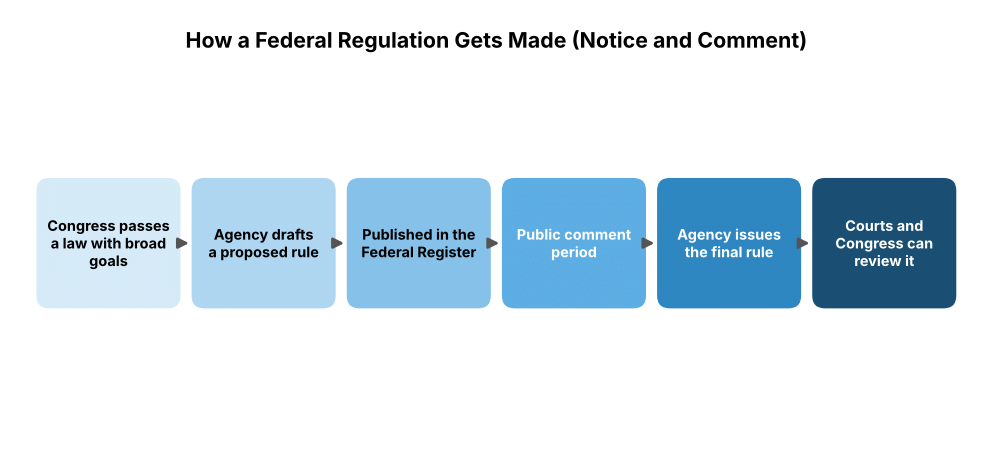
Agencies can’t issue rules however they like. The Administrative Procedure Act of 1946 requires a public process for most regulations, usually called notice-and-comment rulemaking.
- Congress passes an enabling law. The statute gives an agency authority over an area and sets general goals.
- The agency drafts a proposed rule. Staff experts study the problem and write specific requirements.
- Notice is published. The proposed rule appears in the Federal Register, the government’s daily publication of agency actions.
- The public comments. Anyone can submit comments, usually for 30 to 60 days or longer. Businesses, interest groups, state governments, and individual citizens all weigh in. Controversial rules can draw millions of comments.
- The agency issues a final rule. It must respond to significant comments and explain its reasoning. The final rule is published in the Federal Register and added to the Code of Federal Regulations.
- Review and challenges. Congress can overturn a new rule under the Congressional Review Act, and affected parties can sue to block it in federal court.
Why does this matter? The comment period is one of the most direct ways citizens and interest groups can influence policy. It’s another example of the multiple access points created by separation of powers. A group that can’t get a bill through Congress can still shape the regulation that puts a law into practice.
The Courts Push Back on Agency Power
For decades, courts gave agencies a lot of room. That has changed sharply in recent years, and the exam’s newer questions reflect it.
| Case or Doctrine | What It Said | Effect on Agencies |
|---|---|---|
| Chevron v. NRDC (1984) | When a law is ambiguous, courts should defer to an agency’s reasonable interpretation. | Expanded agency power for 40 years. |
| West Virginia v. EPA (2022) | Agencies need clear authorization from Congress before making decisions of vast economic and political significance. This is the major questions doctrine. | Limited the EPA’s power to restructure the power industry. |
| Loper Bright Enterprises v. Raimondo (2024) | Overturned Chevron. Courts must use their own judgment about what an ambiguous law means. | Shifted interpretive power from agencies to judges. |
The Constitution gives “all legislative Powers” to Congress, and critics of broad delegation argue that agencies making major policy violate that principle. The Court last struck down a law for delegating too much power in 1935, but the major questions doctrine and Loper Bright push in the same direction. Supporters of agency power respond that Congress can’t legislate the details of modern policy and that experts should make technical decisions.
Congress and the president also check agency power in other ways, from budgets to appointments. Those tools are covered in the next topic, holding the bureaucracy accountable.
Test-Taking Strategies
Mnemonic Devices and Memory Shortcuts
- “Discretion decides, rulemaking writes.” Discretion is about choosing how to enforce a law. Rulemaking is about writing new binding rules.
- “Notice, comment, final.” The three basic stages of rulemaking under the Administrative Procedure Act.
- “Register first, Code last.” Proposed and final rules appear in the Federal Register. The final version is compiled in the Code of Federal Regulations.
- “Big question, clear answer.” Under the major questions doctrine, a big policy decision needs a clear statement from Congress.
Cross-Topic Connections
- Topic 2.12: The structure of the bureaucracy, including cabinet departments and independent agencies, sets up this topic. Review it in our article on the bureaucracy.
- Topic 2.14: Congressional oversight, presidential appointments, and court challenges are the checks on the powers described here.
- Topic 5.6: Interest groups participate in rulemaking through comments and lobbying, and iron triangles connect agencies, congressional committees, and groups.
- Topic 2.9: Loper Bright overturned a 40-year precedent, a clear example of the stare decisis debate.
Common Question Formats
- Definition MCQ. A scenario describes an agency setting a new standard or choosing enforcement priorities, and you identify it as rulemaking or discretion.
- Process MCQ. A question asks what happens after a proposed rule is published. The answer is the public comment period.
- Concept application FRQ. A passage describes an agency issuing a controversial rule. You explain the authority it used and how Congress, the president, or the courts could respond.
- Quantitative analysis FRQ. A chart shows the number of pages in the Federal Register or the number of rules issued by year. You describe the trend and explain why it might change between administrations.
Frequent Student Mistakes
- Thinking agencies make laws. Agencies make regulations, which have the force of law, but only within the authority Congress gave them. If a rule exceeds that authority, courts can strike it down.
- Believing rules change only when Congress acts. New administrations often rewrite regulations on their own, as the net neutrality and Title IX examples show.
- Treating the comment period as a formality. Agencies must respond to significant comments, and final rules often change because of them.
- Still citing Chevron deference as current law. Loper Bright overturned it in 2024. If a question asks how courts now treat agency interpretations, they no longer defer by default.
Test-Day Shortcuts
- Look for the verb. “Sets standards,” “issues regulations,” or “finalizes a rule” means rulemaking. “Prioritizes,” “enforces,” or “decides whom to investigate” means discretion.
- Trace the authority. When a question asks why an agency could act, the answer is a law passed by Congress that delegated the power.
- Connect rule swings to elections. A stimulus showing a rule adopted, repealed, and restored is pointing you toward presidential control of the bureaucracy.
Time Management Tips
- Multiple choice: Definition questions should take 30 to 45 seconds. Process questions go just as fast once you know the notice-and-comment sequence.
- Concept application FRQ: Spend about 20 minutes. Name the agency’s power in the first part, then give each check its own sentence in the later parts.
- Quantitative analysis FRQ: Describe the trend precisely first, using numbers from the chart. Then connect it to a concept such as a change in administration or divided government.
Check for Understanding
Think you’ve got it? Complete the quiz below to make sure. Download your results at the end.