
Maximize your score with these resources:
- Albert.io AP® US Government question banks
- Free AP® US Government cheat sheets
- Free AP® US Government score calculator
The right to privacy is one of the most contested and evolving concepts in American constitutional law. While the word “privacy” never appears in the Constitution, the Supreme Court has repeatedly found it embedded in the Bill of Rights — particularly in the Due Process Clause of the Fourteenth Amendment. Understanding how and why courts have protected privacy, what limits exist on that protection, and how it applies to modern issues like digital surveillance is essential for AP® US Government success. This topic shows up regularly on both the multiple-choice and free-response sections, often paired with specific landmark cases. This article covers Topic 3.9: Amendments: Due Process and the Right to Privacy (Learning Objective LOR-2.J), which is part of Unit 3: Civil Liberties and Civil Rights (13-18% of the exam weight).
The Constitutional Basis: Where Privacy Comes From
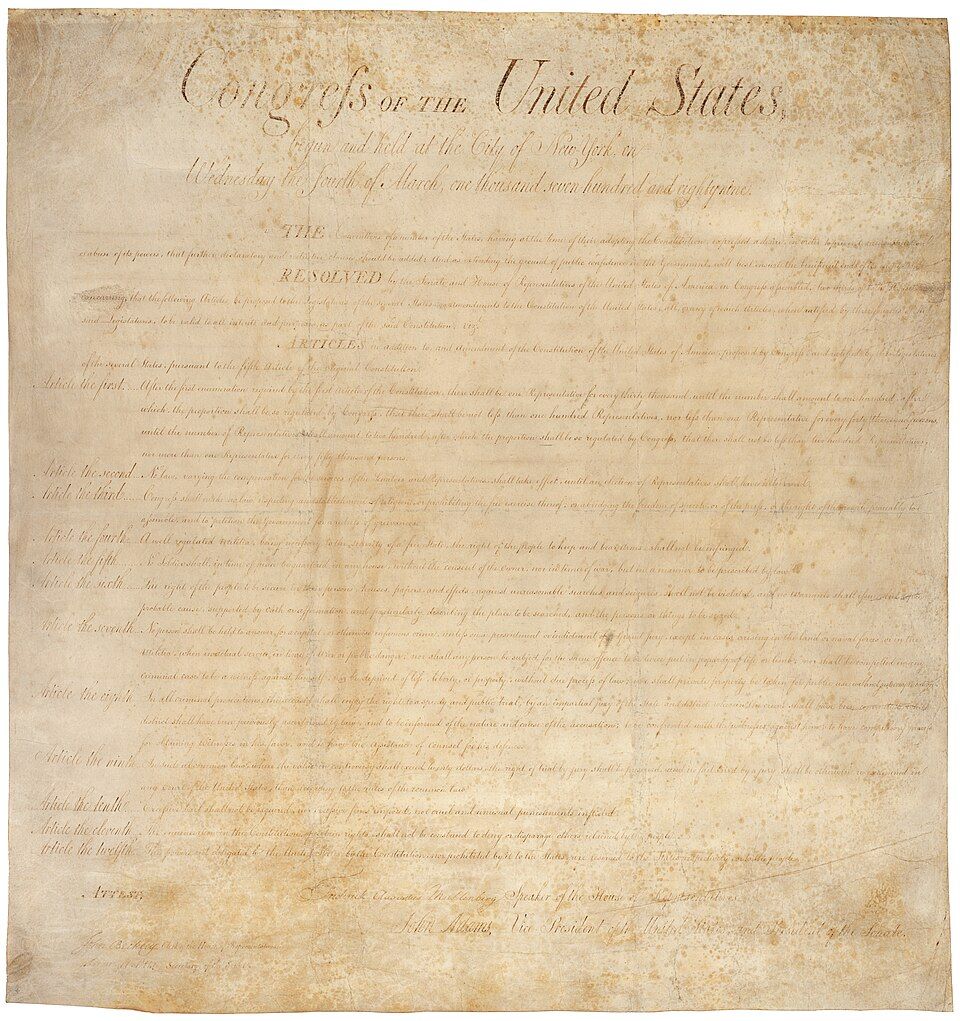
The Constitution doesn’t explicitly protect privacy. Instead, the Supreme Court has inferred a right to privacy from the “penumbras” (shadows) of explicit constitutional protections. This approach began with Griswold v. Connecticut (1965), where the Court struck down a state law that banned contraception use, even for married couples. Justice William O. Douglas reasoned that while privacy itself wasn’t mentioned in the Bill of Rights, it was implied by the protections already there.
Understanding this conceptual foundation is crucial: the Court didn’t create privacy out of thin air. Instead, it traced privacy rights through multiple constitutional layers:
- First Amendment — Protects freedom of association, which includes the right to keep certain affiliations private.
- Fourth Amendment — Guards against unreasonable searches and seizures, which is fundamentally about keeping personal spaces private.
- Fifth Amendment — Self-incrimination clause implies you don’t have to disclose private thoughts or information that would harm you.
- Ninth Amendment — States that rights retained by the people are not limited to those enumerated in the Constitution.
- Fourteenth Amendment Due Process Clause — The “liberty” protected by due process includes personal autonomy in intimate decisions.
Why this matters for the exam: AP questions don’t just ask you to list these amendments. They ask you to trace the logic of how courts connect dots across the Constitution to build a privacy argument. When you see a question about privacy, you’re being tested on your understanding that constitutional rights can be implied, not just stated.
Griswold v. Connecticut: The Birth of the Modern Right to Privacy
In 1965, Connecticut had a law on the books that criminalized the use of contraceptives, even by married couples. A clinic director was arrested for distributing contraceptives and prescribing contraceptive advice. The case reached the Supreme Court as Griswold v. Connecticut, and it became the foundational privacy case in American constitutional law.
The Court’s reasoning in Griswold established how privacy works in constitutional law:
- Privacy exists in the penumbra of enumerated rights. Specific constitutional protections create zones of privacy around them. For example, the First Amendment’s protection of association implies you have a private sphere where you can associate with people without government intrusion.
- The right to privacy extends to intimate decisions. Justice Douglas identified “intimate relations” and “procreation” as core privacy interests. The decision to use contraception is so personal that it falls within this protected zone.
- The state must have a compelling interest to invade this privacy. Connecticut’s interest in regulating contraception (however framed) didn’t meet this high standard for married couples in their own homes.
The impact was transformative: the Court had created a constitutional right that wasn’t explicitly written down. For the AP exam, Griswold is the case you need to know cold. It appears on nearly every major AP® US Government test, either directly or as context for understanding more recent privacy decisions.
Roe v. Wade and the Application of Privacy to Abortion
Seven years after Griswold, the Supreme Court applied the privacy framework to abortion in Roe v. Wade (1973). A Texas woman challenged the state’s abortion ban, and the Court ruled that the constitutional right to privacy is broad enough to encompass a woman’s decision whether or not to have an abortion.
The Court didn’t say the right to abortion is absolute. Instead, it created a trimester framework that balanced the woman’s privacy interest against the state’s interests in potential life:
| Trimester | Woman’s Right | State’s Authority |
|---|---|---|
| First trimester | Woman’s right to abortion is nearly absolute. The state cannot regulate or restrict abortion. | State interest in protecting potential life is not yet compelling. |
| Second trimester | Woman retains the right to abortion, but the state can regulate abortion to protect maternal health. | State can regulate the abortion procedure in ways reasonably related to maternal health (e.g., licensing of who performs it and where). |
| Third trimester | Woman’s right can be restricted as the fetus approaches viability. | State can ban abortion except when necessary to preserve the life or health of the mother. |
Roe illustrates an essential principle: constitutional rights are not unlimited, and courts balance competing interests. The privacy right to make intimate reproductive decisions is powerful, but it doesn’t trump all government authority. On the AP exam, you’ll be asked to distinguish Roe’s approach (privacy + balancing) from other doctrines like strict scrutiny or rational basis review.
Dobbs v. Jackson Women’s Health Organization (2022) overturned Roe, holding that the Constitution does not protect a right to abortion. This is recent and important for understanding that constitutional interpretations can shift with new Court majorities. However, for most AP exams given in 2025-2026, the focus remains on understanding how and why Roe applied privacy doctrine to abortion, rather than detailed analysis of Dobbs itself.
Privacy Beyond Reproduction: Lawrence v. Texas and Digital Age Issues
Privacy isn’t limited to contraception and abortion. The Supreme Court has extended privacy protections to other intimate personal decisions. Lawrence v. Texas (2003) applied privacy doctrine to strike down laws criminalizing consensual same-sex relations between adults. The Court held that the right to privacy protects the liberty to engage in consensual sexual conduct in one’s own home, regardless of the sex of one’s partner.
Lawrence built directly on Griswold and Roe by extending privacy to another intimate life choice. The pattern you need to recognize for the AP exam:
- Griswold = privacy over contraception (right to prevent pregnancy)
- Roe = privacy over abortion (right to terminate pregnancy)
- Lawrence = privacy over intimate consensual relations (right to choose one’s partner)
These cases show how privacy doctrine evolves. Courts apply the same underlying principle — that certain intimate decisions are too personal for government control — to new contexts. On the AP exam, you might see questions asking you to predict how privacy doctrine would apply to a new hypothetical situation. Use this progression to help you reason through the answer.
In the digital age, privacy faces new challenges. The Fourth Amendment traditionally protected against physical searches, but modern technology raises questions: Does the government need a warrant to access your cell phone location data? Your emails? Your social media? Courts are still working through these issues, but the core principle remains: the government generally needs a warrant based on probable cause to invade private spaces or access intimate information. However, some government surveillance programs operate in gray areas — the PATRIOT Act (2001) expanded government surveillance powers after 9/11, and NSA programs have collected vast amounts of electronic data. This tension between security and privacy is a live issue in contemporary American politics and a likely subject for AP free-response questions.
Limits on Privacy: When the Government Can Restrict Private Conduct
The constitutional right to privacy is real and powerful, but it’s not absolute. Several important limitations apply:
- Government has legitimate interests in regulating conduct. Even if conduct happens in private, the government can regulate it if it has a sufficiently important reason. For example, you don’t have a privacy right to sell organs or engage in certain kinds of harmful self-harm.
- The right applies primarily to personal autonomy, not to all private conduct. A person’s private bedroom activities may be protected (Lawrence), but a person’s private financial fraud is not. The privacy right is rooted in personal liberty, autonomy, and dignity — not in secrecy generally.
- Competing rights can limit privacy. If your privacy interest conflicts with someone else’s constitutional right, courts must balance them. For example, the First Amendment right to publish newsworthy information can sometimes override an individual’s interest in keeping something private.
- States can regulate practices that pose health or safety risks. The second trimester of Roe allowed states to regulate abortion to protect maternal health. Similarly, states can regulate substances or practices if they have legitimate health rationales.
The AP exam tests this nuance heavily. You’ll see questions that give you a hypothetical situation and ask whether privacy protects it. The answer usually requires recognizing that privacy is a real right but not unlimited. A good test-taking strategy is to ask: “What government interest might limit this right?” and “Does that interest outweigh the privacy claim?” This balancing is how courts actually think about privacy claims.
Privacy and Due Process: Substantive Due Process as the Framework
Understanding privacy requires understanding substantive due process, a doctrine that emerged from the Fourteenth Amendment’s Due Process Clause. The clause says no state shall “deprive any person of life, liberty, or property, without due process of law.” Courts have interpreted “liberty” to include certain fundamental rights, including privacy.
This creates a hierarchy of judicial scrutiny:
| Level of Scrutiny | When Applied | Standard | Privacy Example |
|---|---|---|---|
| Strict scrutiny | When a law infringes a fundamental right (like privacy) | Law must be narrowly tailored to achieve a compelling government interest. Very hard to satisfy. | A law banning contraception entirely would face strict scrutiny and likely fail. |
| Intermediate scrutiny | When a law substantially relates to an important government interest | Law must be substantially related to an important government interest. Moderate difficulty. | Waiting periods or parental consent laws in abortion cases were judged under Casey’s (1992) separate “undue burden” test, not intermediate scrutiny. |
| Rational basis | Most laws; no fundamental right or suspect classification involved | Law just needs to be rationally related to a legitimate government interest. Easy to satisfy. | If the right to privacy didn’t apply, abortion bans might face only rational basis review. |
Why this matters: When courts identify something as a fundamental right protected by privacy, they automatically apply strict scrutiny to laws restricting it. This makes it much harder for the government to justify those laws. This is why identifying whether privacy applies is so important in constitutional law cases.
Test-Taking Strategies
Mnemonic Devices and Memory Shortcuts
Remember the privacy progression with “GRL” (Griswold, Roe, Lawrence):
- Griswold (1965) — Contraception / “penumbra” principle established
- Roe (1973) — Abortion / trimester framework
- Lawrence (2003) — Consensual relations / extending privacy to new contexts
Remember the limitations with “CASH”:
- Competing rights can limit privacy
- All privacy is tied to government interests (can be limited if interest is compelling)
- Secrecy alone doesn’t create a privacy right (must be about personal autonomy)
- Health and safety interests can restrict privacy (second trimester regulations, for example)
Cross-Topic Connections
Privacy doesn’t exist in isolation on the AP exam. Connect it to:
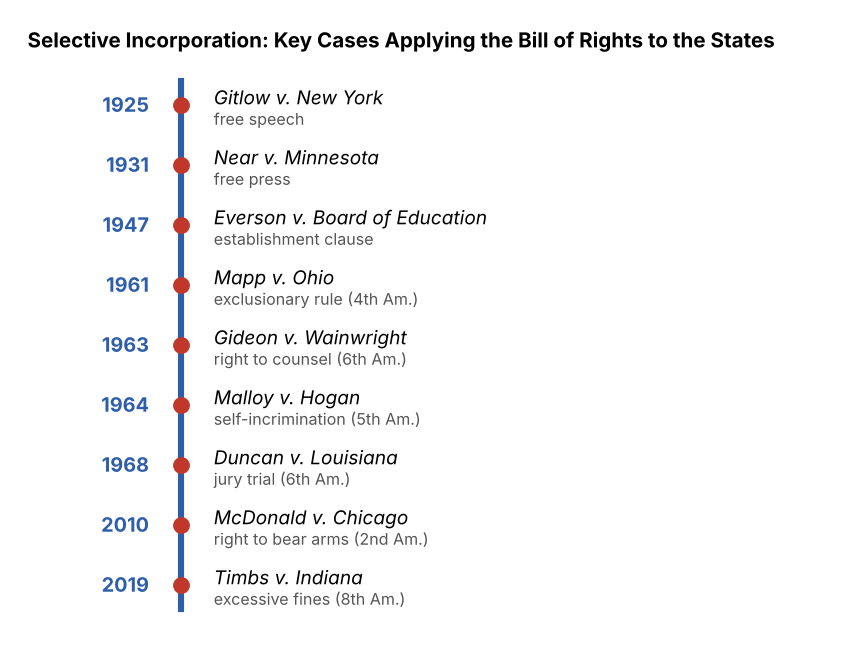
- Topic 3.7 (Selective Incorporation) — Privacy rights have been incorporated to apply to the states through the Fourteenth Amendment’s Due Process Clause. Know which amendments protect privacy and how incorporation made them binding on states.
- Topic 3.8 (Due Process and Rights of the Accused) — Both topics rest on the Due Process Clause: rights of the accused on procedural due process, privacy on substantive due process. Understand how “liberty” under the Due Process Clause protects different kinds of rights.
- Topic 3.3 (First Amendment: Freedom of Speech) — The First Amendment’s protection of association creates one of the “penumbras” from which privacy is derived. Freedom of association and privacy are closely related.
- Topic 3.10 (Equal Protection) — Some laws that restrict privacy might also face equal protection challenges (e.g., gender-based abortion restrictions).
Common Question Formats
Privacy questions on the AP exam typically appear in these forms:
- Case-based MCQ: “Which of the following best explains the Supreme Court’s reasoning in Griswold v. Connecticut?” Expect to distinguish between penumbra doctrine, strict scrutiny, and substantive due process reasoning.
- Hypothetical scenario MCQ: “A state passes a law requiring a 48-hour waiting period before any surgical procedure, including non-reproductive surgeries. Based on privacy doctrine, which of the following is most likely?” You’ll need to apply the principle to a new situation.
- FRQ (Concept-Based): “Identify and explain the constitutional basis for the right to privacy, using specific cases and amendments.” This requires you to trace privacy through multiple constitutional sources and explain the penumbra doctrine clearly.
- FRQ (Comparison): “Compare the Supreme Court’s approach to privacy in Griswold v. Connecticut with its approach in Roe v. Wade. How did the Court’s understanding of the scope and limits of privacy change?” This tests whether you understand the evolution of privacy doctrine.
- FRQ (Application): “Recent proposed legislation would require genetic testing before marriage. Using constitutional principles about privacy and due process, evaluate whether such a law would likely survive judicial review.” This tests your ability to apply privacy doctrine to novel situations.
Frequent Student Mistakes
Avoid these common errors when writing about or answering questions on privacy:
- Saying privacy is in the Constitution. Privacy is not explicitly mentioned in the Constitution. It is inferred or implied from other protections. Get this wrong and you lose credibility on an FRQ.
- Confusing “penumbra” with “specific constitutional right.” A penumbra is the shadow or implied right surrounding explicit rights. Don’t say “the penumbra protects privacy” — say “the penumbra doctrine allows courts to infer privacy rights from other explicit protections.”
- Treating privacy as unlimited. Privacy is real but not absolute. If you claim something is protected by privacy, be ready to explain what government interests might limit it and which scrutiny level would apply.
- Assuming Roe is still good law. Roe was overturned in 2022, but understanding how it applied privacy doctrine is still essential for the AP exam. Know Roe’s reasoning and trimester framework, even if it’s not current law.
- Forgetting the Fourth Amendment connection. Digital privacy, surveillance, and searches are all Fourth Amendment issues rooted in the privacy principle. Connect privacy in intimate decisions (Griswold/Roe) to privacy in homes and data (Fourth Amendment).
Test-Day Shortcuts
- When you see a case name, ask: “What right did the Court protect here?” Griswold protected contraception use, Roe protected abortion access, Lawrence protected consensual relations. These are the specific holdings. Don’t confuse them.
- When you see “state regulation,” ask: “Which trimester or which scrutiny level applies?” The level of judicial review determines whether the regulation survives. Strict scrutiny (usually hits) vs. intermediate scrutiny (might survive). This distinction often determines the answer.
- When a question asks about a “new” privacy issue, apply the “intimate decision” test. Does the issue involve a deeply personal, intimate decision about bodily autonomy, reproduction, or family relations? If yes, privacy doctrine might apply. If no (e.g., financial disclosure), it probably won’t.
- Remember that privacy is about personal autonomy, not secrecy. The government can’t regulate your private thoughts or intimate decisions, but it can regulate public conduct even if done “privately.” A person smoking marijuana in their home is still violating drug law.
Time Management Tips
- On MCQs about privacy cases, read the answer choices carefully for precision. Wrong answers often include half-truths (like “the First Amendment protects privacy” — true, but usually not the best answer). The best answer will accurately describe the specific reasoning the Court used.
- On FRQs, structure your response around the specific learning objective: “The right to privacy is inferred from the Bill of Rights through substantive due process and the Fourteenth Amendment. Explain the penumbra doctrine, cite Griswold, then show how the Court extended privacy to abortion in Roe.” This structure takes the guesswork out of what to cover.
- If you’re running out of time on a privacy FRQ, prioritize explaining one case deeply over listing multiple cases shallowly. A thorough explanation of Griswold (penumbra, specific holding, why it mattered) scores better than a list that says “Griswold: contraception, Roe: abortion, Lawrence: relations.” Depth beats breadth.
Check for Understanding
Think you’ve got it? Complete the quiz below to make sure. Download your results at the end.