
Every day, people try to convince you of something. An advertisement says a sneaker will make you faster. A classmate argues that school should start later. A news column claims that a new law will save money. Some of these arguments are strong, and some fall apart under a closer look. Evaluating arguments means testing whether a claim is backed by good reasons and evidence, a skill that matters on tests and in everyday life.
This article covers Topic 3.1: Evaluating Arguments and Claims in Unit 3, Integration of Knowledge and Ideas. The topic asks you to identify claims, reasons, and evidence, judge whether evidence is relevant and sufficient, and recognize flawed reasoning.
By the end, you should be able to:
- Identify the claim, reasons, and evidence in an argument.
- Judge whether evidence is relevant, sufficient, and credible.
- Distinguish facts from opinions.
- Recognize common logical fallacies.
The Parts of an Argument
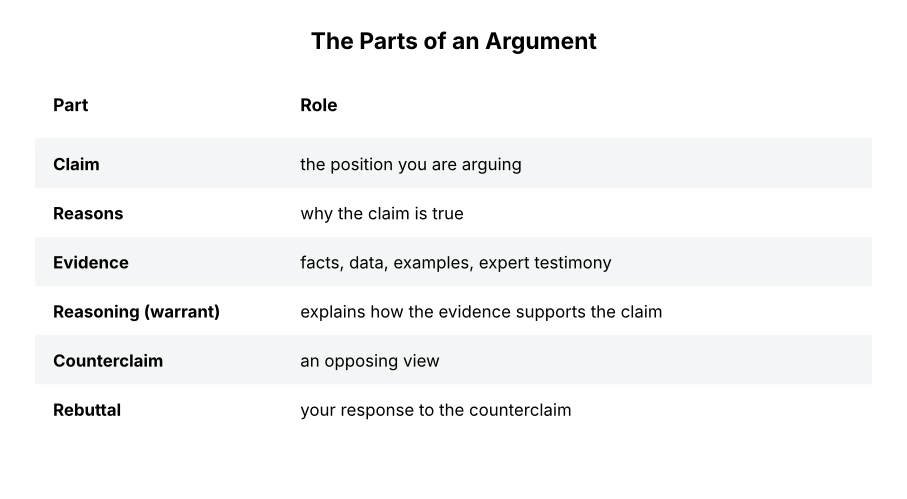
| Part | Definition | Example |
|---|---|---|
| Claim | The main position the author argues | Schools should start later in the morning. |
| Reason | A statement explaining why the claim is true | Teenagers need more sleep to learn well. |
| Evidence | Facts, data, examples, or expert opinions that support a reason | The American Academy of Pediatrics recommends that middle and high schools start no earlier than 8:30 a.m. |
| Counterclaim | An opposing view the author addresses | Later start times could complicate bus schedules. |
| Rebuttal | The author’s response to the counterclaim | Districts that changed schedules found workable transportation solutions. |
Evaluating Evidence
Ask three questions about every piece of evidence:
- Is it relevant? Does it actually support this specific reason? A statistic about adult sleep habits may not prove anything about teenagers.
- Is it sufficient? Is there enough evidence? One anecdote about one student is not enough to support a claim about all students.
- Is it credible? Does it come from a reliable, qualified source? Data from a medical organization is more credible than an anonymous online comment.
Why does this matter? A claim can sound convincing and still be poorly supported. Tests often ask whether a piece of evidence strengthens or weakens an argument, or which additional evidence would help most.
Fact Versus Opinion
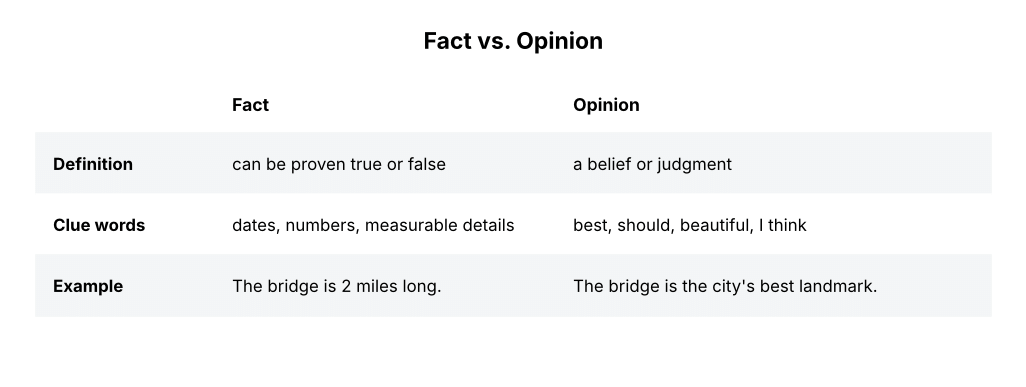
- A fact can be verified as true or false: “The school day begins at 7:30 a.m.”
- An opinion expresses a belief or judgment: “7:30 a.m. is far too early.”
Opinions are not bad; arguments are built on them. But a strong argument supports its opinions with facts. Watch for judgment words such as best, worst, should, unfair, and terrible.
Common Logical Fallacies
A fallacy is an error in reasoning that weakens an argument.
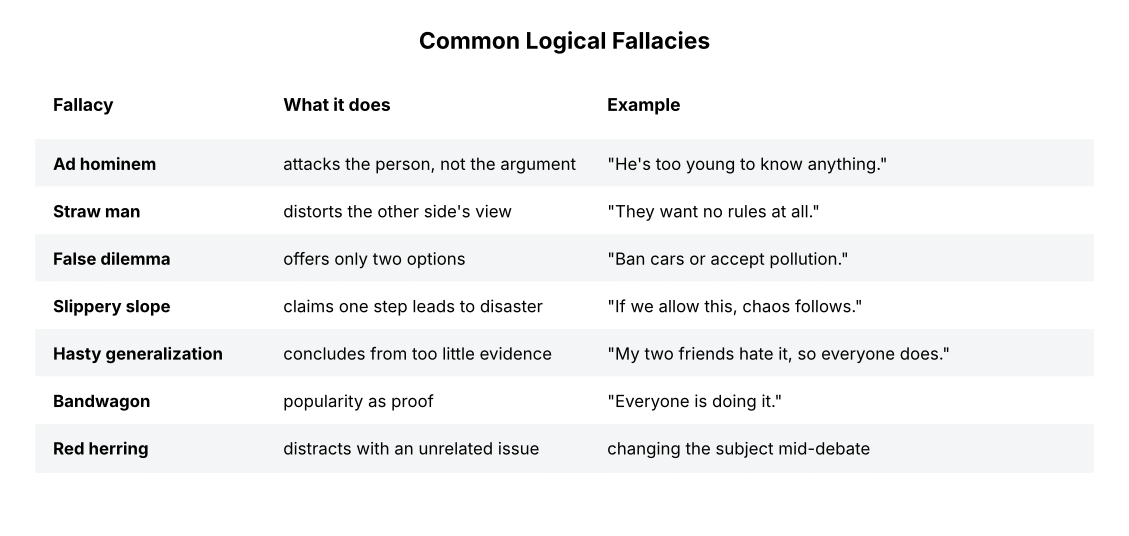
| Fallacy | What It Does | Example |
|---|---|---|
| Hasty generalization | Draws a broad conclusion from too little evidence | “My cousin hated that school, so it must be terrible.” |
| Ad hominem | Attacks the person instead of the argument | “Don’t listen to her plan; she’s always late.” |
| Straw man | Misrepresents the opposing view to make it easier to attack | “They want later start times because they think students should be lazy.” |
| False dilemma | Presents only two options when more exist | “Either we start school later or students will keep failing.” |
| Bandwagon | Claims something is right because many people do it | “Everyone is buying this phone, so you should too.” |
| Slippery slope | Claims one step will lead to extreme results without proof | “If we allow phones at lunch, soon nobody will ever study.” |
Why does this matter? Fallacies often appear in advertising, politics, and online debates. Recognizing them protects you from being misled and helps you build stronger arguments yourself.
Worked Example
Our town should ban leaf blowers. They are incredibly annoying, and my neighbor runs his every Saturday at 7 a.m. Besides, anyone who uses one obviously doesn’t care about the environment.
- Claim: the town should ban leaf blowers.
- Reason 1: they are annoying, an opinion.
- Evidence: one neighbor’s habit, which is insufficient and a hasty generalization.
- Reason 2: users do not care about the environment, an ad hominem attack with no evidence.
- Evaluation: the argument is weak. Stronger support might include noise measurements, data on emissions, or examples from towns with similar laws.
Test-Taking Strategies
Mnemonic Devices and Memory Shortcuts
For evidence, remember RSC: Relevant, Sufficient, Credible. For structure, think “claim, reasons, evidence, counterclaim, rebuttal.”
Cross-Topic Connections
- Opposing views are developed in Topic 3.2: Developing Claims and Counterclaims.
- Persuasive techniques are covered in Topic 2.9: Analyzing Rhetorical Devices.
- Judging data appears in Topic 3.3: Analyzing Visual and Quantitative Information.
- Strong support requires Topic 1.6: Using Textual Evidence to Support Claims.
Common Question Formats
- Identify the author’s central claim.
- Choose the evidence that best supports a claim.
- Identify a fallacy in an argument.
- Determine which new information would weaken an argument.
Frequent Student Mistakes
- Accepting a claim because the writer sounds confident.
- Treating opinions as facts.
- Confusing a reason with evidence.
Test-Day Shortcuts
For “strengthen” or “weaken” questions, restate the claim in a few words first. Then choose the answer that most directly affects that exact claim.
Time Management Tips
Argument questions on English unit tests and standardized reading tests such as the SAT and ACT take about a minute. Fallacy identification questions are often quicker.