
Two websites report on the same new energy drink. One says it is “scientifically proven to boost focus.” The other says studies found “no measurable benefit.” The first site is run by the company that sells the drink. The second is a university health center. Which do you trust? Questions like this come up every time you research a topic, read the news, or scroll through social media. Judging bias and reliability is how you decide which sources deserve your trust.
This article covers Topic 3.7: Identifying Bias and Reliability in Sources in Unit 3, Integration of Knowledge and Ideas. The topic asks you to recognize bias in texts, evaluate the credibility of sources, and compare how different sources present the same information.
By the end, you should be able to:
- Define bias and identify signs of it in a text.
- Evaluate a source’s reliability using clear criteria.
- Distinguish primary and secondary sources.
- Compare how different sources treat the same topic.
What Is Bias?
Bias is a preference or leaning that affects how information is presented. Every writer has a perspective, so some bias is unavoidable. The question is whether the bias distorts the facts or hides important information.
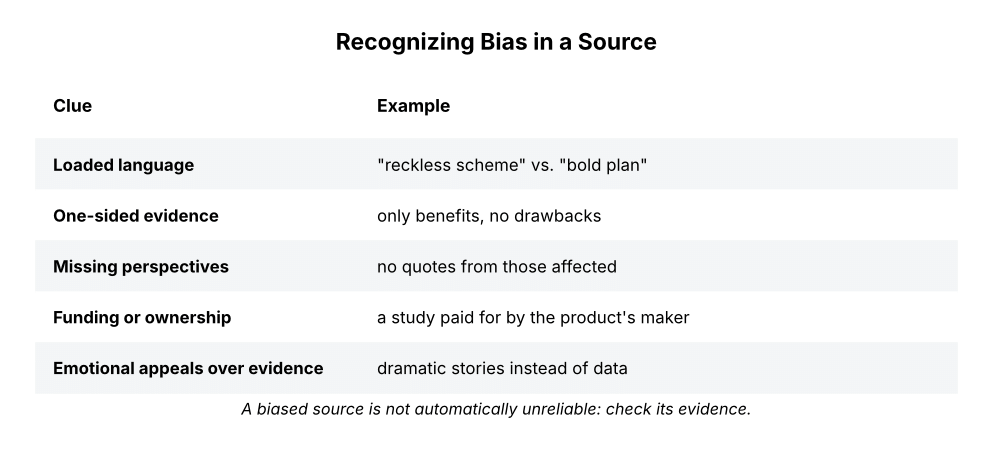
Signs of bias include:
- Loaded language: emotionally charged words, such as “reckless scheme” instead of “proposal.”
- One-sided evidence: only facts that support one view, with opposing evidence left out.
- Stereotypes or generalizations about groups of people.
- Selective quoting: quotations taken out of context.
- Emphasis and placement: burying important facts at the end or giving minor points the headline.
- Financial or personal interest: the author or publisher benefits if readers believe the message.
Evaluating Reliability
A reliable source provides accurate, well-supported information. Many librarians teach the CRAAP test, developed at California State University, Chico:
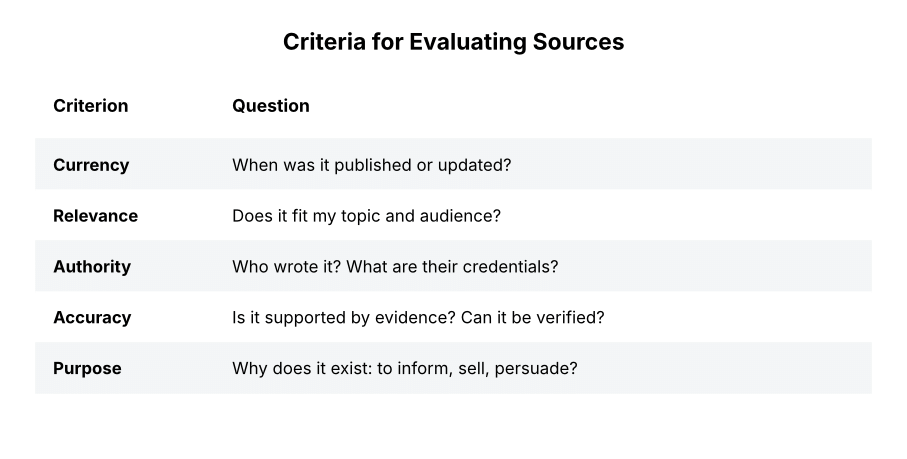
| Criterion | Question to Ask |
|---|---|
| Currency | When was it published or updated? Is it recent enough for this topic? |
| Relevance | Does it address my question at the right level? |
| Authority | Who wrote or published it? What are their qualifications? |
| Accuracy | Is the information supported by evidence? Can it be verified elsewhere? |
| Purpose | Why does this source exist: to inform, persuade, sell, or entertain? |
Why does this matter? Unreliable information spreads quickly online. Checking authority and purpose before accepting a claim protects you from misinformation and strengthens any research paper you write.
Primary and Secondary Sources
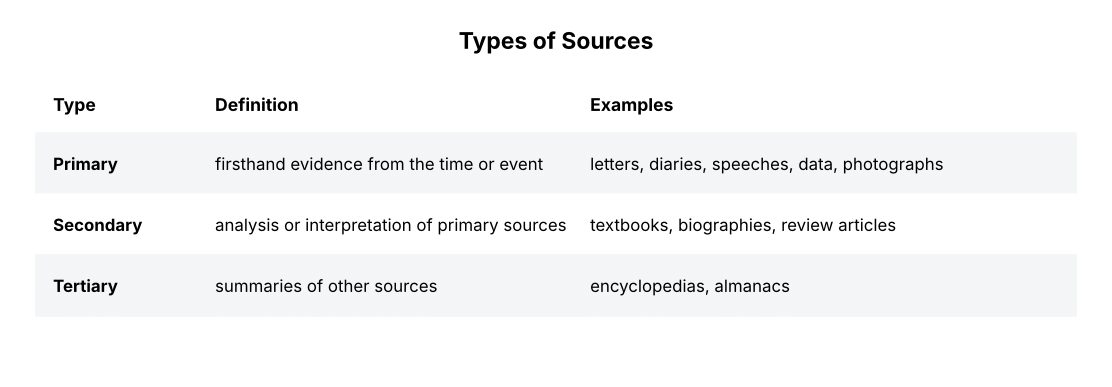
- Primary sources are firsthand accounts or original materials from the time being studied: letters, diaries, photographs, speeches, interviews, original research data.
- Secondary sources analyze or interpret primary sources: textbooks, encyclopedias, documentaries, and most news analysis.
Primary sources offer direct evidence but reflect the creator’s perspective. Secondary sources offer context but depend on the author’s interpretation. Strong research uses both.
Lateral Reading
Professional fact-checkers often use lateral reading: instead of staying on one website to judge it, they open new tabs and search for what other reliable sources say about that site and its claims. This quickly reveals whether a source is trustworthy or connected to a particular interest.
Worked Example
Compare two headlines about the same event:
- Source A: “City Council Approves Plan to Add Bike Lanes Downtown”
- Source B: “Council Ignores Drivers, Rams Through Costly Bike Lane Scheme”
- Same facts: the council approved bike lanes.
- Source A: neutral verbs (“approves,” “add”).
- Source B: loaded language (“ignores,” “rams through,” “costly,” “scheme”) signals strong opposition.
- Next steps: check who publishes each source, whether Source B gives evidence about costs, and whether either source includes multiple perspectives.
Why does this matter? Comparing sources shows how word choice and emphasis shape readers’ opinions. Test questions often ask which source is more objective or how two texts differ in their treatment of a topic.
Bias Is Not the Same as Unreliable
A source can have a clear point of view and still be accurate. An opinion column by a respected scientist may be openly persuasive while using solid evidence. Your job is to recognize the perspective, check the facts, and decide how much weight to give the source.
Test-Taking Strategies
Mnemonic Devices and Memory Shortcuts
Use CRAAP: Currency, Relevance, Authority, Accuracy, Purpose. For bias, ask “Who benefits if I believe this?”
Cross-Topic Connections
- Evaluating evidence is covered in Topic 3.1: Evaluating Arguments and Claims.
- Loaded words rely on Topic 2.2: Connotation and Denotation.
- An author’s motives are examined in Topic 2.5: Analyzing Author’s Purpose and Point of View.
- Comparing sources is practiced in Topic 3.4: Comparing and Contrasting Texts.
Common Question Formats
- Identify loaded language that reveals bias.
- Choose the most reliable source for a research question.
- Compare how two sources present the same event.
- Distinguish primary from secondary sources.
Frequent Student Mistakes
- Trusting a source because it looks professional.
- Assuming any source with a point of view is unreliable.
- Ignoring who published a source and why.
Test-Day Shortcuts
When comparing sources, underline emotionally charged words in each. The source with fewer loaded words and more verifiable facts is usually the more objective one.
Time Management Tips
Source evaluation questions on English unit tests and standardized reading tests such as the SAT and ACT take 45 seconds to a minute. Read source descriptions carefully first.