
Maximize your score with these resources:
- Albert.io AP® US Government question banks
- Free AP® US Government cheat sheets
- Free AP® US Government score calculator
Federalism sounds abstract until you look at a real policy. Marijuana is legal for adults in Colorado but still illegal under federal law. Your state sets its own drinking laws, yet every state landed on 21 as the legal age. Health insurance rules, school testing, driver’s licenses, and disaster response all depend on how Washington and the states share power and money. The AP® U.S. Government and Politics exam uses examples like these to test whether you understand how federalism works in practice, not only on paper.
This article covers Topic 1.9: Federalism in Action in Unit 1, Foundations of American Democracy. The topic asks you to explain how the division of power between national and state governments shapes policymaking, including the tools Washington uses to influence the states and the conflicts that result.
By the end, you should be able to:
- Distinguish categorical grants, block grants, and mandates, and explain why each level of government prefers different ones.
- Explain how conditions on federal money let Congress shape policy in areas it can’t regulate directly.
- Use real policy examples, such as the drinking age, Medicaid, education, and marijuana, to show federalism working and clashing.
- Weigh the advantages and drawbacks of letting states make different choices.
Fiscal Federalism: Power Through the Purse
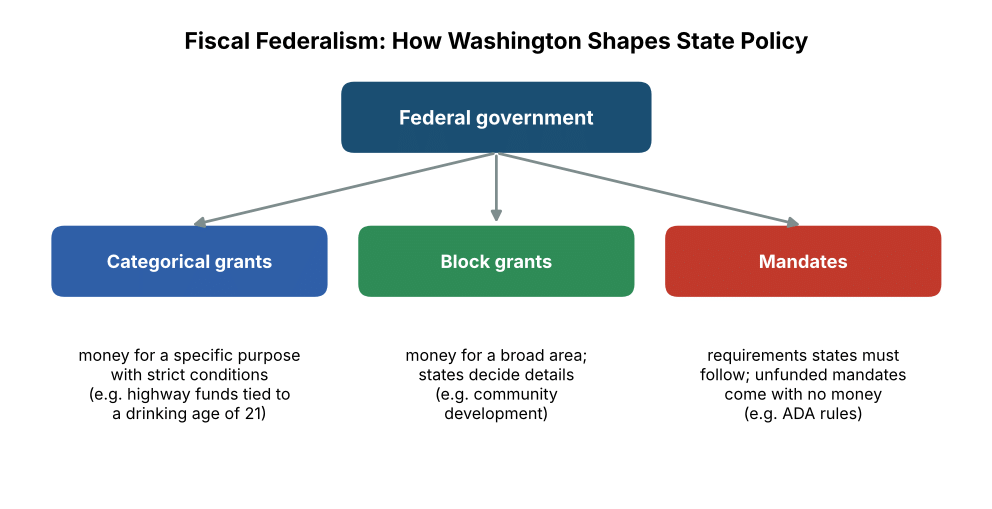

The national government collects far more tax revenue than most states can raise on their own, and it can borrow in ways states usually can’t. That gives Washington a powerful tool. Fiscal federalism is the use of federal money, and the conditions attached to it, to influence what states do.
The Interstate Highway System is a classic example. Under the Federal-Aid Highway Act of 1956, the national government paid 90 percent of construction costs, and states built and ran the roads. Neither level could have done it alone. That kind of shared work is called cooperative federalism.
Federal money comes in a few forms, and the exam expects you to tell them apart.
| Tool | How It Works | Example | Who Prefers It |
|---|---|---|---|
| Categorical grant | Money for a specific purpose, with strict conditions. | Title I funding for high-poverty schools. | Congress, because it controls how money is spent. |
| Block grant | Money for a broad area, with wide state discretion. | TANF welfare funding after the 1996 welfare reform law. | States, because they choose how to spend it. |
| Mandate | A federal requirement states must follow. | Accessibility rules in the Americans with Disabilities Act (1990). | Congress. States dislike mandates, especially unfunded ones. |
An unfunded mandate is a requirement that comes with little or no federal money to pay for it. States complained for years that laws like the ADA and the Clean Air Act forced them to spend their own budgets on national priorities. Congress responded with the Unfunded Mandates Reform Act of 1995, which makes it harder, though not impossible, to pass new ones.
Why does this matter? Grants let Congress influence areas it has no clear power to regulate directly, like education and local policing. The type of grant also reveals who holds power. When Congress shifts from categorical grants to block grants, it’s giving states more control. When it adds conditions or mandates, it’s pulling control back to Washington.
Strings Attached: How Conditions Shape State Policy
Congress can’t order states to set a drinking age. It can, however, attach conditions to money states want. The most famous example is the National Minimum Drinking Age Act of 1984, which withheld a share of federal highway funds from any state that allowed people under 21 to buy alcohol. Every state eventually raised its age to 21.
South Dakota challenged the law. In South Dakota v. Dole (1987), the Court upheld it. Congress can attach conditions to federal grants as long as the conditions relate to the purpose of the spending (safer highways) and aren’t so harsh that they amount to coercion. The amount at stake was a small percentage of highway money, so the Court treated it as encouragement.
That limit mattered 25 years later. The Affordable Care Act of 2010 told states to expand Medicaid to cover more low-income adults or risk losing all of their existing Medicaid funding. In National Federation of Independent Business v. Sebelius (2012), the Court ruled that threat was coercive. Chief Justice John Roberts called it “a gun to the head.” States could keep their existing funding and decide for themselves whether to expand. The result is a patchwork: most states expanded Medicaid, while a minority chose not to, so eligibility depends on where you live.
| Condition | Court’s Ruling | Lesson |
|---|---|---|
| Raise the drinking age or lose part of your highway funds (1984) | Upheld in South Dakota v. Dole (1987) | Related conditions with modest penalties are allowed. |
| Expand Medicaid or lose all existing Medicaid funds (2010) | Struck down as coercive in NFIB v. Sebelius (2012) | Conditions can’t threaten so much money that states have no real choice. |
Federalism in the Policy Arena
Real policy debates show federalism’s tensions better than any definition. These four examples are the kind the exam uses in stimulus questions.
- Education. The No Child Left Behind Act (2002) required states to test students every year and penalized schools that missed targets. States pushed back against the rigid rules, and the Every Student Succeeds Act (2015) kept annual testing but returned most decisions about accountability to the states. Power moved toward Washington and then partly back.
- Marijuana. Colorado and Washington legalized recreational marijuana in 2012, and many states have followed. Federal law still classifies marijuana as a controlled substance, and under Gonzales v. Raich (2005) Congress can enforce that ban even where states allow it. In practice, federal enforcement against state-legal businesses has been limited, so both laws exist side by side.
- Driver’s licenses. The REAL ID Act of 2005 set national security standards for state-issued IDs used to board flights. Many states resisted the cost and privacy concerns, and full enforcement was delayed for nearly two decades until 2025.
- Disaster response. After Hurricane Katrina in 2005, confusion over whether local, state, or federal officials were in charge slowed the response in New Orleans. Federalism can blur responsibility when a crisis crosses levels of government.
Why does this matter? Each example shows the same pattern. Washington sets goals or rules, states adapt or resist, and the outcome varies from state to state. On the exam, if a stimulus shows different states doing different things on the same issue, federalism is almost always the concept being tested.
Laboratories of Democracy: Strengths and Drawbacks
Justice Louis Brandeis made the best-known case for letting states experiment in a 1932 dissent:
It is one of the happy incidents of the federal system that a single courageous State may, if its citizens choose, serve as a laboratory; and try novel social and economic experiments without risk to the rest of the country.
The idea shows up throughout American history. Wyoming Territory let women vote in 1869, half a century before the Nineteenth Amendment. Massachusetts passed a near-universal health insurance law in 2006 that became a model for the Affordable Care Act. Massachusetts also recognized same-sex marriage in 2004, eleven years before Obergefell v. Hodges (2015) made it national.
Federalism has real costs too. The exam wants you to argue both sides.
| Strengths | Drawbacks |
|---|---|
| States can test policies before the whole country adopts them. | Rights and services vary by state. Medicaid eligibility, for example, depends on your address. |
| Policies can fit local conditions and values. | States have used “states’ rights” to resist national civil rights protections, most notably segregation. |
| More offices mean more access points for citizens and interest groups. | Overlapping authority can blur who is responsible, as the Katrina response showed. |
| Power is spread out, which protects against national overreach. | States may compete to cut taxes or regulations in a “race to the bottom.” |
Test-Taking Strategies
Mnemonic Devices and Memory Shortcuts
- “Categorical = Congress controls. Block = Broad.” Categorical grants come with Congress’s conditions. Block grants give states broad freedom.
- “Dole was a nudge, Sebelius was a shove.” The drinking age condition was a small nudge the Court allowed. The Medicaid threat was a shove it rejected.
- “Unfunded = Unhappy states.” States resent mandates that come without money to pay for them.
Cross-Topic Connections
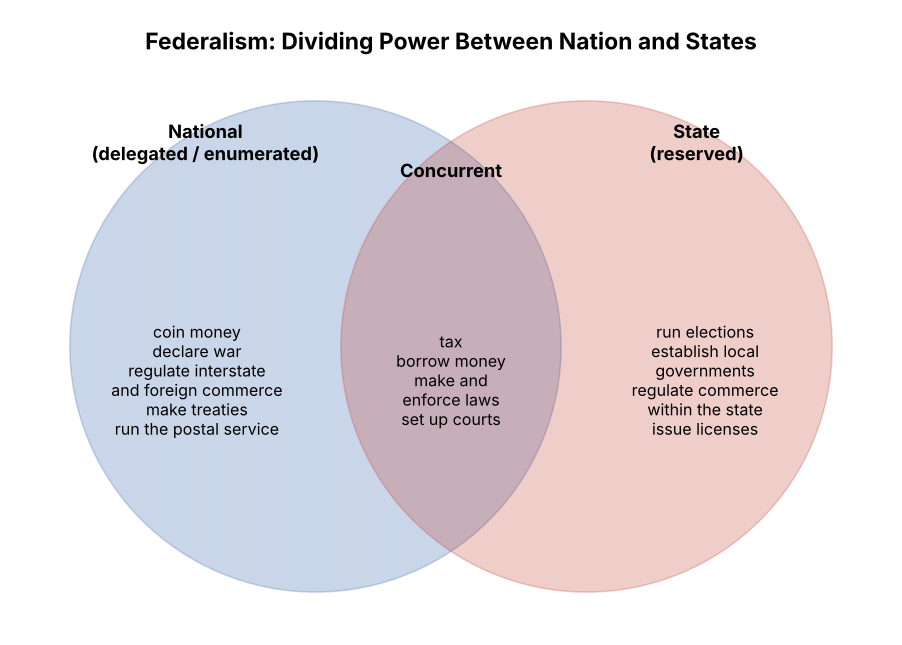
- Topic 1.7: Enumerated, reserved, and concurrent powers set the starting point. Grants and mandates are how Washington reaches beyond that starting point. See our review of the relationship between states and the federal government.
- Topic 1.8: Court cases like McCulloch, Lopez, and Raich set the legal limits. Grants work within those limits. Review them in our article on constitutional interpretations of federalism.
- Topic 1.6: Federalism is one of the multiple access points created by dividing power. A group that loses in Congress can try a state legislature instead.
- Unit 4: Liberals and conservatives often disagree about which level of government should handle an issue, and that disagreement can flip depending on the policy.
Common Question Formats
- Grant identification MCQ. A stimulus describes federal money with specific rules or broad discretion and asks you to name the grant type.
- Map or chart stimulus. A map shows which states expanded Medicaid or legalized marijuana. Questions ask what the variation shows about federalism or why states made different choices.
- Concept application FRQ. A scenario describes a state resisting a federal policy. You explain the federalism concept involved and how Congress, the courts, or the state could respond.
- Argument essay. Prompts about whether states or the national government should lead on a policy area invite examples from this topic, supported by Federalist No. 10, Brutus No. 1, or the Tenth Amendment.
Frequent Student Mistakes
- Treating block grants as “no strings.” Block grants still come with some rules. They offer more discretion than categorical grants, not total freedom. Revenue sharing, used from 1972 to 1986, was the version with almost no strings.
- Calling every federal condition a mandate. A condition on a grant is voluntary in theory, because a state can turn down the money. A mandate applies whether or not a state takes federal funds.
- Saying the Supreme Court struck down the Affordable Care Act. In NFIB v. Sebelius, the Court upheld most of the law. It only limited the penalty for states that refused to expand Medicaid.
- Assuming federal law automatically wins on marijuana. Federal law does take priority, but enforcement depends on federal resources and priorities. Legal supremacy and actual enforcement are separate questions.
Test-Day Shortcuts
- Ask who controls the money. If Washington decides exactly how funds are used, it’s categorical. If states decide, it’s a block grant. If there’s no money at all, look for a mandate.
- Look for variation across states. A stimulus showing different state policies on one issue is testing federalism. Explain why the variation exists before explaining its effects.
- Connect conditions to coercion. In any question about grant conditions, the key test is whether states still have a real choice.
Time Management Tips
- Multiple choice: Grant type questions should take under 45 seconds. Map-based questions take longer, so read the title and legend before the question stem.
- Concept application FRQ: Spend about 20 minutes. Name the specific tool (categorical grant, block grant, mandate) in your first sentence so the reader sees you know the vocabulary.
- Argument essay: If you argue for state control, plan your rebuttal around civil rights history. If you argue for national control, plan it around laboratories of democracy. Having the counterargument ready saves time when you reach that part.
Check for Understanding
Think you’ve got it? Complete the quiz below to make sure. Download your results at the end.