

Maximize your score with these resources:
- Albert.io AP® Biology question banks
- Free AP® Biology cheat sheets
- Free AP® Biology score calculator
Energy flow through ecosystems is one of the most predictable and testable concepts on the AP® Biology exam (CED Unit 8). Unlike matter, which cycles, energy flows in one direction — from the sun through producers, consumers, and decomposers, with significant losses as heat at every transfer. Understanding this one-way flow explains why food chains are short, why top predators are rare, and why ecosystems depend on continuous solar input.
What We Review
Key Takeaways
- Energy flows one way (sun → producers → consumers → heat); matter cycles and is reused indefinitely.
- Only about 10% of energy transfers between trophic levels; ~90% is lost as metabolic heat.
- NPP = GPP − Respiration — net primary productivity is what’s actually available to consumers.
- Food chains are typically 4–5 levels because energy loss limits how many trophic levels an ecosystem can support.
- Endotherms have low ecological efficiency (~10%); ectotherms have high ecological efficiency (~40–50%) because they don’t use energy to generate body heat.
- Energy pyramids never invert (2nd law of thermodynamics); biomass and numbers pyramids can.
- Decomposers break down dead matter from all trophic levels, connecting energy flow to nutrient cycling.
The Basics of Energy Flow
All energy in most ecosystems originates from solar radiation. Producers convert this light energy into chemical energy through photosynthesis. In some ecosystems (deep-sea hydrothermal vents, caves), chemosynthetic bacteria serve as producers instead, oxidizing inorganic compounds like hydrogen sulfide to fix carbon.
The three functional groups in energy flow:
- Producers (autotrophs) — plants, algae, cyanobacteria, and chemosynthetic bacteria that convert inorganic energy into organic compounds
- Consumers (heterotrophs) — organisms that obtain energy by eating other organisms (herbivores, carnivores, omnivores)
- Decomposers (detritivores and saprotrophs) — fungi, bacteria, and invertebrates that break down dead organic matter, releasing nutrients back into the ecosystem
Critical AP® exam distinction: Energy flows through an ecosystem (one-way, from sun → producers → consumers → heat), while matter cycles (carbon, nitrogen, phosphorus are recycled). Energy must be continuously supplied because it’s lost as heat at every trophic transfer, but atoms are reused indefinitely.
Trophic Levels in Ecosystems
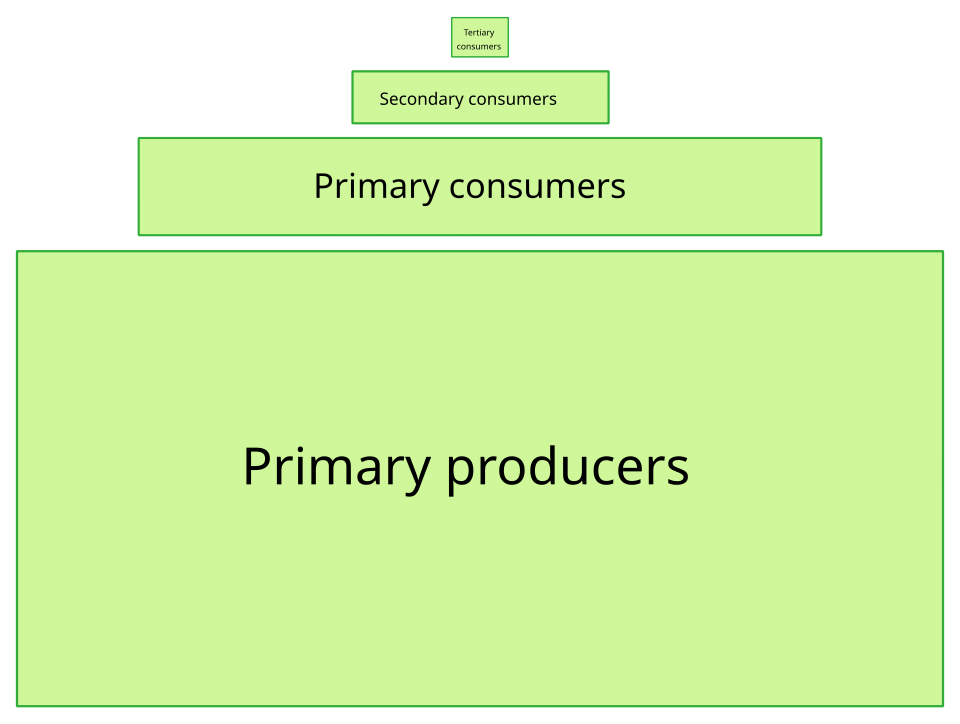
Trophic levels organize organisms by their position in the energy flow hierarchy:
| Trophic Level | Organisms | Energy Source | Example (Grassland) |
|---|---|---|---|
| 1 — Primary producers | Autotrophs (plants, algae, cyanobacteria) | Sunlight or chemical energy | Grasses |
| 2 — Primary consumers | Herbivores | Producers | Grasshoppers, rabbits |
| 3 — Secondary consumers | Carnivores/omnivores that eat herbivores | Primary consumers | Frogs, shrews |
| 4 — Tertiary consumers | Top predators | Secondary consumers | Hawks, snakes |
| All levels — Decomposers | Fungi, bacteria, detritivores | Dead organic matter from any level | Soil bacteria, mushrooms |


A food chain is a single linear pathway; a food web is the realistic interconnected network. The AP® exam uses food webs to test your ability to trace energy flow, predict species removal effects, and identify trophic levels for organisms that feed at multiple levels.
The Flow of Energy: From Producers to Top Predators
The most important quantitative concept: energy transfer between trophic levels is inefficient. On average, only about 10% of the energy at one trophic level is converted into biomass at the next level. The remaining ~90% is lost as metabolic heat (cellular respiration’s second-law inefficiency), indigestible material, and waste products.
| Measure | Definition | Formula | What It Tells You |
|---|---|---|---|
| GPP | Total energy fixed by producers through photosynthesis | Total carbon fixed per unit area per unit time | How much energy enters the ecosystem |
| NPP | Energy remaining after producers use some for their own respiration | NPP = GPP − Respiration | How much energy is actually available to consumers |
AP® Exam Calculation — The 10% Rule:
If producers fix \(20{,}000 \text{ kcal/m}^2\text{/yr}\) (GPP) and use \(12{,}000 \text{ kcal}\) for respiration:
- NPP = \(20{,}000 – 12{,}000 = 8{,}000 \text{ kcal/m}^2\text{/yr}\)
- Energy available to primary consumers: \(8{,}000 \times 0.10 = 800 \text{ kcal}\)
- Energy available to secondary consumers: \(800 \times 0.10 = 80 \text{ kcal}\)
- Energy available to tertiary consumers: \(80 \times 0.10 = 8 \text{ kcal}\)
This explains why food chains rarely exceed 4–5 trophic levels and why top predators have small populations — there simply isn’t enough energy left to support another level.
Endotherms vs. Ectotherms
| Feature | Endotherms | Ectotherms |
|---|---|---|
| Temperature regulation | Internal metabolic heat generation | External environmental sources |
| Examples | Birds, mammals | Reptiles, amphibians, fish, invertebrates |
| Metabolic rate | High — must eat frequently | Low — can survive long without food |
| Energy used for body heat | ~80–90% of consumed energy | Very little |
| Energy converted to biomass | ~10–20% (low ecological efficiency) | ~40–50% (high ecological efficiency) |
| Ecological consequence | Less biomass available to next trophic level | More biomass available to next trophic level |
Energy Storage and Use
Organisms allocate their energy budget across competing demands: maintenance (cellular respiration for ATP), growth (adding new biomass that becomes available to the next trophic level), reproduction, and storage (fats/lipids in animals, starch in plants).
The Importance of Decomposers
Decomposers feed on dead organic matter from every trophic level simultaneously. Without them, dead organisms and waste would accumulate, nutrients would remain locked in dead biomass, and producers would eventually run out of inorganic nutrients, collapsing the entire food web.
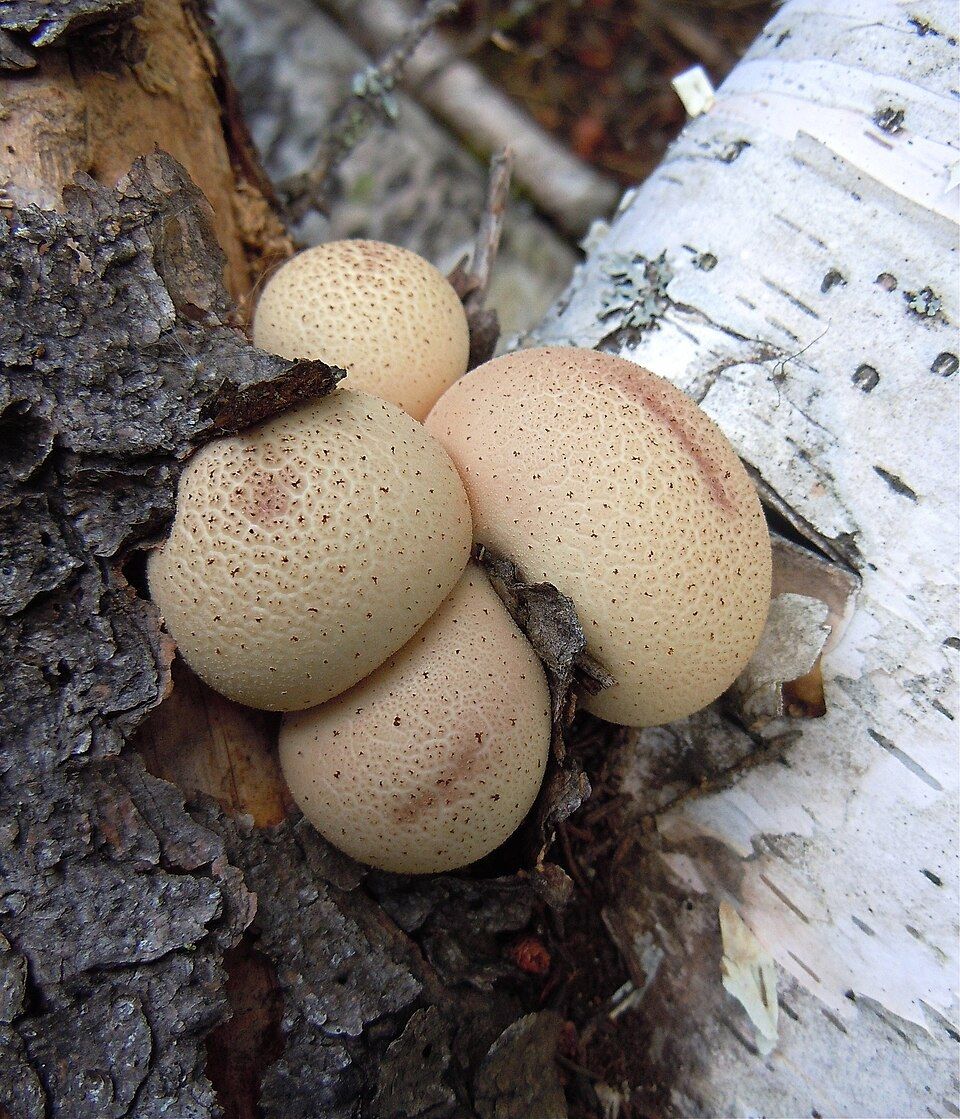
Detritivores (earthworms, millipedes, dung beetles) physically break down dead material, increasing surface area for saprotrophs (fungi and bacteria) that perform the chemical decomposition. This makes decomposers the link between energy flow and nutrient cycling.
Energy Flow Visualization
| Pyramid Type | What It Shows | Can It Be Inverted? | Example of Inversion |
|---|---|---|---|
| Energy pyramid | Energy (kcal/m²/yr) at each trophic level | Never — always upright (2nd law of thermodynamics) | N/A |
| Biomass pyramid | Total dry mass of organisms at each level | Yes — in some aquatic ecosystems | Open ocean: phytoplankton biomass < zooplankton biomass (rapid phytoplankton turnover) |
| Numbers pyramid | Count of individual organisms at each level | Yes — when producers are large | A single tree supports thousands of insects |
Quick Reference Chart
| Term | Definition | AP® Exam Relevance |
|---|---|---|
| Producer (autotroph) | Organism that fixes inorganic energy into organic compounds | Base of all energy pyramids; photosynthesis and chemosynthesis |
| Consumer (heterotroph) | Organism that obtains energy by eating other organisms | Classified by trophic level (primary, secondary, tertiary) |
| Decomposer | Organism that breaks down dead organic matter | Links energy flow to nutrient cycling; feeds from all levels |
| 10% rule | Approximately 10% of energy transfers to the next trophic level | Used in calculations on virtually every AP® exam |
| GPP | Gross primary productivity — total energy fixed by producers | Know formula and relationship to NPP |
| NPP | Net primary productivity — GPP minus producer respiration | NPP = GPP − R; this is what’s available to consumers |
| Endotherm | Organism that generates internal metabolic heat | Low ecological efficiency; uses ~80–90% of energy for heat |
| Ectotherm | Organism relying on environment for body heat | High ecological efficiency; more energy converted to biomass |
| Energy pyramid | Diagram showing energy at each trophic level | NEVER inverts — this is a common exam question |
| Biomass pyramid | Diagram showing dry mass at each trophic level | CAN invert in aquatic ecosystems (rapid turnover) |
Test-Taking Strategies
Mnemonics to lock in key concepts:
- “NPP = GPP minus R” (say it like a chant) — Write this in your test booklet margin the moment you sit down. If the question gives you GPP and respiration, immediately calculate NPP before applying the 10% rule.
- “Divide by 10” shortcut — For trophic calculations: start with NPP, divide by 10 for each step up. “How much energy reaches tertiary consumers if producers fix 50,000 kcal?” → \(50{,}000 \div 10 \div 10 \div 10 = 50 \text{ kcal}\) (three divisions for three transfers: producers → 1° → 2° → 3° consumers).
- “Energy Exits, Matter Returns” — Energy flows one way and exits as heat (never cycles). Matter returns — decomposers cycle atoms back to producers. If a question asks what happens to energy, never say it “recycles.”
- “Ecto = Efficient, Endo = Expensive” — Ectotherms are energy-efficient (more biomass to next level). Endotherms are energy-expensive (most energy heats the body). This shows up in food web efficiency questions.
- “Energy pyramids NEVER flip” — This is a 2nd Law absolute. Only biomass and numbers pyramids can invert. If an MCQ says an energy pyramid is inverted, it’s wrong — every time.
Cross-topic connections the AP® exam tests:
- Energy flow → Cellular respiration (Unit 3): The 90% energy loss occurs because organisms use most consumed energy for ATP production via cellular respiration, releasing heat. Always connect the 10% rule to the second law of thermodynamics and cellular respiration.
- Energy flow → Photosynthesis (Unit 3): GPP = total photosynthetic output. NPP is the fraction that enters food webs. FRQs may ask you to connect C fixation rates to ecosystem productivity.
- Energy flow → Food web stability (Unit 8): Energy limitations explain why ecosystems are vulnerable to top predator removal — trophic cascades ripple through energy-limited food webs.
Common mistakes to avoid:
- Confusing energy flow with nutrient cycling — Energy flows ONE WAY and exits as heat. Matter CYCLES. Never say energy “recycles.” This is an immediate point deduction on FRQs.
- Using GPP instead of NPP — The energy available to consumers is NPP. Always subtract producer respiration first before applying the 10% rule. Many students skip this step and get every subsequent calculation wrong.
- Saying energy pyramids can invert — Only biomass and numbers pyramids can invert. Energy pyramids are ALWAYS upright (2nd law of thermodynamics). No exceptions.
- Placing decomposers at the “top” of a food chain — Decomposers process dead matter from ALL levels simultaneously. They’re not a higher trophic level; they’re a parallel pathway.
Test-day shortcuts:
- When you see a trophic calculation, identify: (1) Is GPP or NPP given? (2) How many trophic transfers? (3) Divide by 10 per transfer.
- For endotherm vs. ectotherm questions: endotherm = expensive = low efficiency. Ectotherm = economical = high efficiency. More energy gets to the next level with ectotherms.
- If asked about pyramid shapes, immediately eliminate any answer that says the energy pyramid can be inverted.
Time management: Energy flow FRQs often combine a calculation (NPP, 10% rule) with an explanation question. Budget 2 minutes for the math and 3 minutes for the explanation. Show every calculation step — partial credit is awarded for correct setup even if you make an arithmetic error.
Check for Understanding
Think you’ve got it? Complete the quiz below to make sure. Download your results at the end.