

Maximize your score with these resources:
- Albert.io AP® Human Geography question banks
- Free AP® Human Geography cheat sheets
- Free AP® Human Geography score calculator
Malthusian Theory stands at the center of every conversation about population growth, resource scarcity, and sustainability. Named after Thomas Malthus, an 18th-century economist and demographer, this theory has shaped how policymakers, environmentalists, and geographers think about the relationship between human populations and finite resources. For AP® Human Geography, understanding Malthusian Theory is essential — it appears directly in Unit 2 (Population and Migration), contributes to questions about resource management and environmental sustainability, and provides the intellectual foundation for nearly every modern population policy debate you’ll encounter on the exam.
This article covers Topic 2.6: Malthusian Theory (Learning Objective: Explain the strengths and limitations of Malthusian theory relative to population change). You’ll learn Malthus’s core argument, the distinction between geometric and arithmetic growth, positive and preventive checks, the Neo-Malthusian revival, and the major critiques that continue to shape this debate today. By the end, you’ll understand not just what Malthusian Theory is, but why it remains controversial and how to apply it to real-world examples on test day.
Malthus’s Core Argument: Geometric vs. Arithmetic Growth
Thomas Malthus published his foundational work, An Essay on the Principle of Population, in 1798. His central claim was deceptively simple but carried profound implications: human population grows exponentially (geometrically), while food production grows linearly (arithmetically). In other words, populations double at fixed intervals, but food supplies increase by fixed amounts. This mathematical gap would inevitably lead to famine, war, and suffering unless population growth was checked by some force.
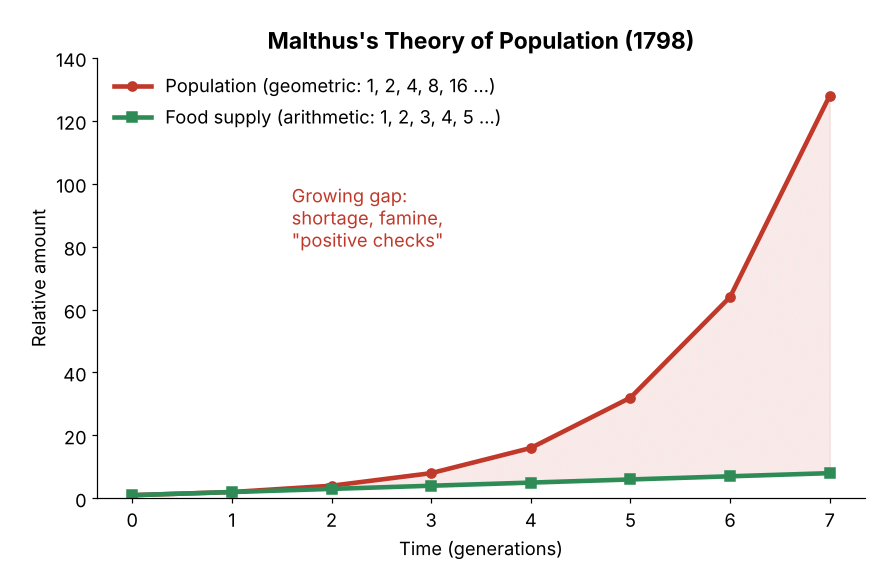
To understand why this matters for the exam, you need to grasp the actual numbers. Consider this comparison:
- Geometric (exponential) growth: 1, 2, 4, 8, 16, 32, 64, 128… Each generation doubles. Population can grow by 50%, 100%, or more in a generation.
- Arithmetic (linear) growth: 1, 2, 3, 4, 5, 6, 7, 8… Food production increases by a constant amount each generation. The absolute increase stays constant (so the percentage growth rate falls), and totals grow much more slowly.
Within just a few generations, exponential population growth massively outpaces linear food production. Malthus argued this gap was inescapable — and unless populations voluntarily restrained their growth, nature and society would do it for them through misery and premature death.
On the exam, you might see this tested as: “Which of the following best explains why Malthus predicted population crises?” The answer hinges on this geometric-vs.-arithmetic distinction. Students who understand the math can immediately rule out answers about technological optimism or unlimited resources.
Positive and Preventive Checks: How Population Growth Gets Limited
Malthus identified two categories of mechanisms that constrain population growth. Understanding the difference is critical for test day because exam questions often ask you to categorize population control methods or predict which checks are most likely to operate in a given context.
| Type of Check | Definition | Examples | How It Works |
|---|---|---|---|
| Positive checks | Factors that increase mortality rates or reduce life expectancy; they work by raising deaths rather than lowering births | Famine, disease, war, unsanitary living conditions, poor healthcare access | When population exceeds food supply, starvation and disease increase. Death rates rise, population declines. Brutal but “natural” from Malthus’s perspective. |
| Preventive checks | Factors that reduce fertility rates or delay reproduction; they work by lowering births rather than raising deaths | Delayed marriage, celibacy, contraception, voluntary family planning, female education, economic incentives to have fewer children | When people choose to marry later, have fewer children, or use contraception, birth rates fall without a rise in death rates. Society avoids the “misery” of positive checks. |
The crucial insight: Preventive checks are always preferable to positive checks, yet Malthus was deeply pessimistic about human willingness to use them. He believed most people lacked the moral restraint to delay marriage and limit family size. Therefore, he predicted that positive checks — famine, disease, war — would inevitably kick in to control population. This pessimism is often linked to economics’ nickname, “the dismal science.”
For the exam, recognize that any policy designed to reduce birth rates (family planning programs, female education, access to contraception) is attempting to invoke preventive checks. Conversely, any policy that reduces death rates (improved healthcare, food distribution, sanitation) theoretically increases population pressure if people then have more children. This tension is central to modern population policy debates.
Neo-Malthusian Theory and the Modern Revival
After Malthus died, his theory fell out of favor for much of the 1800s. Technological innovation (the steam engine, railways, improved agriculture) seemed to disprove his predictions. But in the mid-20th century, population growth exploded, and Malthusian concerns roared back. This modern wave is called Neo-Malthusianism.
Key figures and developments in Neo-Malthusian thought:
- Paul Ehrlich and “The Population Bomb” (1968): Ehrlich revived Malthusian panic, predicting mass starvation by the 1970s if population continued unchecked. He argued that overpopulation threatened not just food supplies but all finite resources: fossil fuels, minerals, freshwater, and arable land. Though his specific predictions proved wrong (technological improvements in agriculture prevented the famine he forecast), his framework remained influential in environmental and sustainability debates.
- The Limits to Growth (1972): This MIT-sponsored study modeled global resource depletion and concluded that infinite growth on a finite planet was impossible. It became a foundational text for environmentalism and framed population growth as part of a broader sustainability crisis.
- Climate change and resource scarcity arguments: Today’s Neo-Malthusians argue that rising CO2 emissions, freshwater depletion, soil degradation, and species loss are evidence of overpopulation. They contend that Earth’s “carrying capacity” is limited and that current population levels are already unsustainable.
On the AP exam, Neo-Malthusianism often appears in questions about environmental degradation, population policy, or resource management. When you see a passage about overpopulation causing deforestation or water scarcity, recognize that it’s drawing on Neo-Malthusian logic: more people = more resource pressure.
Critiques of Malthusian Theory: Why It Has Failed Predictions
Malthusian Theory is intellectually elegant but has a poor track record. Global population has soared from 1 billion in 1800 to 8 billion today — yet widespread famine is less common, life expectancy has increased, and average calorie consumption has grown. How can the theory survive so many falsified predictions? The answer lies in understanding the major critiques, which you must know for the exam.
| Critic/Framework | Core Argument | Key Evidence | Why It Matters |
|---|---|---|---|
| Ester Boserup (Induced innovation) | Humans don’t passively accept resource limits. Population pressure induces technological innovation in agriculture, water management, and resource extraction. Supply adapts to demand rather than constraining it. | The Green Revolution (1960s-70s) dramatically increased crop yields through new seeds, fertilizers, and irrigation. Global food production has grown even faster than population since Malthus’s time. | On the exam, Boserup appears as the “technological optimist” counterargument. When a question asks “Which theory best explains how societies cope with population pressure?” Boserupian induced innovation is a strong answer if the passage mentions agricultural advances or adaptation. |
| Karl Marx (Structural critique) | Malthus mistakes capitalism’s problems for universal human conditions. Overpopulation isn’t a natural phenomenon — it’s created by capitalist exploitation that forces wages down and creates a “reserve army of labor.” Under a more equitable system, resources would be distributed fairly regardless of population size. | Marxist scholars point out that global food production far exceeds what’s needed to feed everyone; hunger is a problem of distribution and inequality, not absolute scarcity. | Marx rarely appears as a test answer for AP® Human Geography, but his critique surfaces in questions about whether population or inequality is the root cause of poverty and resource conflict. Recognize that this is a structural (Marxist) vs. natural (Malthusian) distinction. |
| Julian Simon (Resource abundance) | Humans are the “ultimate resource.” As population grows and resources become scarcer, prices rise, which incentivizes innovation and substitution. Historical data show that resource scarcity has declined (prices of metals, energy, and commodities have fallen over the long term). More people = more problem-solvers. | Simon famously bet Paul Ehrlich that resource prices would fall over a decade (they did). He argues that every major doomsday prediction about overpopulation has been falsified by human ingenuity. | Simon represents the “cornucopian” or technological-optimism position. On the exam, this appears as a foil to environmental catastrophism. If a question presents apocalyptic predictions about resource depletion, Simon would argue those predictions overestimate scarcity and underestimate human adaptability. |
These critiques don’t eliminate Malthusian Theory from the exam — they complicate it. The most sophisticated test questions recognize that Malthus identified a real tension (population growth vs. resource capacity) but failed to account for human innovation, institutional change, and the role of inequality in determining who experiences scarcity. Neo-Malthusians acknowledge the critiques but counter that technological fixes (like fertilizer and fossil fuels) are themselves unsustainable and delayed crises rather than prevented them.
Modern Applications: Carrying Capacity, Sustainability, and Population Policy
Despite its flaws, Malthusian thinking dominates modern population and environmental policy. Understanding these applications is crucial for test day because they show up in case studies about specific countries and regions.
Carrying capacity: This term, borrowed from ecology, refers to the maximum population size a given environment can sustainably support. A region’s carrying capacity depends on available arable land, freshwater, mineral resources, energy sources, and the technology and institutions for using them. Neo-Malthusians argue that many regions (particularly arid lands, small island nations, and areas with rapid population growth) are already exceeding their carrying capacity, leading to environmental degradation and resource conflict.
Population policy: Nations use two main Malthusian-inspired strategies. First, anti-natalist policies attempt to reduce birth rates through family planning programs, female education, and economic incentives (like China’s former one-child policy, though it’s now abandoned). Second, pro-natalist policies encourage larger families in countries with aging or declining populations (common in Western Europe and Japan). Both are grounded in the logic that population size must be managed to match resources and labor needs.
Climate change and resource conflict: Contemporary geographers use Malthusian frameworks to analyze conflicts over water, land, and minerals. The Syrian drought (2006-2010) is often cited as a Neo-Malthusian example: population pressure on limited water supplies triggered rural-to-urban migration, agricultural collapse, and eventually civil conflict. Whether resource scarcity “caused” the war or merely exacerbated existing tensions remains debated — but the Malthusian lens (population exceeds resources) shapes how policy experts frame the problem.
Test-Taking Strategies
Mnemonic Devices and Memory Shortcuts
“PPC” for the three core concepts:
- P: Population grows geometrically (exponentially)
- P: Production grows arithmetically (linearly)
- C: Checks (positive or preventive) limit the gap
“PosiPreve” for the check types: Positive checks = deaths rise (starvation, disease, war). Preventive checks = births fall (delayed marriage, contraception, education).
Cross-Topic Connections
Malthusian Theory connects directly to:
- Topic 2.1 (Population Distribution): Why are populations concentrated in regions of high carrying capacity (river valleys, coastal plains)? Malthusian logic explains settlement patterns.
- Topic 2.3 (Population Composition): How do age-dependency ratios relate to population pressure? Younger populations exert more pressure on resources; aging populations raise different Malthusian concerns (who supports the elderly?).
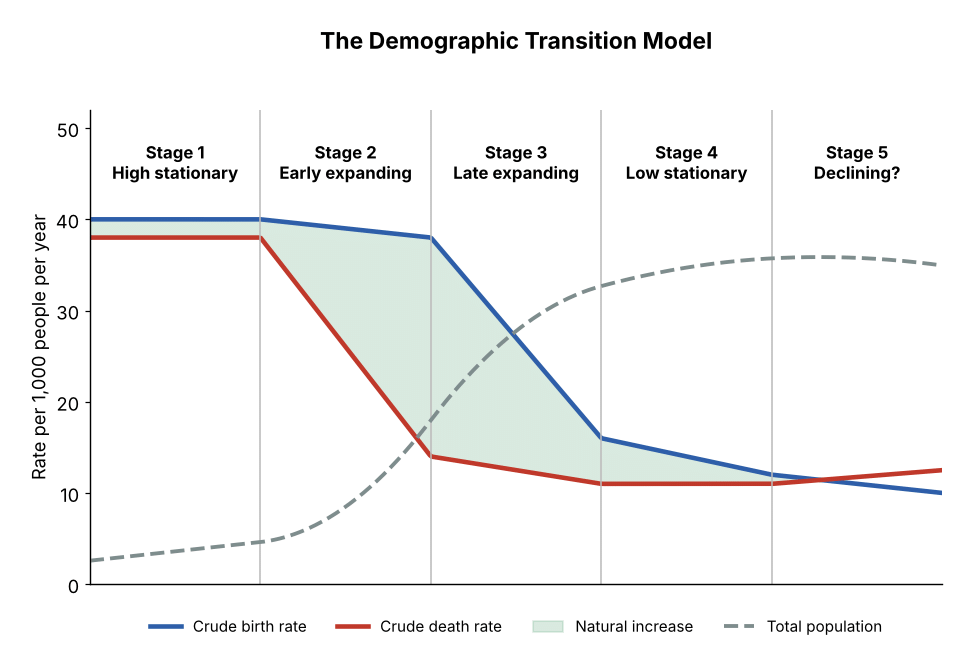
- Topic 2.5 (The Demographic Transition Model): The demographic transition model is partly a response to Malthusianism. As death rates fall first and birth rates fall later, does population stabilize before resource crises hit?
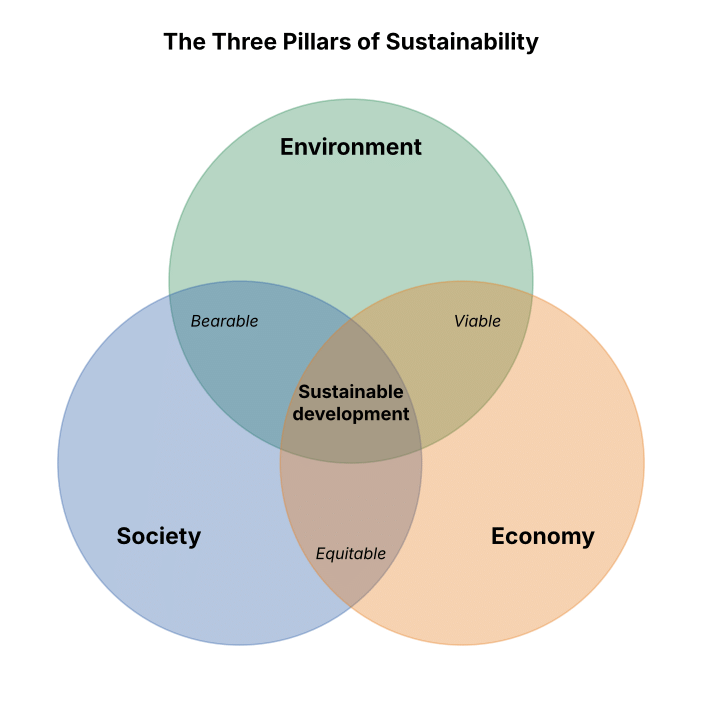
- Unit 5 (Sustainability): Neo-Malthusian arguments about overshoot and carrying capacity directly appear in questions about environmental limits and sustainable development.
Common Question Formats
You’ll encounter Malthusian Theory in these question types:
- “Which of the following best explains…” questions with a passage about resource scarcity, famine, or environmental degradation: Expect answer choices that reference population pressure, carrying capacity, or Malthusian logic. Recognize the framing (Is the problem overpopulation, or inequality and distribution?).
- Case study questions about specific countries and population policy: A passage about China’s one-child policy or Rwanda’s population density might ask you to identify it as an anti-natalist policy or explain its intent using Malthusian concepts.
- Free-response prompts asking you to “explain the intent and effects of a population policy”: This is directly from learning objective IMP-2.C. You must connect the policy (e.g., incentives for smaller families) to Malthusian checks (preventive checks to avoid positive checks like famine) and explain whether it succeeded or failed.
- Stimulus-response questions with data on population, food production, or resource use: You might see graphs showing diverging population and food production trends. Recognize this as the Malthusian gap and be prepared to evaluate whether the data supports Malthusian predictions or contradicts them.
Frequent Student Mistakes
Mistake 1: Confusing positive and preventive checks. Students often reverse these. Remember: positive checks increase mortality (“positive” because death rates go up). Preventive checks reduce fertility (they “prevent” births). A simple mental rule: “Preventive = fewer births, Positive = more deaths.”
Mistake 2: Treating Malthusian Theory as universally accepted. Malthusian predictions have consistently failed, and major scholars (Boserup, Marx, Simon) have critiqued the theory harshly. On the exam, don’t assume a passage endorsing Malthusian logic is stating fact. Instead, recognize it as one framework among several. Strong answers acknowledge both the theory’s influence and its limitations.
Mistake 3: Overlooking the inequality argument. Many modern famines and resource conflicts are not about absolute scarcity (the world produces enough food) but about distribution. When a question presents a population crisis, ask: Is this really overpopulation, or is it unequal access to resources? The most sophisticated AP answers distinguish between these.
Test-Day Shortcuts
When you see “population pressure,” “carrying capacity,” or “resource scarcity” in a question: Quickly map it onto the Malthusian framework. Is the passage suggesting that population exceeds resources (Neo-Malthusian position)? Or is it describing a distribution problem (Marxist or equity-based critique)? This framing guides your answer selection.
When a question asks about a population policy: First, identify whether it’s anti-natalist (reducing births via preventive checks) or pro-natalist (encouraging births). Then assess: What problem is it trying to solve? (Overpopulation and resource pressure, or demographic decline and labor shortage?) Is it effective? (Has it achieved its stated goal, or have unintended consequences emerged?) This logic works for any policy, from China to Japan to sub-Saharan Africa.
Time Management Tips
For multiple-choice questions involving Malthusian Theory: Don’t spend more than 2-3 minutes per question. The core logic is simple (population grows faster than food), so if you haven’t identified the answer in under 3 minutes, you’re likely overthinking it. Move on and return if time permits.
For free-response questions asking about population policy: Dedicate your first minute to identifying the type of policy (anti-natalist or pro-natalist) and its intent. Then use 2-3 minutes to explain how it works (which checks it invokes). Finish with 1-2 minutes on effects (did it succeed? what were unintended consequences?). This structure ensures you hit all parts of the rubric efficiently.
Check for Understanding
Think you’ve got it? Complete the quiz below to make sure. Download your results at the end.