

Maximize your score with these resources:
- Albert.io AP® Biology question banks
- Free AP® Biology cheat sheets
- Free AP® Biology score calculator
What We Review
Introduction to Mendelian Inheritance
A fruit fly’s eye color, a pea plant’s seed texture, a human’s blood type — all follow rules discovered by an Augustinian friar more than 160 years ago. Gregor Mendel’s experiments with pea plants in the 1860s established the fundamental laws of heredity, rules that still form the backbone of genetics on the AP® Biology exam. Whether you’re analyzing a two-gene cross that produces a 9:3:3:1 ratio or a pedigree suggesting X-linked inheritance, these foundational concepts appear in virtually every genetics question. This review covers Mendel’s laws, dominance patterns, mono- and dihybrid crosses, sex-linked and linked genes, and pedigree analysis.
Fundamental Principles of Mendelian Inheritance
Genes and alleles: A gene is a segment of DNA that codes for a specific protein (or functional RNA), which in turn influences a trait. Alleles are different versions of the same gene. Organisms with two copies of each gene (one from each parent) can be homozygous (PP or pp) or heterozygous (Pp).
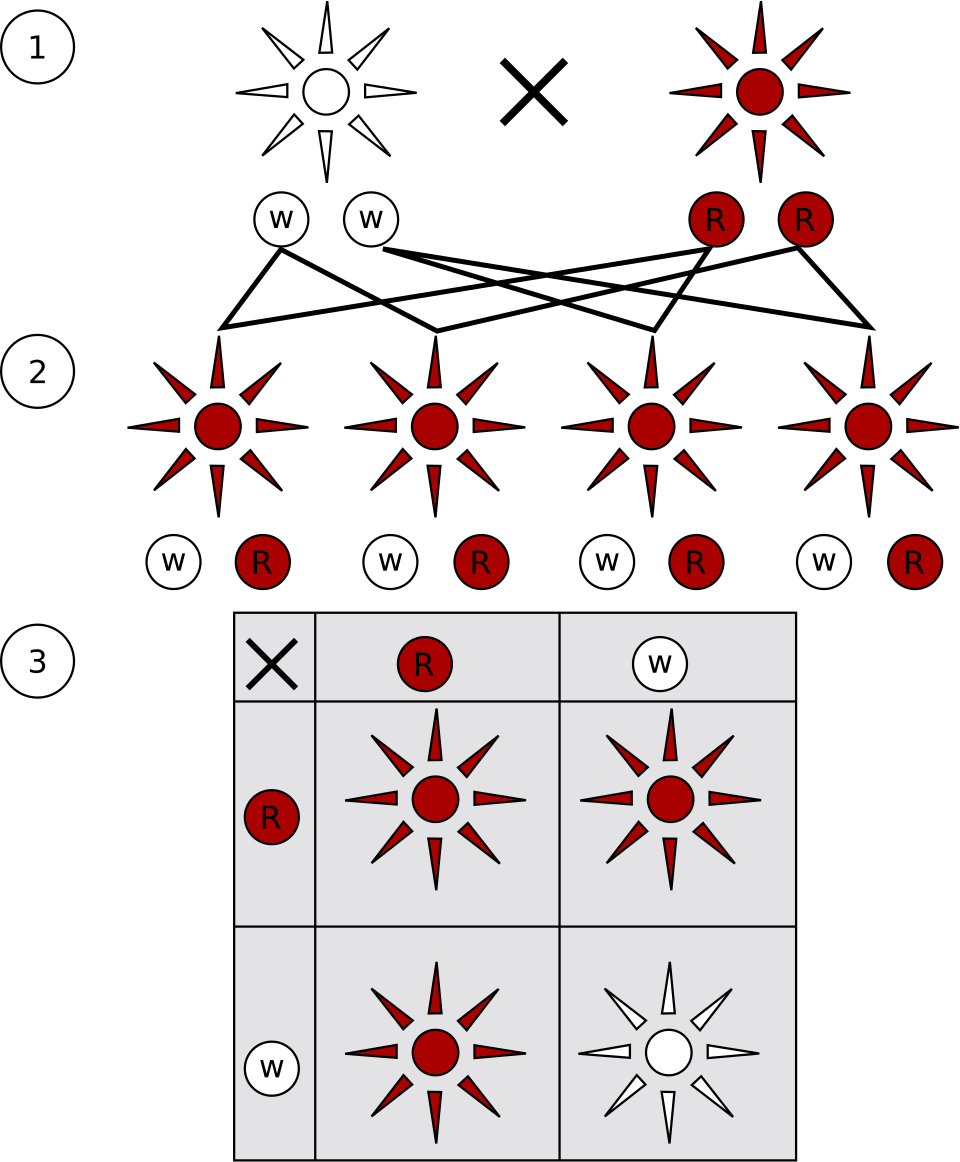
Mendel’s two laws:
| Law | What it says | Cellular basis |
|---|---|---|
| Law of Segregation | The two alleles for each gene separate during gamete formation, so each gamete carries only one allele | Homologous chromosomes separate in anaphase I of meiosis |
| Law of Independent Assortment | Genes on different chromosomes sort independently during gamete formation | Homologous pairs orient randomly at the metaphase I plate |
Critical caveat: Independent assortment applies only to genes on different chromosomes. Genes on the same chromosome may be linked (inherited together).


Mendelian Inheritance Patterns
Simple dominance and monohybrid crosses: Simple (complete) dominance occurs when one allele fully masks the other in a heterozygote. The dominant allele determines the phenotype; the recessive allele is expressed only when homozygous. In a monohybrid cross (Pp × Pp):
| P | p | |
|---|---|---|
| P | PP | Pp |
| p | Pp | pp |
- Genotype ratio: 1 PP : 2 Pp : 1 pp
- Phenotype ratio: 3 purple : 1 white
This 3:1 ratio is the hallmark of a monohybrid cross between two heterozygotes. Commit it to memory — it appears constantly on the AP exam.
Dihybrid crosses: A dihybrid cross tracks two genes simultaneously. For RrYy × RrYy (round/wrinkled seeds and yellow/green seeds), each parent produces four gamete types: RY, Ry, rY, ry. A 4×4 Punnett square yields the classic 9:3:3:1 phenotypic ratio — but only if the two genes assort independently (on different chromosomes). If a dihybrid cross produces a different ratio, the genes are likely linked.
Sex-linked traits: X-linked traits are carried on the X chromosome. Because males have only one X (XY), a single recessive allele on X will be expressed — making males more frequently affected by X-linked recessive conditions like color blindness and hemophilia. Example cross: Carrier female (XCXc) × Unaffected male (XCY):
- Daughters: 1/2 XCXC (unaffected), 1/2 XCXc (carrier)
- Sons: 1/2 XCY (unaffected), 1/2 XcY (affected)
Linked genes: Linked genes are on the same chromosome and tend to be inherited together, violating independent assortment. Offspring show more parental (non-recombinant) phenotypes than expected and fewer recombinant phenotypes. Recombination frequency reflects physical distance between genes on the chromosome.
Using Pedigree Charts
A pedigree chart tracks inheritance across generations. Squares = males, circles = females, shaded = affected. To determine the inheritance pattern, apply these diagnostic rules:
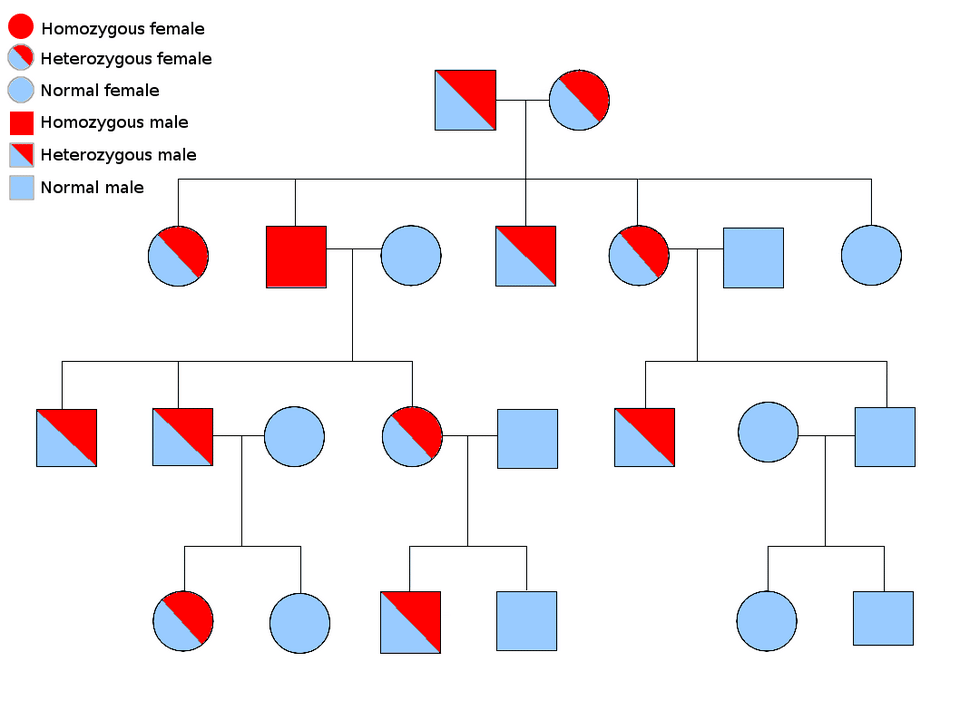
- Autosomal dominant: Appears in every generation; all affected individuals have at least one affected parent
- Autosomal recessive: Can skip generations; two unaffected parents can produce an affected child (both must be carriers)
- X-linked recessive: More males affected; no male-to-male transmission; carrier mothers pass to 50% of sons
Quick shortcut: If an affected female appears, the trait is probably not X-linked recessive (females need two recessive X-linked alleles to be affected).
Practical Applications and Implications
Mendelian genetics and evolution: The allelic variation that Mendel discovered is the raw material for evolution. Hardy-Weinberg equilibrium equations let you calculate allele and genotype frequencies in populations — connecting Mendelian genetics directly to population genetics. When Hardy-Weinberg conditions are violated (natural selection, genetic drift, mutation, migration, non-random mating), allele frequencies change and evolution occurs.
Genetic conditions and their inheritance patterns:
| Condition | Inheritance Pattern | Key Feature |
|---|---|---|
| Cystic fibrosis | Autosomal recessive | Both parents must be carriers (Cc × Cc); 1/4 chance affected child |
| Huntington’s disease | Autosomal dominant | Only one dominant allele needed; late onset means carriers may have children before diagnosis |
| Sickle cell anemia | Autosomal recessive (with co-dominance) | Heterozygotes (HbA/HbS) have sickle cell trait; heterozygote advantage in malaria regions |
| Hemophilia A | X-linked recessive | Primarily affects males; carrier mothers pass to 50% of sons |
| Duchenne muscular dystrophy | X-linked recessive | Dystrophin gene on X chromosome; progressive muscle weakness |
Test-Taking Strategies
Mnemonics:
- “Big letter wins” — The capital-letter allele determines the phenotype in a heterozygote under simple dominance
- “Segregation = Separation in anaphase I” — The Law of Segregation maps directly to homologous chromosomes separating in meiosis I
- “9:3:3:1 = two hets, two genes” — This ratio only appears when both parents are heterozygous for both genes, and the genes assort independently
- “Testcross = cross with homozygous recessive” — If any offspring show the recessive phenotype, the parent was heterozygous
- “SHAM” for Hardy-Weinberg violations — Selection, small population (Hdrift), Assortative mating, Migration/mutation
Cross-topic connections:
- Mendelian genetics + meiosis — The Law of Segregation maps to anaphase I; independent assortment maps to metaphase I. If a question asks why Mendel’s laws work, explain the meiotic mechanism.
- Mendelian genetics + evolution — Natural selection shifts allele frequencies away from equilibrium. Heterozygote advantage (sickle cell trait) explains why harmful recessive alleles persist.
- Mendelian genetics + molecular genetics — Trace gene → mRNA → protein → trait to explain why alleles produce different phenotypes. A mutation creates a new allele that makes a nonfunctional protein.
Common question formats:
- Punnett square MCQs: predict offspring ratios or probability of a specific genotype/phenotype
- Pedigree analysis: determine inheritance mode and predict genotypes of specific individuals
- Chi-square FRQs: calculate expected values from a Mendelian ratio, compute chi-square, compare to critical value
- Data interpretation: given experimental cross results, determine whether genes are linked or assort independently
Frequent student mistakes:
- Confusing genotype (allele combination, e.g., Pp) with phenotype (observable trait, e.g., purple)
- Forgetting that a 9:3:3:1 ratio requires both parents to be heterozygous for both genes
- In sex-linked problems, writing XcXc for a male — males are XcY, never XcXc
- Not applying probability rules: for independent events, multiply (AND rule); for mutually exclusive events, add (OR rule)
Test-day shortcuts:
- For probability questions: Use the multiplication rule instead of drawing full Punnett squares. P(Pp × Pp → pp) = 1/4. P(both traits recessive in a dihybrid) = 1/4 × 1/4 = 1/16.
- For chi-square: df = phenotype classes − 1. Memorize critical values at p = 0.05: df=1 → 3.84, df=2 → 5.99, df=3 → 7.81.
- For pedigrees: Two unaffected parents with an affected child = recessive trait. Check for affected females to distinguish autosomal from X-linked.
- For testcrosses: All dominant offspring = homozygous dominant parent. ~50% recessive offspring = heterozygous parent.
Time management: Punnett square MCQs should take 60–90 seconds — use the multiplication shortcut (9/16, 3/16, 1/16) instead of the full 4×4 grid. Save the full square for FRQs where showing work matters. Chi-square FRQs: set up the table first, then compute to avoid arithmetic errors under pressure.