

Maximize your score with these resources:
- Albert.io AP® Calculus question banks
- Free AP® Calculus cheat sheets
- Free AP® Calculus score calculator
Derivatives measure how functions change with respect to their inputs and form the backbone of calculus. The power rule for derivatives is your essential first tool—it turns the slow limit definition into a one-step calculation for polynomial, radical, and rational functions.
In this guide, you’ll master the power rule, work through fractional and negative exponents, and learn exam-ready strategies to recognize when and how to apply it. By the end, the power rule will be automatic.
What We Review
Power Rule: Key Concepts at a Glance
| Concept | Statement | AP® Standard |
|---|---|---|
| Power Rule | If f(x) = x^r, then f'(x) = r·x^(r–1) | CED Topic 2.1 — Defining Average and Instantaneous Rate |
| Applies to | All real exponents: positive, negative, fractional | Essential for FRQ Part A polynomial derivatives |
| Fractional exponents | √x = x^(1/2) → derivative = (1/2)x^(–1/2) | Rewrite radicals before differentiating |
| Negative exponents | 1/x² = x^(–2) → derivative = –2x^(–3) | Rewrite fractions before differentiating |
| Constant rule | d/dx[c] = 0 for any constant c | Constants vanish; don’t forget leading coefficients |
Understanding the Power Rule
Statement of the Rule
The power rule is stated simply:
If \(f(x) = x^r\) for any real number \(r\), then:
\(\frac{d}{dx}\left[x^r\right] = r \cdot x^{r-1}\)Key insight: Multiply by the exponent, then reduce the exponent by 1. This works for all real exponents—positive integers, negative numbers, and fractions.
Why It Works
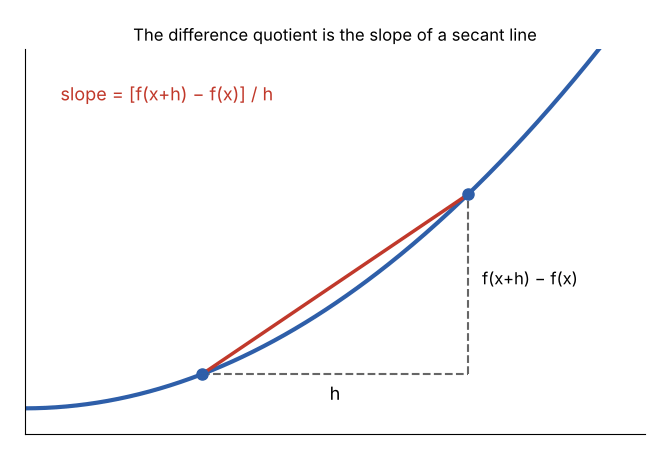
The power rule comes from the limit definition of the derivative:
\(f'(x) = \lim_{h \to 0} \frac{(x + h)^r – x^r}{h}\)When you expand \((x + h)^r\) using the binomial theorem (for integer \(r\)) or generalized binomial series, all but one term vanishes as \(h \to 0\), leaving \(r \cdot x^{r-1}\). This algebraic foundation explains why the shortcut works and why it applies even to fractional and negative exponents.
Examples with Step-by-Step Solutions
Derivative of a Basic Positive Integer Power
Example: Find \(f'(x)\) for \(f(x) = x^3\).
- Identify the exponent: \(r = 3\).
- Apply the power rule: \(\frac{d}{dx}\left[x^3\right] = 3 \cdot x^{3-1}\).
- Simplify: \(f'(x) = 3x^2\).
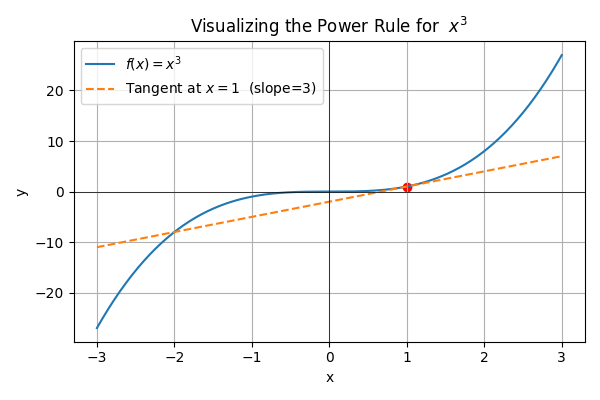
This derivative tells you the instantaneous rate of change of the cubic function at any point. The image below shows the slope of \(f(x) = x^3\) evaluated at \(x = 1\):
Quick practice: Apply the same process to \(f(x) = x^4\) and verify that \(f'(x) = 4x^3\).
Derivative of \(\sqrt{x}\) (Fractional Exponent)
Radicals are just exponents in disguise. Rewrite \(\sqrt{x} = x^{\frac{1}{2}}\), then apply the power rule:
- Rewrite: \(\sqrt{x} = x^{\frac{1}{2}}\).
- Apply the power rule: \(\frac{d}{dx}\left[x^{\frac{1}{2}}\right] = \frac{1}{2} \cdot x^{\frac{1}{2}-1}\).
- Simplify the exponent: \(\frac{1}{2} – 1 = -\frac{1}{2}\).
- Result: \(f'(x) = \frac{1}{2}x^{-\frac{1}{2}} = \frac{1}{2\sqrt{x}}\).
Exam tip: Both forms (\(\frac{1}{2}x^{-\frac{1}{2}}\) and \(\frac{1}{2\sqrt{x}}\)) are correct. Keep the exponent form when chaining with other rules; convert to radical form if asked to rationalize or simplify.
Derivative of \(\frac{1}{x^2}\) (Negative Exponent)
Negative exponents represent reciprocals. Rewrite \(\frac{1}{x^2} = x^{-2}\) and apply the power rule:
- Rewrite: \(\frac{1}{x^2} = x^{-2}\).
- Apply the power rule: \(\frac{d}{dx}\left[x^{-2}\right] = -2 \cdot x^{-2-1} = -2x^{-3}\).
- Equivalent form: \(-\frac{2}{x^3}\).
Pattern to notice: When the exponent is negative, the derivative is also negative (assuming the original coefficient is positive). This reflects that reciprocal functions decrease as \(x\) increases.
Common Mistakes and How to Avoid Them
| Mistake | Wrong | Correct | Fix |
|---|---|---|---|
| Not reducing exponent by 1 | d/dx[x³] = 3x³ | d/dx[x³] = 3x² | Always subtract 1 from the exponent |
| Fractional exponent arithmetic error | 1/2 – 1 = 1/2 | 1/2 – 1 = –1/2 | Write it out: 1/2 – 2/2 = –1/2 |
| Forgetting leading coefficient | d/dx[5x³] = 3x² | d/dx[5x³] = 15x² | Multiply power rule result by coefficient |
| Not rewriting radicals/fractions first | Applying rule to √x directly | Rewrite as x^(1/2) first | Always convert before differentiating |
Quick Reference Chart
| Function f(x) | Derivative f'(x) | Notes |
|---|---|---|
| \(x^n\) | \(nx^{n-1}\) | Power rule (any real n) |
| \(\sqrt{x}\) | \(\frac{1}{2\sqrt{x}}\) | Rewrite as x^(1/2) |
| \(\frac{1}{x}\) | \(-\frac{1}{x^2}\) | Rewrite as x^(–1) |
| \(\frac{1}{x^2}\) | \(-\frac{2}{x^3}\) | Rewrite as x^(–2) |
| \(c\) (constant) | \(0\) | Derivative of any constant is 0 |
Test-Taking Strategies
Mnemonic: “Bring Down and Reduce”
The power rule is a two-step physical action: bring down the exponent to the front as a coefficient, then reduce the exponent by 1. Repeat this as a mantra when differentiating polynomials under time pressure.
For radicals and fractions, add a step zero: rewrite as a power. “Rewrite → Bring Down → Reduce” catches nearly every power rule question on the AP® exam.
Cross-Topic Connections
Tangent Lines & Linear Approximation: Once you have \(f'(x)\), you can write the tangent line at any point \((a, f(a))\): \(y = f'(a)(x – a) + f(a)\). This is critical for linearization problems on the AP exam.
Optimization (FRQ staple): To find critical points, set \(f'(x) = 0\) and solve. The power rule makes this algebraically feasible for polynomial functions—a cornerstone of free-response optimization questions.
Related Rates & Motion: If \(s(t) = t^3\) represents position, then \(v(t) = s'(t) = 3t^2\) is velocity. Recognizing when to apply the power rule to position functions is essential for related rates and motion problems.
Common Question Formats
“Find the derivative”: Straightforward application. Rewrite, apply the rule, simplify. Typically worth 1–2 points on the AP exam.
“Find the slope of the tangent line at x = a”: Find \(f'(x)\), then evaluate at \(x = a\). Example: If \(f(x) = x^2\) and \(f'(x) = 2x\), then the slope at \(x = 3\) is \(f'(3) = 6\).
“Determine where the function is increasing or decreasing”: The derivative’s sign tells you the behavior: \(f'(x) > 0\) means increasing, \(f'(x) < 0\) means decreasing.
Frequent Mistakes on Exams
Dropping the exponent reduction: Students write \(f'(x) = nx^r\) instead of \(nx^{r-1}\). Slow down and subtract 1 explicitly.
Confusing the power rule with the product rule: Check: Is the entire expression a single power of \(x\)? If yes, use power rule alone.
Misinterpreting the question: If asked “find the derivative,” write the full function \(f'(x)\). If asked “find the slope at x = 2,” evaluate: \(f'(2) = \text{number}\).
Test-Day Shortcuts and Time Management
Mental exponent subtraction: For \(x^5\), immediately think “5 times x to the 4th.” Practice this reflex so you don’t lose time on every term.
Exponent-form shorthand: Write \(x^{-1/2}\) instead of \(\frac{1}{2\sqrt{x}}\) during work. Convert only if the final answer must be in radical form.
Scan for constants: Constants differentiate to 0. Skip them during your power rule work, then omit in the final answer.
Timing: A basic power rule question should take 30–60 seconds, including simplification. For compound expressions like \(f(x) = 3x^4 – 2x^{-2} + 7\), differentiate term-by-term quickly: \(12x^3 + 4x^{-3}\).
Free-response strategy: Show your rewrite step (e.g., “\(\sqrt{x} = x^{1/2}\)“), then apply the power rule. Graders give partial credit for process, so don’t skip steps.
Check for Understanding
Think you’ve got it? Complete the quiz below to make sure. Download your results at the end.