
Maximize your score with these resources:
- Albert.io AP® US Government question banks
- Free AP® US Government cheat sheets
- Free AP® US Government score calculator
Separation of powers and checks and balances show up everywhere on the AP® U.S. Government and Politics exam. You’ll see them in multiple-choice stimulus questions, in concept application FRQs about a president fighting with Congress, and as the backbone of argument essays built on Federalist No. 51. If you understand this topic well, most of Unit 2 becomes easier, because every branch’s powers are really a list of the ways it can block the other two.
This article covers Topic 1.6: Principles of American Government from Unit 1, Foundations of American Democracy. The College Board attaches two learning objectives to it:
LO 1.6.A: Explain the constitutional principles of separation of powers and checks and balances.
LO 1.6.B: Explain the effects of separation of powers and checks and balances for the U.S. political system.
By the end, you should be able to:
- Describe what each branch does and why the Framers kept those jobs apart.
- Name specific checks each branch holds over the others, with a real example of each.
- Explain Madison’s argument in Federalist No. 51 in your own words.
- Connect the design to things you see in the news: gridlock, impeachment, interest groups going to court when Congress won’t act.
Separation of Powers: Three Branches, Three Jobs
Separation of powers means the Constitution hands the three core jobs of government to three different institutions. Congress writes the law, the president carries it out, and the courts decide what it means in actual cases. The Framers borrowed the idea from the French philosopher Montesquieu, whose The Spirit of the Laws (1748) argued that liberty can’t survive when one person or body makes, enforces, and judges the law.


Madison put the fear bluntly in Federalist No. 47:
The accumulation of all powers, legislative, executive, and judiciary, in the same hands, whether of one, a few, or many, and whether hereditary, self-appointed, or elective, may justly be pronounced the very definition of tyranny.
Notice the words “or many.” Madison worried about an elected majority grabbing every lever of power, not only a king. That concern drives the whole topic.
| Branch | Core Job | Where in the Constitution | How Members Get There |
|---|---|---|---|
| Legislative (Congress) | Makes laws, taxes, spends, declares war. | Article I, the longest article. | House elected every 2 years; senators every 6, staggered. |
| Executive (President) | Enforces laws, commands the military, runs foreign policy. | Article II. | Chosen by the Electoral College for a 4-year term. |
| Judicial (Federal Courts) | Decides cases and interprets the law. | Article III, the shortest of the three. | Nominated by the president, confirmed by the Senate, serve for life. |
That last column matters more than it looks. The Framers gave each branch a different way of being chosen and a different term length on purpose. A House member facing voters in 18 months, a senator with six years of cover, a president answering to a national electorate, and a judge who never faces voters at all will rarely want the same thing at the same moment. Before the 17th Amendment (1913), state legislatures picked senators, which widened the gap even more. Different constituencies produce different interests, and different interests make it hard for any one faction to control all three branches at once.
Checks and Balances: How Each Branch Pushes Back
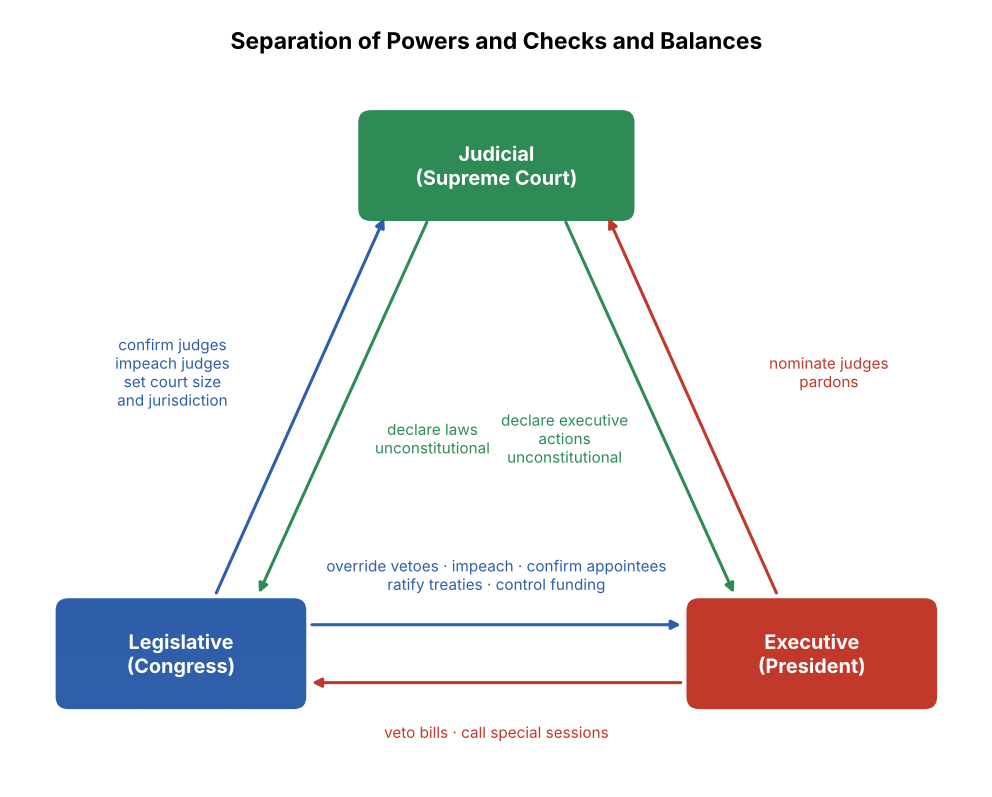
Separation alone wouldn’t protect much. If Congress could pass any law it wanted with no response from the other branches, the “separate” president and courts would just be spectators. Checks and balances fix that by giving each branch a partial share of the others’ powers, so each one can slow down, block, or reverse the others.
These are the checks you need to know cold:
| Check | Who Uses It | On Whom | Real Example |
|---|---|---|---|
| Veto | President | Congress | Obama vetoed a bill approving the Keystone XL pipeline in 2015. |
| Veto override (two-thirds of both chambers) | Congress | President | Congress overrode Nixon’s veto of the War Powers Resolution in 1973. |
| Senate confirmation | Senate | President, courts | The Senate rejected Robert Bork’s Supreme Court nomination in 1987, 58–42. |
| Treaty ratification (two-thirds of the Senate) | Senate | President | The Senate refused to ratify the Treaty of Versailles in 1919 and 1920. |
| Power of the purse | Congress | President, agencies | A 2018–2019 fight over border wall funding shut down the government for 35 days. |
| Impeachment and removal | House, then Senate | President, judges | The House impeached Andrew Johnson, Bill Clinton, and Donald Trump (twice). |
| Judicial appointments | President | Courts | Presidents nominate every federal judge, and those picks last for decades. |
| Judicial review | Courts | Congress, President | In Youngstown Sheet & Tube v. Sawyer (1952), the Court blocked Truman’s seizure of steel mills. |
Two checks on this list need extra attention because students misplace them.
- Judicial review is not written in the Constitution. The Court claimed it in Marbury v. Madison (1803), a required case for this course. Chief Justice John Marshall reasoned that a law conflicting with the Constitution can’t be valid, and that deciding such conflicts is the courts’ job. Federalist No. 78 had made a similar argument during ratification. If a question asks where judicial review “comes from,” the answer is Marbury, not Article III.
- The courts have no army and no budget of their own. Hamilton wrote in Federalist No. 78 that the judiciary has “neither force nor will, but merely judgment.” It depends on the executive to enforce its rulings and on Congress to fund it. That weakness is why the Court’s legitimacy (Topic 2.9) matters so much.
Congress also checks the courts in ways people forget. It sets the number of justices (nine since 1869), creates the lower federal courts, and can limit what kinds of cases they hear. When Congress disagrees with how the Court read a statute, it can rewrite the statute. When the disagreement is about the Constitution itself, the only fix is an amendment. The 11th, 14th, and 26th Amendments each reversed a Supreme Court decision.
Why does this matter for the exam? Unit 2 FRQs regularly ask you to explain how one branch can respond to another. If a prompt describes a president issuing an executive order Congress dislikes, you should immediately list the options: Congress can pass a law overriding it (and override the likely veto), cut off funding for it, hold oversight hearings, or, in extreme cases, impeach. Courts can strike it down if someone with standing sues. You can read more on the executive side in our review of checks on the presidency.
Federalist No. 51: Madison’s Case for Dividing Power
Federalist No. 51 is one of the required foundational documents in AP® U.S. Government, and it’s the one tied directly to this topic. James Madison published it in February 1788, writing as “Publius,” to convince New Yorkers that the new Constitution wouldn’t let the national government become a tyranny. Anti-Federalists feared exactly that. You can see how that fight played out in our article on the ratification of the Constitution.


Madison starts from a realistic view of human nature:
If men were angels, no government would be necessary. If angels were to govern men, neither external nor internal controls on government would be necessary. In framing a government which is to be administered by men over men, the great difficulty lies in this: you must first enable the government to control the governed; and in the next place oblige it to control itself.
His argument moves in five steps. Knowing them in order lets you summarize the essay in an FRQ without quoting it word for word.
- People with power will try to grab more. Madison doesn’t count on leaders being good. He assumes ambition and designs around it.
- Written limits aren’t enough. In Federalist No. 48, Madison called paper rules “parchment barriers” that a determined branch would ignore. Each branch needs real tools to defend itself.
- Give each branch the means and the motive to resist. His exact phrase is that officials need “the necessary constitutional means and personal motives to resist encroachments of the others.” The motive is personal ambition: a senator protects the Senate’s power because it’s his power too.
- Ambition checks ambition. “Ambition must be made to counteract ambition” is the most quoted line in the essay. Self-interest, pointed the right way, becomes a safeguard.
- Divide the strongest branch, and add federalism. Madison expected the legislature to dominate in a republic, so the Constitution splits it into two chambers with different elections. He also points to a “double security”: power is divided between the national government and the states, and then divided again among branches at each level.
Madison also returns to the theme of Federalist No. 10 near the end. In a large republic with many competing groups, he argues, a single majority faction will have a hard time forming and oppressing everyone else. Federalist No. 10 explains why a large republic controls factions. Federalist No. 51 explains how the structure of government controls the people running it. Pair them in an argument essay and you’ve covered both halves of Madison’s plan.
| Federalist No. 51 Idea | Where You See It in the Constitution |
|---|---|
| “Ambition must be made to counteract ambition” | The veto and the override, Senate confirmation, impeachment. Each gives one branch a weapon against another. |
| Different modes of election for each branch | Two-year House terms, six-year Senate terms, the Electoral College, and lifetime judicial appointments. |
| The legislature must be divided | Bicameralism: a bill has to pass both the House and the Senate in identical form. |
| “Double security” for the people’s rights | Federalism, with states keeping reserved powers under the 10th Amendment. |
What This Design Means for American Politics
The second learning objective, LO 1.6.B, asks about effects. The exam wants you to explain the real-world effects of dividing power, both good and bad. Four effects come up again and again.
Multiple Access Points
Because power is spread across branches (and across state and national governments), people who want to change policy have many doors to knock on. A group that loses in Congress can go to court. A group that loses in court can go back to Congress or lobby a federal agency writing the rules.
The clearest recent example involves pay discrimination. In Ledbetter v. Goodyear Tire & Rubber Co. (2007), the Supreme Court ruled that Lilly Ledbetter had filed her pay discrimination claim too late under the existing law. Advocates took the fight to Congress, which passed the Lilly Ledbetter Fair Pay Act in 2009 so the filing clock restarts with each discriminatory paycheck. It was the first bill President Obama signed. Advocates lost at the Court and then won in Congress, which is exactly how multiple access points work. The same logic drives interest group strategy in Unit 5.
Slow, Incremental Change
A new law has to pass two chambers, survive a possible veto, and hold up in court. That’s a lot of places for a policy to die. Supporters of the system say this forces compromise and protects minority views from a fired-up majority. Critics say it produces gridlock, especially under divided government, when one party controls the White House and the other controls at least one chamber of Congress. Both views are fair game on the exam, and you should be able to argue either side with evidence.
Conflict Between the Branches Is Built In
Madison expected the president and Congress to fight, and he designed the system to produce those fights. Government shutdowns over the budget, battles over Supreme Court confirmations, and lawsuits over executive orders are all checks and balances working as intended, even when the results are messy.
Impeachment as the Ultimate Check
Impeachment lets Congress remove a president, vice president, or federal judge for “treason, bribery, or other high crimes and misdemeanors.” It takes two separate steps, and students often mix them up:
- The House impeaches. A simple majority of the House approves articles of impeachment. This works like an indictment, a formal accusation that still has to be proven at trial.
- The Senate tries the case. Senators act as the jury. Conviction takes a two-thirds vote of senators present. When the president is on trial, the Chief Justice presides.
| President | What Happened | Outcome |
|---|---|---|
| Andrew Johnson (1868) | Impeached after firing his Secretary of War in defiance of Congress. | Acquitted by one vote in the Senate. |
| Richard Nixon (1974) | The House Judiciary Committee approved articles over the Watergate cover-up. | Resigned before a full House vote. |
| Bill Clinton (1998) | Impeached for perjury and obstruction of justice. | Acquitted in 1999. |
| Donald Trump (2019 and 2021) | Impeached twice, first over Ukraine and then over the January 6 Capitol attack. | Acquitted both times. |
No president has ever been removed. The Senate has convicted and removed several federal judges, most recently Judge G. Thomas Porteous in 2010. The Framers set the bar high on purpose. Two-thirds of the Senate almost always requires votes from the president’s own party, which keeps impeachment from becoming a routine partisan weapon.
Test-Taking Strategies
Mnemonic Devices and Memory Shortcuts
- “Purse, Pen, and Gavel.” Congress controls the purse (spending), the president controls the pen (signing or vetoing bills), and the courts hold the gavel (deciding what the law and the Constitution mean). When you’re stuck on which branch holds a power, ask which of the three it belongs to.
- “House accuses, Senate convicts.” The House impeaches by simple majority; the Senate removes by two-thirds.
- “Angels and ambition.” These two words carry Federalist No. 51. Men aren’t angels, so government needs controls. Ambition checks ambition, so the controls come from giving each branch self-interest in defending itself.
- Two-thirds club. Veto override, treaty ratification, impeachment conviction, and proposing a constitutional amendment all need two-thirds. Confirmations and impeachment itself need only a simple majority.
Cross-Topic Connections
- Topic 1.4 and 1.5: The Articles of Confederation had no separate executive or national judiciary. That weakness is why the Framers built three branches. See our review of the challenges of the Articles of Confederation.
- Topic 1.7: Federalism is the “double security” Madison describes. Expect questions that pair vertical division of power (national vs. state) with horizontal division (branch vs. branch).
- Topics 2.5, 2.11, and 2.14: Checks on the presidency, the judiciary, and the bureaucracy are this topic applied to one branch at a time. Learn the checks here and Unit 2 becomes mostly review.
- Topic 5.6: Interest groups use multiple access points, so they lobby Congress, file lawsuits, and comment on agency rules depending on which door is open.
Common Question Formats
- Quote-based MCQ. You’ll get a line from Federalist No. 51, usually “ambition must be made to counteract ambition” or the “if men were angels” passage, and a question asking which constitutional feature reflects it. The answer is almost always a specific check (veto, confirmation, impeachment) or bicameralism.
- Scenario MCQ. A stimulus describes a conflict, like the Senate delaying a cabinet nominee, and asks which principle it shows. Name the principle first (checks and balances), then find the answer that matches it.
- Concept application FRQ. A short news-style passage describes a clash between branches. Part A asks you to describe a power or concept in the scenario. Parts B and C ask you to explain how the scenario connects to it and how another branch or group could respond.
- Argument essay. Prompts about whether the Constitution balances power effectively, or whether gridlock is a strength or a flaw, invite Federalist No. 51 as evidence. Use it with one specific check as a second piece of evidence.
Frequent Student Mistakes
- Treating separation of powers and checks and balances as the same thing. Separation divides the jobs. Checks and balances let the branches interfere with each other’s jobs. If a question asks about a veto, that’s a check, not separation.
- Saying impeachment means removal. Impeachment is the House’s accusation. Clinton and Trump were impeached and stayed in office. On the exam, “impeached” and “removed” are different answer choices for a reason.
- Placing judicial review in the Constitution. It comes from Marbury v. Madison (1803). The Constitution creates the courts, but it never says they can strike down laws.
- Assuming Madison trusted the majority. Federalist No. 51 exists partly to restrain majorities. If an answer choice says Madison wanted the popular will to act quickly and without obstacles, it’s wrong.
Test-Day Shortcuts
- Look for the verb. “Rejects,” “blocks,” “overrides,” “refuses to fund,” and “strikes down” all signal a check. Once you spot it, identify who is checking whom, and most of the question is done.
- Match the vote to the action. If an answer choice pairs a simple majority with a veto override or conviction, eliminate it. Those need two-thirds.
- Use Madison’s language. In an FRQ, a phrase like “ambition counteracting ambition” or “means and motives to resist” shows the reader you know the document, and it takes five seconds to write.
Time Management Tips
- Multiple choice: You have 80 minutes for 55 questions, about 87 seconds each. Quote-based Federalist No. 51 questions are fast points once you know the five-step argument, so bank the extra time for longer data and text stimuli.
- Concept application FRQ: Aim for about 20 minutes. Write one or two sentences per part, and always name the specific check (“the Senate could refuse to confirm”) instead of a vague phrase like “Congress could stop it.”
- Argument essay: Budget about 40 minutes and spend the first 5 outlining. Pick your claim, pick Federalist No. 51 plus one concrete example of a check in action, and plan your response to the opposing view before you start writing.
Check for Understanding
Think you’ve got it? Complete the quiz below to make sure. Download your results at the end.