
Maximize your score with these resources:
- Albert.io Digital SAT® Reading and Writing question banks
- Free Digital SAT® Reading and Writing cheat sheets
“The company announced that they would open a new factory.” In everyday speech, that sentence sounds perfectly normal. On the Digital SAT, however, “company” is a singular noun, and the pronoun that refers to it should be “it.” Pronoun-antecedent agreement questions test whether every pronoun matches the noun it replaces, and they often appear in sentences where the antecedent is several words away.
This article covers Topic 4.4: Pronoun-Antecedent Agreement in Unit 4, Standard English Conventions. The topic asks you to choose pronouns that agree in number with their antecedents and that refer clearly to a single noun.
By the end, you should be able to:
- Identify the antecedent of a pronoun.
- Choose singular or plural pronouns to match the antecedent.
- Handle collective nouns, organizations, and indefinite pronouns.
- Distinguish possessive pronouns from contractions.
The Basic Rule
An antecedent is the noun a pronoun refers to. The pronoun must match the antecedent in number.
- The river overflowed its banks. (singular)
- The rivers overflowed their banks. (plural)
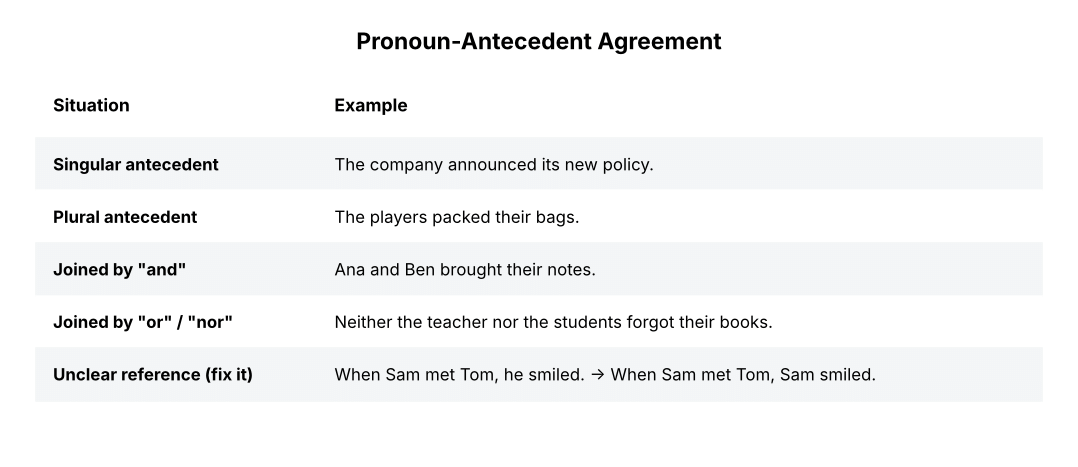
On the SAT, the most common choices are it and its versus they, them, and their.
Finding the Antecedent
Ask, “What does this pronoun refer to?” Then look backward in the sentence, or sometimes in the previous sentence, for the noun. Like subject-verb agreement, this often requires skipping past prepositional phrases.
Worked example 1:
The museum’s collection of ancient textiles is so fragile that curators must display it / them under dim, filtered light.
- What is fragile and displayed? The “collection.”
- “Collection” is singular; “textiles” sits inside a prepositional phrase.
- Correct pronoun: “it.”
Organizations and Collective Nouns
Companies, schools, governments, teams, and other organizations are treated as singular on the SAT.
- Incorrect: The university updated their admissions policy.
- Correct: The university updated its admissions policy.
- Correct: The orchestra performed its final concert of the season.
Why does this matter? This is the single most common pronoun error tested on the SAT. Spoken English often uses “they” for organizations, so the wrong answer sounds natural. Checking whether the antecedent is one organization or many people solves it.
Indefinite Pronouns as Antecedents
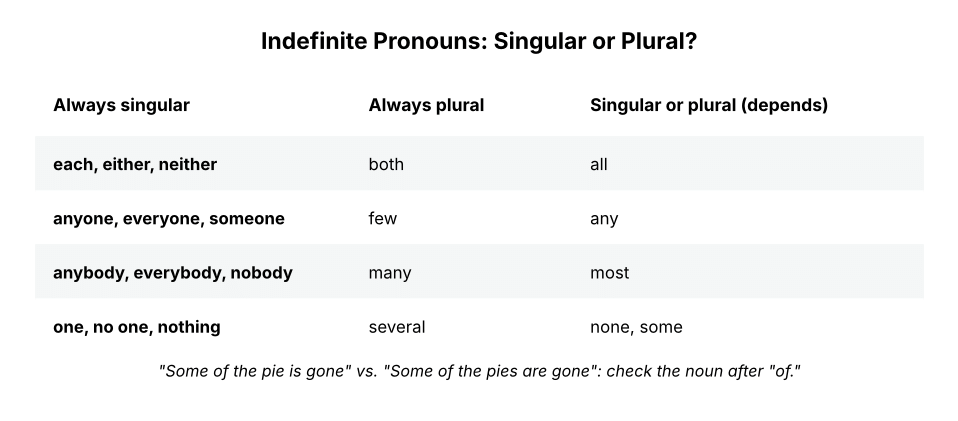
Words such as each, either, neither, and one are singular antecedents. Words such as both, few, many, and several are plural.
- Each of the bridges has its own inspection schedule.
- Both of the bridges need their cables replaced.
Modern style guides increasingly accept singular “they” for a person whose gender is unknown or for people who use that pronoun. SAT questions are usually designed so the antecedent is clearly an object, organization, or plural group, which avoids the issue.
Compound Antecedents
- Joined by and: plural. “The engineer and the architect presented their design.”
- Joined by or or nor: agree with the closer antecedent. “Neither the manager nor the employees shared their concerns.”
Possessive Pronouns Versus Contractions
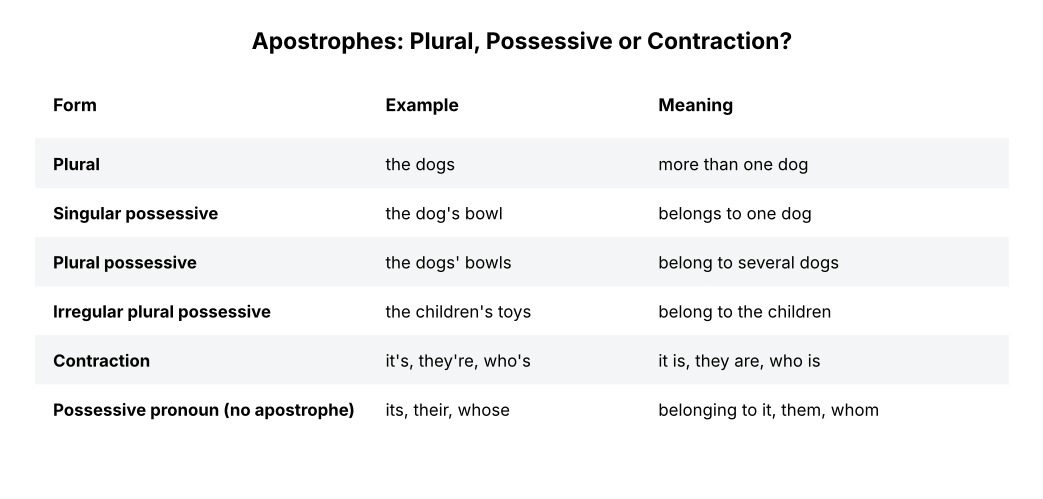
Many pronoun questions combine agreement with apostrophe errors. Possessive pronouns never use apostrophes.
| Possessive | Contraction | Test |
|---|---|---|
| its (belonging to it) | it’s (it is / it has) | Replace with “it is” |
| their (belonging to them) | they’re (they are) | Replace with “they are” |
| whose (belonging to whom) | who’s (who is / who has) | Replace with “who is” |
Worked example 2:
The hummingbird can beat its / it’s / their wings dozens of times per second.
- Antecedent: “hummingbird,” singular.
- The wings belong to the bird, so a possessive is needed.
- “It’s” means “it is,” which does not fit; “their” is plural.
- Correct: “its.”
Antecedents in Earlier Sentences
Sometimes the antecedent sits in a previous sentence. A passage might describe “the Hubble Space Telescope” in one sentence and then ask about a pronoun in the next: “Since its launch in 1990, ___ has captured images of distant galaxies.” Read the sentence before the underlined portion so you do not miss the noun the pronoun replaces. When the antecedent is far away, the SAT may prefer repeating the noun itself for clarity.
Clear Reference
A pronoun should point clearly to one antecedent. If a sentence mentions two possible nouns, the best answer may replace the pronoun with a noun. “When the biologist met the photographer, she described the expedition” is unclear; “the biologist described the expedition” is clear.
Why does this matter? Precise pronoun use is a hallmark of strong academic writing. Clear references keep readers from guessing, which is exactly what both SAT graders and teachers reward.
Test-Taking Strategies
Mnemonic Devices and Memory Shortcuts
“One group, one it.” For apostrophes, “possessive pronouns never get apostrophes.”
Cross-Topic Connections
- Verb agreement uses the same subject-finding skills in Topic 4.3: Subject-Verb Agreement.
- All tested rules are summarized in Topic 4.8: Grammar Rules Overview.
- Deeper practice is in Grammar Topic 6.2: Pronoun-Antecedent Agreement.
- Apostrophe rules are reviewed in Grammar Topic 7.4: Apostrophes and Possessives.
Common Question Formats
- Choose “it,” “its,” “they,” or “their” to match an antecedent.
- Choose between a possessive pronoun and a contraction.
- Choose a pronoun for an organization or collective noun.
- Replace an unclear pronoun with a specific noun.
Frequent Student Mistakes
- Using “their” for a single company, team, or school.
- Writing “it’s” when the possessive “its” is needed.
- Matching a pronoun to a noun inside a prepositional phrase.
Test-Day Shortcuts
When choices include “its,” “it’s,” “their,” and “they’re,” decide singular or plural first, then possessive or contraction. Two quick decisions eliminate three choices.
Time Management Tips
The Digital SAT Reading and Writing section gives about 71 seconds per question. Pronoun questions typically take 20 to 30 seconds.