
Maximize your score with these resources:
- Albert.io AP® Calculus question banks
- Free AP® Calculus cheat sheets
- Free AP® Calculus score calculator
Radius and interval of convergence are core concepts in AP® Calculus BC that determine where a power series converges. When you write a function as a power series, it only produces meaningful results within a specific region around its center. Identifying this region ensures your approximations stay valid.
This guide covers finding the radius of convergence (how far the series works) and the interval of convergence (which x-values validate it), plus endpoint testing and differentiation/integration effects. These align with AP® standards LIM-8.D.1 through LIM-8.D.6.
What We Review
Understanding Power Series
Definition of a Power Series
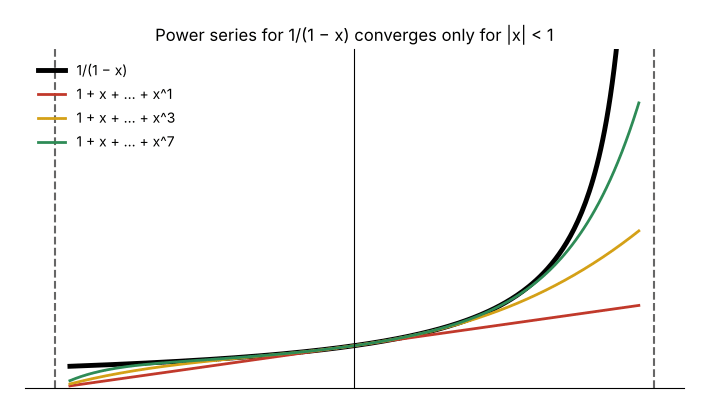
A power series is an infinite sum of terms, each involving a power of a variable centered at a point:
\(\sum_{n=0}^{\infty} a_n (x – r)^n\)
Here, r is the center, and \(a_n\) are the coefficients. It’s like a polynomial with infinitely many terms—except it only “works” (converges) for certain x-values.
Why Convergence Matters
Not every power series converges everywhere. Some converge at one point, others over an interval, and a few everywhere. Knowing where a series converges ensures your function values and approximations are valid. Use a series outside its convergence region and your answer is meaningless.
The Ratio Test and Radius of Convergence
The ratio test is your primary tool for finding the radius of convergence (LIM-8.D.3). It compares consecutive terms: if the ratio shrinks below 1, the series converges; if it grows beyond 1, the series diverges.
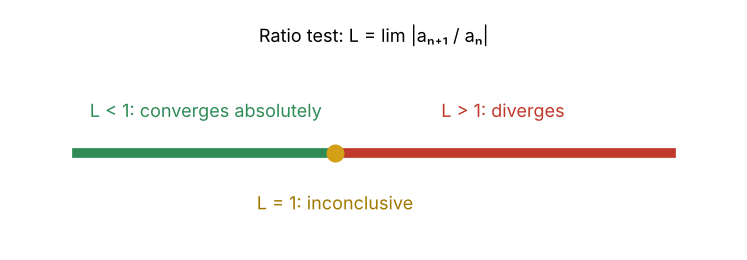
For a general term \(a_n\), apply the ratio test:
\(\lim_{n \to \infty} \left|\frac{a_{n+1}}{a_n}\right|\)
- Limit < 1: Series converges
- Limit > 1: Series diverges
- Limit = 1: Test is inconclusive—use another test
When you apply this to a power series \(\sum_{n=0}^{\infty} a_n (x – r)^n\), the radius of convergence is:
\(R = \frac{1}{\lim_{n \to \infty} \left|\frac{a_{n+1}}{a_n}\right|}\)
This formula gives you R, the distance from the center where the series behaves reliably.
Example: Finding the Radius
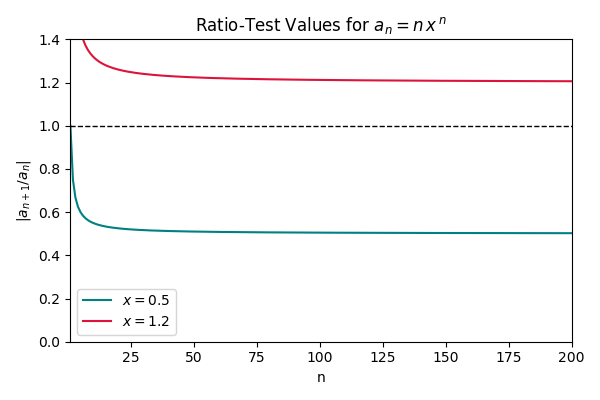
Find the radius of convergence for \(\sum_{n=1}^{\infty} n x^n\).
- The general term is \(a_n = n x^n\).
- Apply the ratio test: \(\lim_{n \to \infty} \left|\frac{(n+1)x^{n+1}}{n x^n}\right| = \lim_{n \to \infty} \left(1 + \frac{1}{n}\right) |x| = |x|\)
- For convergence, \(|x| < 1\), so R = 1.
Finding the Interval of Convergence
The radius gives an open interval, but endpoints require separate testing (LIM-8.D.4). The interval of convergence starts as \(|x – r| < R\), but endpoints \(x = r \pm R\) might converge or diverge independently.
Three-Step Process
- Use ratio test to find R.
- Test \(x = r + R\): Apply alternating series, p-series, or comparison tests.
- Test \(x = r – R\): Determine convergence; include endpoint only if it converges.
Example: Full Interval Analysis
For \(\sum_{n=0}^{\infty} \frac{x^n}{n+1}\), suppose the ratio test gives \(R = 1\).
- At x = 1: \(\sum_{n=0}^{\infty} \frac{1}{n+1}\) (harmonic series)—diverges.
- At x = −1: \(\sum_{n=0}^{\infty} \frac{(-1)^n}{n+1}\) (alternating, decreasing)—converges.
Final interval: \(-1 \leq x < 1\)
Differentiation and Integration
Key fact: Differentiation and integration preserve the radius of convergence (LIM-8.D.6). If your series has radius \(R\), the derivative or integral also has radius \(R\). However, always retest endpoints after these operations.
Example: Term-by-Term Differentiation
Start with \(\sum_{n=0}^{\infty} x^n\), which converges for \(|x| < 1\) (\(R = 1\)).
Differentiate term by term:
\(\sum_{n=1}^{\infty} n x^{n-1}\)
The new series still has \(R = 1\).
Key Vocabulary
| Term | Definition |
| Power Series | Infinite sum \(\sum a_n(x – r)^n\) |
| Radius (R) | Distance from center where series converges; found via ratio test |
| Interval of Convergence | All x-values where series converges (includes endpoint analysis) |
| Ratio Test | \(\lim_{n \to \infty} \left|\frac{a_{n+1}}{a_n}\right|\); if < 1, converges; if > 1, diverges |
| Endpoint Testing | Separately test \(x = r \pm R\) to determine bracket type |
Test-Taking Strategies
Memory Tricks
“RAT = Ratio Always Tested.” Ratio test → find radius → test endpoints. This three-step flow is linear and easy to skip if you stop early.
“R is radius, not diameter.” If \(r = 2\) and \(R = 3\), the interval starts as \(|x – 2| < 3\) or \(-1 < x < 5\). Don’t double R.
Common AP® Question Types
- “Find the radius of convergence.” Stop after ratio test. Answer is R only.
- “Find the interval of convergence.” Full three-step process required: ratio test → radius → endpoint checking.
- “For which values of x does the series converge?” Same as interval—test endpoints.
- “Differentiate the series and find its radius.” Radius stays the same; rewrite with derivative terms.
Critical Student Mistakes
- Dropping absolute values in ratio test. Always use \(\left|\frac{a_{n+1}}{a_n}\right|\).
- Confusing the ratio-test limit with radius. If \(\lim \left|\frac{a_{n+1}}{a_n}\right| = \frac{1}{3}\), then \(R = 3\), not \(\frac{1}{3}\).
- Skipping endpoint testing. Series can converge inside but diverge at boundaries.
- Mismatching bracket types. Start with open interval \(|x – r| < R\); adjust only after endpoint tests confirm convergence.
- Ignoring inconclusive ratio test. When limit equals 1, use alternating series, p-series, or integral test instead.
Cross-Topic Connections
- Infinite Series (Unit 10.1–10.3): Radius and interval rely on convergence tests (ratio, alternating, p-series). Master those first.
- Taylor & Maclaurin Series (Unit 10.14): Power series are the foundation. Interval of convergence tells you where the approximation is valid.
- Lagrange Error Bound (Unit 10.12): Error in a Taylor approximation depends partly on position within the convergence interval.
Speed & Accuracy Tips
- Write the ratio-test formula at the top. Reference it constantly; having it visible saves mental energy.
- Test the simpler endpoint first. If one endpoint is obviously a p-series or harmonic series, start there to build confidence.
- Use \(|x – r| < R\) notation before interval notation. The absolute-value form clarifies your work and reduces notation errors.
- Flag inconclusive endpoints immediately. If ratio test yields limit = 1, choose backup test early rather than wasting time.
Final Verification Checklist
- ☐ Did I use absolute values in the ratio test?
- ☐ Is radius R positive and not the limit itself?
- ☐ Did I test both \(x = r + R\) and \(x = r – R\)?
- ☐ Is my answer in interval form with correct bracket types?
- ☐ Did the question ask for radius alone (just R) or interval (full \(a \leq x < b\))?