
Maximize your score with these resources:
- Albert.io AP® Precalculus question banks
- Free AP® Precalculus cheat sheets
- Free AP® Precalculus score calculator
A car’s odometer tells you how far you went. Its speedometer tells you how fast you are going right now. Those are two different questions, and AP® Precalculus asks you to answer both from a table, a graph, or a formula. Topic 1.2 is where you learn to tell an average rate of change from a rate of change at a single point.
This article covers Topic 1.2: Rates of Change in Unit 1, Polynomial and Rational Functions. The topic asks you to compare rates of change at two points using average rates of change near those points, and to describe how two quantities vary together.
By the end, you should be able to:
- Calculate an average rate of change over any interval, with units.
- Estimate the rate of change at a point using small intervals.
- Compare rates of change at two different points.
- Interpret the sign of a rate of change in context.
For the companion idea of how inputs and outputs change in tandem, see our combined review of Topics 1.1 and 1.2. This guide goes deeper on calculation and comparison.
Average Rate of Change
The CED defines the average rate of change of a function over an interval as the constant rate of change that would produce the same change in output over that interval. It is the ratio of the change in output to the change in input:
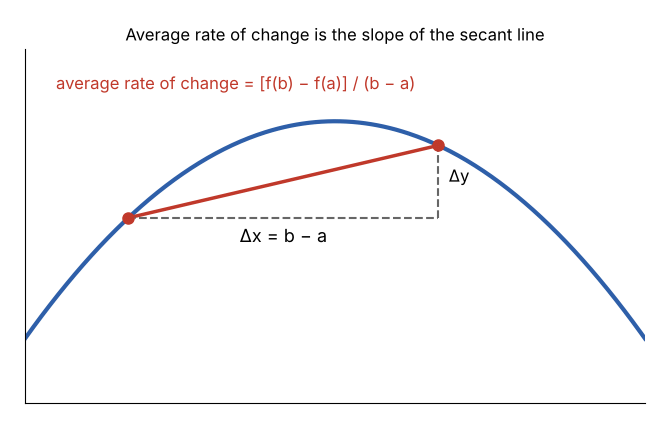
\(\text{AROC on }[a,b]=\dfrac{f(b)-f(a)}{b-a}\)
Graphically, this is the slope of the secant line through \((a,f(a))\) and \((b,f(b))\).
| Representation | How to find AROC |
|---|---|
| Table | Subtract the two output values and divide by the difference in inputs. |
| Graph | Read two points and find the slope of the segment between them. |
| Formula | Evaluate \(f(a)\) and \(f(b)\), then apply the ratio. |
| Verbal context | Identify the two quantities and their units; the answer is output units per input unit. |
Worked Example 1: AROC from a Table
A pot of water warms on a stove.
| Time (min) | 0 | 2 | 4 | 6 |
|---|---|---|---|---|
| Temperature (°F) | 50 | 58 | 62 | 63 |
On \([0,2]\): \(\dfrac{58-50}{2-0}=4\) °F per minute. On \([2,4]\): \(\dfrac{62-58}{4-2}=2\) °F per minute. On \([4,6]\): \(\dfrac{63-62}{6-4}=0.5\) °F per minute.
The temperature is always increasing, but the rate of increase shrinks. That pattern, increasing at a decreasing rate, sets up the concavity ideas in Topic 1.3.
Rate of Change at a Point
The CED states that the rate of change at a point can be approximated by average rates of change over small intervals containing that point. The smaller the interval, the better the estimate.
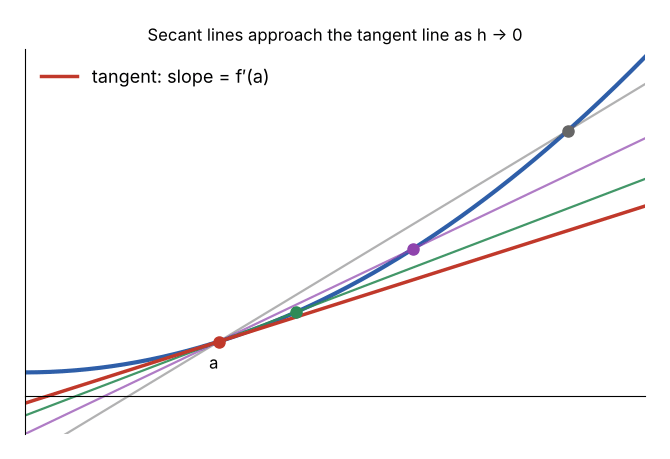
Take \(f(x)=x^2\) at \(x=2\):
On \([1.9,2.1]\): \(\dfrac{4.41-3.61}{0.2}=4\). On \([2,2.01]\): \(\dfrac{4.0401-4}{0.01}=4.01\).
Both estimates point to a rate of change of about 4 at \(x=2\). You do not need calculus here; you only need to show that shrinking the interval stabilizes the answer.
Worked Example 2: Comparing Two Points
Is \(f(x)=x^2\) changing faster at \(x=1\) or \(x=3\)? Use small intervals around each point.
Near \(x=1\): \(\dfrac{f(1.1)-f(0.9)}{0.2}=\dfrac{1.21-0.81}{0.2}=2\)
Near \(x=3\): \(\dfrac{f(3.1)-f(2.9)}{0.2}=\dfrac{9.61-8.41}{0.2}=6\)
The function is changing about three times as fast at \(x=3\). This comparison method is exactly what learning objective 1.2.A asks for.
Why does this matter? Free-response questions often give a table and ask which interval or point shows faster change. Those questions typically expect an interpretation in context with units, so finish every rate with a sentence such as “the temperature increases by about 2 °F per minute.”
Reading the Sign
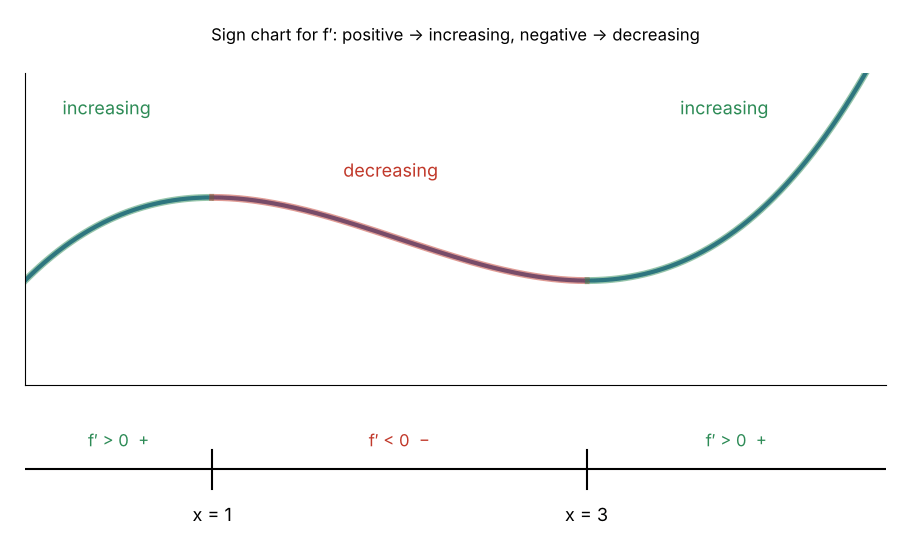
- Positive rate: As one quantity increases, the other increases too.
- Negative rate: As one quantity increases, the other decreases.
- Zero average rate: The output values at the two endpoints are equal, even if the function rose and fell in between. Check a graph or more data before concluding anything.
Test-Taking Strategies
Mnemonic Devices and Memory Shortcuts
Remember “Out over In”: change in output over change in input. For units, say “per” out loud: degrees per minute, dollars per item.
Cross-Topic Connections
- Topic 1.1: Change in Tandem covers how inputs and outputs vary together.
- Topic 1.3: Rates of Change in Linear and Quadratic Functions shows why linear AROC is constant and quadratic AROC changes at a constant rate.
- Topic 1.4: Polynomial Functions and Rates of Change links rate changes to extrema and inflection points.
- Topic 1.14: Function Model Construction uses rates to build models from data.
Common Question Formats
- A table of values asking for the AROC over an interval, with units.
- A graph asking at which labeled point the function changes fastest.
- A free-response part asking you to interpret a rate in context.
Frequent Student Mistakes
- Flipping the ratio and dividing input change by output change.
- Mixing the order of subtraction, such as \(f(b)-f(a)\) over \(a-b\).
- Calling a zero AROC proof that the function is constant on the interval.
Test-Day Shortcuts
When comparing rates at two points, use intervals of the same width around each point. Then you can compare output changes directly without dividing.
Time Management Tips
The May 2027 exam is hybrid digital. Multiple choice has 28 no-calculator questions in 80 minutes and 12 graphing-calculator questions in 40 minutes. Free response has two calculator questions in 30 minutes, then two no-calculator questions in 30 minutes. AROC items in the no-calculator part should take about 2 minutes each.
Check for Understanding
Think you’ve got it? Complete the quiz below to make sure. Download your results at the end.