
Maximize your score with these resources:
- Albert.io AP® Physics C: Mechanics question banks
- Free AP® Physics C: Mechanics cheat sheets
- Free AP® Physics C: Mechanics score calculator
Put a sphere and a hoop at the top of a ramp and let them go. They have the same mass and the same radius — so why does the sphere always win? The answer is rolling motion, and it’s one of the most insight-dense topics in AP® Physics C: Mechanics. Rolling combines translational dynamics, rotational dynamics, and energy conservation into a single framework, and it tests all three at once. This article covers Topic 6.5 from the AP® Physics C: Mechanics curriculum.
What Is Rolling Without Slipping?
Rolling without slipping means there’s no relative motion between the contact point and the surface. This creates a direct mathematical link between translational and rotational motion that you’ll use in every rolling problem.
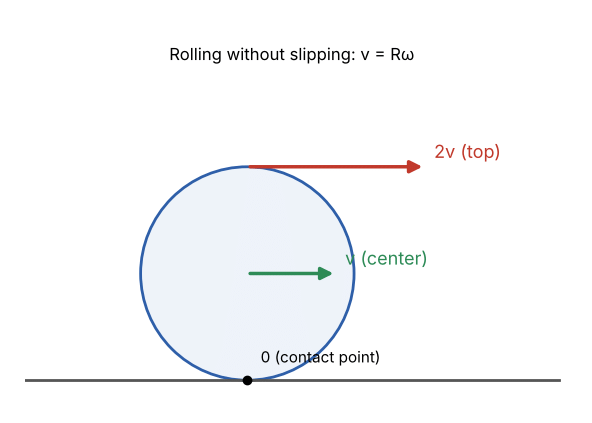
For a wheel of radius R rolling on the ground, the no-slip condition requires:
\(v_{cm} = R\omega\)At the contact point, the translational velocity of the center (forward) and the rotational velocity (backward, at the bottom of the wheel) must exactly cancel — giving that point zero velocity relative to the ground.
Differentiating gives the acceleration form:
\(a_{cm} = R\alpha\)These two constraints are the engine of rolling mechanics. Once you apply them, translation and rotation are coupled — knowing one tells you the other immediately.
- Rolling without slipping: No-slip condition applies. v_cm = Rω. Static friction at the contact point. Friction does no work.
- Rolling with slipping: The object skids. v_cm ≠ Rω. Kinetic friction acts. Energy is lost to heat.
Energy in Rolling Motion
A rolling object has both translational and rotational kinetic energy simultaneously:
\(KE_{total} = \frac{1}{2}mv_{cm}^2 + \frac{1}{2}I\omega^2 = \frac{1}{2}mv_{cm}^2\left(1 + \frac{I}{mR^2}\right)\)The factor \(k = \frac{I}{mR^2}\) is the key dimensionless shape parameter:
| Shape | Moment of Inertia | k = I/mR² | KE Factor (1+k) |
|---|---|---|---|
| Hoop (thin cylindrical shell) | mR² | 1 | 2 |
| Solid cylinder / disk | ½mR² | 1/2 | 3/2 |
| Spherical shell | ⅔mR² | 2/3 | 5/3 |
| Solid sphere | ⅖mR² | 2/5 | 7/5 |
A larger k means more energy goes into rotation and less into translation. A solid sphere (k = 2/5) is the most efficient roller — it puts the most energy into translational motion.
Rolling Down an Incline
Energy method — use this to find final speed:
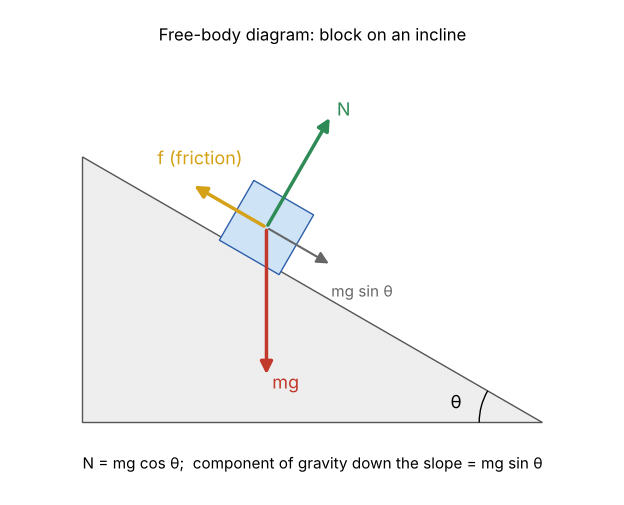
Starting from rest at height h, conservation of energy gives:
\(mgh = \frac{1}{2}mv_{cm}^2\left(1 + k\right)\) \(v_{cm} = \sqrt{\frac{2gh}{1+k}}\)This is independent of mass and radius individually. Only shape (through k) determines the final speed. That’s why the race outcome is universal — a solid sphere always beats a disk which always beats a hoop, regardless of their specific masses or sizes.
Force and torque method — use this to find acceleration or friction:
- Translation: \(mg\sin\theta – f = ma_{cm}\)
- Rotation about center: \(fR = I\alpha\)
- No-slip constraint: \(a_{cm} = R\alpha\)
Solving:
\(a_{cm} = \frac{g\sin\theta}{1+k}\) \(f = \frac{mg\sin\theta \cdot k}{1+k}\)Acceleration is also independent of mass and radius. A sliding (frictionless) object has acceleration g sinθ. A rolling object has acceleration g sinθ / (1+k), which is always smaller.
The Role of Static Friction
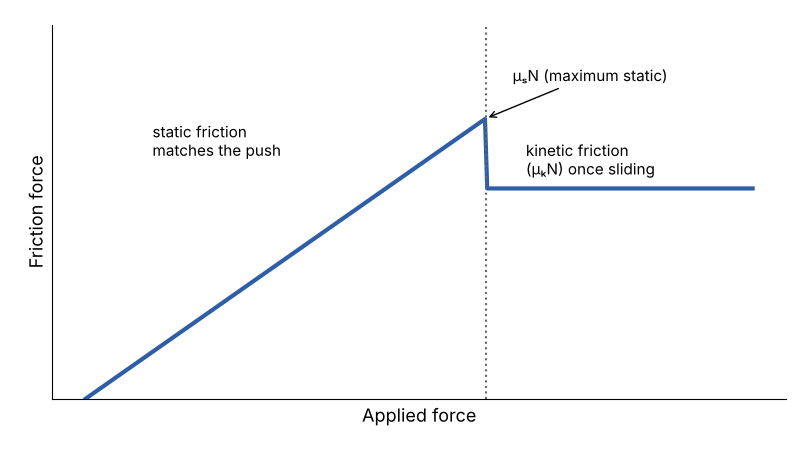
The friction force in rolling without slipping is static friction, not kinetic friction. The contact point has zero velocity, so there’s no sliding — no kinetic friction. Static friction causes the rotation. Static friction does zero work in pure rolling because the contact point displacement is zero. This is why energy conservation applies to rolling problems without a friction work term.
Rolling Race Rankings
| Shape | k | Final Speed | Rank |
|---|---|---|---|
| Solid sphere | 2/5 | \(\sqrt{10gh/7}\) | 1st (fastest) |
| Solid disk/cylinder | 1/2 | \(\sqrt{4gh/3}\) | 2nd |
| Spherical shell | 2/3 | \(\sqrt{6gh/5}\) | 3rd |
| Hoop/thin cylindrical shell | 1 | \(\sqrt{gh}\) | 4th (slowest) |
| Sliding (no friction) | 0 | \(\sqrt{2gh}\) | Fastest of all |
Test-Taking Strategies
Mnemonic: SNSR
Use SNSR to remember the four pillars of rolling motion:
| Letter | Concept | What to Remember |
|---|---|---|
| S | No-Slip condition: v = Rω and a = Rα | Write these first in every rolling problem — they link translation to rotation |
| N | No friction work in rolling | Static friction at the contact point does zero work — use energy conservation freely |
| S | Sphere beats disk beats shell beats hoop | Lower k = more energy into translation = faster rolling; sphere always wins |
| R | Rolling is always slower than sliding | a = g sinθ / (1+k) — the 1+k denominator always slows rolling vs. frictionless sliding |
Cross-Topic Connections
Rotational KE (Topic 6.1) + 6.5: Rolling is the direct application of combined kinetic energy. Set up KE_total = KE_trans + KE_rot and use the no-slip condition to express both in terms of a single variable. These two topics are inseparable in practice.
Newton’s second law (Topic 2.5) + 6.5: The force/torque approach uses F = ma (translation) and τ = Iα (rotation) simultaneously. The no-slip condition then links them. This three-equation system is the core of the dynamics method.
Angular momentum (Topic 6.3) + 6.5: When a rolling object is given an impulse, apply the angular impulse-momentum theorem. Treat the rolling constraint as a given, then use conservation of angular momentum if applicable.
Common Question Formats
- Ranking by speed or time: Which rolling object reaches the bottom first? Use the sphere-disk-shell-hoop ordering. No calculation needed.
- Find acceleration on an incline: a = g sinθ / (1 + k). Identify the shape, look up k, substitute.
- Find the friction force: f = mg sinθ · k / (1+k). Or solve the torque equation for f = Ia_cm/R².
- Compare rolling to sliding: Rolling object is slower. Sliding block: a = g sinθ. Rolling object: a = g sinθ/(1+k).
- Multi-part FRQ: Part (a) energy method for final speed; Part (b) force/torque for acceleration; Part (c) friction; Part (d) check if rolling is possible (f ≤ μs × N).
Frequent Student Mistakes
- Using kinetic friction instead of static: Rolling without slipping always involves static friction. You cannot use f = μ_k × N.
- Adding a friction work term to energy conservation: Static friction does zero work in rolling. Never include a friction energy loss term.
- Forgetting the no-slip condition in dynamics problems: Without a_cm = Rα, the problem is unsolvable — you’ll have too many unknowns.
- Applying the wrong k value: Sphere k = 2/5, disk k = 1/2, ring/hoop k = 1. Check which shape the problem describes before plugging in.
Test-Day Shortcuts
- Energy method first: If the problem asks for final speed at the bottom of a ramp, go straight to v = √(2gh/(1+k)). One line. The force/torque method takes four lines.
- The answer is independent of mass and radius: For standard rolling-down-a-ramp problems, final speed and acceleration depend only on height (or angle) and shape (k). If you get an answer involving mass or radius, double-check.
- For rolling-possible questions: Find f = mg sinθ·k/(1+k) and compare to μ_s·mg cosθ. If f ≤ μs × N, rolling without slipping is possible.
Time Management
Rolling problems on the free-response section typically have 3–4 parts. Part (a) almost always asks for speed via energy conservation — this is fast (90 seconds). Part (b) asks for acceleration via force/torque — budget 2 minutes and write out all three steps (translation equation, rotation equation, no-slip condition). Ranking problems in multiple choice are instant once you know the sphere-disk-shell-hoop ordering.
Check for Understanding
Think you’ve got it? Complete the quiz below to make sure. Download your results at the end.