

Maximize your score with these resources:
- Albert.io AP® Physics 1 question banks
- Free AP® Physics 1 cheat sheets
- Free AP® Physics 1 score calculator
Rotational motion is the physics of spinning, pivoting, and revolving objects — from a figure skater pulling in her arms to a rod balanced on a fulcrum. Every concept in linear motion has a rotational analog, and understanding that one-to-one correspondence is the key to mastering this unit on the AP® Physics 1 exam.
Key Concepts in Rotational Motion
Center of Mass
The center of mass (CM) is the single point where all of an object’s mass can be treated as concentrated for purposes of analyzing motion. When you balance a pen on your finger, the point where it balances is the CM. Forces applied at the CM produce linear acceleration only — no rotation.
For objects with uniform density, the CM is at the geometric center (the midpoint of a uniform rod, the center of a uniform disk). For non-uniform objects or systems of masses, the CM position is:
xCM = (m1x1 + m2x2 + m3x3 + …) / (m1 + m2 + m3 + …)
Important: the CM can lie outside the physical object (for example, the CM of a ring is at its empty center).
Pivot Point
The pivot point is the center of rotation — the fixed axis around which an object rotates. A force applied exactly at the pivot produces zero torque (the moment arm r = 0). Choosing the pivot point strategically in problems can eliminate unknown forces from your equations.
Torque
Torque (τ) is the rotational equivalent of force — it measures how effectively a force causes an object to rotate. Three factors determine torque:
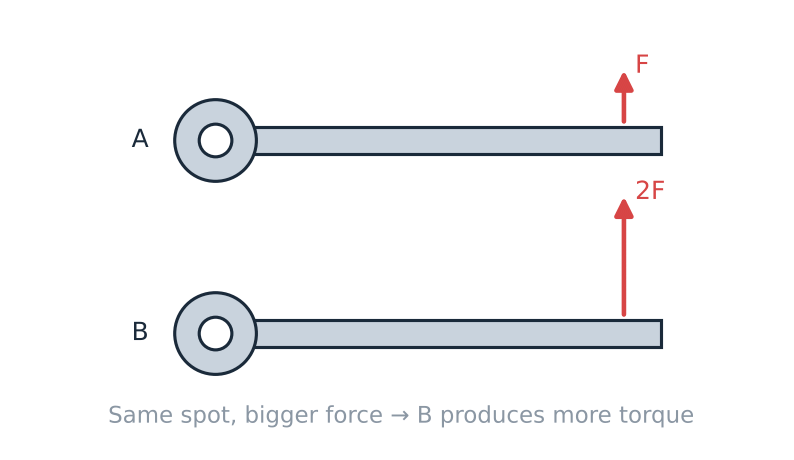
- Force magnitude (F): A greater force produces more torque
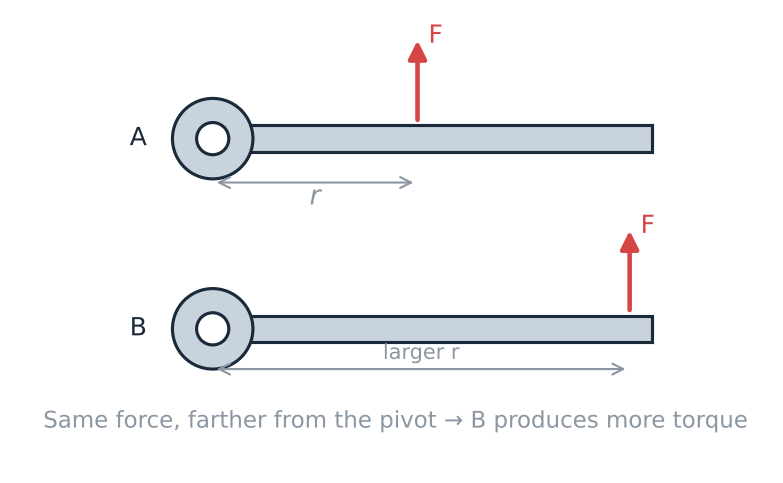
- Distance from pivot (r): The further from the axis, the more torque — this is why you push a door near the handle, not near the hinge
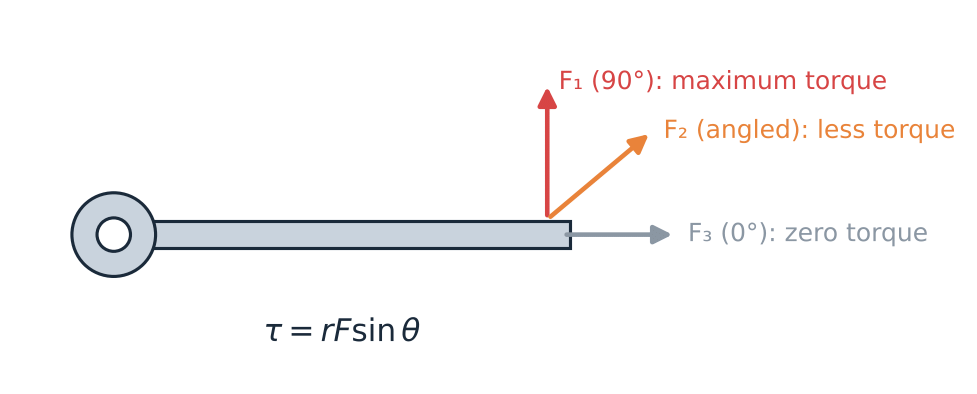
- Angle (θ): The angle between the force vector and the moment arm determines the effective component of force
The torque equation:
τ = rF sin(θ)
The three wrench examples below illustrate these three factors:
Example 1 — Larger force, same point: A greater force on the same spot of the wrench produces more torque.
Example 2 — Same force, different position: Pushing at the end of the wrench (maximum r) is more effective than pushing in the middle (smaller r).
Example 3 — Same force, different angle: F1 (perpendicular, sin 90° = 1) produces maximum torque. F2 (at an angle) produces less. F3 (parallel to the wrench, sin 0° = 0) produces zero torque.
Torque direction is either clockwise (negative by convention) or counterclockwise (positive). For AP® Physics 1, you only need to specify direction as CW or CCW — no 3D vector required.
Angular Velocity and Angular Acceleration
Just as linear velocity describes how fast position changes, angular velocity (ω) describes how fast an object rotates:
ω = Δθ / Δt (radians per second)
Angular acceleration (α) is the rate of change of ω — the rotational analog of linear acceleration.
Moment of Inertia
Moment of inertia (I) is the rotational analog of mass — it measures an object’s resistance to changes in its rotation. The critical difference from mass: moment of inertia depends on how mass is distributed, not just how much mass there is. Mass farther from the rotation axis contributes more to I.
Classic demonstration: a figure skater spins faster when she draws in her arms, reducing I and (by conservation of angular momentum) increasing ω.

David W. Carmichael, CC BY-SA 3.0, via Wikimedia Commons

Newton’s second law for rotation:
τ = Iα
This is the exact analog of F = ma: net torque = moment of inertia × angular acceleration.
Rotational Equilibrium
An object is in rotational equilibrium when the net torque on it is zero:
Στ = 0
This does not mean the object is stationary — it could be rotating at constant ω. If an object is also translationally at rest (ΣF = 0), it is in static equilibrium.
Worked Examples
Example 4: Finding Center of Mass
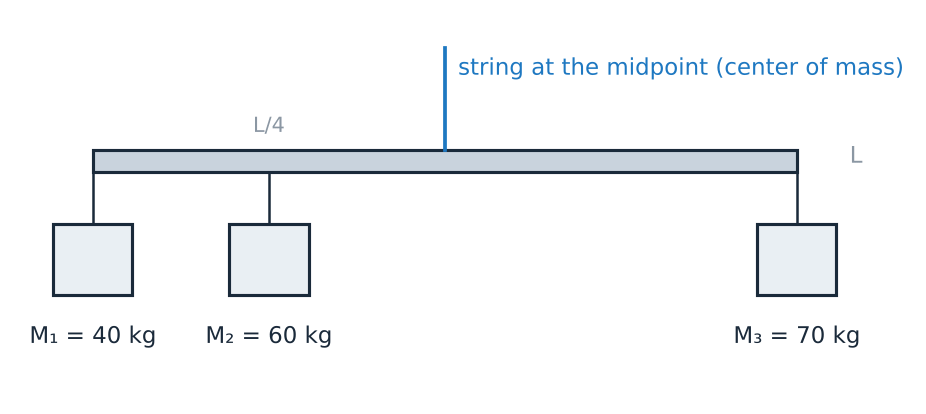
A uniform 2 kg bar of length L has M1 = 40 kg at the left end, M2 = 60 kg at the quarter point (L/4 from left), and M3 = 70 kg at the right end. Where must a string be attached to achieve equilibrium?
This is a center-of-mass problem. Choosing the midpoint of the bar as the reference (x = 0 at center):
xCM = (40·(−L/2) + 60·(−L/4) + 70·(L/2)) / (40 + 60 + 70) = 0
The CM is exactly at the midpoint.
Example 5: Rotational Equilibrium with a Thread
A uniform 2 kg bar of length L is attached to a wall at its left end. A 40 kg block hangs from the right end. A thread connects the right end to the wall at 30° above the bar. Find the tension T in the thread.
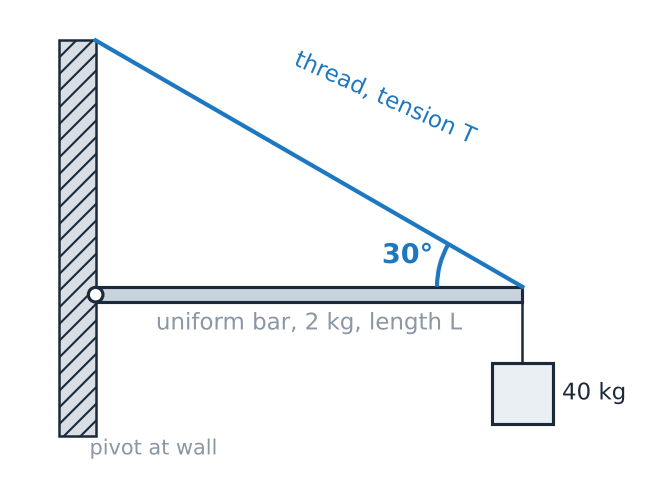
Strategy: Set the pivot at the left end (wall attachment point). This eliminates the wall’s normal force from the torque equation since its moment arm is zero.
Apply Στ = 0:
T · L · sin(30°) = M·g·L + m·g·(L/2)
Solving for T (with M = 40 kg, m = 2 kg, g = 9.8 m/s²):
T = (Mg + mg/2) / sin(30°) = (40·9.8 + 2·9.8/2) / 0.5 ≈ 804 N
Linear vs. Rotational Motion: The Complete Analogy
| Linear Motion | Rotational Motion |
| Displacement (m) | Angular displacement θ (rad) |
| Velocity v (m/s) | Angular velocity ω (rad/s) |
| Acceleration a (m/s²) | Angular acceleration α (rad/s²) |
| Mass m (kg) | Moment of inertia I (kg·m²) |
| Force F = ma | Torque τ = Iα |
| Momentum p = mv | Angular momentum L = Iω |
| Kinetic energy ½mv² | Rotational KE ½Iω² |
| Work W = Fd | Rotational work W = τθ |
Related reading: For a full walkthrough of angular displacement, angular velocity and the angular kinematic equations, read Rotational Kinematics: AP® Physics 1 Review.
Test-Taking Strategies
Mnemonic — Torque factors: “FDA” — Force, Distance (moment arm), Angle. All three go into τ = rF sin(θ). If any factor is zero, torque is zero.
Mnemonic — Rotational analogs: Replace F → τ, m → I, a → α, v → ω in any linear equation and you get the rotational version. F = ma becomes τ = Iα. ½mv² becomes ½Iω².
Pivot point strategy: Always choose your pivot at the point where an unknown force acts — this eliminates that unknown from the torque equation entirely. On FRQs, you must state which point you chose as the pivot.
Cross-topic connections the AP exam tests frequently:
- Rotational motion → Torque: τ = rF sin(θ) and Στ = 0 are both tested independently in the Torque unit — rotational motion connects these into Newton’s second law for rotation (τ = Iα)
- Rotational motion → Angular momentum: When net torque = 0, angular momentum L = Iω is conserved. The figure skater is the classic example: pulling in arms decreases I, so ω must increase to keep L constant
- Rotational motion → Energy: Rolling objects have both translational KE (½mv²) and rotational KE (½Iω²). AP exams ask for total mechanical energy of a rolling sphere — you must include both terms
Common mistakes to avoid:
- Using the wrong angle in τ = rF sin(θ): θ is the angle between the force vector and the moment arm r — not the angle the rod makes with the horizontal. Draw the vectors and measure between them
- Forgetting the rod’s own weight: A uniform rod’s gravitational torque acts at L/2 from the pivot. This is consistently the most-missed force in equilibrium problems
- Confusing τ = Iα with Στ = 0: Use Στ = Iα when the object is angularly accelerating; use Στ = 0 only when it is in rotational equilibrium (constant ω or stationary)
- Treating moment of inertia like mass: I is not a fixed property of an object — it depends on the rotation axis. A rod rotated about its end has a different I than the same rod rotated about its center (4× larger)
- Sign errors in torque: Pick a positive direction (usually counterclockwise) and stick with it for every torque in the problem. Clockwise torques get negative signs
FRQ approach: Rotational dynamics FRQs almost always ask you to (1) draw a free-body diagram, (2) write Στ = Iα (or Στ = 0), (3) pick a pivot and calculate torques. Budget 12–15 minutes for the full FRQ. Earn partial credit by clearly writing your torque equation before solving numerically.
Check for Understanding
Think you’ve got it? Complete the quiz below to make sure. Download your results at the end.