
Maximize your score with these resources:
- Albert.io AP® Physics C: Mechanics question banks
- Free AP® Physics C: Mechanics cheat sheets
- Free AP® Physics C: Mechanics score calculator
Simple Harmonic Motion (SHM) appears in 10–16% of the AP® Physics C: Mechanics exam. Every SHM problem reduces to three core relationships: the restoring force law \(F = -kx\), the sinusoidal solution \(x(t) = A\cos(\omega t + \phi)\), and energy conservation \(E = \frac{1}{2}kA^2\). Master these three and you can solve any SHM problem the exam presents.
What Is Simple Harmonic Motion?
Simple Harmonic Motion occurs whenever a restoring force is directly proportional to displacement and always points toward equilibrium:
Here \(k\) is the spring constant (or effective stiffness), \(x\) is displacement from equilibrium, and the negative sign means the force opposes the displacement. Any system obeying this force law will exhibit predictable, sinusoidal oscillation. Identifying SHM means recognizing this force law — then using its consequences (period, energy, phase relationships) to solve the problem.
The Differential Equation of Simple Harmonic Motion
Applying Newton’s second law \(F = ma\) to the restoring force:
\(\frac{d^2x}{dt^2} = -\frac{k}{m}x\)Define the angular frequency \(\omega = \sqrt{\frac{k}{m}}\), so:
\(\frac{d^2x}{dt^2} = -\omega^2 x\)Acceleration is proportional to displacement and always opposite in sign — the mathematical signature of SHM. The solution must be sinusoidal.
The General Solution: Position, Velocity, and Acceleration
The general solution to the SHM differential equation is:
\(x(t) = A\cos(\omega t + \phi)\)| Parameter | Symbol | Meaning | Determined by |
|---|---|---|---|
| Amplitude | \(A\) | Maximum displacement from equilibrium | Initial conditions |
| Angular frequency | \(\omega\) | Rate of oscillation (rad/s) | \(\omega = \sqrt{k/m}\) |
| Phase constant | \(\phi\) | Sets initial position | Initial conditions |
| Period | \(T\) | Time for one oscillation | \(T = 2\pi/\omega = 2\pi\sqrt{m/k}\) |
Critical insight: Period does not depend on amplitude. A mass oscillates with the same period whether it swings 2 cm or 20 cm from equilibrium.
Differentiate position to get velocity and acceleration:
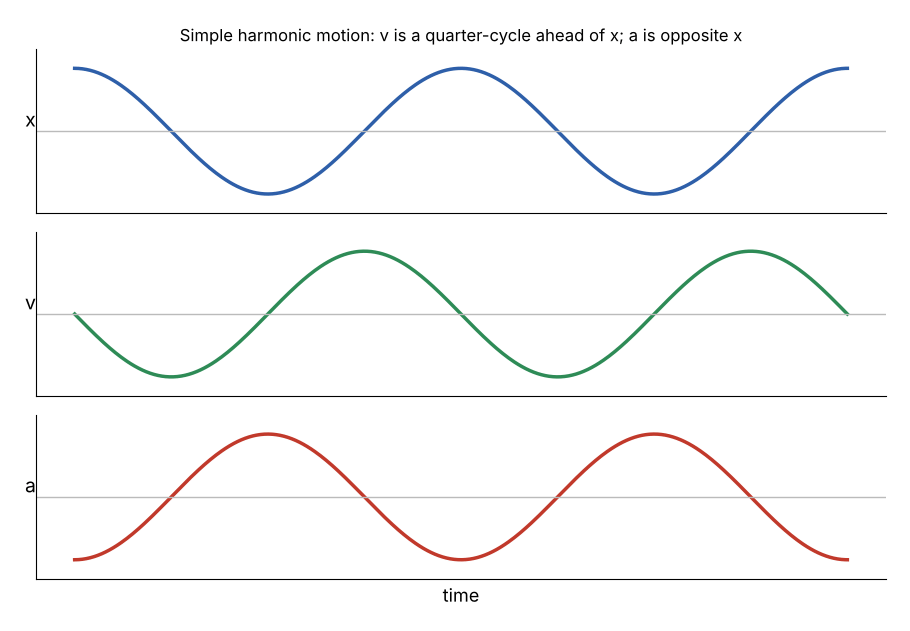
\(v(t) = -A\omega\sin(\omega t + \phi)\) \(a(t) = -A\omega^2\cos(\omega t + \phi) = -\omega^2 x(t)\)Phase relationships: velocity is maximum at equilibrium (\(v_{max} = A\omega\)); acceleration is zero at equilibrium and maximum at extremes (\(a_{max} = A\omega^2\)); position and acceleration are 180° out of phase; velocity is 90° out of phase with position.
Energy in Simple Harmonic Motion
Total mechanical energy in SHM is conserved:
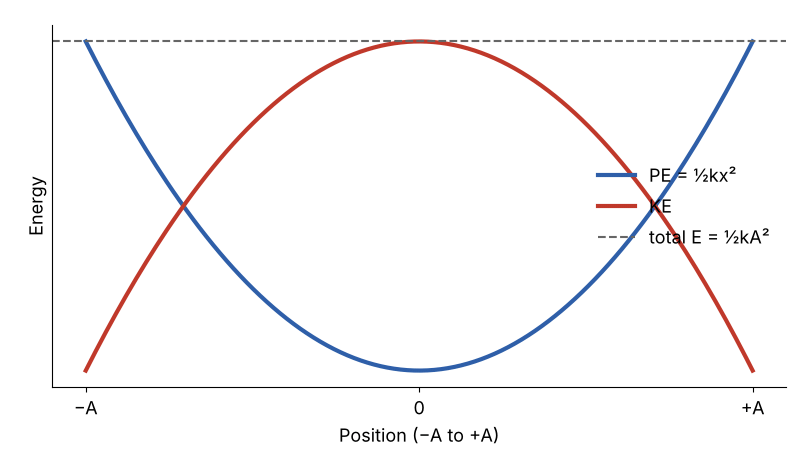
Energy oscillates between kinetic and potential forms, but the total stays constant. If you know amplitude and spring constant, you know total energy. If you know total energy and position, solve for velocity directly using:
\(v = \sqrt{\frac{k}{m}(A^2 – x^2)} = \omega\sqrt{A^2 – x^2}\)The Simple Pendulum: A Special Case
A simple pendulum undergoes SHM under the small angle approximation (typically \(\theta < 15°\)). For a pendulum of length \(L\):
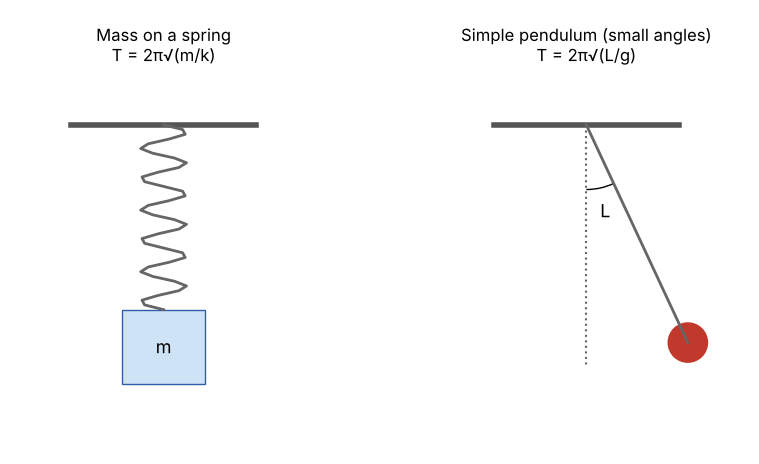
Period depends only on length and gravity — not on mass or amplitude (for small angles). This is why a longer pendulum swings slower, and why changing the bob mass doesn’t change the period.
Worked Example: Finding Amplitude and Phase from Initial Conditions
A 2 kg mass is attached to a spring with \(k = 50\text{ N/m}\). At \(t = 0\): \(x_0 = 0.10\text{ m}\), \(v_0 = 0\text{ m/s}\).
Step 1: \(\omega = \sqrt{50/2} = 5\text{ rad/s}\); \(T = 2\pi/5 \approx 1.26\text{ s}\)
Step 2: Apply initial conditions: \(x(0) = A\cos\phi = 0.10\) and \(v(0) = -A\omega\sin\phi = 0\). From velocity: \(\sin\phi = 0\), so \(\phi = 0\). From position: \(A = 0.10\text{ m}\).
Equations of motion:
\(x(t) = 0.10\cos(5t)\text{ m}\) \(v(t) = -0.50\sin(5t)\text{ m/s}\) \(a(t) = -2.5\cos(5t)\text{ m/s}^2\)When initial velocity is zero, amplitude equals the initial displacement — a quick shortcut for this common case.
Test-Taking Strategies
Mnemonics and Memory Shortcuts.
- “Force Restores” — \(F = -kx\). The negative sign means restoring (always opposite to displacement).
- “Period is Root of Ratio” — \(T = 2\pi\sqrt{m/k}\). Heavier mass oscillates slower; stiffer spring oscillates faster.
- “Energy is Half-k-A-squared” — \(E = \frac{1}{2}kA^2\). Total energy depends only on spring constant and amplitude.
- Pendulum vs. spring analogy: \(T = 2\pi\sqrt{L/g}\) parallels \(T = 2\pi\sqrt{m/k}\). Length plays the role of mass; gravity plays the role of stiffness.
Cross-Topic Connections.
- Calculus: Solving \(\frac{d^2x}{dt^2} = -\omega^2 x\) requires recognizing the sinusoidal solution. Differentiate to get velocity and acceleration — pure calculus application.
- Energy: Use \(\frac{1}{2}kA^2 = \frac{1}{2}mv^2 + \frac{1}{2}kx^2\) to find velocity at any position without solving the full differential equation. Energy conservation is almost always faster than calculus.
- Rotational motion: Pendulum problems bridge oscillations and torque. The restoring torque \(\tau \approx -mgL\theta\) for small angles gives \(\omega = \sqrt{g/L}\).
Common Question Formats.
- Equation of motion: Given \(k\), \(m\), and initial conditions, write \(x(t)\), \(v(t)\), and \(a(t)\).
- Period or frequency: Given system parameters, calculate \(T\) or \(f = 1/T\).
- Energy: Given amplitude and spring constant, find total energy. Given position and energy, find velocity.
- Phase relationships: Identify when position, velocity, and acceleration reach extrema or zero.
- Pendulum: Use \(T = 2\pi\sqrt{L/g}\) to find length, period, or \(g\) from measured oscillations.
- Graphs: Match \(x(t)\), \(v(t)\), \(a(t)\) graphs — recognize 90° and 180° phase shifts.
Frequent Student Mistakes.
- Forgetting the phase constant: Writing \(x(t) = A\cos(\omega t)\) only works if the mass starts at maximum displacement. If \(x(0) \neq A\), then \(\phi \neq 0\). Always determine \(\phi\) from initial conditions.
- Assuming period depends on amplitude: Period is independent of amplitude in ideal SHM. Only mass and spring constant determine period.
- Applying the pendulum formula at large angles: \(T = 2\pi\sqrt{L/g}\) requires small angles (\(\theta < 15°\) approximately). For large angles, the period increases and this formula underestimates the true period.
Test-Day Shortcuts.
- Energy shortcut for velocity: \(v = \omega\sqrt{A^2 – x^2}\). Faster than solving the trig equation from the full sinusoidal expression.
- Phase shortcut: Position and acceleration are always 180° out of phase (acceleration is proportional to −x). Velocity is 90° ahead. If position is at maximum, velocity is zero.
- When initial velocity is zero: Amplitude equals initial displacement directly. No phase calculation needed.
- Max velocity: \(v_{max} = A\omega = A \times \frac{2\pi}{T}\). Quick calculation if you know \(A\) and \(T\).
Time Management Tips.
Identify the system type first (spring-mass vs. pendulum) before writing any equations — 10 seconds of setup prevents formula mix-ups. Use energy conservation whenever possible; it avoids solving differential equations and is almost always faster. On free-response questions involving SHM, sketch the \(x(t)\) curve first to establish the phase constant visually, then write the formal equation. Most SHM free-response problems can be solved completely in 8–12 minutes with this approach.
Check for Understanding
Think you’ve got it? Complete the quiz below to make sure. Download your results at the end.