

Maximize your score with these resources:
- Albert.io AP® US History question banks
- Free AP® US History cheat sheets
- Free AP® US History score calculator
The 1970s began with Americans walking on the moon and ended with gas lines, double-digit inflation, and 52 American hostages held in Iran. In between, a president resigned in disgrace, the Vietnam War ended in defeat, and Americans argued over abortion, busing, school prayer, and the Equal Rights Amendment. Trust in government fell sharply. Topic 8.14 covers this decade of transition, when the liberal consensus of the postwar years broke down and a new conservative movement took shape.
This article covers Topic 8.14: Society in Transition in Period 8, 1945 to 1980. The topic asks you to explain how economic troubles, political scandals, and debates over social and moral issues changed American society and politics in the 1970s and set the stage for the rise of conservatism.
By the end, you should be able to:
- Explain the causes and effects of stagflation.
- Describe the Watergate scandal and its consequences.
- Explain the culture wars that divided Americans.
- Describe the rise of the New Right and the Religious Right.

What We Review
Economic Troubles
The postwar boom ended in the 1970s. Americans faced a combination that economists had thought couldn’t happen: high inflation together with high unemployment, called stagflation.
| Cause | Effect |
|---|---|
| Oil shocks of 1973 and 1979 | Energy prices soared, raising costs throughout the economy |
| Vietnam War spending | Deficits fueled inflation |
| Foreign competition | Rebuilt economies in Japan and West Germany challenged U.S. manufacturing |
| Deindustrialization | Factories closed in the Northeast and Midwest, creating the “Rust Belt” |
| End of the gold standard (1971) | Nixon ended the dollar’s convertibility to gold, ending the Bretton Woods system |
Inflation topped 13% at its peak in 1979 and 1980. Nixon tried wage and price controls in 1971. Gerald Ford’s “Whip Inflation Now” campaign did little. Jimmy Carter’s appointment of Paul Volcker to the Federal Reserve in 1979 led to sharply higher interest rates that eventually tamed inflation, at the cost of a deep recession.
A Crisis of Confidence in Government

Watergate
- In 1972, burglars tied to Nixon’s reelection campaign broke into Democratic headquarters at the Watergate complex.
- Reporting by Washington Post journalists Bob Woodward and Carl Bernstein, plus Senate hearings, revealed a White House cover-up.
- In United States v. Nixon (1974), the Supreme Court ordered Nixon to release secret tape recordings.
- Facing impeachment, Nixon resigned in August 1974, the only president ever to do so. Ford later pardoned him.
Effects
- Congress passed campaign finance reforms and strengthened the Freedom of Information Act.
- Combined with the Pentagon Papers and Vietnam, Watergate deepened distrust of government. Trust in Washington fell from about 75% in the early 1960s to about 25% by 1980.
- Outsider Jimmy Carter won in 1976 by promising honesty.
The Culture Wars
| Issue | Debate |
|---|---|
| Abortion | Roe v. Wade (1973) legalized abortion and sparked a “right to life” movement |
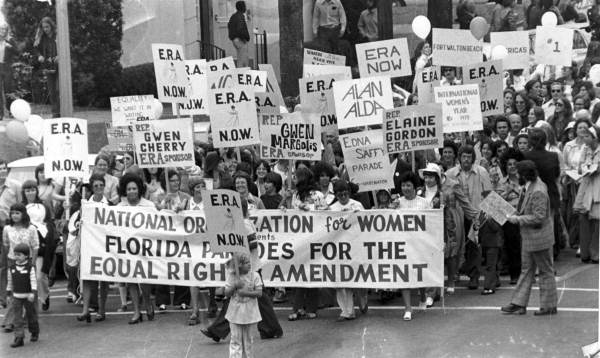
| Equal Rights Amendment | Phyllis Schlafly’s STOP ERA campaign argued the amendment threatened traditional families. It was never ratified. |
| School busing | Swann v. Charlotte-Mecklenburg (1971) approved busing to integrate schools. It provoked fierce resistance, including in Boston. |
| Affirmative action | Regents of the University of California v. Bakke (1978) struck down racial quotas but allowed race as one factor in admissions |
| Gay rights | Anita Bryant led a 1977 campaign to repeal a Miami gay rights ordinance |
The Rise of the New Right
These conflicts helped build a powerful conservative coalition.
- The Religious Right: Evangelical Christians, long less active in politics, organized around moral issues. Jerry Falwell founded the Moral Majority in 1979.
- Tax revolts: California’s Proposition 13 (1978) capped property taxes and inspired anti-tax movements nationwide.
- Sun Belt growth: Population gains in the South and West strengthened conservative voters.
- Neoconservatives: Some former liberals turned against the Great Society and détente.
Carter’s presidency ended with the Iranian hostage crisis, high inflation, and the Soviet invasion of Afghanistan. In 1980, Ronald Reagan united these conservative groups and won a decisive victory.
Why does this matter? The 1970s are the hinge between Periods 8 and 9. This topic explains why the liberal consensus of the postwar era broke down and why conservatism rose so quickly. On essays, connect stagflation, Watergate, and the culture wars as linked causes of Reagan’s 1980 victory.
Test-Taking Strategies
Mnemonic Devices and Memory Shortcuts
- “Stag plus flation.” A stagnant economy plus inflation.
- “Tapes took Nixon down.” The Supreme Court’s order to release the tapes forced his resignation.
- “Moral Majority, Prop 13, Sun Belt.” Three pillars of the New Right.
Cross-Topic Connections
- Topic 8.13: The energy crises fed stagflation.
- Topic 8.11: Civil rights gains provoked the backlash seen in the ERA and busing fights.
- Topic 8.9: Opposition to Great Society liberalism grew through the decade.
- Topic 9.2: Reagan built his coalition from the forces of the 1970s.
Common Question Formats
- Stimulus MCQ. An excerpt from Carter’s “malaise” speech or a STOP ERA flyer, and you identify its context.
- Causation SAQ. You explain one cause of growing distrust in government.
- Continuity and change SAQ. You explain how the 1970s marked a turning point in American politics.
- LEQ. You evaluate the causes of the rise of conservatism between 1964 and 1980.
Frequent Student Mistakes
- Saying Nixon was impeached. He resigned before the House voted.
- Blaming stagflation on one cause. Oil shocks, deficits, and foreign competition all contributed.
- Treating the Religious Right as always political. Evangelicals’ political mobilization was new in the 1970s.
- Misreading Bakke. It banned quotas but allowed race as a factor.
Test-Day Shortcuts
- Spot “crisis of confidence.” It points to Carter’s 1979 speech.
- Use the trust statistic. A drop from about 75% to about 25% is vivid evidence.
- Link the decade to 1980. Every 1970s trend helps explain Reagan’s win.
Time Management Tips
- Multiple choice: Section IA has 55 questions in 55 minutes, about 1 minute each. Political sources from the 1970s often test the author’s view of government.
- Short answer: Section IB has 3 required questions in 40 minutes, roughly 13 minutes each. Name one specific scandal, case, or movement per part.
- Essays: The DBQ gets 60 minutes, including a 15-minute reading period, and the single required LEQ gets 40 minutes. Organize by economic, political, and cultural causes.
Check for Understanding
Think you’ve got it? Complete the quiz below to make sure. Download your results at the end.