

Maximize your score with these resources:
- Albert.io AP® Biology question banks
- Free AP® Biology cheat sheets
- Free AP® Biology score calculator
What We Review
TLDR: Key Takeaways
- “Survival of the fittest” does NOT mean physically strongest — in biology, fitness = relative reproductive success (which organism leaves the most surviving offspring).
- Natural selection requires four conditions: heritable variation, differential reproduction, non-random outcomes, and a selective pressure. Missing any one = no evolution.
- Three modes of selection: directional (mean shifts), stabilizing (extremes removed, curve narrows), disruptive (middle removed, bimodal curve forms).
- Only heritable (genetic) variation drives evolution — environmentally induced variation cannot be passed to offspring and does not change allele frequencies.
- The environment selects among pre-existing variants; it does NOT cause beneficial mutations. Antibiotics reveal resistance; they don’t create it.
- Fitness is always environment-dependent: sickle cell heterozygotes are fittest in malaria regions but not elsewhere. The “fittest” genotype changes when the environment changes.
- Selective pressures can be biotic (predators, disease, competition) or abiotic (climate, pollution) — both change which alleles increase in frequency over generations.
Introduction
“Survival of the fittest” is one of the most misunderstood phrases in biology. Most people hear it and think of the strongest, fastest, or toughest organism winning a fight. But in evolutionary biology, “fittest” means the organism that leaves the most surviving offspring — not the one that wins a wrestling match. A slow, quiet mouse that successfully raises 12 pups is “fitter” than a fast, aggressive mouse that dies before reproducing.
The phrase was actually coined by Herbert Spencer after reading Darwin’s On the Origin of Species. Darwin later adopted it as a shorthand for natural selection, but he preferred the more precise term “natural selection” because “fittest” can be misleading. For AP® Biology, you need to understand fitness in its precise biological meaning — relative reproductive success — and connect it to phenotypic variation, selective pressures, and adaptation. This article covers all of these concepts with the depth and specificity the AP® exam demands.
Understanding Phenotypic Variation
Phenotypic variation is the raw material of natural selection. Without differences among individuals, there is nothing for selection to act on — and evolution grinds to a halt.
Phenotypic variation includes any observable difference among individuals in a population: body size, coloration, enzyme efficiency, disease resistance, behavior, metabolic rate, flowering time — anything that can differ between organisms. These differences arise from three sources:
| Source of Variation | Mechanism | Example | Heritable? |
|---|---|---|---|
| Genetic variation | Different alleles at one or more loci; produced by mutation, recombination, independent assortment | Sickle cell allele (HbS vs. HbA) in human hemoglobin | Yes — passed to offspring |
| Environmental variation | Differences in nutrition, temperature, light, or other conditions during development | Hydrangea flower color changes with soil pH | No — not encoded in DNA |
| Gene-environment interaction | Genetic potential expressed differently depending on environment | Height in humans: genes set the range, nutrition determines where you fall within it | Partially — genetic component is heritable |
Critical AP® point: Natural selection can only cause evolution when the phenotypic variation has a genetic (heritable) basis. If variation is purely environmental (like a plant growing taller because it got more sunlight), that advantage cannot be passed to offspring, and the population’s allele frequencies won’t change. The AP® exam tests this distinction directly — expect a question asking whether a given example of variation can lead to evolution.
Classic examples of heritable phenotypic variation:
- Darwin’s finches: Beak size and shape vary among individuals within each species. Birds with beaks better suited to available food sources survive and reproduce at higher rates, shifting the beak size distribution over generations.
- Arctic hare coat color: Seasonal coat color change (brown in summer, white in winter) is genetically controlled. Individuals with coat colors mismatched to their background are more visible to predators and have lower fitness.
- Antibiotic resistance alleles in bacteria: Random mutations produce variation in antibiotic susceptibility. When antibiotics are applied, resistant variants survive and reproduce — a textbook example of natural selection acting on heritable phenotypic variation.
The Role of Natural Selection
Natural selection is the process by which organisms with heritable traits better suited to their environment produce more surviving offspring than organisms without those traits. Over generations, this differential reproductive success shifts allele frequencies in the population — which is, by definition, evolution.


Natural selection requires four conditions (all must be met simultaneously):
- Variation: Individuals in the population differ in their traits.
- Heritability: At least some of that variation is genetically based and can be passed to offspring.
- Differential survival/reproduction: Some variants survive and reproduce more successfully than others in the current environment.
- Non-random: The survival/reproduction advantage is linked to specific traits — it’s not just random chance (that would be genetic drift).
The AP® exam recognizes three modes of natural selection, and you should be able to identify each from a graph of trait distribution:
| Mode | What It Does | Effect on Variation | Classic Example |
|---|---|---|---|
| Directional selection | Favors one extreme phenotype; shifts the mean | Reduces variation on one side of the distribution | Antibiotic resistance — resistant bacteria increase in frequency after antibiotic exposure |
| Stabilizing selection | Favors the intermediate phenotype; removes extremes | Reduces overall variation (narrows the curve) | Human birth weight — very small and very large babies have lower survival rates |
| Disruptive selection | Favors both extremes; selects against the middle | Increases variation (bimodal distribution); can lead to speciation | African seed crackers — birds with very large or very small beaks survive best; medium beaks are less efficient on either seed type |
AP® exam tip: When you see a bell curve or histogram on the exam, identify which direction(s) the curve is shifting to determine the mode of selection. Directional = curve moves left or right. Stabilizing = curve gets taller and narrower. Disruptive = curve develops two peaks.
Two key examples the AP® exam draws on repeatedly:
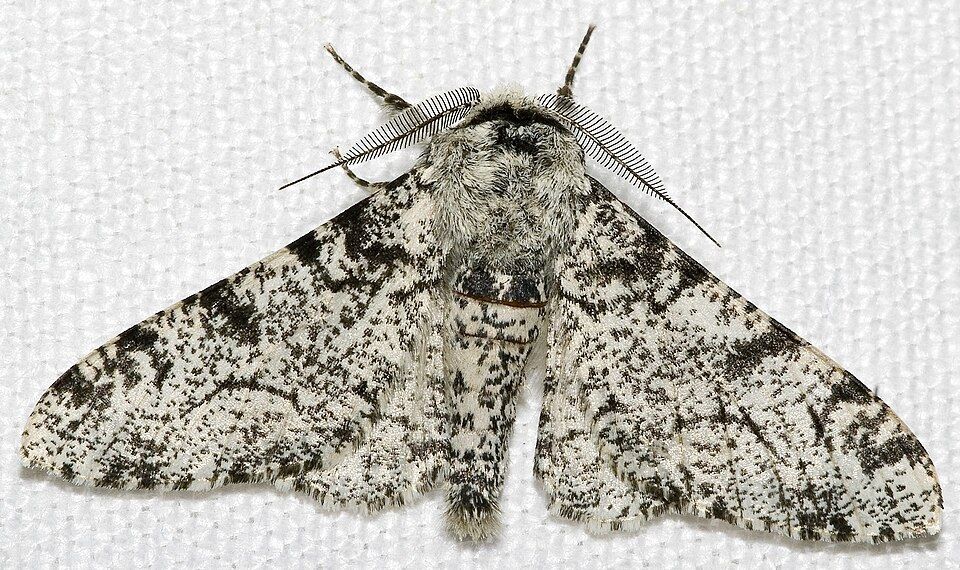
- Peppered moth (Biston betularia): Before the Industrial Revolution, light-colored moths had higher fitness because they blended into pale, lichen-covered tree bark (lower predation). After industrial pollution killed the lichen and darkened the trees with soot, dark-colored moths had higher fitness. This is directional selection driven by a change in the environment. When pollution decreased and lichens returned, selection shifted back — demonstrating that fitness is environment-dependent, not absolute.
- Antibiotic resistance in bacteria: A bacterial population contains random variation in antibiotic susceptibility (from mutations). When exposed to an antibiotic, susceptible bacteria die while resistant variants survive and reproduce. The population shifts toward resistance — directional selection. The antibiotic didn’t cause the mutations; it selected among pre-existing variants. This distinction is heavily tested on the AP® exam.
Environmental Changes and Selective Pressures
Selective pressures are any environmental factors that affect which phenotypes have higher fitness. When the environment changes, selective pressures change — and traits that were previously neutral or disadvantageous may suddenly become critical for survival.
| Type of Pressure | Category | Examples | Effect on Selection |
|---|---|---|---|
| Predation | Biotic | Predator-prey dynamics, mimicry, camouflage | Selects for traits that reduce predation risk (cryptic coloration, toxicity, speed) |
| Competition | Biotic | Intraspecific and interspecific competition for food, mates, territory | Selects for traits that improve resource acquisition or competitive ability |
| Disease/parasites | Biotic | Pathogen exposure, immune system variation | Selects for immune resistance; drives Red Queen dynamics (co-evolutionary arms race) |
| Climate | Abiotic | Temperature shifts, precipitation changes, seasonality | Selects for physiological tolerance, migration ability, or phenological shifts |
| Habitat alteration | Abiotic (human-driven) | Deforestation, urbanization, pollution | Creates novel selection pressures; organisms must adapt, migrate, or face extinction |
Key AP® concept: When the environment changes rapidly, the population must already contain pre-existing genetic variation for traits suited to the new conditions. Natural selection does not create new traits on demand — it can only increase the frequency of alleles that are already present. If no individuals carry beneficial alleles for the new environment, the population may decline or go extinct. This is why genetic diversity is so critical for long-term population survival.
Case studies you should know:
- Coral bleaching: Rising ocean temperatures cause corals to expel their symbiotic algae (zooxanthellae), leading to bleaching. Coral genotypes with higher thermal tolerance survive bleaching events at higher rates — directional selection for heat tolerance. However, if warming exceeds the tolerance range of all genotypes, the entire reef system collapses regardless of variation.
- Urban adaptation: Some bird species in cities have evolved higher-pitched songs to be heard over traffic noise. Urban populations of dark-eyed juncos show reduced migratory behavior compared to rural populations. These are examples of natural selection acting on human-altered environments — a concept the AP® exam increasingly emphasizes.
- Pesticide resistance in insects: Just like antibiotic resistance in bacteria, insect populations exposed to pesticides undergo directional selection for resistance alleles. The key exam point: the pesticide does not cause mutations — it selects among pre-existing variants.
Fitness and Adaptations
In everyday language, “fitness” means physical strength or health. In evolutionary biology, fitness has a precise, technical meaning: an organism’s relative reproductive success compared to other individuals in the population. This is often represented mathematically:
- Absolute fitness (W): The average number of surviving offspring produced by individuals with a particular genotype.
- Relative fitness (w): The fitness of a genotype compared to the most fit genotype in the population (which is set to w = 1.0). A genotype with w = 0.8 produces 80% as many surviving offspring as the fittest genotype.
- Selection coefficient (s): The reduction in fitness relative to the most fit genotype. \(s = 1-w\). A genotype with w = 0.8 has s = 0.2.
An adaptation is a heritable trait that increases an organism’s fitness in its current environment. Adaptations arise through natural selection acting on heritable variation over many generations. They are not “designed” or “intentional” — they result from the non-random survival and reproduction of individuals carrying beneficial alleles.
| Adaptation Type | Definition | Example |
|---|---|---|
| Structural | Physical features that improve survival or reproduction | Cactus spines reduce water loss and deter herbivores; polar bear fur provides insulation and camouflage |
| Physiological | Internal processes that improve function in a specific environment | Camel kidneys concentrate urine to conserve water; deep-sea fish produce antifreeze proteins |
| Behavioral | Actions that improve survival or reproductive success | Bird migration to track seasonal food sources; prairie dog alarm calls warn colony members of predators |
Critical AP® distinction: Fitness is always relative to the environment. A trait that increases fitness in one environment may decrease it in another. Sickle cell heterozygotes (HbA/HbS) have higher fitness than either homozygote in malaria-endemic regions (heterozygote advantage), but in non-malarial environments, the HbS allele provides no benefit and homozygotes (HbS/HbS) still suffer from sickle cell disease. This is why fitness cannot be measured in isolation — it depends entirely on the environmental context.
Common misconception tested on the AP® exam: “Survival of the fittest” does NOT mean that only the “best” organisms survive. It means that organisms with traits better suited to the current environment have a higher probability of surviving and reproducing. Some less-fit individuals still reproduce (selection is probabilistic, not deterministic), and the “fittest” genotype can change whenever the environment changes.
Test-Taking Strategies
Mnemonics and memory shortcuts:
- “VINE” for the four requirements of natural selection: Variation exists → Inheritable (genetic basis) → Non-equal reproduction (differential fitness) → Evolution occurs (allele frequencies change). If any condition is missing, natural selection cannot drive evolution. Practice identifying which VINE condition is absent in trick questions.
- “DSD” for the three modes of selection: Directional (shifts the mean), Stabilizing (shrinks the spread), Disruptive (splits the distribution into two peaks). On any graph question, map the shape change to DSD before choosing an answer.
- “Fitness = Babies, not biceps”: Whenever you see the word “fitness” on the AP® exam, mentally replace it with “relative reproductive success.” A bulky organism that can’t attract mates has low fitness; a tiny organism that raises many offspring has high fitness.
- “Selection REVEALS variation; it doesn’t CREATE it”: Antibiotics reveal resistance that already existed. Drought reveals drought tolerance that was already in the gene pool. Write this distinction on your scratch paper before every natural selection FRQ.
Cross-topic connections:
- Hardy-Weinberg equilibrium (Unit 7): Natural selection is one of the five forces that disrupt H-W equilibrium. If a question gives you allele frequencies and describes selection acting on a phenotype, recognize that the population is NOT in H-W equilibrium and predict the direction of allele frequency change.
- Speciation (Unit 7): Disruptive selection can lead to speciation if subpopulations become reproductively isolated. The bimodal phenotype distribution is the first step toward two distinct gene pools — connect this to allopatric and sympatric speciation.
- Genetic drift vs. natural selection (Unit 7): In small populations, drift can overpower selection. A beneficial allele can be lost by chance. If a question gives a small population + unexpected outcome, think drift first. If the population is large + outcome correlates with environment, think selection.
- Artificial selection (Unit 7): Humans as the selecting agent. Same mechanism as natural selection, but faster and narrower — it reduces genetic diversity while natural selection (especially balancing selection) can maintain it. Bridge these concepts on any compare/contrast FRQ.
- Sickle cell disease (Unit 5): The classic example of heterozygote advantage and environment-dependent fitness. Use this whenever FRQs ask about balancing selection, why deleterious alleles persist, or how fitness depends on environment.
Common question formats:
- Graph interpretation: Before/after bell curve or histogram. Ask yourself: did the mean shift? (directional) Did the spread narrow? (stabilizing) Did two peaks emerge? (disruptive). Don’t guess — map shape changes systematically.
- Scenario-based MCQ: “In a population of rabbits, a new predator arrives that can see only brown rabbits.” → Heritable coat color variation exists → white rabbits have higher survival → directional selection → white allele increases in frequency. Run this chain for every selection scenario.
- FRQ with calculations: May combine H-W equations with selection scenarios. First establish which assumptions are violated (selection = non-random reproduction), then calculate expected allele frequency changes.
- “Explain why” questions: “Explain why the environment does not cause beneficial mutations.” Template answer: Mutations occur randomly and independently of selection pressure. The environment determines which pre-existing variants have higher fitness, causing their alleles to increase in frequency over generations.
Frequent student mistakes:
- Saying organisms “adapt” during their lifetime: Individuals don’t evolve. Populations evolve over generations through changes in allele frequency. Write “the population evolved” or “the frequency of the resistance allele increased” — never “the bacteria adapted to the antibiotic.”
- Confusing “survival of the fittest” with physical strength: Fitness is reproductive success. On FRQs, always define fitness explicitly as “the relative reproductive success of a genotype” — don’t assume the grader shares the everyday definition.
- Claiming the environment “causes” beneficial mutations: This is the single most commonly tested misconception on the AP® Biology exam. Mutations are random. The environment selects among pre-existing variants. State this explicitly: “The antibiotic did not cause the resistance mutation; it selected for bacteria that already carried the resistance allele.”
- Mixing up selection modes on graphs: Stabilizing vs. directional is the most common error. Remember: if the mean doesn’t move but the curve narrows, it’s stabilizing. If the mean shifts, it’s directional. Sketch out what each graph looks like before the exam so the shapes are burned in.
Test-day shortcuts:
- For any natural selection question, first ask: is the variation heritable? If not (a scar, a learned behavior without genetic basis), natural selection cannot cause evolution. Eliminate any answer choice that claims otherwise.
- Three-part answer template for any selection FRQ: (1) Variation existed in the population for [trait]. (2) Individuals with [trait] had higher reproductive success in the [environment]. (3) Over generations, the frequency of the [trait] allele increased in the population. This structure reliably earns full rubric points.
- If a question mentions a “small population” with an unexpected genetic outcome, the answer is almost always genetic drift, not natural selection. Drift is random; selection is non-random. Population size is the key discriminator.
Time management:
- Natural selection FRQs often have 4 parts. Budget ~3 minutes per part. The highest-order thinking points are usually in parts (c) and (d) — don’t burn your time on part (a) and then rush through the valuable back half of the question.
- For graph-based questions, spend 30 seconds identifying axes, units, and the key shape change before writing. This single habit prevents the most common careless errors on visual data questions.
Check for Understanding
Think you’ve got a solid grasp on natural selection and fitness? Complete the quiz below to find out.