
A dove can be just a bird. In a poem about war, though, a dove might stand for peace. A road might be just a path through the woods, or it might stand for a life decision. When an object, person, or event in a poem carries a meaning beyond itself, it becomes a symbol. Learning to recognize symbols, without seeing them everywhere, is one of the key skills of reading poetry.
This article covers Topic 3.4: Symbolism in Unit 3, Figurative Language and Sound. The topic asks you to identify symbols, distinguish conventional from contextual symbols, and support symbolic interpretations with evidence.
By the end, you should be able to:
- Define a symbol and distinguish it from a metaphor.
- Distinguish conventional symbols from contextual symbols.
- Identify clues that an image is symbolic.
- Support a symbolic reading with evidence from the poem.
What a Symbol Is
A symbol is something concrete, such as an object, color, place, animal, or action, that stands for something abstract, such as an idea, feeling, or value. Unlike a metaphor, a symbol usually exists literally in the poem.
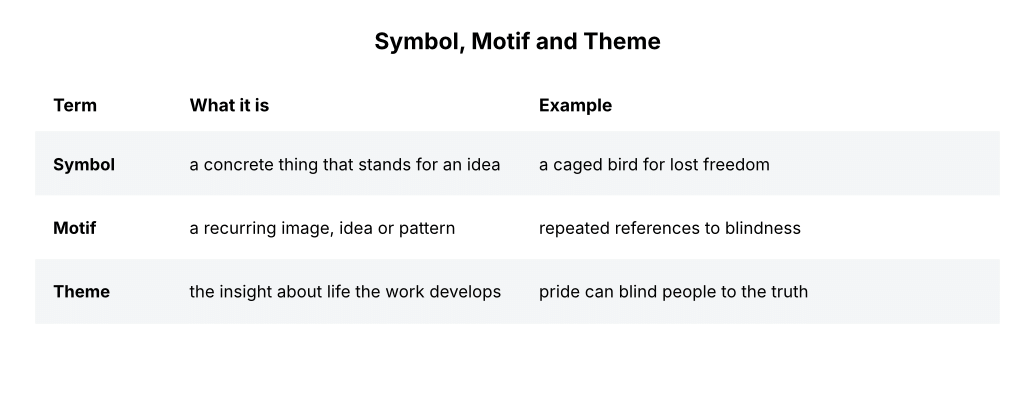
| Device | How It Works | Example |
|---|---|---|
| Metaphor | Says one thing is another | Life is a journey. |
| Symbol | A real thing in the poem that also points to a larger meaning | A traveler choosing between two real roads, where the roads also suggest life choices |
Conventional Versus Contextual Symbols
Conventional symbols have widely shared meanings within a culture.
- A dove or olive branch: peace.
- Spring: birth, youth, renewal.
- Winter or night: old age, death, or despair.
- A rose: love or beauty.
- Light: knowledge, hope, or goodness.
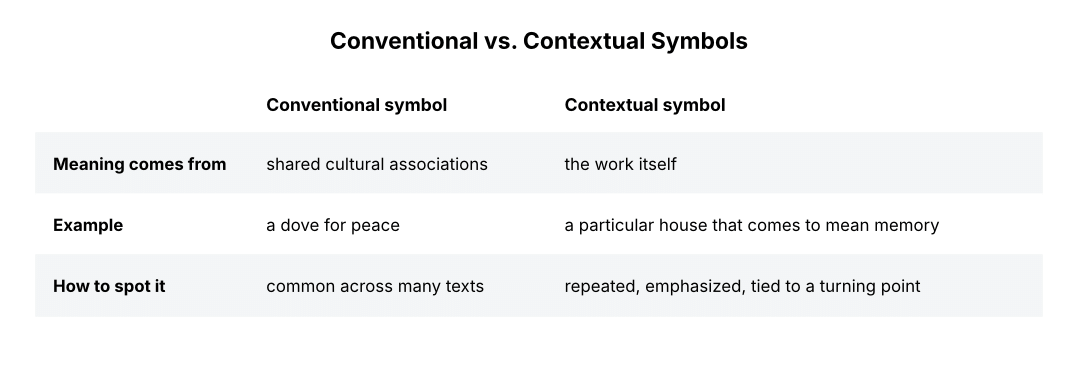
Contextual symbols (also called literary symbols) gain meaning from the specific poem. The poet builds the meaning through repetition, emphasis, and placement.
Conventional meanings can differ across cultures. White often suggests purity in Western traditions, while in parts of East Asia it has been associated with mourning. Always check what the poem itself suggests.
Clues That Something Is Symbolic
- Emphasis: the object appears in the title, the opening, or the ending.
- Repetition: it returns several times.
- Detail: the poet describes it with unusual care.
- Weight: the speaker’s feelings about it seem bigger than the object alone deserves.
- Connection: it links to the poem’s central conflict or theme.
Why does this matter? Not every object is a symbol. A strong symbolic reading points to clues like these. Without evidence, an interpretation becomes guesswork, and teachers and test graders notice the difference.
Worked Example: “The Sick Rose”
William Blake’s short poem “The Sick Rose” (1794) begins:
O Rose thou art sick.
The invisible worm,
The speaker goes on to say the worm, flying in the night and the storm, has found the rose’s bed and its “dark secret love” is destroying her life.
- Literal level: a worm is damaging a rose.
- Conventional symbol: the rose traditionally stands for love and beauty.
- Contextual details: the worm is “invisible,” comes at night, and its love is “dark” and “secret.”
- Symbolic reading: something hidden and destructive is corrupting love or innocence from within. Readers have proposed jealousy, secrecy, or the loss of innocence.
The poem never explains itself, which allows several readings, but each must be supported by the poem’s words.
Symbols in Familiar Poems
In Robert Frost’s “The Road Not Taken,” the two roads are real paths in a yellow wood, but they also suggest life choices. In Dickinson’s “Because I could not stop for Death,” the carriage ride suggests the journey from life to eternity. In both cases, the literal scene makes sense on its own, and the symbolic meaning adds depth.
Why does this matter? Symbols let poets express big, abstract ideas through concrete images that readers can see and remember. They often carry a poem’s theme.
Allegory
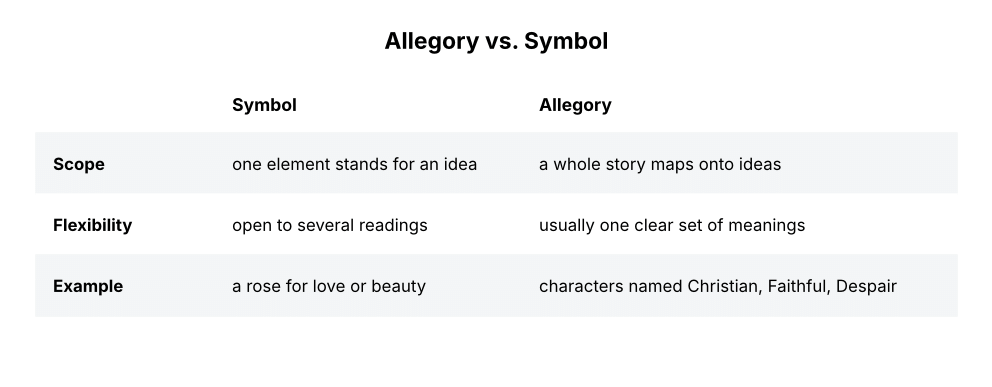
When a whole work is built from symbols that line up one to one with ideas, it is called an allegory. In an allegory, characters and places often have names like Hope or Despair, and the story as a whole teaches a moral or political lesson.
Writing About Symbols
When you explain a symbol, use a three-part structure: name the concrete object, state what it represents, and cite the evidence that supports the connection. For example: “The invisible worm symbolizes a hidden destructive force, as shown by the words ‘night,’ ‘dark,’ and ‘secret.’”
Test-Taking Strategies
Mnemonic Devices and Memory Shortcuts
“Concrete stands for abstract.” A symbol is “real plus more”: it exists in the poem and also means something larger.
Cross-Topic Connections
- Symbols begin as images, as in Topic 3.1: Imagery.
- Compare symbols with Topic 3.2: Simile and Metaphor.
- Symbols often point to Topic 1.4: Theme in Poetry.
- Supporting interpretations is practiced in Reading Skills Topic 1.6: Using Textual Evidence to Support Claims.
Common Question Formats
- Identify what an object most likely symbolizes.
- Choose the detail that best supports a symbolic reading.
- Distinguish a symbol from a metaphor.
- Explain how a symbol contributes to theme.
Frequent Student Mistakes
- Treating every object as a symbol.
- Offering a symbolic meaning without textual evidence.
- Ignoring the literal meaning entirely.
Test-Day Shortcuts
Choose symbolic interpretations that fit the poem’s tone and theme. If an answer choice clashes with the poem’s mood, eliminate it.
Time Management Tips
Symbol questions on English unit tests and standardized reading tests such as the SAT and ACT take 30 to 60 seconds. Look for repeated images before answering.