

Maximize your score with these resources:
- Albert.io AP® Precalculus question banks
- Free AP® Precalculus cheat sheets
- Free AP® Precalculus score calculator
Introduction
In trigonometry and precalculus, the tangent function plays a key role. It helps us understand angles and their relationships. The focus here will be on the characteristics of the tangent function graph, especially its period and asymptotes. By delving into these features, students can improve their understanding and excel in the AP® Precalculus exam.
Understanding the Tangent Function
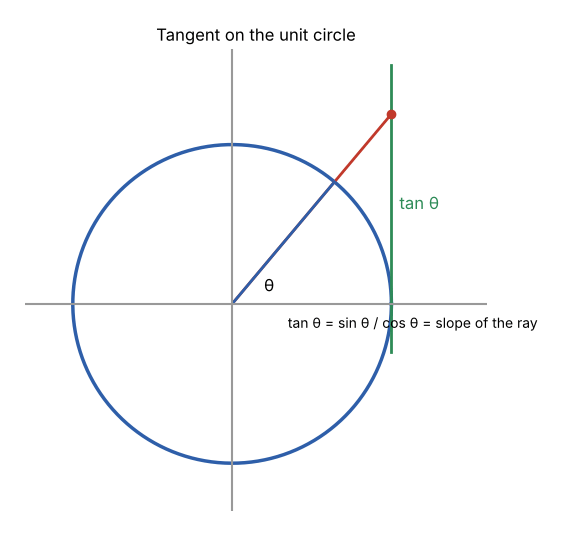
The tangent function is defined as the ratio of the sine to the cosine function:
\(\text{Tangent Function: } \tan(x) = \frac{\sin(x)}{\cos(x)}\)
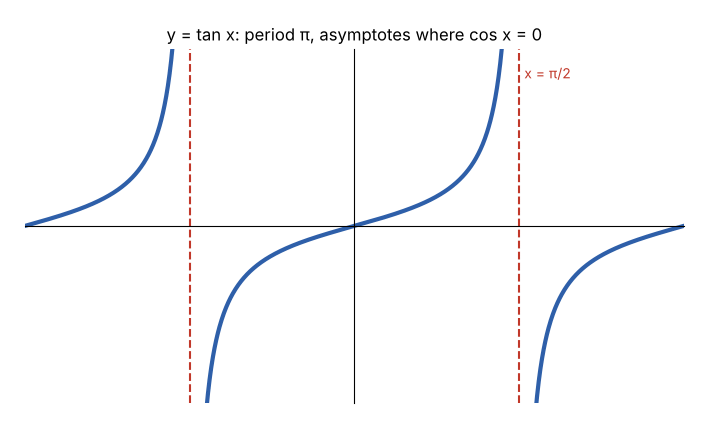
What’s special about the tangent function? Unlike the sine and cosine functions, which are waves with maximum and minimum values, the tangent function does not have a horizontal maximum or minimum. Instead, it continues infinitely in the vertical direction, creating vertical asymptotes wherever cosine equals zero.
Key Characteristics of the Tangent Function
Period of Tangent Function
The period of a function is the length of one complete cycle before it repeats itself. For the tangent function, this period is \(\pi\). This means after an interval of \(\pi\), the tangent graph repeats itself — half the period of sine and cosine (\(2\pi\)).
Example: Graphing One Full Period of a Tangent Function
- Identify the period: \(\pi\).
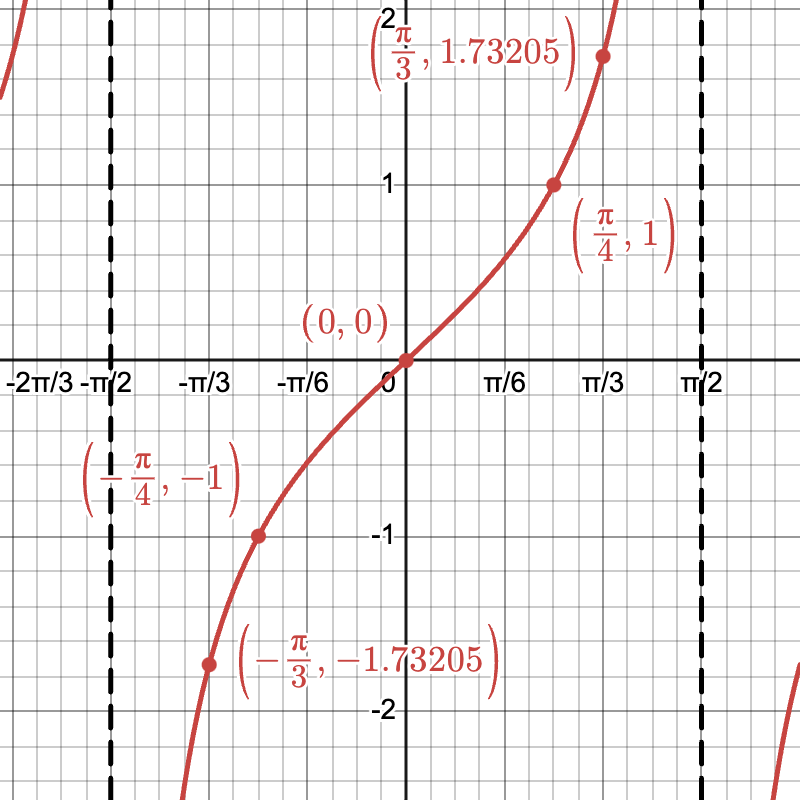
- Plot critical points between \(x= -\pi/2\) and \(x=\pi/2\): \((-\pi/3, -\sqrt{3})\), \((-\pi/4, -1)\), \((0, 0)\), \((\pi/4, 1)\), \((\pi/3, \sqrt{3})\).
- Draw the curve: Recognize the “S” shape, starting from negative infinity and increasing towards positive infinity in between two consecutive asymptotes.
Tangent Asymptotes
Asymptotes are lines that a graph approaches but never actually touches. The tangent function has vertical asymptotes because \(\tan(x)\) becomes undefined where \(\cos(x) = 0\). These occur at:
\(x = \frac{\pi}{2} + k\pi\)
…where \(k\) is an integer.
Example: Identifying Asymptotes in a Tangent Function Graph
- Calculate asymptotes: For the first period, asymptotes at \(x = \frac{\pi}{2}\) and \(x = -\frac{\pi}{2}\).
- Mark these on the graph as dashed vertical lines.
Behavior Between Asymptotes
Between its asymptotes, the graph of the tangent function transitions smoothly, resembling an “S” curve. As \(x\) increases from one asymptote to the next, the graph transitions from concave down to concave up, crossing through the \(x\)-axis at the midpoint.
Example: Analyzing the Graph of Tangent Within One Period
- Identify points of inflection: \(x = 0\) results in \(y = 0\).
- Observe the curve’s direction: As \(x\) approaches \(\pi/2\), the graph curves upward rapidly toward positive infinity.
Sketching the Graph of the Tangent Function
To sketch the tangent function graph:
- Identify the period: \(\pi\).
- Locate asymptotes: Place vertical lines at \(x = \frac{\pi}{2}\) and \(x = -\frac{\pi}{2}\). You can plot more by adding multiples of \(\pi\).
- Plot key points: \((-\pi/4, -1), (0,0), (\pi/4, 1)\)
- Sketch a smooth “S” shape, expanding towards the asymptotes.
- Check for symmetry: The curve should be symmetrical around the origin for each segment (the tangent function is an odd function).
Quick Reference Chart of Key Vocabulary
| Term | Definition |
| Period | The length over which a function completes one full cycle. For tangent: \(\pi\). For sine and cosine: \(2\pi\). |
| Asymptote | A line a graph approaches but never touches. Occurs in tangent at points where \(\cos(x) = 0\), i.e., \(x = \frac{\pi}{2} + k\pi\). |
| Concave Up | A curve that opens upwards like a cup. |
| Concave Down | A curve that opens downward like a frown. |
| Odd Function | A function where \(f(-x) = -f(x)\). The tangent function is odd, meaning it is symmetric about the origin. |
Test-Taking Strategies
Memory Shortcuts and Mnemonics
- “Tan period is HALF of sin/cos”: The period of tangent is \(\pi\), while the period of sine and cosine is \(2\pi\). Tangent completes a full S-curve in half the horizontal distance of a sine wave. Remember: tan period = \(\pi\), sin/cos period = \(2\pi\).
- “cos = 0 → tan = undefined → ASYMPTOTE”: Memorize this chain. Whenever cosine equals zero (at \(\frac{\pi}{2}, \frac{3\pi}{2}, -\frac{\pi}{2}\), etc.), the tangent function is undefined, and a vertical asymptote appears.
- “Tangent passes through the origin and (±π/4, ±1)”: These three key points define the basic tangent curve within one period. The origin is the inflection point; the reference points one-quarter period away give you the curve’s slope and direction.
- “Tan is ODD: f(-x) = -f(x)”: The tangent function is symmetric about the origin. If \(\tan(\pi/6) = 1/\sqrt{3}\), then \(\tan(-\pi/6) = -1/\sqrt{3}\). This odd-function property provides a quick check on any tangent value you compute.
Cross-Topic Connections
- Tangent ↔ Sine and Cosine (Unit 3.2–3.3): The tangent function is defined as \(\tan(x) = \sin(x)/\cos(x)\). Where sine is zero, tangent is zero (x-intercepts). Where cosine is zero, tangent is undefined (asymptotes). Understanding sine and cosine values at key angles directly tells you the behavior of tangent at those points.
- Tangent ↔ Unit Circle (Unit 3.2): At any angle on the unit circle, \(\tan(\theta) = y/x\) (sine over cosine). When the point on the unit circle has x = 0 (at 90° and 270°), the tangent is undefined. The unit circle makes tangent values computable for any key angle without memorizing a separate tangent table.
- Tangent ↔ Graphing Transformations (Unit 3.8): Transformed tangent functions — \(y = a\tan(bx – c) + d\) — follow the same transformation rules as all other function families. The key difference: the period formula is \(\pi/|b|\) (not \(2\pi/|b|\) like sine/cosine). Be careful when computing periods for transformed tangent.
- Tangent ↔ Inverse Trig Functions (Unit 3.9): The inverse tangent function \(arc\tan(x)\) has range \((-\pi/2, \pi/2)\) — exactly the interval between the first pair of asymptotes of the standard tangent function. Understanding the tangent graph makes the restricted domain of arctangent intuitive.
Common Question Formats on the AP Exam
- Identifying the period of tangent (Multiple Choice): “What is the period of \(y = \tan(2x)\)?” Answer: \(\pi/2\) (divide \(\pi\) by the coefficient 2). This question type tests whether you know the tangent period formula is \(\pi/|b|\), not \(2\pi/|b|\). Students who confuse tangent with sine/cosine get \(\pi\) instead of \(\pi/2\).
- Identifying asymptote locations (Multiple Choice): “Which of the following is a vertical asymptote of \(y = \tan(x)\)?” The asymptotes are at \(x = \pi/2 + k\pi\). Verify by checking if \(\cos(x) = 0\) at each option. Answers that give multiples of \(\pi\) (like \(x = \pi\)) are x-intercepts, not asymptotes.
- Graph matching (Multiple Choice): Given a description or equation of a tangent function, select the correct graph. Key features to match: location of x-intercepts (at \(x = k\pi\) for standard tangent), direction of the S-curve (increasing through each period), and asymptote positions.
- Evaluating tangent at specific angles (Multiple Choice): “What is \(\tan(3\pi/4)\)?” Use the unit circle: \(\tan(3\pi/4) = \sin(3\pi/4)/\cos(3\pi/4) = (\sqrt{2}/2)/(-\sqrt{2}/2) = -1\). Recall sine and cosine at the angle, then divide.
Frequent Student Mistakes
- Mistake #1: Using the sine/cosine period formula for tangent. The most common error: computing the period of \(\tan(2x)\) as \(2\pi/2 = \pi\) instead of \(\pi/2\). The tangent period is \(\pi/|b|\), not \(2\pi/|b|\). Write both formulas side by side when studying and always identify the function type before applying a formula.
- Mistake #2: Confusing x-intercepts with asymptotes. Tangent has x-intercepts where \(\sin(x) = 0\) (at \(x = k\pi\)) and asymptotes where \(\cos(x) = 0\) (at \(x = \pi/2 + k\pi\)). Always ask: “Does the graph touch the x-axis here, or does it blow up to infinity?”
- Mistake #3: Claiming tangent has an amplitude. Unlike sine and cosine, the tangent function has no maximum or minimum value — it extends to positive and negative infinity. Amplitude does not apply to tangent. If asked for the “amplitude” of a tangent function, the answer is that it has none.
- Mistake #4: Sketching the tangent curve as decreasing within a period. The standard tangent function is strictly increasing within each period (from asymptote to asymptote). Only a transformed tangent with a negative leading coefficient (\(y = -\tan(x)\)) decreases within each period. Check the sign of the leading coefficient before deciding the curve’s direction.
Test-Day Shortcuts
- For period questions, always identify the function type first. Is it sine/cosine (\(2\pi/|b|\)) or tangent/cotangent (\(\pi/|b|\))? Write this step explicitly on scratch paper. It takes 5 seconds and prevents the most common period error on the AP exam.
- For asymptote questions, check with the cosine condition. If unsure whether \(x = c\) is an asymptote of tangent, compute \(\cos(c)\). If \(\cos(c) = 0\), then \(x = c\) is an asymptote. This avoids formula memorization errors under time pressure.
- For graphing questions, draw asymptotes before plotting any points. Place vertical asymptote lines first, then mark the x-intercept at the midpoint between each pair of asymptotes, then add the \((\pi/4, 1)\) and \((-\pi/4, -1)\) reference points. This structure-first approach is faster and more accurate than sketching freehand.
- For unit circle tangent evaluations, use \(\tan = \sin/\cos\). Don’t try to memorize separate tangent values — recall sine and cosine values at the key angle, then divide. This is faster and more reliable under exam pressure than maintaining a third memorized table.
Time Management Tips
- Tangent questions rarely appear in isolation on the AP exam. They typically appear as part of a question set about trig function behavior or transformations. Spend no more than 90 seconds per tangent question — save extended time for sinusoidal modeling problems, which are more complex and appear more frequently.
- For asymptote identification, eliminate wrong answers quickly. Are the given values multiples of \(\pi\)? If so, they’re likely x-intercepts, not asymptotes. Asymptotes are at odd multiples of \(\pi/2\). This elimination strategy takes 10 seconds per question.
- If you encounter a transformed tangent function on free response, list the four key features immediately: period (\(\pi/|b|\)), phase shift (c/b), asymptote locations, and vertical shift (d). Writing these four values before graphing prevents errors and secures partial credit even if the final sketch has minor inaccuracies.
- For multiple-choice tangent questions with graph options, eliminate graphs that show amplitude behavior (clear maximum/minimum values) — those cannot be tangent functions. Also eliminate graphs showing a full sine-wave shape. The correct tangent graph always shows S-curves between vertical asymptote lines.