
Maximize your score with these resources:
- Albert.io AP® US Government question banks
- Free AP® US Government cheat sheets
- Free AP® US Government score calculator
Introduction
The media is the fourth branch of government. Journalists investigate government action, expose corruption, and inform the public. The media shapes which issues Americans care about, how they understand those issues, and what candidates and policies they support. You need to understand how traditional and new media function differently, what role the media plays in democratic politics, how media consolidation affects coverage, how bias operates in media, and how social media is changing political communication.
Traditional vs. New Media
Traditional media includes newspapers, radio, and broadcast television. Broadcast networks (ABC, CBS, NBC) reach mass audiences through airwaves. Cable news (CNN, Fox News, MSNBC) targets political engagement with 24-hour coverage and opinion shows. Newspapers provide investigative reporting, analysis, and local coverage. Journalists at these outlets have editors, fact-checkers, and established standards.
New media includes websites, blogs, social media, and podcasts. The internet has dramatically lowered the barrier to publishing. Anyone can start a blog or post on social media. Some internet outlets employ journalists and maintain standards. Others are purely opinion. Some are misinformation operations designed to manipulate.
New media has advantages and disadvantages. It allows citizens to be content creators, not just consumers. It provides alternative perspectives not covered by mainstream outlets. But it lacks editorial control and fact-checking. False information spreads quickly on social media before corrections catch up.
The shift from traditional to new media has disrupted the newspaper business. Classified ads migrated to Craigslist and eBay. National advertising moved to Google and Facebook. Newspapers have closed or shrunk dramatically. This has reduced investigative reporting and local news coverage in many communities.
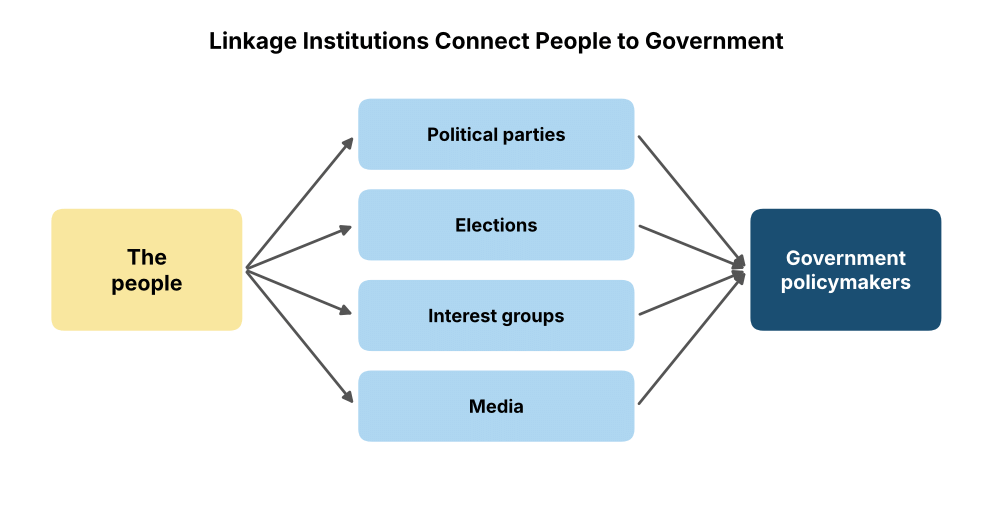
Functions of the Media
The media serves several critical functions in democratic politics.
Investigation: Investigative journalists uncover corruption, fraud, and abuse. Famous examples include Watergate coverage that led to Nixon’s resignation, coverage of the Pentagon Papers, and reporting on the Iraq War. Without investigative journalism, government misconduct often goes undetected.
Agenda-setting: By choosing which stories to cover and which to ignore, the media tells the public what is important. If the media covers an issue extensively, the public thinks it is important, even if objectively it is not. The media agenda-setting power shapes the public agenda.
Framing: The way media present a story shapes how the public understands it. When the media frame a policy as “protection of life,” people understand it one way. When the media frame the same policy as “restriction of choice,” people understand it differently. Frame determines perception.
Priming: Priming is the media’s power to make certain information more salient, more top-of-mind. If the media constantly covers the economy, voters care more about economic issues. If the media focuses on national security, voters care more about security threats.
Public communication: The media provides a platform for debate and communicates government to citizens. Speeches, hearings, and press conferences become public knowledge through media coverage. Citizens learn about policies and candidates through media. Without media, government would be invisible.
Media Ownership and Consolidation
A handful of corporations own most American media. A few corporations (such as Comcast, Disney, Warner Bros. Discovery, Paramount, and Fox) control a large share of national broadcast and cable programming. This consolidation has significant effects.
Reduced local news coverage: Local papers closed when bought by large chains that cut costs. Local stations now produce less local news. A presidential debate might get hours of coverage; a local city council meeting might get none.
Owner power: If one person owns newspapers, TV stations, and radio in a market, that person shapes what the community learns. Owners have incentives to be friendly to politicians and corporations they depend on. This creates conflicts of interest.
Reduced viewpoint diversity: If six corporations control most media, they control which views get heard and which are marginalized. Consolidation can silence minority viewpoints or unpopular positions.
Some argue consolidation is inevitable in a commercial market. Others argue that antitrust enforcement and regulation are needed to preserve media diversity.
Broadcast vs. Internet Regulation
The Federal Communications Commission regulates broadcast television more strictly than cable, newspapers, or internet outlets. Broadcast stations must serve the public interest and cannot broadcast profanity, obscenity, or indecency. Broadcasters also face equal time rules: if a station gives airtime to a political candidate, it must offer equal time to opposing candidates.
Newspapers, by contrast, have near-absolute First Amendment protection. They can endorse candidates, refuse to cover stories, and publish opinions without balancing opposing views. The Supreme Court has held that newspapers are private property, not public forums. Owners decide content.
The internet creates a middle ground. The First Amendment protects online speech. But internet platforms are not truly neutral. Content algorithms determine what users see. Facebook’s algorithm prioritizes engagement, which means sensational and outrageous content spreads. Twitter’s algorithm prioritizes replies and retweets, which amplifies controversy and conflict.
Section 230 of the Communications Decency Act shields internet platforms from liability for user-generated content. Platforms can host content without being sued for defamation or other harms. This has allowed the internet to flourish. But it also means platforms have little incentive to moderate harmful content.
Internet regulation is contested. Some argue platforms should be regulated like broadcasters. Others say Section 230 is essential to internet freedom. Some argue platforms should be broken up or classified as public utilities. These debates will shape the future of online media.
Media Bias
Media bias is real and multifaceted. Structural bias arises from ownership and economic incentives. Commercial media depend on advertising, which means they attract large audiences. Large audiences mean sensational stories are favored over important but boring stories. Breaking news is covered intensely; complex policy analysis is rare.
Individual bias is ideology. Journalists at MSNBC tend to be more liberal. Journalists at Fox News tend to be more conservative. Individual journalists bring their values to their work. They choose which stories to cover, what sources to trust, and how to frame issues.
Partisan media is explicitly ideological. Fox News, MSNBC, and many cable outlets openly embrace ideological positions. They are not neutral; they are advocates. Partisan media energizes party supporters but increases polarization.
Studies suggest journalists are more liberal than the general population. But media also has conservative bias in important ways. Business coverage is often favorable to corporations. Election coverage focuses on the horse race rather than policy. Foreign policy coverage often reflects government perspectives without critical scrutiny.
The term “mainstream media” or “MSM” is increasingly politicized. Conservatives use it to dismiss coverage they disagree with. Liberals use it to refer to corporate-owned outlets. Both sides claim the media is biased against them. Research suggests bias is real but complex.
Horse-Race Journalism, Sound Bites, and Negativity
Election coverage focuses on the horse race: who is ahead, who is behind, and who is gaining. This focus on competition and outcomes leaves little room for policy discussion. Voters learn about candidate matchups, not about candidates’ actual positions.
Campaign coverage emphasizes sound bites: short, memorable quotes. A candidate’s 30-second attack on an opponent gets more airtime than a nuanced policy explanation. This means campaigns focus on slogans and attacks, not substance.
Campaign coverage is increasingly negative. Negative stories get more attention than positive stories. Attacks on opponents are news; policy achievements are not. This incentivizes negative campaigning. If you want coverage, attack your opponent.
Studies show that early election coverage favors frontrunners. Candidates leading in polls get more coverage, which increases their lead. Candidates behind get less coverage, which makes it harder to catch up. This frontrunner bias shapes who wins early contests and builds momentum.
Social Media and Political Communication
Social media platforms have become central to political communication. Presidential campaigns use Twitter/X, Facebook, TikTok, and Instagram to reach voters. Candidates post content directly without media intermediaries. This allows campaigns to control their message.
But social media also enables misinformation. False stories spread instantly. Campaigns and interest groups run ads with misleading claims. Voters encounter false information on their feeds and may believe it.
Social media algorithms create filter bubbles and echo chambers. Algorithms show users content similar to what they have engaged with before. If you follow conservative sources, you see more conservative content. If you follow liberal sources, you see more liberal content. This creates ideologically segregated information environments.
Research is mixed on whether filter bubbles increase polarization. Some studies find they do. Others find that cross-cutting exposure matters less than personal ideology. But algorithms clearly concentrate political information in ways that older media did not.
Social media platforms have enormous power over political discourse. Twitter/X decisions about who to suspend shape the conversation. Facebook’s algorithm shapes what people see. TikTok’s algorithm can make or break political movements. This raises concerns about corporate control of political speech.
Leaks, Anonymous Sources, and Press Relationships
Investigative journalists often rely on anonymous sources: government employees, whistleblowers, or insiders who provide information on condition of anonymity. Anonymous sources allow exposure of wrongdoing that would otherwise be hidden. But they also allow people to spread accusations without accountability. It is difficult to verify anonymous accusations.
Leaks are unofficial releases of government information. Leaks can serve the public interest by exposing classified wrongdoing. But leaks also allow government officials to manipulate the media by leaking selected information to sympathetic journalists. Presidents and officials leak to damage rivals or build support for policies.
The relationship between media and government is adversarial and cooperative. Journalists need sources in government to get information. Government officials need media coverage to communicate with the public. Each uses the other. Press secretaries manage media relationships. Presidents hold press conferences to communicate directly.
Press freedom is highest when the relationship is arms-length and adversarial. When journalists are too cozy with government, they become stenographers for government claims instead of skeptical questioners. Healthy media requires independence.
Citizens United and Campaign Advertising
Citizens United v. FEC (2010) held that the First Amendment protects corporate and union spending on election advertising. Corporations and unions can spend unlimited money on independent expenditures (spending not coordinated with candidates), though they still cannot contribute directly to federal candidates. Super PACs emerged to collect and spend this money.
This has dramatically increased political spending and advertising. Campaign ads are pervasive on all media. Some ads are truthful but many contain misleading claims. Fact-checkers cannot keep up with the volume of advertising.
Candidates and super PACs can run negative ads attacking opponents with exaggeration or false claims. Because of Citizens United, they have money to do this at scale. The media profits from political advertising, which creates incentives to cover politics intensely and sensationally.
Citizens United also allowed dark money: spending by nonprofit organizations that do not disclose donors. Voters see political advertising without knowing who funded it. This raises concerns about accountability and corruption.
Media Literacy and the Future
As misinformation spreads and media sources proliferate, media literacy is increasingly important. Voters need to evaluate sources critically, understand bias, recognize propaganda techniques, and fact-check claims. Schools increasingly teach media literacy to help students navigate information.
The future of media is uncertain. Trust in media is declining. Younger generations rely on social media and influencers rather than traditional news. Local news is disappearing. Subscription models for news are emerging but only serve those who pay. The business model for quality journalism is broken.
Proposals to strengthen journalism include breaking up media monopolies, subsidizing local news, imposing stronger content moderation standards on platforms, and increasing media literacy education. Each proposal is contested and raises its own concerns about government interference or corporate control.
Test-Taking Strategies
Mnemonic: For media functions, remember “IAPFPP” — Investigate, Agenda-setting, Priming, Framing, Platform, Public communication. For media consolidation effects, remember “CDR” — Cuts local coverage, Diversity reduced, Reduces accountability.
Cross-Topic Connections: Media questions connect to First Amendment (free press), political socialization, electoral politics, and public opinion. When you see questions about political influence, ask: What role does media play? Media can affect agenda, framing, and priming, which affects what voters care about and how they think.
Common Question Formats: What function does the media serve? What effect does media consolidation have? How does media bias operate? Why does campaign coverage focus on horse race? How does social media spread misinformation? What impact did Citizens United have on political advertising?
Frequent Student Mistakes:
- Thinking media is monolithic. Traditional media, cable news, partisan outlets, and social media are very different. Know the differences and different regulatory frameworks.
- Confusing structural bias with individual bias. Structural bias from ownership and economic incentives is distinct from ideological bias of individual journalists. Both exist but operate differently.
- Assuming filter bubbles inevitably increase polarization. Research is mixed. What matters is whether people seek diverse viewpoints or retreat into echo chambers.
- Thinking Citizens United was just about corporate spending. It also enabled dark money through nonprofits, which raises accountability concerns.
Test-Day Shortcut: Media questions often ask about a specific function, effect, or type of bias. Identify which aspect of media the question addresses: ownership/consolidation, bias/framing, regulation, or impact on elections. Once you identify the topic, the answer usually follows from understanding that specific aspect. This categorization accelerates your analysis.
Time Management Tip: Media questions are often straightforward conceptual questions. Once you understand the major functions of media, the effects of consolidation, and how bias operates, you can answer quickly. Focus on understanding concepts rather than memorizing facts, and allocate less time to these questions.
Check for Understanding
Think you’ve got it? Complete the quiz below to make sure. Download your results at the end.