
Maximize your score with these resources:
- Albert.io AP® Art History question banks
- Free AP® Art History cheat sheets
- Free AP® Art History score calculator
From roughly 1750 to 1980, European and American art transformed more rapidly than at any prior period in history. The Industrial Revolution, the invention of photography, democratic revolutions, and two World Wars each forced artists to rethink what art was for. The AP® Art History exam tests Topic 4.4: Theories and Interpretations by asking you to explain how formal style reflects these historical and theoretical contexts — not just to identify movements, but to argue why they look the way they do.
Neoclassicism (~1760–1820)
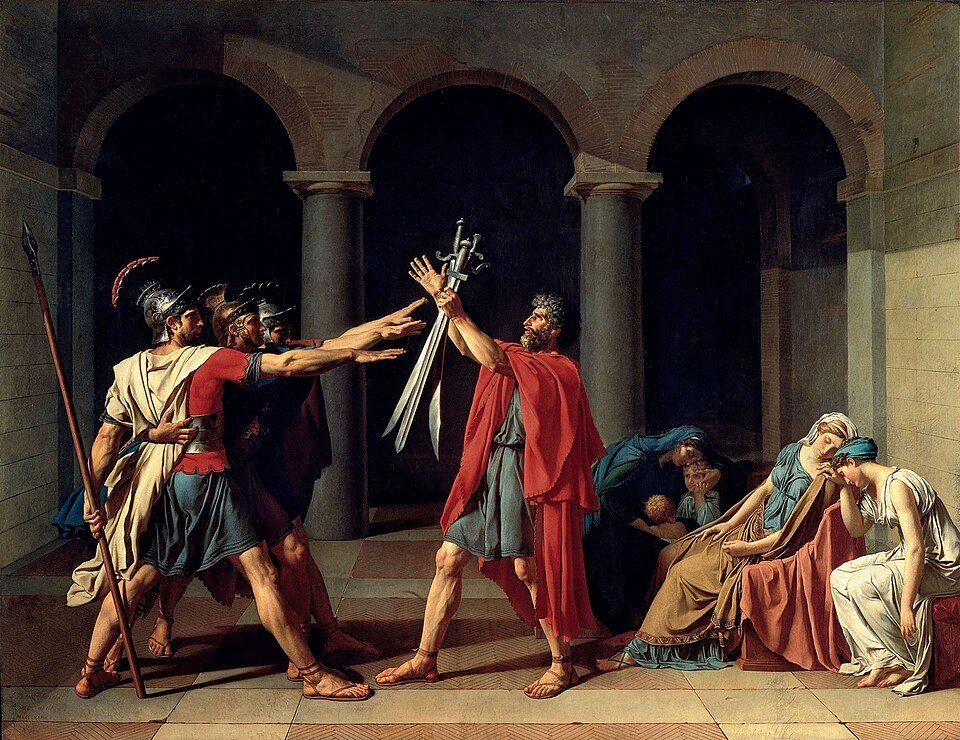
Neoclassicism revived Greek and Roman models with new political seriousness. Driven by Enlightenment rationalism, the rediscovery of Pompeii and Herculaneum, and revolutionary politics, it produced clear, restrained, morally weighty art designed to instruct and inspire civic virtue.
- Key principles: classical subjects, clear contours, restrained color, geometric composition, moral gravity
- Key works: Jacques-Louis David, Oath of the Horatii (1784) and The Death of Marat (1793); Antonio Canova’s sculpture; the Panthéon in Paris
- Key theorist: Johann Joachim Winckelmann, whose Thoughts on the Imitation of Greek Works (1755) argued for “noble simplicity and calm grandeur” as the classical ideal
- Political context: The French Revolution and the early American Republic both embraced classical references as legitimizing models — Roman senators = virtuous republicans
When you see a David painting on the AP exam, connect the formal choice (clear lines, shallow space, gesturing figures) to the political message (civic duty, self-sacrifice, republican virtue).
Romanticism (~1800–1850)
Romanticism emerged as a direct reaction against neoclassical restraint and Enlightenment rationalism. It prioritized emotion over reason, glorified the individual creative genius, and found beauty in dramatic nature, medieval history, and the “exotic” Other.
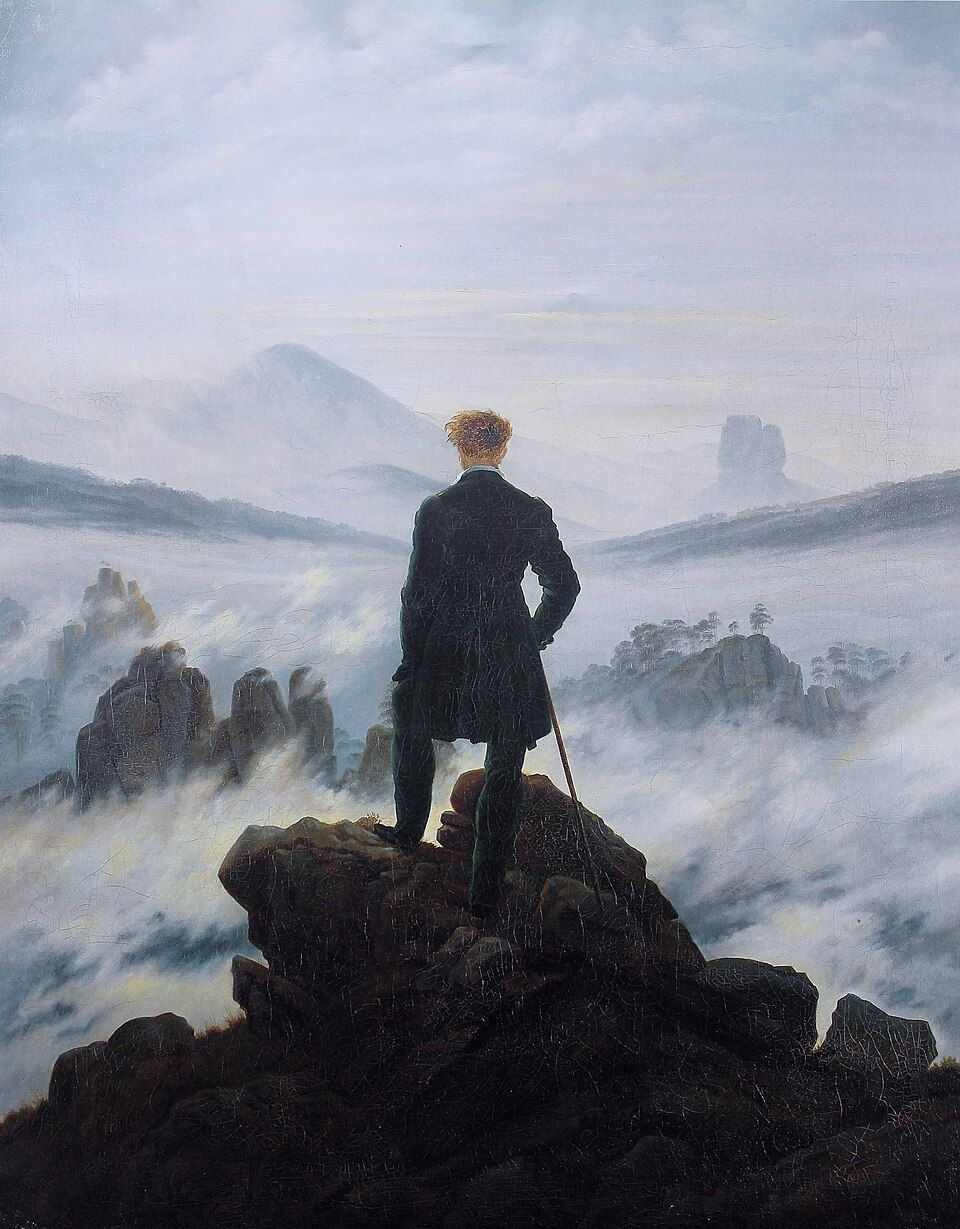
- Key principles: emotion over reason, dramatic color and movement, the sublime in nature, individual creativity, fascination with the medieval and distant
- Théodore Géricault: Raft of the Medusa (1818–19) — monumental scene of suffering and survival that attacked the French government’s negligence
- Eugène Delacroix: Liberty Leading the People (1830) — allegorical revolution scene with dense, swirling color and emotional energy
- Caspar David Friedrich: Wanderer above the Sea of Fog (1818) — the romantic “sublime”: an individual confronting overwhelming nature
- J.M.W. Turner: atmospheric, nearly abstract seascapes that dissolve form into light and weather
- Francisco Goya: Third of May 1808 and the late Black Paintings — nightmarish, psychologically intense responses to war and political terror
Realism (~1840–1880)
Realism rejected both neoclassical idealization and romantic dramatization. Realist artists painted ordinary contemporary life — peasants, factory workers, urban poverty — without heroizing or beautifying. It was a political stance as much as a stylistic one.
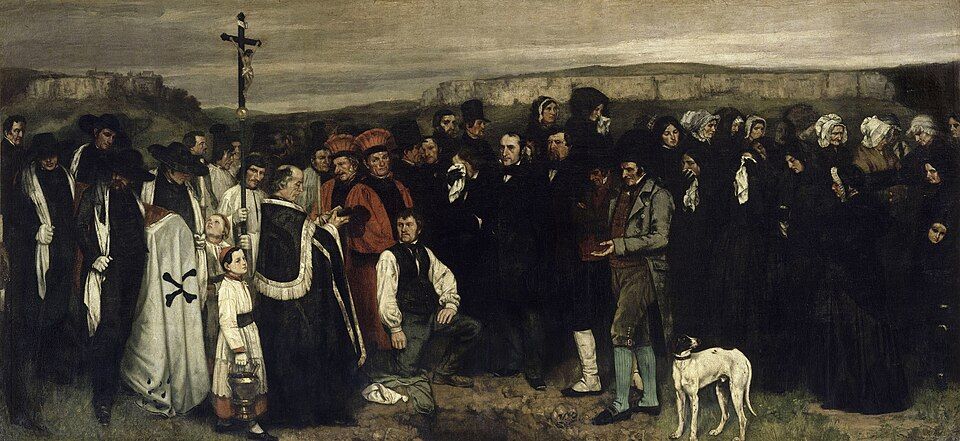
- Key principles: depict contemporary life without idealization; political-social commitment; refusal of allegory and mythology
- Gustave Courbet: The Stone Breakers (1849) and A Burial at Ornans (1850) — monumental treatment of working-class subjects previously deemed unworthy of large-scale painting
- Honoré Daumier: lithographs depicting urban poverty and political satire
- Jean-François Millet: The Gleaners (1857) — peasant scenes that dignified rural labor
Courbet: “I cannot paint an angel because I have never seen one.” — the perfect definition of realism in one sentence.
Photography Enters
The invention of photography (Daguerre, 1839) was the single most disruptive event for 19th-century art. If a camera could capture appearances, painters had to answer: what can painting do that photography cannot? This pressure accelerated the move toward expressiveness, subjectivity, and ultimately abstraction.
- Daguerre and Talbot — inventors of the daguerreotype and calotype processes
- Julia Margaret Cameron — soft-focus portraiture as fine art photography
- Nadar (Félix Tournachon) — portrayed the Parisian creative class; pioneered aerial photography
- Eadweard Muybridge — motion studies that proved how animals and humans actually move (Degas used them to correct his depictions of horses in motion)
For AP FRQs about how photography affected painting: it freed painters from documentary accuracy and pushed them toward what the camera couldn’t capture — emotion, subjectivity, process, dreams.
Impressionism and Post-Impressionism (~1870–1900)
Impressionism emerged in 1860s–70s Paris. These artists worked en plein air (outdoors), used loose, visible brushwork and broken color patches, and focused on the fleeting effects of light and weather rather than carefully finished forms. When the first Impressionist exhibition opened in 1874, critics mocked it — the name stuck.
- Key principles: capturing instantaneous light and atmosphere; modern Parisian life as subject; visible, unblended brushwork
- Claude Monet: Impression, Sunrise (1872), the Water Lilies series, haystacks, and Rouen Cathedral — serial studies of the same subject in changing light
- Pierre-Auguste Renoir: Luncheon of the Boating Party (1880–81) — leisure, sunlight, social pleasure
- Edgar Degas: ballet dancers, racehorses, café scenes — cropped angles borrowed from photography
- Berthe Morisot and Mary Cassatt: women impressionists who depicted domestic and private life from an insider’s perspective — important exam targets
Post-Impressionism (1880s–1900s) reacted against impressionism’s atmospheric dissolution of form, each artist moving toward stronger structure, emotional expression, or symbolic content.
| Artist | Key Move Beyond Impressionism | Key Works |
|---|---|---|
| Paul Cézanne | Constructed forms from intersecting planes of color; preserved volume while breaking traditional perspective — the direct ancestor of Cubism | Mont Sainte-Victoire series; The Card Players |
| Vincent van Gogh | Expressive color and agitated brushwork to convey psychological intensity | The Starry Night; Self-Portrait with Bandaged Ear |
| Paul Gauguin | Symbolic color, Tahitian subjects, “primitivism” — escaping European modernity | Where Do We Come From? What Are We? Where Are We Going? (1897–98) |
| Georges Seurat | Pointillism — small dots of pure color that the eye mixes optically; scientific approach to color theory | A Sunday on La Grande Jatte (1884–86) |
Early Modernist Movements (~1900–1940)
Early 20th-century art produced a rapid succession of movements, each with distinct theoretical commitments. Track the chain of reactions: Cubism breaks up impressionism’s atmosphere into geometric structure. Dada rejects all previous artistic traditions. Surrealism reaches past consciousness for new material. Each movement is partly defined by what it refuses.
| Movement | Core Idea | Key Artists and Works |
|---|---|---|
| Fauvism | Wild, non-descriptive color liberated from naturalism — “fauves” = wild beasts | Matisse, Woman with a Hat (1905), The Red Studio (1911) |
| Cubism | Breaking objects into geometric planes; multiple simultaneous viewpoints; inspired by Cézanne and African art | Picasso and Braque (1907–14); Les Demoiselles d’Avignon (1907); Guernica (1937) |
| German Expressionism | Emotional intensity through distortion of color and form; raw psychological content | Kirchner, Nolde; Käthe Kollwitz’s prints of poverty and war |
| Futurism | Speed, technology, the modern machine; politically aligned with Italian nationalism and fascism | Boccioni, Unique Forms of Continuity in Space (1913) |
| Dada | Anti-art, anti-war response to WWI; absurdity, chance, readymades — if war is irrational, art must be too | Duchamp’s Fountain (1917); Hannah Höch’s photomontages |
| Surrealism | The unconscious, dreams, Freudian symbolism; “pure psychic automatism” | Dalí, Persistence of Memory (1931); René Magritte; Frida Kahlo |
| Bauhaus / Constructivism | Art integrated with design, industry, and social transformation; form follows function | Walter Gropius; Anni and Josef Albers; El Lissitzky; Vladimir Tatlin |
Mid-20th-Century: Abstract Expressionism and Pop
Two postwar American movements dominate this period in the AP framework.
Abstract Expressionism (late 1940s–1950s) centered in New York. Artists created large-scale gestural or color-field abstractions that prioritized process, emotion, and the physical act of painting. Critic Clement Greenberg championed its commitment to flatness as the logical endpoint of modernism.
- Jackson Pollock: drip paintings — paint poured and flung directly onto canvas on the floor; the process becomes the subject
- Mark Rothko: color-field paintings of luminous, hovering rectangles evoking meditative emotional states
- Lee Krasner and Helen Frankenthaler: essential figures often marginalized in early criticism — know their names
- Willem de Kooning: gestural abstraction retaining references to the human figure
Pop Art (late 1950s–1960s) reacted against abstract expressionism’s seriousness by embracing advertising imagery, comics, and consumer goods. Its flatness and irony anticipated postmodernism.
- Andy Warhol: Campbell’s Soup cans, Marilyn Monroe silkscreens — mass reproduction as art; the artist as brand
- Roy Lichtenstein: enlarged comic-book panels treated as high art — borrowed from popular visual culture
- Claes Oldenburg: giant soft sculptures of everyday objects — defamiliarization through scale
Civil Rights, Feminism, and Conceptual Art
By the late 1960s, social movements and conceptual experimentation reshaped art’s purpose and audience. These movements asked: who gets to make art, whose experiences matter, and does art have to be a physical object at all?
- Civil Rights and Black Arts Movement: Romare Bearden’s collages, Faith Ringgold’s story quilts, and Betye Saar’s assemblages engaged directly with Black American history and political struggle
- Feminist art: Judy Chicago’s The Dinner Party (1979) memorialized overlooked women from history; Linda Nochlin’s 1971 essay “Why Have There Been No Great Women Artists?” reframed the question as one about institutional exclusion — not individual talent
- Conceptual art: Joseph Kosuth’s One and Three Chairs (1965), Sol LeWitt’s wall drawings, Yoko Ono’s instruction pieces — the idea can be more important than the physical object
- Minimalism: Donald Judd’s stacked metal boxes, Carl Andre’s floor pieces — strict reduction to industrial materials and geometric forms; no metaphor, no expression
- Earth and Land Art: Robert Smithson’s Spiral Jetty (1970), Nancy Holt’s Sun Tunnels (1973–76) — art moved outside the gallery and into the landscape itself
Interpretive Strategies for the Unit
Use the FIC framework (formal, iconographic, contextual) for any work in this unit, but add three Unit 4-specific lenses:
- Movement and counter-movement: Each style responds to its predecessor. Romanticism rejects neoclassical restraint. Realism rejects romantic dramatization. Impressionism rejects academic finish. Modernism rejects representation altogether. Naming the reaction is half the analysis.
- Technology and media: Photography (1839), lithography, the portable tube of pre-mixed paint (mid-19th century), and later film and video all reshaped what painters could and chose to do.
- Politics: Many canonical works respond to specific political moments — David’s Death of Marat (Revolution), Goya’s Third of May (Peninsular War), Picasso’s Guernica (Spanish Civil War), Civil Rights-era African American art. Knowing the political context turns a visual description into an argument.
Test-Taking Strategies
Use the chronological mnemonic NRR-IP-Mod-AbEx-Pop: Neoclassicism → Romanticism → Realism → Impressionism → Post-impressionism → Modernism (Fauvism, Cubism, Expressionism, Dada, Surrealism, Bauhaus) → Abstract Expressionism → Pop. Three supporting anchors: ‘1839 = photography changes everything’; ‘Cubism = shattered planes, Surrealism = dreams, Dada = absurdity’; ‘AbEx in New York, then Pop reacts with flat irony.’
For MCQ image identification, visual shortcuts cover most questions: classical pose + French Revolution reference → neoclassicism/David; dramatic seascape with tiny human figures → romanticism/Friedrich or Turner; unidealized workers at monumental scale → realism/Courbet; water lilies or Paris cafés with loose brushwork → impressionism; geometric planes with multiple viewpoints → Cubism; dreamlike melting imagery → Surrealism/Dalí; dripped or poured paint, no recognizable subject → Abstract Expressionism/Pollock; consumer product imagery, flat graphic style → Pop/Warhol.
For FRQs, build your thesis around the movement-vs.-counter-movement structure — it gives you a built-in comparative frame that works across any pairing. “Romanticism rejects neoclassical restraint by prioritizing emotion, as seen in Delacroix’s Liberty Leading the People, where swirling color and dynamic figures replace the restrained geometry of David’s compositions” is a model thesis: it names the movement, names the counter-movement, identifies a specific formal feature, and connects it to a specific work.
Watch for two common mistakes. First, students confuse romanticism and realism: romanticism = emotion, drama, the sublime; realism = unidealized depiction of contemporary working-class life. A romantic landscape glorifies nature; a realist painting refuses to beautify it. Second, students call all 20th-century abstraction “modern art.” Pop Art explicitly rejects modernist seriousness — Warhol’s soup cans are not modernist works. And don’t neglect women artists: Morisot, Cassatt, Kahlo, Kollwitz, Frankenthaler, and Ringgold are all exam targets. Budget 2–3 minutes per FRQ sub-part, sketch the movement timeline before writing, and lead every body paragraph with a formal feature tied to a historical force.
Check for Understanding
Think you’ve got it? Complete the quiz below to make sure. Download your results at the end.