

Maximize your score with these resources:
- Albert.io AP® Physics 1 question banks
- Free AP® Physics 1 cheat sheets
- Free AP® Physics 1 score calculator
Pressure is force per unit area. That single definition explains why a nail penetrates wood easily (small area, high pressure), why snowshoes prevent you from sinking (large area, low pressure), and why deep-sea divers experience crushing forces at depth. For AP® Physics 1, you need to handle three types of pressure questions: pressure from a force applied to a surface, pressure at depth in a fluid, and the distinction between gauge and absolute pressure.
| Formula | What It Means | When to Use |
|---|---|---|
| \(P = \frac{F_{\perp}}{A}\) | Pressure = perpendicular force per unit area | Solid-surface pressure; hydraulic force problems |
| \(P_{\text{gauge}} = \rho g h\) | Gauge pressure at depth h in a fluid | Fluid pressure problems; use density in kg/m³ |
| \(P_{\text{abs}} = P_0 + \rho g h\) | Absolute pressure = atmospheric + gauge | When problem asks for total pressure including atmosphere |
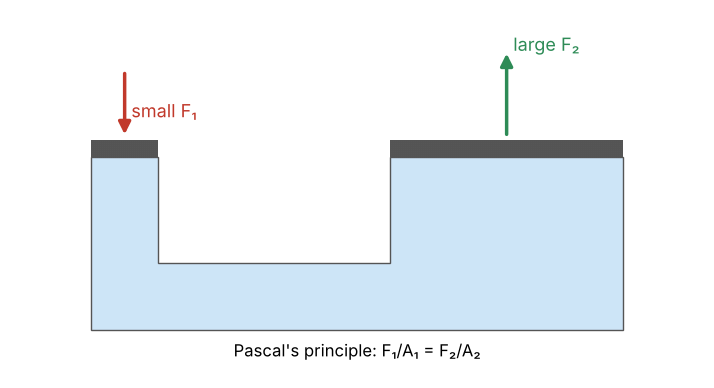
| \(\frac{F_1}{A_1} = \frac{F_2}{A_2}\) | Pascal’s principle — equal pressure in confined fluid | Hydraulic systems |
What We Review
What is the Pressure Formula?
Pressure measures how a force is distributed over an area:
The subscript ⊥ means only the force perpendicular to the surface counts. A force applied at an angle contributes only its perpendicular component to pressure. Pressure is a scalar — no direction, just magnitude.
Worked example: A 100 N force acts perpendicular on a 2 m² surface.
\(P = \frac{100}{2} = 50 \text{ Pa}\)
Same force on a 0.01 m² surface: P = 10,000 Pa. Same force, 200× higher pressure because the area is 200× smaller.
Understanding Gauge Pressure and Absolute Pressure
Gauge pressure is pressure above atmospheric. A car tire pressure gauge reads gauge pressure — it shows how much the tire pressure exceeds the surrounding atmosphere.
\(P_{\text{gauge}} = \rho g h\)
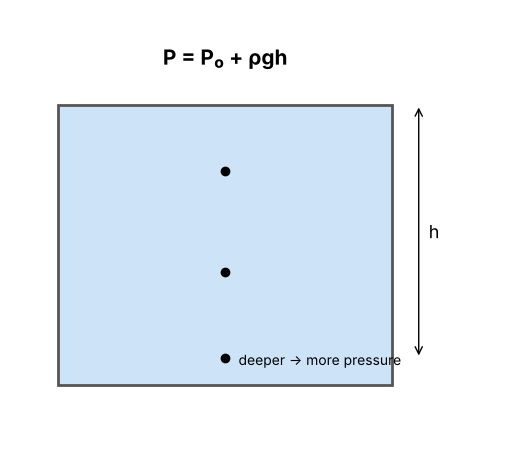
Absolute pressure includes atmospheric pressure at the surface plus gauge pressure:
\(P_{\text{abs}} = P_0 + \rho g h\)
Where P₀ ≈ 101,325 Pa ≈ 1 atm at sea level.

Units of Pressure
- Pascal (Pa) — SI unit; 1 Pa = 1 N/m²
- Atmosphere (atm) — 1 atm = 101,325 Pa ≈ 100,000 Pa (useful benchmark)
- Bar — 1 bar = 100,000 Pa
Benchmark to memorize: Every 10 m of freshwater adds approximately 100,000 Pa (1 atm) of gauge pressure. This lets you estimate depth pressures instantly.
How Pressure Works in Fluids
In a static fluid, pressure at depth h below the surface is:
\(P_{\text{gauge}} = \rho g h\)
Pressure at the same depth is equal everywhere in a connected fluid, regardless of container shape. This is why a narrow tube and a wide tank connected at the bottom have the same pressure at the same depth.
Worked example 1: Pressure at the base of a 10 m water column:
\(P_{\text{gauge}} = 1000 \times 9.81 \times 10 = 98{,}100 \text{ Pa} \approx 1 \text{ atm}\)
Worked example 2: Diver at 5 m depth in seawater (ρ = 1030 kg/m³):
Gauge: \(1030 \times 9.81 \times 5 = 50{,}522 \text{ Pa}\)
Absolute: \(101{,}325 + 50{,}522 = 151{,}847 \text{ Pa}\)
Real-World Applications of Pressure
- Hydraulics (Pascal’s principle): Pressure applied to a confined fluid is transmitted equally throughout. A small force on a small piston creates the same pressure as a large force on a large piston. \(F_1/A_1 = F_2/A_2\). If output piston has 10× larger area, output force is 10× larger.
- Barometers: Measure atmospheric pressure by balancing a column of mercury. 1 atm supports a 760 mm Hg column (Torricelli’s barometer).
- Deep-sea pressure: Every 10 m underwater ≈ 1 additional atm. A submarine at 300 m depth experiences about 31 atm absolute pressure.
Test-Taking Strategies
Mnemonic: “F over A.” Pressure = Force ÷ Area. Smaller area = higher pressure. This answers all qualitative pressure questions about nails, snowshoes, and stilettos instantly.
Mnemonic: “RGH for gauge.” Gauge pressure = Rho × g × Height. Three variables, all you need for depth pressure.
Benchmark: 10 m water ≈ 1 atm ≈ 100,000 Pa. Memorize this. At 20 m: 2 atm gauge, 3 atm absolute. At 30 m: 3 atm gauge, 4 atm absolute. This benchmark resolves most depth pressure MCQs in under 10 seconds.
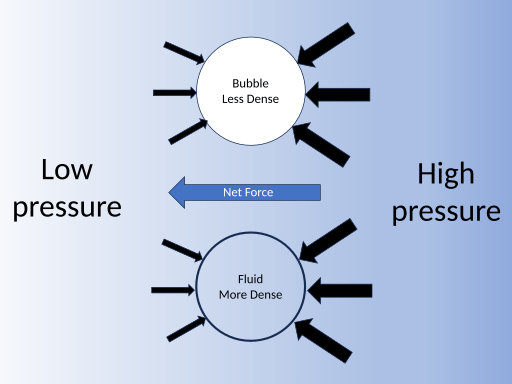
Cross-topic connections: Pressure connects to force (P = F/A) and area, directly linking to Newton’s laws. Hydraulic systems (Pascal’s principle) use pressure to amplify force, the same way levers amplify force using moment arms — both are simple machines conserving work. Pressure differences in fluids create buoyant forces (Fb = ρVsubg), connecting this topic to buoyancy. Bernoulli’s equation uses pressure as one of three energy terms (P + ½ρv² + ρgh = constant), making pressure the connecting thread through all fluid topics.
Common question formats:
- Pressure from force and area: P = F⊥/A. Watch for forces at angles — only the perpendicular component counts.
- Gauge pressure at depth: \(P_{\text{gauge}} = \rho g h\). Use ρ = 1000 for freshwater, 1025–1030 for seawater.
- Gauge vs. absolute: If asked for “total pressure” or “absolute pressure,” add P₀ = 101,325 Pa to the gauge pressure.
- Pascal’s principle: F₁/A₁ = F₂/A₂. Cross-multiply to find the unknown.
Frequent student mistakes:
- Confusing gauge and absolute. Gauge = above atmospheric only. Absolute = gauge + atmospheric. Read the problem carefully.
- Using angled force instead of perpendicular force. Only F⊥ contributes to pressure. If a force is applied at 30° to a surface, use F·sin(30°) for the perpendicular component.
- Wrong density units. Density must be in kg/m³ for pressure in Pascals. 1000 kg/m³ for freshwater, NOT 1 g/cm³ (even though numerically equal).
- Ignoring P₀ when asked for absolute pressure. If the problem asks for “the total pressure” and you calculate only ρgh, you’re off by 1 atm.
Test-day shortcuts: For depth pressure estimation, use the benchmark: every 10 m water ≈ 100,000 Pa. At 5 m: ≈ 50,000 Pa gauge. At 20 m: ≈ 200,000 Pa gauge, ≈ 300,000 Pa absolute. For Pascal’s principle: larger piston area → larger force at same pressure. Write F₁/A₁ = F₂/A₂ and cross-multiply immediately — this is a two-step arithmetic problem.