
Maximize your score with these resources:
- Albert.io AP® US Government question banks
- Free AP® US Government cheat sheets
- Free AP® US Government score calculator
Introduction
Voting is democracy’s foundation. The Constitution has been amended five times to expand voting rights, and the Voting Rights Act of 1965 remains the most powerful federal voting rights legislation. You need to master both the historical expansion of voting rights and the competing models of voting behavior. Understand demographic turnout patterns and apply three major voting models to explain election results.
The Expansion of Voting Rights
The Constitution created no federal voting qualification. States decided who could vote. For most of American history, only white men could vote. Five constitutional amendments gradually expanded voting rights.
15th Amendment (1870): Prohibited states from denying the right to vote based on race or prior servitude. Black men gained voting rights after the Civil War. However, southern states used literacy tests, poll taxes, grandfather clauses, and intimidation to prevent black voting. When Reconstruction ended in 1877, federal enforcement stopped. Southern states reimposed restrictions, and black voting rates plummeted.
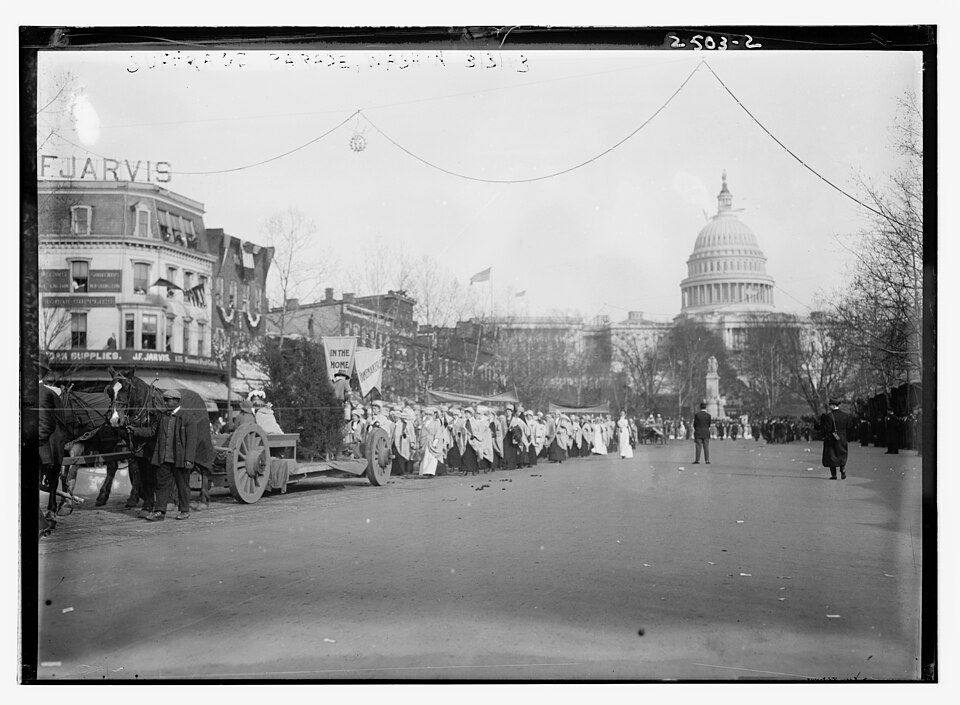
19th Amendment (1920): Granted women the right to vote after decades of advocacy and state-level wins. Women gained the ballot nationwide.
23rd Amendment (1961): Gave residents of Washington, D.C. the right to vote in presidential elections by granting the District electoral votes.
24th Amendment (1964): Abolished poll taxes in federal elections. Poll taxes were flat fees required to vote, disproportionately affecting poor and black voters. Harper v. Virginia State Board of Elections (1966) later banned poll taxes in state elections too, holding they violated the Equal Protection Clause.
26th Amendment (1971): Lowered the voting age from 21 to 18. Young people in the Vietnam War era demanded political voice. If drafted to fight and die in war, they argued, they should be able to vote.
Voting Rights Act of 1965: The most significant federal voting rights legislation in a century. It prohibited literacy tests, a key weapon southern states used to disenfranchise black voters. It required federal preclearance of voting changes in jurisdictions with a history of discrimination. If a southern state wanted to change voting rules, it had to get federal approval first. This gave the federal government direct enforcement power. Black voter registration in the South skyrocketed.
Shelby County v. Holder (2013): The Supreme Court struck down the Section 4(b) coverage formula determining which jurisdictions need preclearance, holding that it was based on 50-year-old data and no longer reflected current conditions. After Shelby County, states previously covered by preclearance could change voting rules without federal approval. Many states immediately enacted strict voter ID laws and reduced early voting periods, which many scholars argue suppressed minority voting rates.
Current Voting Access Debates
Modern voting rights debates center on voter ID laws, voter registration requirements, and voting methods.
Voter ID laws: Some states require photo ID to vote. Supporters argue this prevents fraud. Critics argue that voter fraud is rare and that ID requirements suppress voting among poor people, elderly, and minorities who are less likely to have current photo ID.
Voter registration: Voters must register before the election. Registration deadlines vary. Some states allow same-day registration; others require registration weeks in advance. States debate automatic registration and whether to make registration easy when people interact with the DMV or other agencies.
Early voting and mail-in voting: Some states allow weeks of early voting before Election Day, making it easier to vote without taking time off work. Mail-in voting allows people to vote from home. The COVID-19 pandemic expanded mail-in voting. Some politicians argue this increases fraud risk; others argue it increases access and turnout.
Voter Turnout and Demographic Patterns
Voting turnout is not uniform. Presidential election turnout is typically 55-65 percent of eligible voters (about 66 percent in 2020). Midterm turnout is lower, around 40-50 percent in recent cycles. Certain demographic groups vote at dramatically different rates.
Age: Younger voters (18-29) have the lowest turnout rates, typically 35-40 percent. Older voters (65+) vote at the highest rates, around 65-70 percent. Young people are less likely to be registered and less likely to vote even if registered. Older people have more stable residences, more interest in outcomes affecting retirement, and more established voting habits.
Education: People with college degrees vote at much higher rates (65-70 percent) than people with high school diplomas or less (40-50 percent). Higher education correlates with political interest, information, and civic engagement.
Race: White voters turn out at higher rates (around 60 percent in presidential elections) than black voters (55-60 percent in recent years) or Hispanic voters (40-50 percent). Hispanic turnout is lower partly because a significant portion of the Hispanic population is not yet citizens.
Income: Wealthier people vote at higher rates. This reflects both resources (time to vote, stable address for registration) and political interest.
These patterns remain fairly stable over time, though they shift in response to campaigns, candidates, and political context. A particularly engaging candidate or issue can increase turnout among normally low-turnout groups.
Three Models of Voting Behavior
Political scientists explain voting using three competing models. Each emphasizes different factors. A complete understanding uses all three.
Rational Choice Model
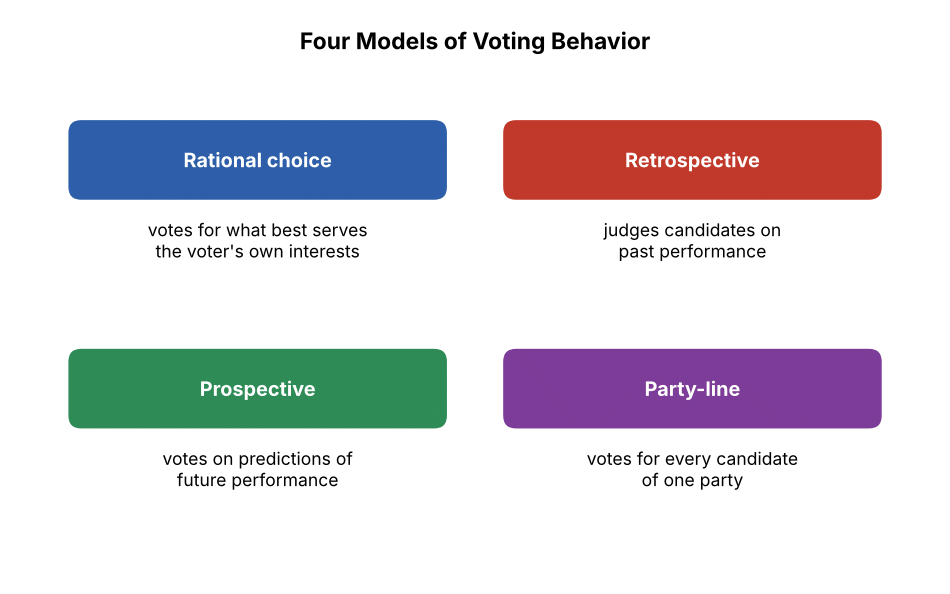
The rational choice model assumes voters are rational actors who evaluate candidates and issues based on self-interest. Voters compare candidates on policy positions and choose the candidate whose policies align with their preferences or serve their interests.
Issue voting: Voters support the candidate who matches their stance on a specific issue like the economy, healthcare, or climate change.
Retrospective voting: Voters evaluate the incumbent’s performance and decide whether to reelect them. Did the economy improve? Did the incumbent keep campaign promises? Voters support incumbents who delivered results and vote them out if they failed. Prospective voting, by contrast, looks forward: voters choose the candidate whose promised future policies they expect to serve them best.
The rational choice model assumes voters have information about candidates and policies. In reality, voters often have limited information and rely on shortcuts like party labels or candidate appearance. The model is partly descriptive (some voting is rational) but also partly aspirational (it assumes more information and rationality than voters typically exhibit).
Sociological Model
The sociological model emphasizes the role of social groups in voting. Voters belong to social groups (class, religion, race, region) that share interests and values. These groups develop voting traditions and transmit them across generations.
Examples: Religious Catholics voted Democratic for generations because the Democratic Party opposed nativism and supported labor unions and immigrant rights. Union members vote Democratic because unions support labor-friendly policies. Wealthy business owners vote Republican because of support for low taxes and deregulation.
Religious leaders and community organizations mobilize their members. Trade unions encourage members to vote for labor-friendly candidates. The sociological model explains voting as a product of group identity and social influence, not just individual calculation.
The sociological model has been most accurate for predicting voting patterns among long-established groups in stable electoral coalitions. But group alignments change over time. Southern white voters abandoned the Democratic Party from the 1960s onward as the party embraced civil rights. Young voters are less influenced by their parents’ party affiliation than previous generations.
Psychological Model: Party Identification
The psychological model emphasizes party identification: your long-term psychological attachment to a political party. It forms early in life, often influenced by parents. Party ID is relatively stable but can shift in response to major political events.
Party identification acts as a perceptual filter. Democrats view Democratic candidates favorably and Republican candidates unfavorably. They interpret political information through a partisan lens. When their party wins, they feel good. When their party loses, they feel bad. Partisanship is not just a rational calculation; it is an identity, similar to rooting for a sports team.
The psychological model explains why many voters vote straight party tickets. It explains why voters forgive party leaders who make mistakes but harshly judge the other party’s leaders for identical behavior. It explains political polarization: as voters identify more strongly with parties, they are more likely to view the other party as not just wrong but dangerous or immoral.
The psychological model has become more predictive in recent elections as party polarization has increased. In the 1950s, many voters split their tickets, voting for candidates from different parties. Today, straight-ticket voting is far more common.
Incumbency Advantage
Incumbents win reelection at very high rates. In recent House elections, over 90 percent of incumbents seeking reelection win. This pattern holds across both parties and across time. Why?
Incumbents have name recognition, fundraising advantages, and the ability to do constituent service (helping constituents with federal agencies). Incumbents can direct spending to their districts, claim credit for local projects, and maintain visibility through media attention. Challengers are typically less well-known and less well-funded.
Redistricting increases incumbency advantage. In most states, the party controlling the legislature draws congressional districts. They can draw districts to pack opposition voters into a few safe opposition districts while spreading their own voters across many safe districts for their party. This creates safe seats for the incumbent party.
Incumbency advantage means electoral change is gradual. Even if voters are dissatisfied with Congress as a whole, they tend to reelect their own representative. This makes the House less responsive to nationwide political shifts and more stable than it might otherwise be.
Candidate Characteristics and Campaign Factors
Beyond issues and partisanship, candidate characteristics matter. Voters respond to candidate appearance, charisma, and perceived competence. Campaign intensity and messaging matter. A well-funded campaign with an effective message can persuade swing voters. A gaffe or scandal can harm a candidate. In very competitive elections, late-breaking events matter. An economic recession just before an election often hurts the incumbent. An attack on the country (like September 11) often boosts the incumbent.
Test-Taking Strategies
Mnemonic for Amendments: “15-19-23-24-26” — 15th (race), 19th (gender), 23rd (D.C. presidential electors), 24th (poll tax), 26th (age 18). For voting behavior models: “RSP” — Rational choice, Sociological groups, Psychological party ID.
Cross-Topic Connections: Voting rights questions connect to federalism (states vs. federal power to regulate elections), civil rights (who is protected from discrimination), and constitutional amendments. Voting behavior questions connect to political socialization, political culture, and electoral politics.
Common Question Formats: Which amendment granted voting rights to a specific group? Why did voting expand? What effect did a voting rights act have? Which demographic group has highest turnout? Which voting behavior model explains a specific voting pattern? How does incumbency affect elections?
Frequent Student Mistakes:
- Confusing the amendments. Know which amendment did what. The 15th is about race, the 19th is about gender, the 24th is about poll taxes, the 26th is about age 18. They come in a logical sequence.
- Thinking voting restrictions are history. Shelby County allowed new voting restrictions. Modern debates about voter ID, early voting, and registration are real.
- Overstating how much the voting behavior models disagree. All three have validity. Rational choice explains some voting. Group identity explains some voting. Party ID explains some voting. A complete explanation uses all three.
- Assuming incumbency advantage is universal. It is very high in House elections but lower in presidential elections and in races where the incumbent party is unpopular.
Test-Day Shortcut: For voting rights questions, remember the amendment timeline and what each did. For voting behavior questions, identify the question type: Is it about demographic turnout? (Look for age, education, income, race patterns.) Is it about voting models? (Match the voting pattern to rational choice, sociological, or party ID model.) Is it about incumbency? (Incumbents usually win.) This categorization will guide your answer.
Time Management Tip: Voting rights questions are usually straightforward factual questions about amendments and laws. They are fast points if you memorize the major provisions. Voting behavior questions require understanding the models but are otherwise conceptual. Allocate time based on question format.
Check for Understanding
Think you’ve got it? Complete the quiz below to make sure. Download your results at the end.