
Maximize your score with these resources:
- Albert.io Digital SAT® Reading and Writing question banks
- Free Digital SAT® Reading and Writing cheat sheets
The word “novel” can mean a long work of fiction, or it can mean new and original. “Sound” can describe a noise, a solid argument, or a narrow body of water. On the Digital SAT, Words in Context questions test whether you can choose the word that fits precisely in a specific sentence. They make up a substantial share of the Craft and Structure domain, and they reward careful reading far more than memorized vocabulary lists.
This article covers Topic 2.1: Words in Context in Unit 2, Craft and Structure. The topic asks you to determine the meaning of a word as it is used in a passage and to choose the most logical and precise word to complete a text.
By the end, you should be able to:
- Recognize the two main types of Words in Context questions.
- Use context clues to predict a word’s meaning before reading the choices.
- Choose words that fit both meaning and tone.
- Avoid traps based on common but incorrect meanings.
Two Question Types
| Type | Typical Stem | Your Task |
|---|---|---|
| Fill in the blank | “Which choice completes the text with the most logical and precise word or phrase?” | Choose the word that best fits the blank |
| Meaning in context | “As used in the text, what does the word ___ most nearly mean?” | Choose the synonym that matches the word’s use in this sentence |
Fill-in-the-blank questions are more common on the Digital SAT, but the same strategy works for both.
Predict Before You Look
The most reliable approach is to cover the choices, read the passage, and fill in the blank with your own simple word. Then pick the choice closest to your prediction.
Worked example 1:
Early critics dismissed the composer’s experimental symphony as noise. Decades later, however, musicians came to regard the work as ______, praising its daring rhythms as decades ahead of their time.
- The contrast word “however” signals a shift from negative to positive.
- “Praising its daring rhythms as decades ahead of their time” suggests something groundbreaking.
- Prediction: “groundbreaking.”
- Best choice: “visionary.” A choice like “chaotic” matches the early critics, not the later musicians; “conventional” contradicts “ahead of their time.”
Using Context Clues
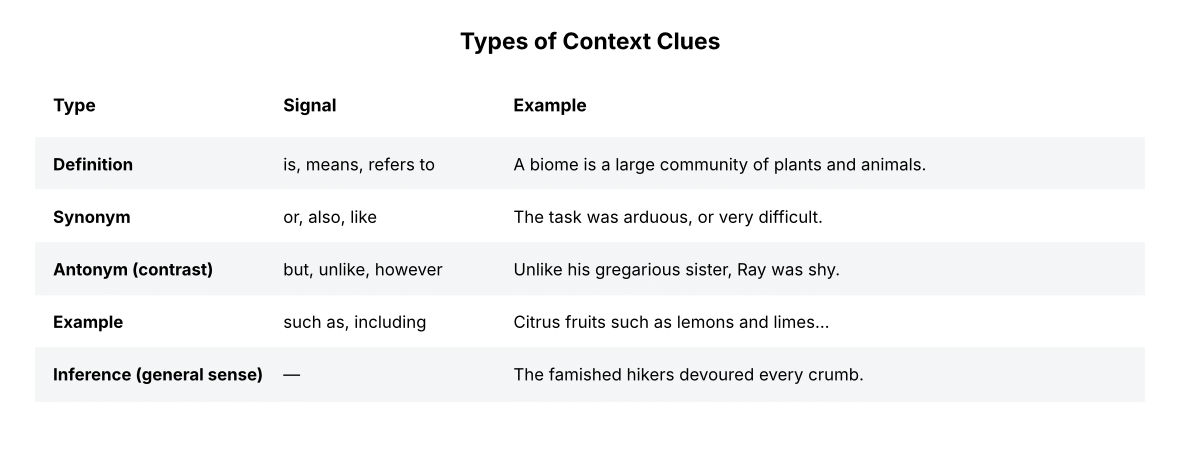
- Contrast clues: however, although, but, despite, instead signal an opposite meaning.
- Continuation clues: and, also, moreover, a colon, or a semicolon signal a similar meaning.
- Cause and effect clues: because, so, therefore, as a result signal a logical consequence.
- Restatement clues: a phrase later in the passage often defines or explains the missing word.
Why does this matter? The passage always contains enough information to choose correctly. Students who rely on what a word “usually” means fall for traps; students who rely on the passage’s clues get the point.
Common Meanings Versus Context Meanings
The SAT likes words with several meanings. In “The scientist’s findings were sound,” the word means well-founded or reliable, not loud. In “The senator’s speech was arresting,” it means striking or attention-grabbing, not related to police.
Worked example 2:
The historian’s account was notably spare: she described the battle in a few precise sentences, leaving out the dramatic speeches other writers had invented.
As used in the text, “spare” most nearly means “concise.” The colon introduces an explanation, “a few precise sentences,” which defines the word. “Extra,” a common meaning of “spare,” does not fit at all.
Precision and Tone
Sometimes two choices have similar meanings, and you must choose the one that fits more precisely. Consider degree and connotation:
- “Disliked” is milder than “loathed.”
- “Thrifty” is positive; “stingy” is negative.
- “Suggested” is weaker than “demonstrated.”
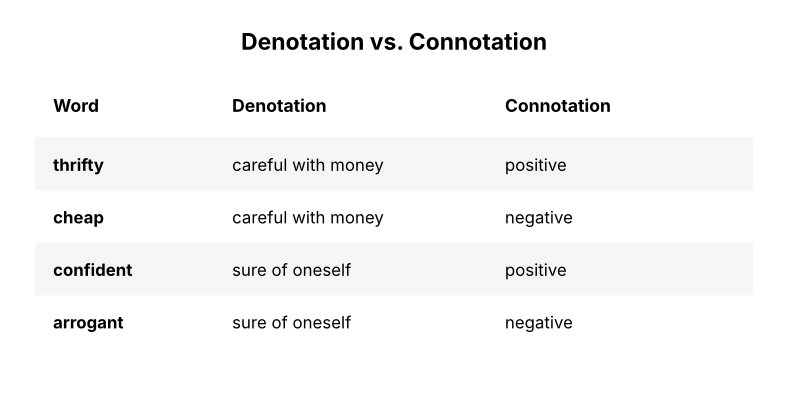
If a passage describes a scientist’s tentative early results, “suggested” fits better than “proved.” Matching the strength of the word to the strength of the evidence is a frequent SAT test point.
Why does this matter? Precise word choice is a core writing skill. The same thinking that helps on test questions helps you choose words that say exactly what you mean in your own essays.
Building Vocabulary Efficiently
Memorizing long lists is less useful than reading widely and noticing how words function. When you meet an unfamiliar word, note the sentence it appeared in, its meaning in that sentence, and any other meanings. Pay special attention to common words with less familiar meanings, such as “qualify” (to limit a claim), “check” (to restrain), and “temper” (to moderate).
Test-Taking Strategies
Mnemonic Devices and Memory Shortcuts
“Cover, predict, match.” For contrast clues, remember “however flips the meaning.”
Cross-Topic Connections
- Clue types are reviewed in Topic 2.2: Context Clues.
- Word strength and tone connect to Reading Skills Topic 2.2: Connotation and Denotation.
- Building vocabulary over time is covered in Reading Skills Topic 4.5: Building Academic Vocabulary.
- Logical connections between sentences are tested in Topic 3.2: Transitions.
Common Question Formats
- Complete a text with the most logical and precise word.
- Identify what a word most nearly means as used in the text.
- Choose between words with similar meanings but different strengths.
- Choose a phrase that fits the tone of a passage.
Frequent Student Mistakes
- Choosing a word’s most common meaning instead of its meaning in context.
- Ignoring contrast words like “however” and “although.”
- Picking a choice that is too strong or too weak for the evidence.
Test-Day Shortcuts
Plug each remaining choice into the sentence and read it silently. The right word sounds logical with every part of the passage, not just the words right next to the blank.
Time Management Tips
The Digital SAT Reading and Writing section gives about 71 seconds per question. Words in Context questions often take 30 to 45 seconds; do not overthink them.