
Maximize your score with these resources:
- Albert.io AP® Human Geography question banks
- Free AP® Human Geography cheat sheets
- Free AP® Human Geography score calculator
Every country has to decide where power lives. In France, the national government in Paris sets most policy for the whole country. In the United States, the 50 states set their own rules on education, criminal law, and much more. Those two approaches, unitary and federal government, shape how countries respond to diversity, distance, and demands for self-rule. The AP® Human Geography exam asks you to explain the difference and to connect a country’s form of governance to its geography.
This article covers Topic 4.7: Forms of Governance in Unit 4, Political Patterns and Processes. The topic asks you to explain how unitary and federal states distribute power, and how each form fits different kinds of countries.
By the end, you should be able to:
- Define unitary and federal states and name examples of each.
- Explain why unitary states tend to be more centralized and federal states more decentralized.
- Connect a country’s size, diversity, and history to its form of governance.
- Explain how devolution can shift power within both kinds of states.
Unitary and Federal States
The key question is how power is divided between the national government and regional governments.
| Feature | Unitary State | Federal State |
|---|---|---|
| Where power sits | Concentrated in the national government, which can create, change, or abolish regional governments. | Shared between the national government and regional units whose powers are protected by the constitution. |
| Direction of power | Top-down and centralized. | Dispersed across several centers of power. |
| Regional units | Carry out national policy with limited independent authority. | Make their own laws in many areas, such as education or policing. |
| Typical countries | Smaller or more culturally uniform states. | Large or culturally diverse states. |
| Examples | France, Japan, China, the United Kingdom | United States, Germany, India, Brazil, Nigeria |


Most countries in the world are unitary. Federal states are fewer, but they include many of the largest countries by area and population. Geographers see a pattern in that distribution.
Why Countries Choose One Form or the Other
Why Unitary States Work for Some Countries
Unitary systems fit countries that are relatively compact or culturally similar. A single national government can pass uniform laws, run one school system, and respond quickly in a crisis. Japan’s strong sense of shared national identity and its relatively uniform population fit a centralized system. France has a long tradition of central control, dating to the monarchy and reinforced after the French Revolution, when the country was divided into departments designed to be run from Paris.
Why Federal States Work for Others
Federal systems fit countries where distance or diversity makes central control difficult. They give regions room to govern themselves, which can hold a diverse country together.
- Size. The United States, Brazil, and Australia cover huge areas. Letting states handle local matters means policies can fit local conditions.
- Cultural diversity. India has hundreds of languages and many religions. Its states, many drawn along language lines, let different groups govern themselves while staying in one country.
- Managing conflict. Nigeria has more than 250 ethnic groups. Its federal system, now divided into 36 states, was designed partly to keep any one group from dominating and to reduce the risk of conflict like the civil war of 1967 to 1970.
- History. Germany’s federal system, with 16 states, was built after World War II partly to prevent the kind of concentrated power that allowed Nazi rule.
Why does this matter? The exam often asks you to explain why a particular country has the form of governance it does. Link federalism to large size, cultural diversity, or a history of conflict. Link unitary government to cultural uniformity, compact territory, or a tradition of central rule.
Strengths and Weaknesses
Neither form is automatically better. Each has trade-offs.
| Form | Strengths | Weaknesses |
|---|---|---|
| Unitary | Uniform laws; clear lines of authority; fast national decisions. | Can ignore regional needs; minority regions may feel unrepresented and push for autonomy. |
| Federal | Local control; room for policy experimentation; accommodates diversity. | Laws vary from place to place; overlapping authority can cause conflict and slow responses. |
A third form, a confederation, gives most power to member units, with only a weak central government. The United States under the Articles of Confederation is the classic example. Confederations are rare today, but supranational organizations like the European Union share some of their features, since member states keep most of their sovereignty.
Devolution: Shifting Power Within States
Devolution is the transfer of power from a central government to regional governments. It can happen in both unitary and federal states, and it’s one of the main ways governments respond to demands for self-rule.
- The United Kingdom is a unitary state, but since 1999 it has devolved significant powers to a Scottish Parliament, a Welsh legislature, and a Northern Ireland Assembly. Scotland held an independence referendum in 2014, and voters chose to stay in the UK.
- Spain is divided into autonomous communities with their own governments. Catalonia held an independence referendum in 2017 that Spain’s national government and courts declared illegal.
- France began decentralizing in the 1980s, giving its regions more authority, though it remains a unitary state.
- Belgium changed from a unitary state to a federal one in 1993 to manage tensions between its Dutch- and French-speaking regions.
Devolution can calm separatist movements by giving regions more control. It can also strengthen regional identity and fuel demands for full independence. For more, see our review of devolution.
Test-Taking Strategies
Mnemonic Devices and Memory Shortcuts
- “Unitary stacks power, federal spreads it.” Unitary states stack power at the top in one central government. Federal states spread it across states or provinces.
- “Big and diverse goes federal.” Large, culturally diverse countries tend to choose federal systems.
Cross-Topic Connections
- Topic 4.6: Federal states depend on internal boundaries to divide power among regions. See our review of internal boundaries.
- Topic 4.8: Devolutionary factors like ethnic separatism and uneven development push states to decentralize.
- Topic 4.9: Supranational organizations like the EU challenge state sovereignty in ways that resemble confederation.
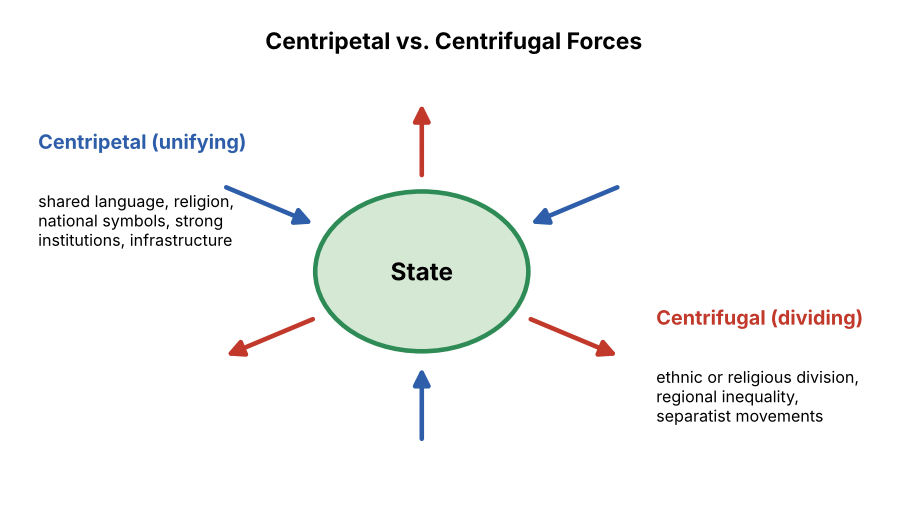
- Topic 4.10: The form of governance can strengthen centripetal forces or feed centrifugal ones. See our review of the consequences of centrifugal and centripetal forces.
Common Question Formats
- Classification MCQ. A description of a country’s government asks whether it’s unitary or federal.
- Map-based MCQ. A world map of unitary and federal states asks you to identify the pattern, such as large countries being federal.
- FRQ with a stimulus. A description of devolution in the United Kingdom or Spain asks you to explain why the central government transferred power.
- No-stimulus FRQ. You compare unitary and federal systems and explain why a culturally diverse country might choose federalism.
Frequent Student Mistakes
- Calling the United Kingdom federal. Scotland and Wales have devolved legislatures, but Parliament in London keeps final authority. The UK is a unitary state with devolution.
- Assuming federal means weak. Federal governments can be very powerful. The difference is that regional powers are constitutionally protected.
- Confusing devolution with independence. Devolution transfers some power to regions inside the state. Independence creates a new state.
- Ignoring geography. The best answers explain why a form fits a country, using size, diversity, or history.
Test-Day Shortcuts
- Look for “constitutionally protected.” If regional powers can’t be taken away by the national government alone, it’s a federal state.
- Look for “top-down” or “centralized.” These words point to unitary states.
- Link devolution to separatism. A question about regions gaining power is often really about separatist pressure.
Time Management Tips
- Multiple choice: Classification questions should take about 30 seconds. Map-pattern questions take longer, so check the legend first.
- Free response: Budget about 25 minutes per FRQ. For comparison parts, give one feature of each form in parallel sentences so the contrast is obvious to the grader.
- Keep two examples ready. France for unitary and India or Nigeria for federal cover most prompts about diversity and governance.
Check for Understanding
Think you’ve got it? Complete the quiz below to make sure. Download your results at the end.