
Maximize your score with these resources:
- Albert.io AP® Microeconomics question banks
- Free AP® Microeconomics cheat sheets
- Free AP® Microeconomics score calculator
You have $40 and a free Saturday. You could see a movie with friends, buy a new video game, or pick up a paid shift and end the day richer. You cannot do all three. That small decision holds the whole idea of microeconomics: limited resources force choices, and every choice has a cost.
This article covers Topic 1.1: Scarcity in Unit 1, Basic Economic Concepts. The topic asks you to define resources and explain what causes their scarcity, including why a few resources may not be scarce at all.
By the end, you should be able to:
- Define scarcity and explain how it creates trade-offs for individuals, firms, and societies.
- Name the factors of production and classify real examples.
- Explain why established knowledge may not be scarce, using the idea of non-rival resources.
- Connect scarcity to opportunity cost and marginal decision-making.
Scarcity and Trade-Offs
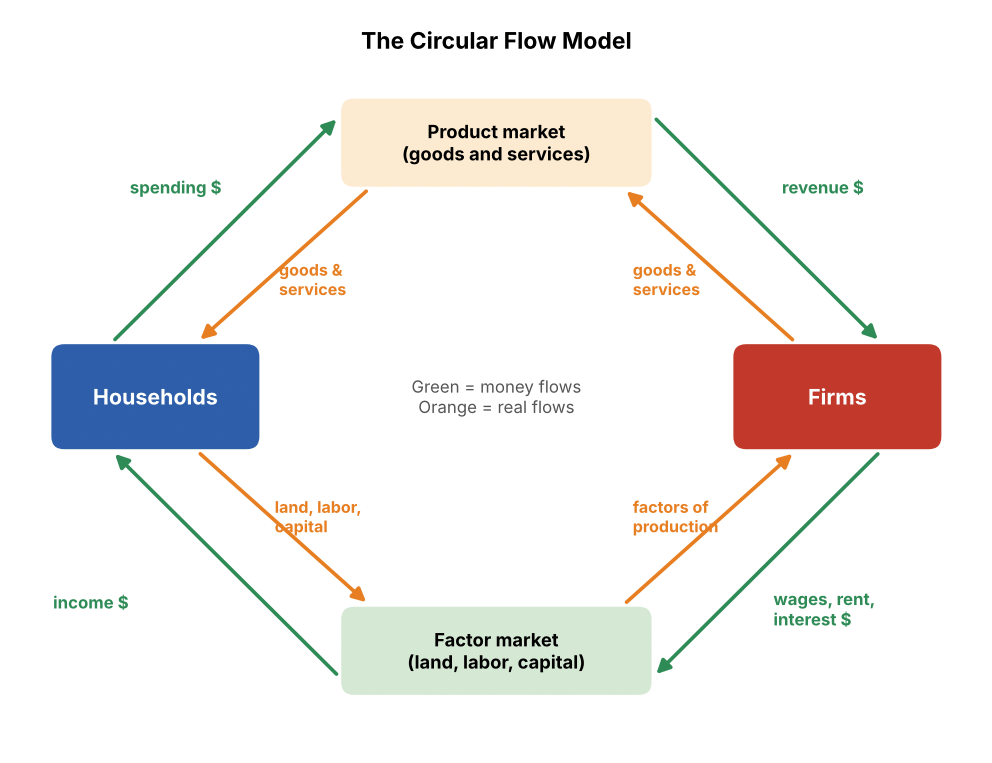
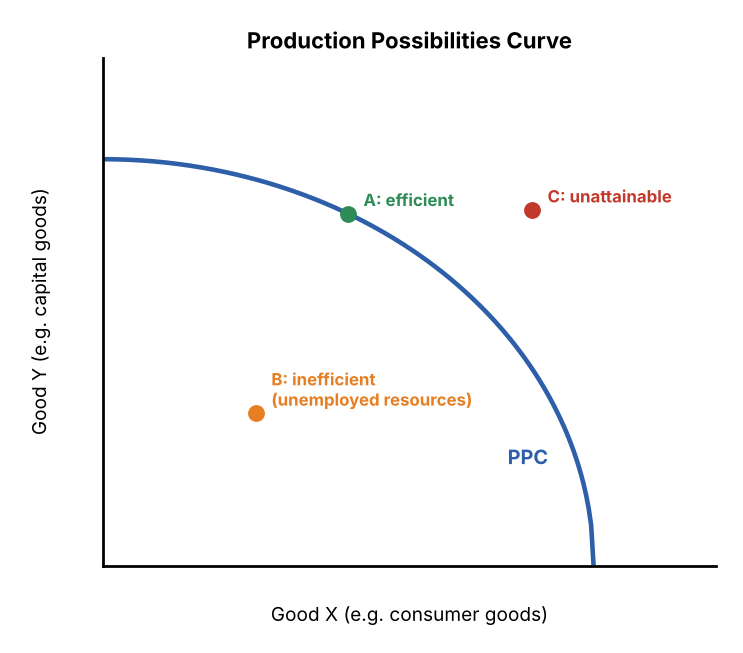
The CED’s enduring understanding is that most resources are scarce, and using them usually involves constraints and trade-offs. Economic trade-offs arise because there are not enough resources to meet all of society’s wants and needs.
| Decision-maker | Constraint | Trade-off |
|---|---|---|
| Consumer | Income and time | Spending $40 on a game means not spending it on a concert |
| Firm | Budget, workers, equipment | Hiring more sales staff means less money for new machines |
| Government | Tax revenue | Funding more highways means less for public schools |
Why does this matter? Microeconomics studies how these decision-makers choose. Every later model, from consumer choice to a firm’s profit-maximizing output, is a structured way of handling a trade-off created by scarcity.
Factors of Production
Resources, or factors of production, are the inputs used to produce goods and services.
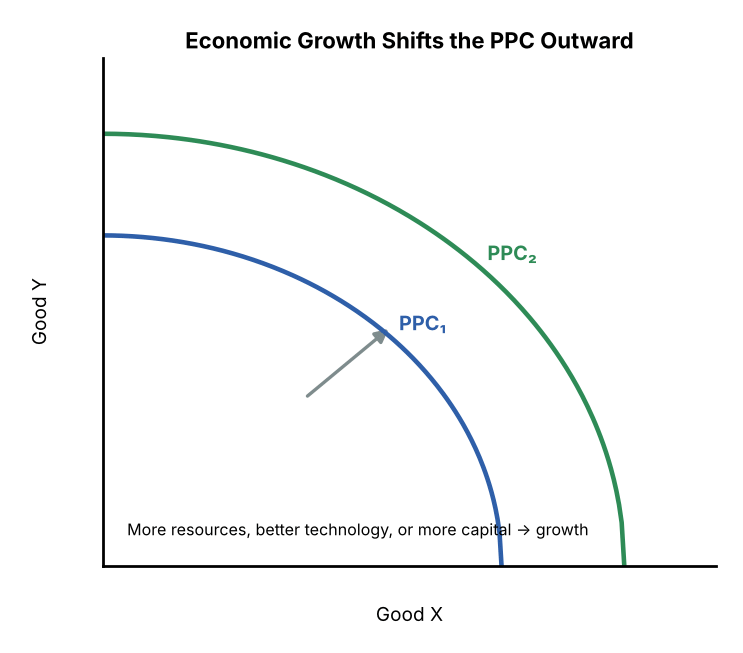
- Land: Natural resources such as soil, minerals, water, and timber.
- Labor: Human time and effort, from a nurse’s shift to a programmer’s code.
- Capital: Human-made tools used in production, such as machines, factories, and delivery trucks. Money and stocks are not capital in this sense.
- Entrepreneurship: The skill of organizing the other resources and taking on risk to start or grow a business.
The Exception: Non-Rival Resources
Here is the twist that sets the Micro CED apart. Most factors of production, such as land, labor, and capital, are scarce. But some, such as established knowledge, may not be scarce because they are non-rival.
| Resource | Rival or non-rival? | Why |
|---|---|---|
| A ton of steel | Rival | If one factory uses it, another cannot. |
| An hour of a worker’s time | Rival | That hour can be spent in only one job. |
| The Pythagorean theorem | Non-rival | Millions can use it at once without using it up. |
| A widely known recipe technique | Non-rival | One chef using it leaves it fully available to others. |
A resource is rival when one person’s use reduces what is left for others. Knowledge that is already discovered can be shared without being depleted, so it does not create the same trade-offs. You will revisit rivalry when you study public goods in Unit 6.
Why does this matter? This distinction explains why ideas can spread so cheaply once discovered, while physical inputs keep their price. It also explains why firms invest heavily in research: new knowledge is costly to create, but once it exists, using it again costs little.
Worked Example: From Scarcity to Opportunity Cost
A student has 3 free hours. She can work at $15 per hour or study for an exam. If she studies, the opportunity cost is the next-best alternative she gave up:
\(\text{Opportunity cost}=3\times 15=45\), or $45 in lost wages.
Notice what the cost is not. It is not the cost of every possible activity she skipped, only the single best one. That rule will matter again when you weigh marginal benefits and marginal costs in Topics 1.5 and 1.6.
Test-Taking Strategies
Mnemonic Devices and Memory Shortcuts
Remember the factors as “LLCE”: Land, Labor, Capital, Entrepreneurship. For the exception, think “Knowledge is Kind”: it can be shared without running out.
Cross-Topic Connections
- Topic 1.2: Resource Allocation and Economic Systems shows how societies answer what, how, and for whom to produce.
- Topic 1.3: Production Possibilities Curve graphs scarcity and trade-offs.
- Topic 1.5: Cost-Benefit Analysis turns trade-offs into explicit and implicit costs.
- Topic 1.6: Marginal Analysis and Consumer Choice shows how scarce income gets allocated.
Common Question Formats
- “Which of the following best illustrates scarcity?” with one answer about limited resources.
- A classification item asking whether a resource is land, labor, capital, or entrepreneurship.
- A question asking why some knowledge is not scarce, with non-rivalry as the answer.
Frequent Student Mistakes
- Calling money a factor of production. It buys resources but does not produce anything itself.
- Confusing scarcity with a shortage. A shortage depends on price; scarcity exists at any price.
- Assuming every resource is scarce. The CED names established knowledge as a possible exception.
Test-Day Shortcuts
For classification items, ask “Was it made by people to produce other goods?” If yes, it is capital. If it came from nature, it is land.
Time Management Tips
The May 2027 exam is hybrid digital: 60 multiple-choice questions in Bluebook in 1 hour 10 minutes, then 3 handwritten free-response answers in 1 hour, including a 10-minute reading period. Definition items like these should take under 40 seconds, leaving time for graph-heavy questions later.
Check for Understanding
Think you’ve got it? Complete the quiz below to make sure. Download your results at the end.