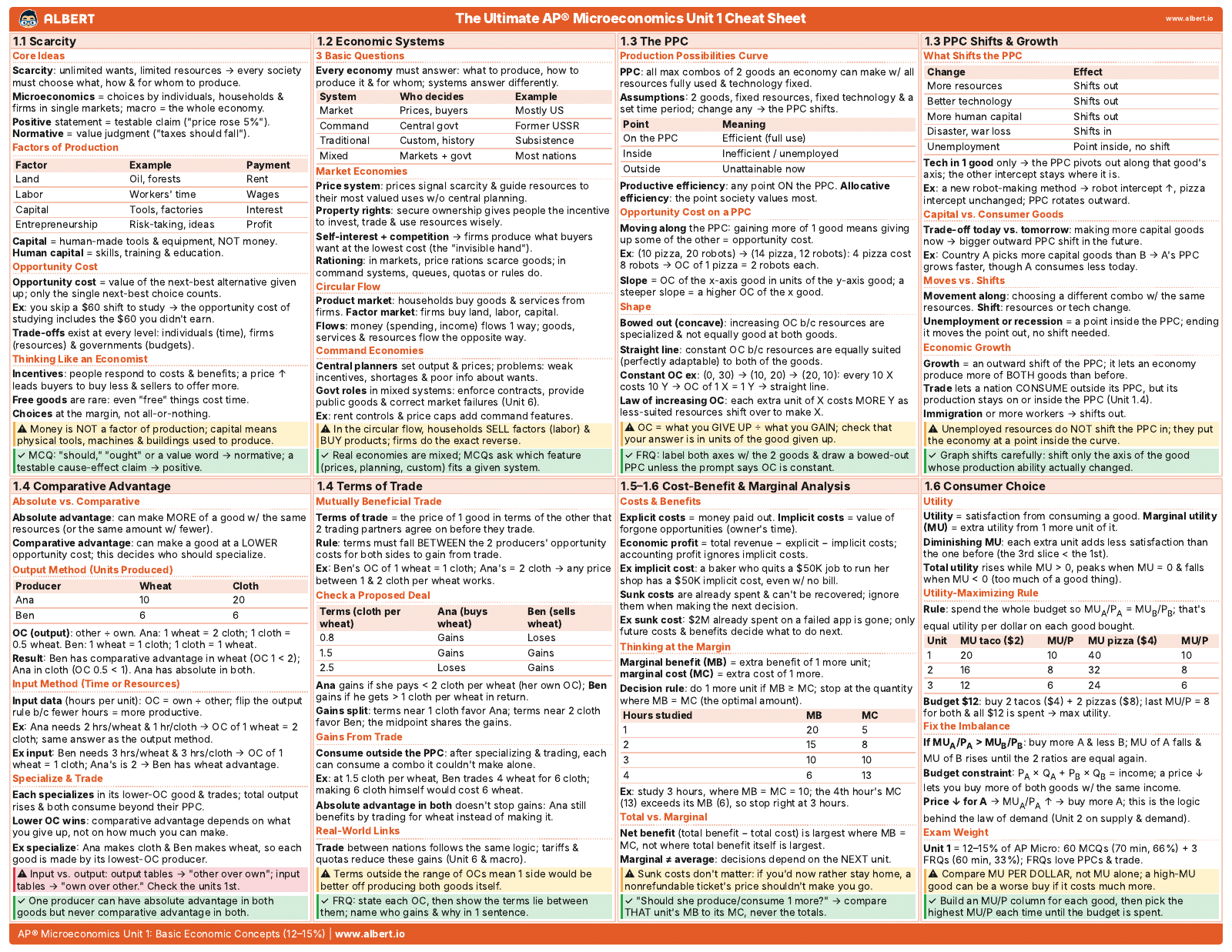
AP® Microeconomics Unit 1 Cheat Sheet: Basic Economic Concepts
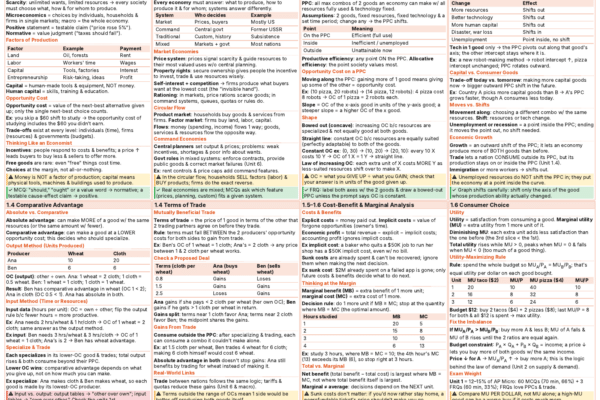
Free AP Micro Unit 1 cheat sheet: scarcity, PPC, comparative advantage, terms of trade, marginal analysis and consumer choice, Simple and Ultimate.

Free AP® Microeconomics review: 40+ study guides by unit, practice questions and exam-day strategy in one place.
Free AP Micro Unit 1 cheat sheet: scarcity, PPC, comparative advantage, terms of trade, marginal analysis and consumer choice, Simple and Ultimate.

This article covers Topic 6.5: Inequality (Learning Objective POL-2.E) from Unit 6: Market Failure and the Role of Government in AP® Microeconomics. You’ll learn…

International trade and public policy sit at the heart of how modern economies function. Understanding how markets reach equilibrium within a country, how that…
Income elasticity of demand and cross-price elasticity of demand are two critical extensions of the elasticity concept that go far beyond simple price sensitivity.…
You have $40 and a free Saturday. You could see a movie with friends, buy a new video game, or pick up a paid…
Government intervention in markets shapes prices, output, consumer welfare, and efficiency outcomes. But intervention doesn’t work the same way in every market structure. A…
Social efficiency in markets is at the heart of microeconomic analysis. Understanding when markets produce socially optimal outcomes and when they fail is essential…

Factor markets—the markets for labor, capital, land, and entrepreneurship—determine how resources are allocated and priced in an economy. Unlike product markets where you analyze…
Topic 5.3: Profit-Maximizing Behavior in Perfectly Competitive Factor Markets is one of the most testable concepts in AP® Microeconomics Unit 5. This topic frequently…
A monopsony is a factor market with a single buyer — just as a monopoly has a single seller. If you’ve studied monopoly power,…

Factor markets are where the inputs to production change hands. While you’ve likely spent most of your microeconomics course studying product markets (where consumers…
This article covers Topic 3.7: Perfect Competition from Unit 3: Production, Cost, and the Perfect Competition Model, which carries 22–25% of the AP® Microeconomics…