

Maximize your score with these resources:
- Albert.io AP® Microeconomics question banks
- Free AP® Microeconomics cheat sheets
- Free AP® Microeconomics score calculator
Factor markets are where the inputs to production change hands. While you’ve likely spent most of your microeconomics course studying product markets (where consumers buy finished goods), factor markets operate by the same supply-and-demand logic but with a crucial twist: firms are now the buyers, and households are the suppliers.
This article covers Topic 5.1: Introduction to Factor Markets (Learning Objective PRD-4.A), part of Unit 5 (Factor Markets) on the AP® Microeconomics exam, which typically accounts for 10-13% of your exam weight. You’ll see factor market concepts show up in multiple choice questions about hiring decisions, wage determination, and input pricing, and they often thread into free-response questions about firm behavior under different market structures.
By the end of this article, you’ll understand how you decide how much of a factor to hire, why that decision depends on both the productivity of the input and its cost, and how changes in product demand or technology shift your demand for factors.
What Are Factor Markets?
Factor markets are markets where factors of production (the inputs firms use to make stuff) are bought and sold. The four main factors of production are:
- Labor — workers and their time. Traded in labor markets where firms hire and workers supply effort in exchange for wages.
- Capital — machinery, tools, buildings, and equipment. Firms rent or purchase capital, and households/investors supply it in capital markets.
- Land — natural resources, physical space, and raw materials. Traded in real estate and commodity markets; suppliers (often resource owners) receive rent or resource payments.
- Entrepreneurship — the coordination and risk-taking that organizes the other factors. Entrepreneurs receive profit (what’s left after paying the other factors).
The fundamental difference from product markets: in factor markets, firms are the demanders and households (or other firms) are the suppliers. A coffee shop demands labor; workers supply it. A manufacturer demands capital; banks and investors supply credit and equipment. This reversal is critical to understanding the dynamics.
Derived Demand: Why Your Factor Demand Depends on Product Demand
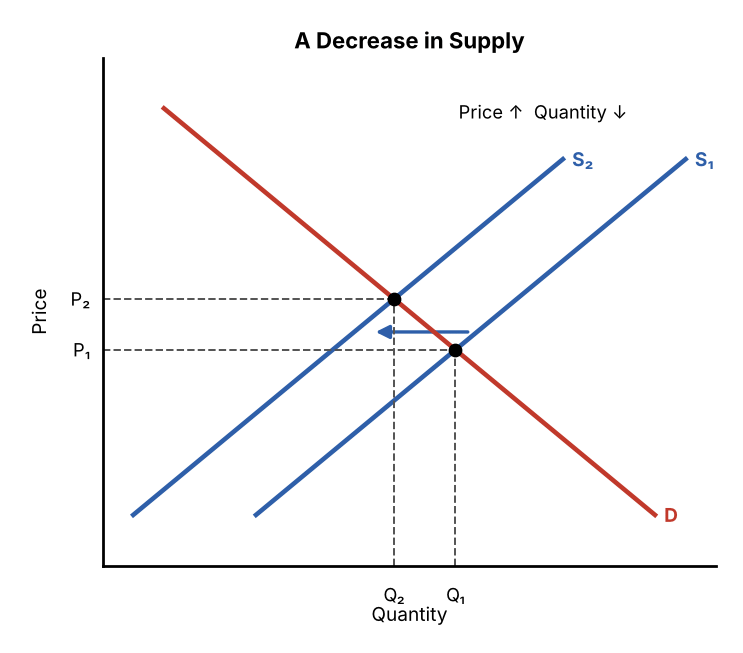
Derived demand is the idea that your demand for a factor of production is derived from the demand for the final product it helps you make. You don’t hire workers because you love workers; you hire them because you want to make and sell products. If product demand drops, your factor demand drops — even if the factor itself hasn’t changed.
Here’s the chain of reasoning:
- Consumer demand for your product increases (the product becomes more popular or your market share grows).
- To meet that demand, you need to increase output.
- To increase output, you must hire more workers, buy more raw materials, or rent more equipment.
- Your factor demand increases.
Flip this: if consumers stop buying your product, you cut production and lay off workers. The demand for labor doesn’t change because workers became less productive or more expensive — it changes because the demand for your output fell.
This is why factor markets are so sensitive to business cycles. During a recession, consumer spending drops, firms cut production, and layoffs spike. During a boom, demand for factors surges. The factor market is a transmission belt for changes in product demand.
Marginal Revenue Product (MRP) and Marginal Factor Cost (MFC): Your Core Decision Framework
Your decision to hire one more unit of a factor hinges on two numbers: how much additional revenue that unit generates, and how much it costs to hire it. These are Marginal Revenue Product (MRP) and Marginal Factor Cost (MFC).
Marginal Revenue Product (MRP)
MRP is the additional revenue you earn from hiring one more unit of a factor. It’s calculated as:
\(\text{MRP} = \text{MR} \times \text{MP}\)Where:
- MR (Marginal Revenue) = the additional revenue from selling one more unit of output.
- MP (Marginal Product) = the additional units of output from hiring one more unit of the factor.
Let’s work through an example. Suppose you run a pizza shop and hire one more worker:
- That worker bakes 10 additional pizzas per shift (MP = 10).
- You sell each pizza for $12, so MR = $12.
- MRP of that worker = $12 × 10 = $120.
That worker generates $120 in additional revenue for your business. But should you hire them? Only if the cost of hiring them is less than $120.
Marginal Factor Cost (MFC)
MFC is the additional cost of hiring one more unit of a factor. In competitive labor markets (which the AP exam usually assumes), MFC equals the wage you must pay. If you hire someone for $15 an hour, your MFC for an 8-hour shift is $120.
In monopsony (a single buyer, like a professional sports league buying player contracts), MFC exceeds the wage because you must raise your wage offer to hire additional workers. But stick with competitive markets for now — that’s the baseline AP scenario.
Why MRP Matters: It’s Your Demand Curve for the Factor
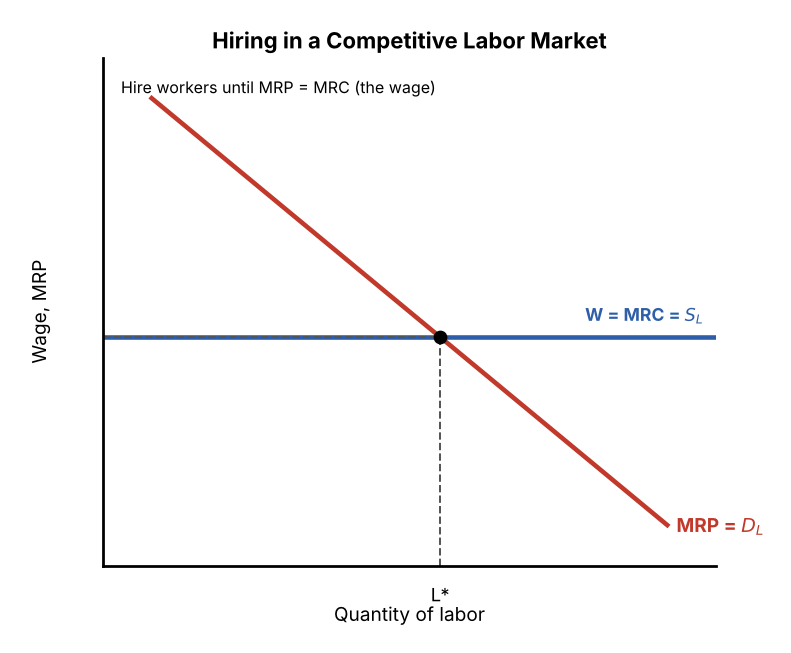
Here’s a key insight: your MRP curve is your demand curve for a factor. It shows the maximum price (wage, rental rate, etc.) you will pay for each additional unit of that factor.
- At MRP = $120 for the first worker, you are willing to pay up to $120 to hire them.
- If the market wage is $100, you hire (since $100 < $120 and profit increases).
- As you hire more workers, MP declines (the law of diminishing marginal returns), so MRP falls.
- If MRP drops to $90 and the wage is $100, you stop hiring (since $90 < $100 and profit would decrease).
The MRP curve slopes downward (due to diminishing marginal product), and it traces out exactly how much of a factor you will demand at each price. This is your demand curve.
The Profit-Maximizing Rule in Factor Markets
You maximize profit in factor markets by following this rule:
Hire factors until MRP = MFC.
This logic mirrors your output-level rule (produce until MR = MC). Just as you produce an extra unit of output only if the marginal revenue exceeds marginal cost, you hire an extra factor only if the marginal revenue from that factor exceeds its marginal cost.
Let’s extend the pizza shop example:
| Worker # | MP (pizzas) | MR per pizza | MRP | Wage (MFC) | Hire? |
|---|---|---|---|---|---|
| 1st | 10 | $12 | $120 | $100 | Yes (MRP > MFC) |
| 2nd | 8 | $12 | $96 | $100 | No (MRP < MFC) |
Your profit-maximizing choice: hire 1 worker (and no more). The first worker’s MRP ($120) exceeds the wage ($100), so you gain $20 in net benefit. The second worker’s MRP ($96) falls short of the wage, so you’d lose $4 if you hired them. Stop at 1.
In competitive labor markets, this rule simplifies even further: you hire until MRP = wage. Why? Because in a competitive market, you are a price-taker; you can hire as many workers as you want at the going wage. The wage = MFC, so you hire until your downward-sloping MRP curve intersects the horizontal wage line.
How Your Factor Demand Shifts
Your MRP curve can shift, changing your entire demand for a factor. Three major causes:
1. Changes in Product Demand (Derived Demand Effect)
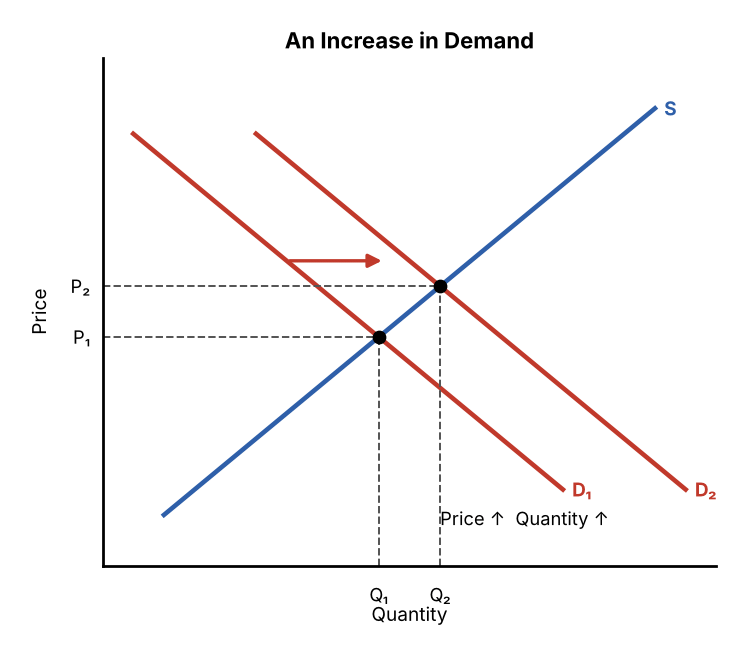
If consumer demand for your product increases, your product’s price may rise or you may sell more units at the same price. Either way, your MR increases, which increases MRP = MR × MP. Your MRP curve shifts rightward (upward), and you demand more of each factor at every wage.
- Example: Starbucks becomes wildly popular. Store demand for labor increases because MRP per barista rises. Starbucks hires more workers at the same wage.
- Flip side: If product demand falls, your MRP drops, and you cut factor hiring.
2. Changes in Factor Productivity (Technology and Complementary Factors)
If the marginal product of a factor increases (due to better technology, worker training, or more complementary factors), then your MRP rises even if product demand doesn’t change. A better tool, a faster computer, or a more skilled workforce increases MP, which increases MRP.
- Example: You invest in new sewing machines. Your workers’ MP increases because each worker can now sew more pieces per hour. MRP per worker rises. You hire more workers at the same wage.
- Opposite: If factor productivity falls (old machines break down, workers are less trained), your MRP falls and you demand less of that factor.
3. Changes in the Prices of Other Factors (Substitution and Complementarity)
Factors can be substitutes or complements. If the price of a substitute factor rises, you switch to the now-relatively-cheaper factor, increasing its demand. If a complementary factor becomes more expensive, you may use less of both.
- Example (substitution): If wages for manual laborers rise, you may buy more automated equipment instead. Labor and capital are substitutes, so an increase in the wage shifts your demand curve for capital rightward.
- Example (complementarity): If the price of steel skyrockets, you may reduce your demand for both steel and the labor needed to work with it. The factors are complements, so a price increase for one reduces your demand for the other.
This is why factor markets don’t exist in isolation — they’re deeply interconnected. A change in one factor market ripples across others.
Test-Taking Strategies
Mnemonic Devices and Memory Shortcuts
“MRP = MR × MP: The Multiplication Game” — This is the formula you must memorize cold. Marginal Revenue Product equals Marginal Revenue times Marginal Product. Once you lock this in, everything else flows from it.
“Hire Until Equal” — Your profit-maximizing rule is simple: hire factors until MRP = MFC. If you see a question asking how many units you should hire, this is your decision rule. MRP > MFC? Hire more. MRP < MFC? Stop hiring.
“Three Shifters of MRP: Demand, Productivity, Other Prices” — When a question asks what shifts your factor demand, think in this order:
- D = Demand for the product (derived demand effect)
- P = Productivity of the factor (technology, training, complementary inputs)
- O = Other factor prices (substitutes and complements)
Cross-Topic Connections
Topic 3.7 (Perfect Competition) → Topic 5.1 (Factor Markets): In perfect competition, you are a price-taker in both product and factor markets. The wage is fixed, so you simply hire until MRP = wage. This is the cleanest scenario for factor market questions.
Topic 4.2 (Monopoly) → Topic 5.1: As a monopolist, you face a downward-sloping demand curve, so your MR < P. This makes your MRP calculation slightly different (lower MR means lower MRP), so you demand less labor at the same wage than a competitive firm does. If a question asks about input hiring under different market structures, this difference is key.
Topic 3.1 (The Production Function) → Topic 5.1: Marginal product is the bridge. When you calculated MC = ΔTC / ΔQ, you were implicitly using marginal product. Higher MP means lower MC; higher MP also means higher MRP. These concepts are flip sides of the same coin.
Topic 5.2 (Changes in Factor Demand and Factor Supply) → Topic 5.1: This article introduces the framework; Topic 5.2 applies it to shifts in factor demand and factor supply and the resulting changes in wages and employment. Master the MRP = MFC logic here, and wage determination becomes straightforward.
Common Question Formats
Format 1: Calculate MRP and decide whether to hire.
Example: “Your workers produce 5 widgets per day. You sell widgets at $10 each. The market wage is $40 per day. Should you hire another worker?”
Your process: MRP = $10 × 5 = $50. MFC = $40 (the wage). Since $50 > $40, hire the worker. This is often a multiple-choice question where you must compute MRP and compare it to MFC.
Format 2: Identify what shifts your factor demand.
Example: “A new technology increases the productivity of workers in your manufacturing plant. What happens to your demand for labor?”
Your reasoning: Higher productivity (higher MP) → higher MRP → rightward shift in your demand curve for labor. The answer is usually “demand increases” or “the demand curve shifts right.”
Format 3: Explain the effect of product demand on your factor demand.
Example: “Suppose consumer demand for automobiles falls. What happens to your demand for steel (an input in auto manufacturing)?”
Your reasoning: Lower product demand → lower prices or lower sales for you → lower MR → lower MRP for steel → your demand for steel decreases. This tests your understanding of derived demand.
Format 4: Short-answer or FRQ involving factor market logic.
Example: “Explain why a competitive firm’s demand curve for labor is the same as its MRP curve.”
Your answer: In a competitive market, you can hire as many workers as you want at the market wage. You hire until MRP = wage. Your MRP curve shows the maximum wage you will pay for each quantity of labor. Since you hire along your MRP curve, your MRP curve is your demand curve.
Frequent Student Mistakes
Mistake 1: Confusing MP with MRP.
Student error: “If marginal product increases, firms will hire more workers.” This is sloppy. What actually matters is MRP. Yes, higher MP means higher MRP (if MR is constant), which can lead to higher hiring. But you only hire more workers if MRP increases relative to the wage. If MP increases but so does the wage, your hiring might stay the same or even fall.
Correction: Always connect MP to MRP to MFC. Say “Higher MP increases MRP, which increases the quantity of labor you demand at a given wage.” This shows you understand the full chain.
Mistake 2: Thinking you demand factors for their own sake.
Student error: “The firm wants to hire more workers because it values labor.” You don’t value factors for intrinsic reasons. You value factors because those factors help you produce and sell output.
Correction: Every factor decision flows from derived demand. You hire workers to increase output and revenue. If hiring doesn’t increase revenue more than it costs, don’t hire. Use the MRP = MFC rule.
Mistake 3: Misidentifying the direction of shifts.
Student error: “When product demand increases, factor supply increases.” Demand ≠ supply. An increase in product demand increases your demand for factors, but it doesn’t directly affect factor supply (the willingness of households/other firms to supply factors).
Correction: Focus on demand. Product demand up → derived demand for factors up → your demand curve for factors shifts right. Supply is a separate question (wages might rise, attracting more workers, but that’s a movement along the supply curve, not a shift).
Test-Day Shortcuts
Shortcut 1: Recognize MRP = MFC questions instantly.
If a multiple-choice question asks “how much should this firm hire?” or “at what price will a firm hire this many units?”, your answer is always the point where MRP = MFC (or MRP = wage in competitive markets). You don’t need to overthink it. Set up the equation and solve.
Shortcut 2: Use your MRP curve as a demand curve shortcut.
On the AP exam, questions often ask “what happens to the firm’s demand for labor?” Instead of redrawing supply-and-demand diagrams, think: “Does MRP shift?” If yes, demand shifts in the same direction. If no, demand doesn’t shift (it’s just a movement along the existing demand curve if the wage changes).
Shortcut 3: Derived demand is the key to rapid reasoning.
When in doubt, ask: “Did product demand change?” If yes, factor demand changed in the same direction (because of derived demand). If no, look at factor productivity or other factor prices. This three-part checklist resolves most “why did demand shift” questions in seconds.
Time Management Tips
For Multiple Choice: MRP and wage comparison questions should take 30-45 seconds. You compute MRP (multiply MR × MP), compare it to MFC or the wage, and pick your answer. Don’t second-guess; the math is straightforward.
For Free-Response: If you get a factor market FRQ, allocate 2-3 minutes to drawing your MRP curve and the wage line, identifying the hiring quantity at the intersection, and then explaining any shifts. The key is clarity: show that you understand MRP = MFC and can apply derived demand logic. Partial credit is generous if you set up the framework correctly.
Avoid the trap of over-explaining. AP readers want to see that you understand the logic (MRP = MFC, derived demand, factor productivity), not that you can write five paragraphs. A clear sentence like “You hire until MRP = wage because hiring stops when the marginal benefit (MRP) equals the marginal cost (wage)” is enough.
Check for Understanding
Think you’ve got it? Complete the quiz below to make sure. Download your results at the end.