
Maximize your score with these resources:
- Albert.io AP® Microeconomics question banks
- Free AP® Microeconomics cheat sheets
- Free AP® Microeconomics score calculator
Introduction
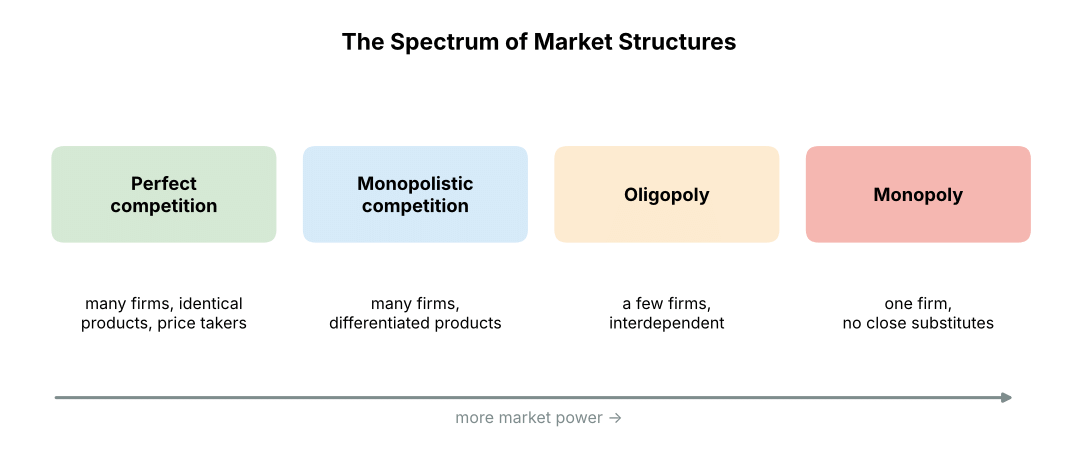
Oligopoly is the only market structure where strategic thinking defines behavior. A few large firms dominate the industry, and what one firm does directly affects the others. An airline’s price cut damages rival airlines immediately. A smartphone maker’s innovation forces competitors to respond. This mutual interdependence makes oligopoly fundamentally different from perfect competition, monopolistic competition, and monopoly. Game theory is the tool to understand strategic behavior when firms are thinking about each other’s moves.
Oligopoly Definition and Characteristics
Oligopoly: An industry with a few large firms that account for most output.
Key characteristics:
- Few firms: Small enough that each firm recognizes rivals and reacts to their decisions. Typically 3-10 firms dominate; many smaller firms may exist but are insignificant.
- Mutual interdependence: Each firm’s profit depends directly on competitors’ actions. Pricing decisions, output changes, and product launches trigger competitor responses.
- High barriers to entry: Economies of scale, brand loyalty, patents, control of resources, or high capital requirements keep new entrants out. Incumbent firms sustain positive economic profit in the long run.
- Product differentiation (may vary): Oligopolies can produce identical products (oil refining, steel) or differentiated products (automobiles, smartphones). Differentiation affects strategy but not the core interdependence problem.
Real-world examples: Airlines (American, United, Delta), automobiles (GM, Ford, Toyota), smartphones (Apple, Samsung, Google), breakfast cereals (Kellogg, General Mills, Quaker).
Mutual Interdependence and Strategic Behavior
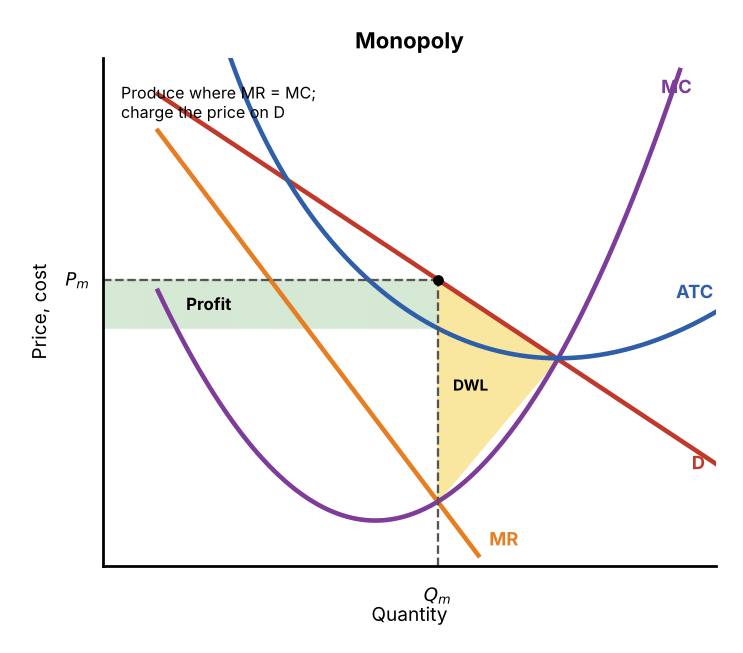
The core challenge in oligopoly: A firm cannot maximize profit by simply setting MR = MC. That rule works for monopolies and monopolistic competitors because their actions do not trigger immediate responses. But in oligopoly, competitors respond instantly.
When Delta lowers fares, United and American cannot ignore it; they must cut fares or lose customers. When Apple launches a new feature, Samsung and Google develop competing features. When Coca-Cola runs a major ad campaign, Pepsi responds. Each firm is thinking: “If I do this, what will they do? And if they respond that way, what should I do next?”
This forward-thinking, game-playing aspect is what makes oligopoly behavior unpredictable from simpler cost-and-demand analysis alone. Firms are not just responding to market demand; they are second-guessing each other.
The Kinked Demand Curve Model
One classic model explains oligopolistic pricing through asymmetric competitor responses.
The assumption: If a firm raises price above the current level, competitors do not match it (they profit by keeping prices low), so the firm faces elastic demand and loses many customers. If a firm lowers price, competitors match the cut immediately (to protect market share), so the firm faces inelastic demand and gains few customers.
Result: The demand curve has a kink at the current price. Above the kink, demand is elastic (raising price loses customers fast). Below the kink, demand is inelastic (lowering price gains few customers because rivals match).
Implication: The marginal revenue curve has a discontinuity (gap) at the kink. When MR has a gap, small changes in MC do not shift the profit-maximizing quantity. The firm maintains price and quantity even as costs change. This explains price rigidity in oligopoly: prices stay stable for long periods.
Limitation: The kinked demand curve assumes specific competitor responses but does not explain why firms expect those responses. Game theory provides a more rigorous foundation.
Fundamentals of Game Theory
Game theory: The study of strategic interactions among rational decision-makers.
A game has four components:
- Players: Decision-makers (firms, in microeconomics).
- Strategies: Choices available to each player (price, output, advertising level).
- Payoffs: Outcomes from each combination of strategies (profits).
- Information: What each player knows (whether they know competitors’ payoffs, etc.).
Dominant strategy: A choice that is best for a player regardless of what others do. If a firm has a dominant strategy, it will choose that strategy without predicting rivals’ moves. But many games lack dominant strategies, forcing firms to think about what rivals will do.
Nash equilibrium: A set of strategies where no player can improve their payoff by unilaterally changing strategy, given what others are doing. Once at a Nash equilibrium, no firm has incentive to deviate because rivals will not accommodate the deviation. Nash equilibrium is the likely stable outcome.
The Prisoner’s Dilemma in Oligopoly
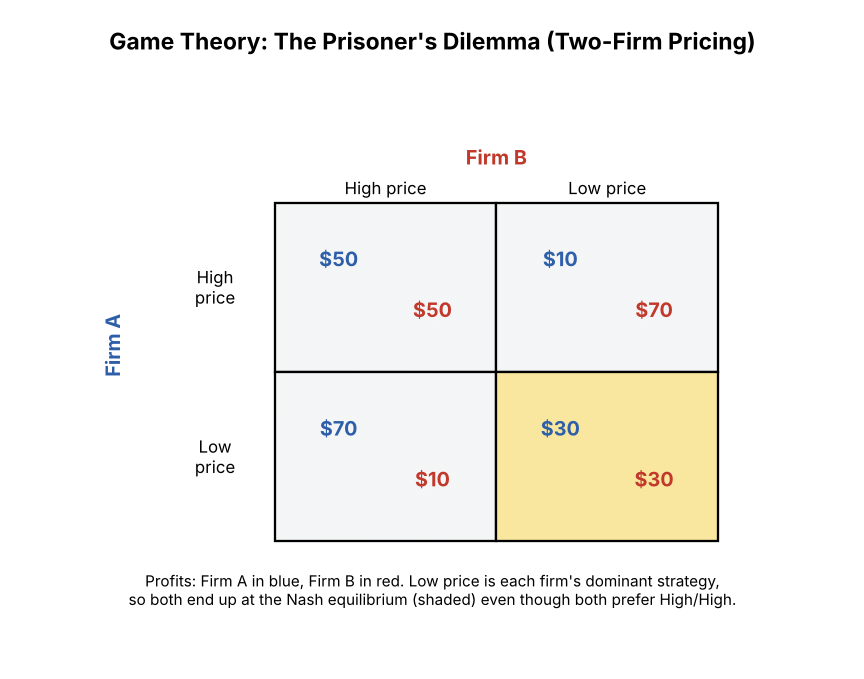
The prisoner’s dilemma is a game where individual rationality leads to collective loss. It explains why oligopolies often cannot sustain collusion despite incentive to coordinate.
Setup: Two competing firms, each deciding whether to charge “High Price” or “Low Price.”
| Firm A Firm B | High Price | Low Price |
|---|---|---|
| High Price | A = 10, B = 10 | A = 5, B = 15 |
| Low Price | A = 15, B = 5 | A = 8, B = 8 |
Analysis: For Firm A, low price is dominant. If B charges high price, A earns 15 (better than 10). If B charges low price, A earns 8 (better than 5). So A chooses low price. The same logic applies to B. Both choose low price, earning 8 each. But if both had charged high price, they would each earn 10. The outcome is worse than what coordination would achieve.
The dilemma: Both firms want higher prices and higher profit. But each fears the other will cheat and undercut, so both undercut. Individual rationality produces collective loss.
In real oligopoly: Airlines want to maintain high fares but fear competitors will offer discounts. Computer makers want to maintain chip prices but fear rivals will price aggressively. The prisoner’s dilemma is constant.
Cartel Behavior and Collusion
Cartel: A group of firms that explicitly or tacitly agrees to restrict output and raise prices above competitive levels.
Why cartels form: To escape the prisoner’s dilemma. If firms could coordinate on high prices, they would earn more collectively (and individually, if divided equally). OPEC coordinated on oil production limits and raised prices far above competitive levels.
Cartel stability problem: Each member has incentive to cheat. If all other members honor the agreement and charge high price, a cheater can undercut slightly and capture huge market share, earning enormous profit. This temptation to cheat is perpetual.
Enforcement problem: Maintaining a cartel requires detecting cheating and punishing defectors. If firm A secretly lowers price, other members must discover it and respond (e.g., by starting a price war). Antitrust law prohibits explicit cartel agreements in the U.S. and most countries, making formal enforcement mechanisms illegal.
Real-world result: Cartels often collapse as members cheat. The OPEC cartel has periodically broken down when members produce beyond agreed quotas to gain revenue. Airline collusion was detected and prosecuted; members paid billions in fines.
Tacit Collusion and Price Leadership
Tacit collusion: Firms coordinate prices without explicit communication, finding a cooperative equilibrium through observation and repeated interaction.
Price leadership: One firm (typically the largest or most efficient) sets price, and competitors match it. The leader does not announce the price; it simply raises or lowers price, and followers observe and match.
How it works: The leader sets price to maximize its profit, accounting for the fact that followers will match. Followers set price equal to the leader’s price, maximizing their profit given the leader’s choice. This achieves a coordinated outcome closer to monopoly pricing than to competitive pricing, without illegal explicit agreement.
Antitrust concern: Price leadership can indicate collusion, but it is legal if it involves no explicit communication. However, antitrust authorities monitor oligopolies for evidence of collusion and investigate suspicious price patterns.
Stability: Tacit collusion is fragile. It works when demand is stable and entry barriers are high. When demand fluctuates or new competitors emerge, the cooperative arrangement breaks down and price wars occur.
Barriers to Entry and Long-Run Profit
Why oligopolies sustain positive economic profit in the long run: High barriers to entry prevent new firms from entering and competing away profit.
Natural barriers:
- Economies of scale: MES is large relative to market demand. A new entrant must be a large producer from day one, requiring massive capital investment and risk.
- Control of essential inputs: An incumbent firm may own critical resources (patents, minerals, exclusive supplier contracts) that a new entrant cannot access.
Strategic barriers:
- Brand loyalty: Consumers prefer established brands and are willing to pay premiums. Building rival brand awareness requires huge advertising spend.
- Network effects: A platform’s value grows as more users join. Incumbent platforms (Facebook, Visa) become harder to dislodge as they grow larger.
- Exclusive contracts: An incumbent may lock suppliers or distributors into exclusive relationships, blocking rivals’ access.
Result: With barriers in place, oligopolists earn positive economic profit indefinitely. Profit does not fall to zero (as in perfect competition and monopolistic competition). Barriers maintain the oligopolistic structure.
Market Concentration and the Herfindahl-Hirschman Index (HHI)
Market concentration: The degree to which a few firms dominate an industry.
Herfindahl-Hirschman Index (HHI): Sum of squared market shares. HHI = Σ(market share %)^2.
Interpretation:
- HHI below 1,500 = unconcentrated (competitive)
- HHI 1,500-2,500 = moderately concentrated
- HHI above 2,500 = highly concentrated (oligopoly or monopoly)
- HHI = 10,000 = monopoly (one firm with 100%)
Example: Five firms with market shares 40%, 30%, 15%, 10%, 5%. HHI = 40^2 + 30^2 + 15^2 + 10^2 + 5^2 = 1,600 + 900 + 225 + 100 + 25 = 2,850 (highly concentrated oligopoly).
Antitrust use: The U.S. Department of Justice and Federal Trade Commission use HHI to assess whether mergers would harm competition. Under the 2023 Merger Guidelines, a merger increasing HHI by more than 100 points in a market with HHI above 1,800 is presumed to harm competition and may face challenge.
Limitation: HHI measures structure (how concentrated) but not behavior (whether firms collude) or performance (profit, innovation). Two oligopolies with the same HHI may behave very differently depending on entry barriers, demand stability, and history.
Oligopoly Outcomes: The Spectrum from Competition to Collusion
Oligopolies do not settle into a single outcome. They move along a spectrum depending on conditions:
- Competitive outcome: Fierce price wars, prices near marginal cost, minimal profit. Occurs when entry is easy, demand is unstable, or many firms compete.
- Cooperative (cartel) outcome: High prices, restricted output, maximum profit divided among members. Occurs when firms can coordinate and enforce agreement.
- Mixed outcome (most common): Tacit coordination on prices (like price leadership) with periodic cheating and price wars. Profit is above competitive but below monopoly.
Factors favoring cooperation: Few firms, homogeneous products, stable demand, high barriers to entry.
Factors favoring competition: Many firms, differentiated products, volatile demand, low barriers to entry.
Test-Taking Strategies
Mnemonic: “KING” (Kinked demand, Interdependence, Nash, Game theory): Use this to organize oligopoly concepts. These are the four pillars.
Cross-Topic Connections (High-Yield): (1) Oligopoly profit is sustained by barriers to entry (unlike monopolistic competition). (2) Oligopolies have downward-sloping demand and price-setting power (like monopoly). (3) Oligopolies face strategic uncertainty (unlike perfect competition or monopoly where strategy is clear). (4) Game theory (Nash equilibrium, dominant strategy, prisoner’s dilemma) applies uniquely to oligopoly on the AP exam.
Game Theory Quick Reference:
- Dominant strategy: Best choice regardless of what others do. Play it immediately.
- Nash equilibrium: Outcome where no player can improve by unilaterally deviating. It’s stable and predictable.
- Prisoner’s dilemma: Dominant strategies lead to worse outcome than cooperation. Individual incentive and collective welfare conflict.
Common Question Formats: “Which statement best describes mutual interdependence in oligopoly?” “In the payoff matrix, identify the Nash equilibrium.” “Why do cartels tend to break down?” “Calculate HHI from market share data.” “How does price leadership allow tacit collusion?” “What happens when oligopolies compete intensely vs. cooperate?”
Payoff Matrix Strategy: When you see a 2×2 payoff matrix, immediately:
- For each player, find dominant strategy (if it exists) by comparing payoffs for each opponent choice.
- Mark the cell where both players play their dominant strategy. This is likely the Nash equilibrium.
- Identify if this outcome is worse than a mutually beneficial outcome (prisoner’s dilemma).
Practice this on 3-4 matrices now so it becomes automatic on test day.
Frequent Student Mistakes and How to Avoid Them: (1) Confusing Nash equilibrium with the best outcome: Nash equilibrium is stable (no player wants to deviate unilaterally) but may be suboptimal (both could do better by cooperating). In the prisoner’s dilemma, Nash equilibrium is not best outcome. (2) Forgetting that oligopolies have barriers to entry: This is why they sustain profit long-run unlike monopolistic competition. Barriers are critical. (3) Missing that oligopolies are unpredictable: Perfect competition, monopolistic competition, and monopoly have clear predictions (MR = MC). Oligopoly behavior depends on how firms think rivals will respond, making it ambiguous without explicit strategic analysis. (4) Mixing up price leadership with price discrimination: Price leadership is a tacit collusion where firms coordinate on high prices. Price discrimination is when a monopoly charges different prices to different customers. Different concepts.
Test-Day Process of Elimination: If the question says “few firms” and “mutual interdependence,” you have oligopoly. If it asks about strategy or payoffs, game theory applies. If it mentions coordination or agreement, think collusion and stability. If it asks why cartels break down, the answer is incentive to cheat. If it shows a matrix, find the Nash equilibrium cell.
Time Management Tip: Payoff matrix questions are high-yield and high-speed if you master the template. Practice finding dominant strategies and Nash equilibrium on 5 matrices now (spend 2-3 minutes each). Once the pattern is automatic, you can solve exam questions in 60-90 seconds. This single skill unlocks 10-15% of oligopoly exam points.
Check for Understanding
Think you’ve got it? Complete the quiz below to make sure. Download your results at the end.