

Maximize your score with these resources:
- Albert.io AP® Microeconomics question banks
- Free AP® Microeconomics cheat sheets
- Free AP® Microeconomics score calculator
Monopolistic competition sits at the intersection of monopoly and perfect competition. It’s one of the most tested market structures on the AP® Microeconomics exam because it mirrors the real world better than either extreme. You’ll see firms with market power operating in nearly every industry: coffee shops, restaurants, clothing brands, and streaming services all practice monopolistic competition. Understanding how these firms behave in the short run and adjust in the long run is crucial for both multiple-choice questions and free-response problems on the exam.
This review covers the defining characteristics of monopolistic competition, the short-run and long-run equilibrium conditions, product differentiation strategies, and the efficiency implications. You’ll also learn how to recognize monopolistically competitive markets on the exam and avoid common pitfalls that cost students points.
This article targets learning objectives MKT-4.E and MKT-4.F, which focus on short-run profit and loss scenarios and long-run equilibrium with zero economic profit. These concepts fall within Unit 4 on imperfect competition, which accounts for 15-22% of the exam weight.
What Defines Monopolistic Competition?
Monopolistic competition is a market structure with four defining characteristics:
- Many firms: Enough sellers that no single firm controls the market, but not so many that individual firms act as price-takers.
- Product differentiation: Each firm sells a unique version of a similar good (brand, quality, location, design).
- Free entry and exit: Barriers to entry are low, so new firms can enter when existing firms earn economic profit.
- Some price-making ability: Because products are differentiated, each firm faces a downward-sloping demand curve and has control over its price.
The key insight: monopolistically competitive firms are not perfect competitors (who are price-takers), but they’re also not true monopolists (because many competitors exist). This middle ground creates unique short-run and long-run outcomes that the exam tests frequently.
Why this matters for the exam: You need to recognize when a market is monopolistically competitive versus perfectly competitive or monopolistic. The exam rewards students who can identify the market structure from a scenario and apply the appropriate equilibrium analysis.
Short-Run Equilibrium: Firms Can Earn, Break Even, or Lose
In the short run, a monopolistically competitive firm operates similarly to a monopoly. Each firm faces a downward-sloping demand curve and maximizes profit by producing where marginal revenue equals marginal cost.
The equilibrium rule: Find the quantity where \(MR = MC\). Then move up to the demand curve to read the price the firm can charge. The firm’s profit or loss depends on how price compares to average total cost at that quantity.
Three outcomes are possible:
- Economic profit: If \(P > ATC\), the firm earns profit above the normal return. This signals new firms to enter the market.
- Break-even: If \(P = ATC\), the firm covers all costs (including opportunity costs) but earns zero economic profit.
- Economic loss: If \(P < ATC\), the firm loses money. It continues to operate as long as \(P > AVC\) (to minimize losses), but may exit in the long run.
The exam frequently presents short-run scenarios with graphs or data and asks you to identify whether a firm earns profit, breaks even, or takes a loss. Practice reading the relationship between P and ATC at the profit-maximizing quantity.
Common trap: Students often confuse short-run profit with long-run profit. In the short run, monopolistically competitive firms CAN and DO earn positive economic profit. But this triggers entry and shifts everything in the long run.
Long-Run Equilibrium: Economic Profit Falls to Zero
The long run brings a critical change: economic profit must equal zero for all firms in monopolistic competition. Here’s why:
- If firms earn economic profit in the short run, new firms enter the market (free entry assumption).
- New entry increases total supply, which shifts individual firms’ demand curves to the left (because customers have more options).
- As demand shifts left, price falls and profit shrinks.
- Entry stops only when economic profit reaches zero, or \(P = ATC\).
Similarly, if firms take losses in the short run, some firms exit the market. Their exit reduces supply, shifts remaining firms’ demand curves to the right, and price rises until losses are eliminated.
The long-run equilibrium condition: Each firm produces at \(P = ATC\), earning zero economic profit.
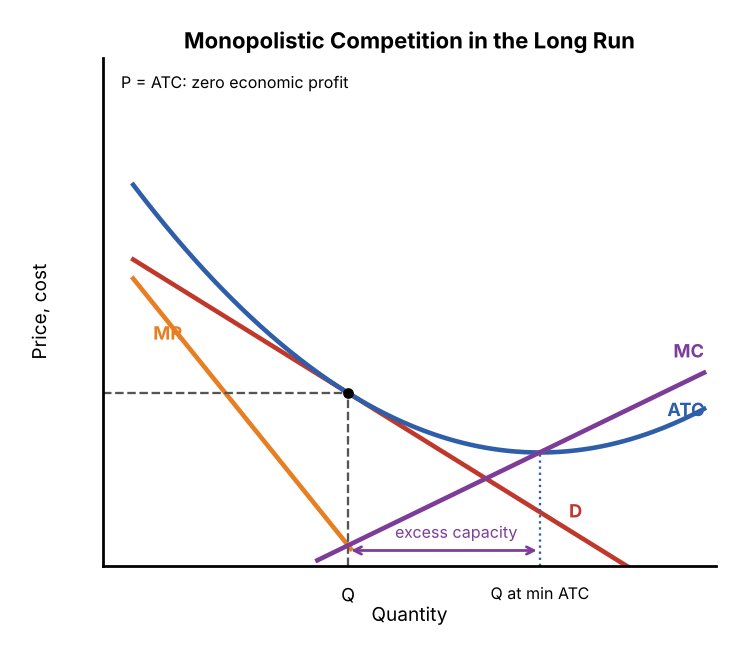
But here’s the twist: unlike perfect competition, \(P \neq MC\) in long-run monopolistic competition. The firm still faces a downward-sloping demand curve, so its marginal revenue lies below price. At the profit-maximizing quantity (where \(MR = MC\)), the firm’s price exceeds its marginal cost. This is the defining inefficiency of monopolistic competition.
Excess Capacity and Allocative Inefficiency
Monopolistically competitive firms operate with excess capacity in the long run. This is a signature feature of the market structure.
What is excess capacity? The firm produces less output than the quantity that would minimize average total cost. In other words, if the firm increased production slightly, ATC would fall.
Why does this happen? At long-run equilibrium, the firm produces where \(MR = MC\) and \(P = ATC\). But the downward-sloping demand curve means MR is always less than P. Because MR is below price, the profit-maximizing quantity occurs to the left of the point where demand equals MC. The minimum ATC point sits further to the right. So the firm never produces at its lowest-cost scale.
The efficiency problem: Monopolistic competition is allocatively inefficient because \(P > MC\). Resources are not allocated optimally from society’s perspective. In perfect competition, \(P = MC\) in the long run, meaning the last unit sold generates a price equal to its cost to produce. In monopolistic competition, consumers value the last unit (at price P) more than it costs to produce, but the firm restricts output to maintain price power.
The exam tests your understanding of this distinction. Be ready to explain why monopolistic competition produces less output and charges a higher price than perfect competition with identical cost structures.
Product Differentiation: The Root of Market Power
Product differentiation is what gives monopolistically competitive firms their pricing power. Without differentiation, all firms would sell identical goods and become price-takers (perfect competition). Differentiation takes two forms:
| Type | Definition | Examples | Exam Relevance |
|---|---|---|---|
| Price competition | Firms compete on price while quality or other features remain similar. | Grocery stores, gas stations, airline ticket prices | Shows how tight margins can become; entry erodes profits quickly. |
| Non-price competition | Firms compete through advertising, brand loyalty, design, location, quality, customer service. | Starbucks vs. local coffee shops; Apple vs. Samsung; Nike vs. Adidas | Explains why firms can maintain different prices for similar goods and why demand curves are downward-sloping but relatively elastic. |
Non-price competition is the more sophisticated strategy. A coffee shop doesn’t just compete on price; it invests in ambiance, barista skill, loyalty programs, and location to attract price-insensitive customers. These efforts shift its demand curve to the right (more customers at each price) and make it less price-elastic (fewer customers leave if prices rise).
Why this matters for the exam: Free-response questions often ask you to explain how a monopolistically competitive firm can maintain economic profit in the short run or why entry occurs despite the firm’s apparent market advantage. The answer lies in product differentiation. If a coffee shop is extremely profitable, rivals will enter with their own differentiated products, not identical copies. Differentiation also explains why the demand curve slopes downward and why firms have price-making power despite competition.
Comparing Market Structures: Where Monopolistic Competition Fits
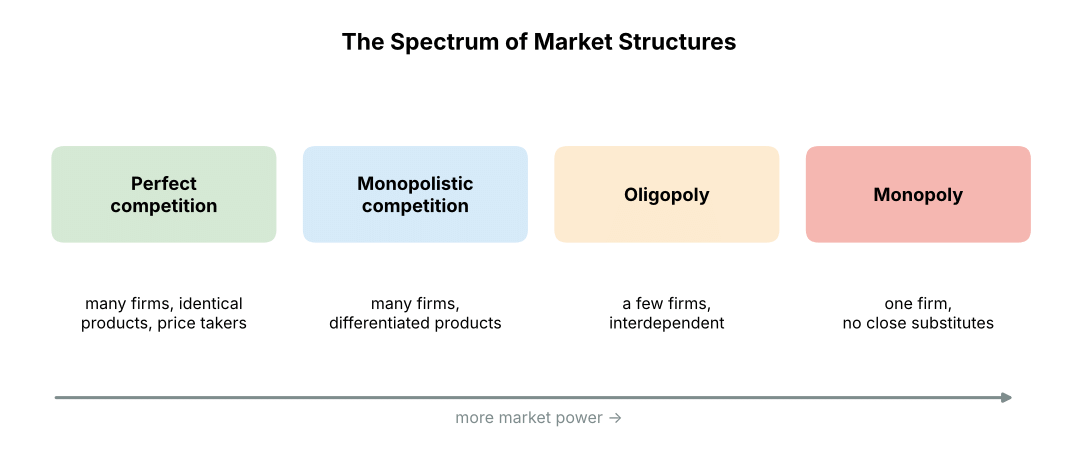
The exam rewards students who can compare and contrast market structures. Here’s how monopolistic competition aligns with and diverges from its neighbors:
| Feature | Perfect Competition | Monopolistic Competition | Monopoly |
|---|---|---|---|
| Number of firms | Very many | Many | One |
| Product | Identical | Differentiated | Unique (no substitutes) |
| Barriers to entry | None | Low | High |
| Price-making ability | None (price-taker) | Some (downward-sloping demand) | Significant (downward-sloping demand) |
| Short-run profit? | Possible (profit or loss) | Yes, often | Yes |
| Long-run equilibrium | \(P = MC = ATC\) | \(P = ATC\), but \(P > MC\) | \(MR = MC\), with \(P \gt MC\) and \(P \geq ATC\) |
| Allocatively efficient? | Yes | No (\(P > MC\)) | No (\(P > MC\)) |
| Productively efficient? | Yes (minimum ATC) | No (excess capacity) | Varies (usually not) |
The key contrast for the exam: monopolistic competition looks like monopoly in the short run (downward-sloping demand, \(MR < P\), possible profit) but like perfect competition in the long run (zero economic profit, free entry/exit, many firms). This dual nature appears repeatedly in exam questions.
Real-World Examples and How to Spot Them
The exam tests your ability to recognize monopolistic competition in scenarios. Here are industries and businesses that fit the structure:
- Restaurants: Many local options, each differentiated by cuisine, ambiance, service, or location. A new restaurant can enter if existing ones are profitable. But no single restaurant is a monopoly.
- Clothing and apparel: Brands like Nike, Adidas, H&M, and local boutiques all sell similar products (shoes, shirts) but compete on brand, design, and quality.
- Coffee shops: Starbucks, local cafes, and chains compete in most cities. Starbucks has brand power (can charge higher prices), but many alternatives exist.
- Barbershops and salons: Multiple service providers in a city, each with loyal customers, but free entry for new competitors.
- Fast-casual dining: Chipotle, Panera, and local alternatives offer differentiated products at different prices.
When you see a scenario with many firms, some pricing power, easy entry, or brand differentiation, think monopolistic competition.
Test-Taking Strategies
Mnemonic Devices and Memory Shortcuts
Use “MDFE” to remember the four characteristics: Many firms, Differentiated products, Free entry/exit, Economic profit (possible in short run).
For long-run equilibrium, recall: “Equal to ATC, Not to MC.” This phrase captures the essence: \(P = ATC\) (zero profit), but \(P > MC\) (inefficiency).
Cross-Topic Connections
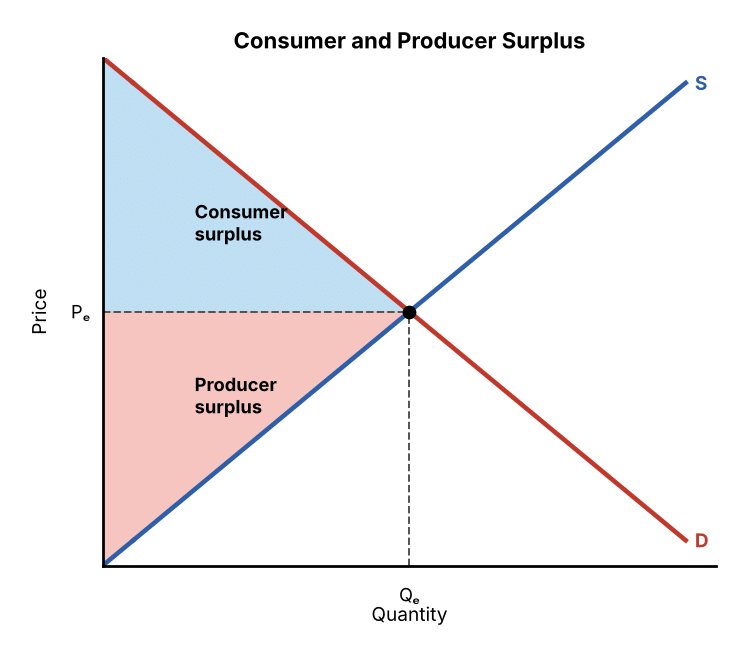
- Consumer surplus and deadweight loss (Unit 2): Because \(P > MC\), monopolistic competition creates deadweight loss. Fewer units are produced than the socially optimal quantity.
- Elasticity (Unit 2): The demand curves for monopolistically competitive firms are more elastic than monopolies (more substitutes) but less elastic than perfect competitors (product differentiation).
- Price discrimination (Unit 4): Non-price competition (advertising, quality, loyalty programs) is not price discrimination; price discrimination means charging different buyers different prices for the same good.
- Externalities (Unit 6): Advertising and product differentiation can create externalities (information, congestion, brand clutter).
Common Question Formats
- Identify the market structure: “A city has 15 restaurants, each with a different menu and loyal customers. This is an example of…” Answer: monopolistic competition.
- Short-run vs. long-run: “In the short run, a monopolistically competitive firm earns profit. What happens in the long run?” Answer: Entry shifts demand left until \(P = ATC\) and profit falls to zero.
- Graph analysis: “On a graph, identify where \(MR = MC\) to find quantity, read price from the demand curve, and compare P to ATC to determine profit/loss.”
- Efficiency comparison: “Explain why monopolistic competition is allocatively inefficient.” Answer: \(P > MC\); too little output is produced.
Frequent Student Mistakes
“Monopolistically competitive firms earn long-run profit.” This is incorrect. In long-run equilibrium, economic profit is zero because entry occurs. Students sometimes confuse the short run (profit possible) with the long run (profit zero). Always specify whether you’re analyzing short-run or long-run equilibrium. Long-run equilibrium requires \(P = ATC\).
“Monopolistic competition is just monopoly with many firms.” This misses the critical role of free entry. While the short-run analysis resembles monopoly (downward-sloping demand, \(P > MC\)), the long-run outcome (zero profit, excess capacity) is unique. Focus on the entry mechanism. It’s free entry and exit that drives long-run equilibrium to \(P = ATC\).
“Excess capacity means the firm is inefficient; it should produce more.” This confuses firm-level efficiency with market efficiency. Excess capacity is a defining feature of long-run monopolistic competition, not a mistake. The firm is maximizing profit given its demand curve. Excess capacity reflects the conflict between profit maximization (\(MR = MC\)) and productive efficiency (minimum ATC). The downward-sloping demand curve makes these incompatible in the long run.
Test-Day Shortcuts
Quick identification: If a scenario describes many firms, some price control, and differentiated products, it’s monopolistic competition. You don’t need perfect information; these three clues are usually sufficient.
Short-run profit analysis: Compare P (from demand curve at profit-max quantity) to ATC. If \(P > ATC\), profit is the shaded area. The size of the profit signals how attractive entry is to new competitors.
Long-run reasoning: Always ask: “If profit is positive, will firms enter? If yes, demand shifts left until \(P = ATC\).” This logical chain replaces the need to redraw graphs each time.
Time Management Tips
Multiple-choice: Monopolistic competition questions often test scenario recognition first. Spend 30 seconds identifying the market structure before diving into analysis. If you correctly identify monopolistic competition, the equilibrium rules follow automatically.
Free-response: Allocate time as follows: (a) Identify the market structure (20 seconds); (b) Sketch or describe the short-run equilibrium and profit (90 seconds); (c) Explain the long-run adjustment and entry mechanism (60 seconds); (d) Compare to perfect competition if asked (30 seconds). These steps structure your analysis and prevent costly omissions.
Graph interpretation: On exam graphs, always label the key points: \(MR = MC\) quantity, demand price, ATC, and the profit/loss area. These labels clarify your reasoning and earn points even if your numerical answer is slightly off.
Check for Understanding
Think you’ve got it? Complete the quiz below to make sure. Download your results at the end.