
Maximize your score with these resources:
- Albert.io AP® Business with Personal Finance question banks
- Free AP® Business with Personal Finance score calculator
Two coffee shops open on the same street. One says its purpose is “to serve the fastest cup in town.” The other says it exists “to create a welcoming third place for the neighborhood.” Months later, one has added drive-through lanes and the other has added couches and open-mic nights. Their decisions split because their guiding beliefs were different from the start. Topic 1.5 is about those beliefs, the strengths behind them, and the statements that put them into words.
This article covers Topic 1.5: Vision in Unit 1, Businesses, Competition, and New Ideas. The topic asks you to explain how core values and core competencies shape decisions, develop or evaluate vision and mission statements, and describe the goals of businesses, social enterprises, and nonprofits.
By the end, you should be able to:
- Distinguish core values from core competencies and explain how each guides decisions.
- Explain how individuals use their own values and competencies in career choices.
- Tell a vision statement from a mission statement and evaluate both.
- Compare the goals of businesses, social enterprises, and nonprofit organizations.
Core Values vs. Core Competencies
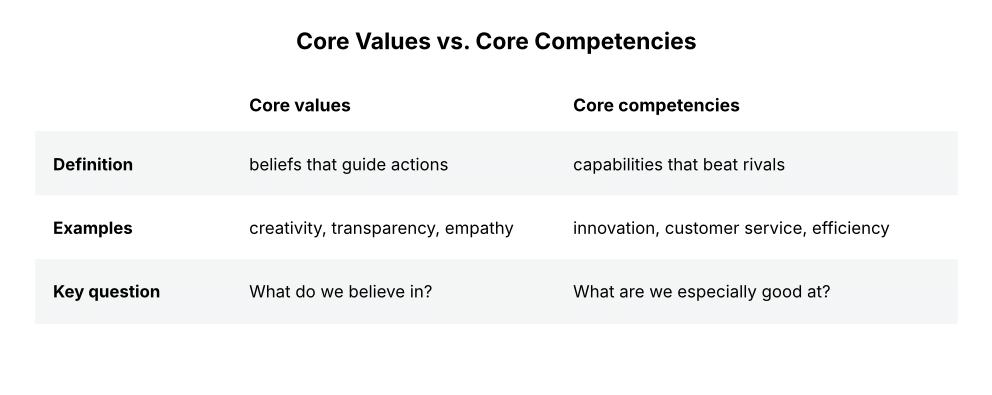
| Core values | Core competencies | |
|---|---|---|
| Definition | Defining beliefs and principles that guide actions | Capabilities, skills, and expertise that help outperform rivals |
| CED examples | Creativity, excellence, transparency, empathy, reliability | Innovation, customer service, communication, ethical behavior, efficiency |
| Key question | What do we believe in? | What are we especially good at? |
| How a business uses it | Aligns employees to a shared purpose and guides decisions | Decides which opportunities to pursue and how to allocate resources |
A useful way to remember the difference: values describe character, and competencies describe capability. Notice that “ethical behavior” appears as a competency example. A business can be skilled at acting ethically, and that skill can win customers.
Personal finance link: Individuals use the same tools. If you value creativity and you are skilled at communication, careers in design or marketing may fit better than one built around routine tasks. The CED expects you to explain how values and competencies affect educational, career, and job decisions.
Vision Statements vs. Mission Statements
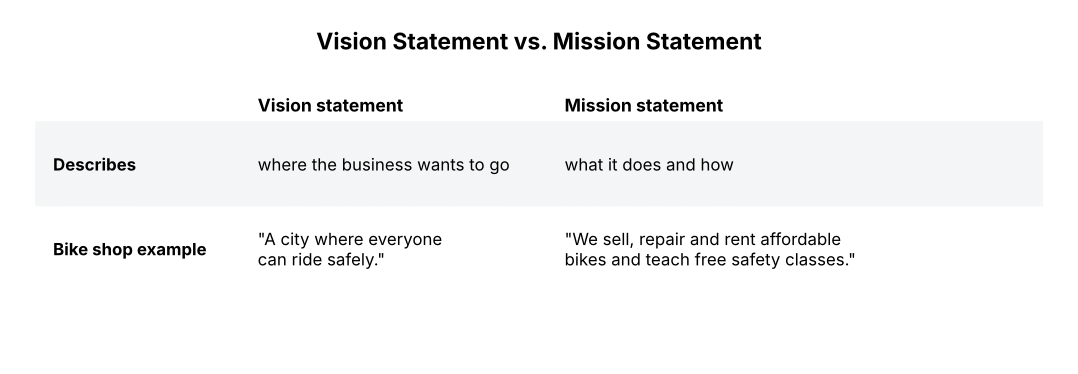
| Statement | What it describes | Example for a bike shop |
|---|---|---|
| Vision statement | A concise description of core values and aspirations: where the business wants to go | “A city where everyone can ride safely and joyfully.” |
| Mission statement | What the business does and how it will achieve its long-term goals | “We sell, repair, and rent affordable bikes and teach free safety classes to new riders.” |
Both statements do two jobs:
- Internally, they communicate long-term goals and values to guide decisions and give employees a shared purpose.
- Externally, they tell potential customers and investors what the business stands for.
Evaluating a statement: A strong vision is short and inspiring. A strong mission names what the business does, for whom, and how. A weak mission such as “We want to be the best” fails because it says nothing about the product, the customer, or the method.
Businesses, Social Enterprises, and Nonprofits
| Organization | Primary goal | What happens to surplus money |
|---|---|---|
| Business | Achieve and increase profit, fulfill its mission, stay competitive and viable | Profit can go to owners |
| Social enterprise | Earn profit and achieve social objectives through its products, operations, or financial model | Profit can go to owners while the social goal is pursued |
| Nonprofit | Serve the public good | Surplus must be reinvested in the organization by law |
Businesses can raise profit in two ways: increase revenues or decrease costs. Nonprofits often rely on grants and donations as part of their revenue.
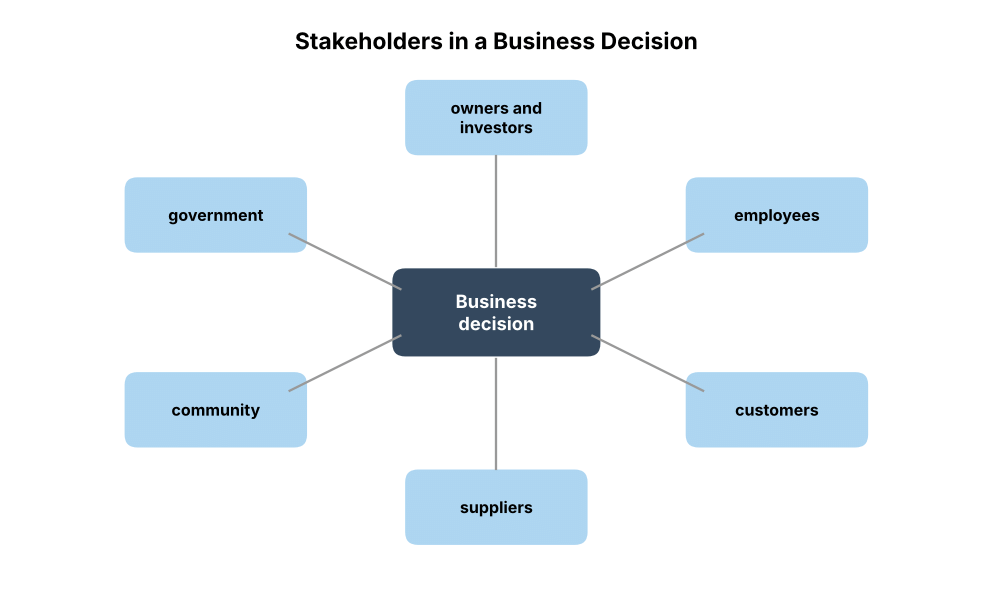
Why does this matter? Task 6 of the Business Canvas Project asks you to write your own vision and mission statements. Expect questions that ask whether a decision is consistent with an organization’s stated values.
Worked Example: Is the Decision Consistent?
A snack company’s vision is “healthy food that everyone can afford.” A supplier offers cheaper ingredients that would cut costs by 20% but add a lot of sugar.
- Profit view: Lower costs would raise profit.
- Values view: More sugar conflicts with “healthy.”
- Evaluation: Accepting the offer is inconsistent with the vision. A consistent alternative is negotiating a lower price on the current ingredients or reducing packaging costs.
Test-Taking Strategies
Mnemonic Devices and Memory Shortcuts
“Vision = Where, Mission = What and How.” For values and competencies, remember “Values = character, Competencies = capability.”
Cross-Topic Connections
- Topic 1.2: Markets and Competitive Advantage explains how core competencies create an edge over rivals.
- Topic 1.4: How Do Business Ideas Originate? covers the passion and problem-solving that often shape a founder’s values.
- Topic 1.1: What Is a Business? explains the value creation a mission statement describes.
- AP® Microeconomics Topic 3.4: Types of Profit explains the profit goal that separates businesses from nonprofits.
Common Question Formats
- Two statements asking which is the vision and which is the mission.
- A scenario asking whether an organization is a business, social enterprise, or nonprofit.
- A decision asking whether it is consistent with a stated core value.
Frequent Student Mistakes
- Swapping vision and mission. The mission is the practical “what we do.”
- Saying nonprofits cannot have revenue above costs. They can, but the surplus must be reinvested.
- Treating a social enterprise as a nonprofit. A social enterprise still seeks profit.
Test-Day Shortcuts
Look for “profit” and “social goal” together to spot a social enterprise. Look for “reinvest surplus,” “donations,” or “grants” to spot a nonprofit.
Time Management Tips
The AP Business with Personal Finance Exam on May 4, 2027, is fully digital in Bluebook. Free-response Question 1 gives you 25 minutes for your Business Canvas Project, including a product pitch. Have a one-sentence version of your vision and mission ready so your pitch starts strong.
Check for Understanding
Think you’ve got it? Complete the quiz below to make sure. Download your results at the end.