
Maximize your score with these resources:
- Albert.io AP® Business with Personal Finance question banks
- Free AP® Business with Personal Finance score calculator
Walk through a farmers market and you will see a dozen stands selling nearly identical tomatoes at nearly identical prices. Walk into a phone store and you will see a handful of brands charging very different prices for phones with very different features. Both are markets, but competition works differently in each. Topic 1.2 explains how buyers and sellers settle on a price, and how a business can pull ahead of its rivals.
This article covers Topic 1.2: Markets and Competitive Advantage in Unit 1, Businesses, Competition, and New Ideas. The topic asks you to explain how buyers and sellers interact to set a market price, and to develop or evaluate a plan for gaining competitive advantage.
By the end, you should be able to:
- Define a market and explain how voluntary exchange benefits both sides.
- Explain how buyers and sellers together establish a prevailing market price.
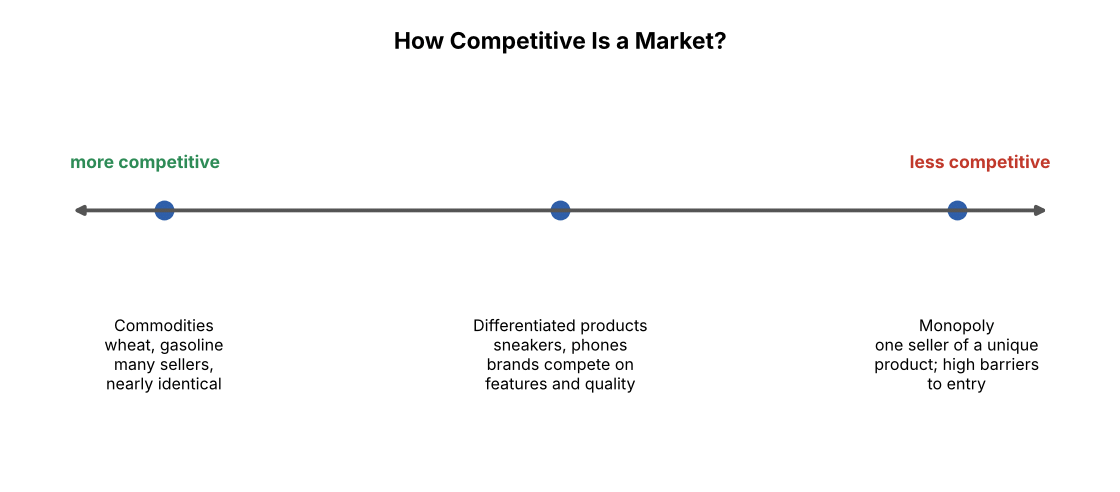
- Describe what makes a market more or less competitive.
- Match a competitive advantage strategy to the type of market a business is in.
Markets and the Market Price
A market is any physical or virtual space where businesses (sellers) interact with customers (buyers). Markets can be local (a town’s hair salons), regional (a state’s home builders), or global (smartphones).
- Voluntary exchange benefits both sides. Sellers earn revenue, and buyers get products they need or want.
- Sellers want higher prices to gain profit. Buyers want lower prices to save money.
- In a competitive market, this push and pull tends to settle on a prevailing market price.
If one tomato stand charges far more than the others, buyers walk to the next stand. If it charges far less, it gives away money it could have earned. Over time, prices cluster around a common level.
Exam note: The CED excludes drawing and manipulating supply and demand graphs. You need to explain how prices form in words, not graph them.
What Makes a Market More or Less Competitive?
Competitive advantage is the ability to outperform rivals in the same market, which can increase market share and potentially profits. How hard that is depends on three features of the market:
| Feature | More competitive when… | Less competitive when… |
|---|---|---|
| Number of rivals and offerings | Many businesses sell many options | Few businesses sell few options |
| Differentiation | Products are nearly identical | Products have distinguishing features |
| Rivals’ ability to undercut | Rivals can easily offer the same product for less | Rivals cannot easily match the product or price |
Strategies for Competitive Advantage
The competitiveness of a market shapes which strategy a business chooses.
| Market type | Typical strategy | Example |
|---|---|---|
| Commodities (wheat, corn, gasoline) | Produce as efficiently as possible to charge the lowest price | A grain farm invests in equipment to cut cost per bushel |
| Differentiated products | Show customers the product is superior: higher quality, unique features, better service, lower prices, or more effective marketing | A sneaker brand adds a recycled-material line and a lifetime repair program |
| Any competitive market | Create or strengthen barriers to entry | A drug company patents a new medicine |
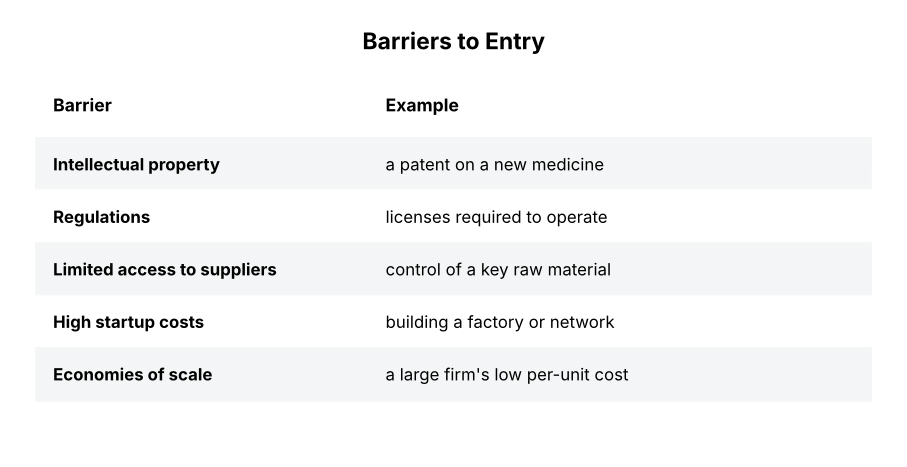
The CED lists these barriers to entry:
- Intellectual property rights, such as patents.
- Regulations that limit rivals.
- Limited access to resource suppliers.
- High startup costs.
- Low prices made possible by operating at a large scale.
At the extreme is a monopoly: one business producing a unique good or service with no competition. A monopoly does not have to compete for customers, so it often works to keep barriers to entry high and protect that position.
Worked Example: Evaluating a Plan
Two friends plan to open a smoothie shop near a high school. There are already three smoothie shops within a mile, all charging about $7 for similar drinks.
- Diagnose the market: Several rivals, similar products, and easy imitation. This is a competitive market with weak differentiation.
- Weak plan: “We will charge $6.50.” Rivals can match that quickly, and the margin shrinks for everyone.
- Stronger plan: Offer high-protein smoothies designed with a local sports nutritionist and a student loyalty card. This differentiates on quality and customer service.
- Evaluate: The plan is stronger if rivals cannot easily copy the nutritionist partnership. If they can, the advantage may not last.
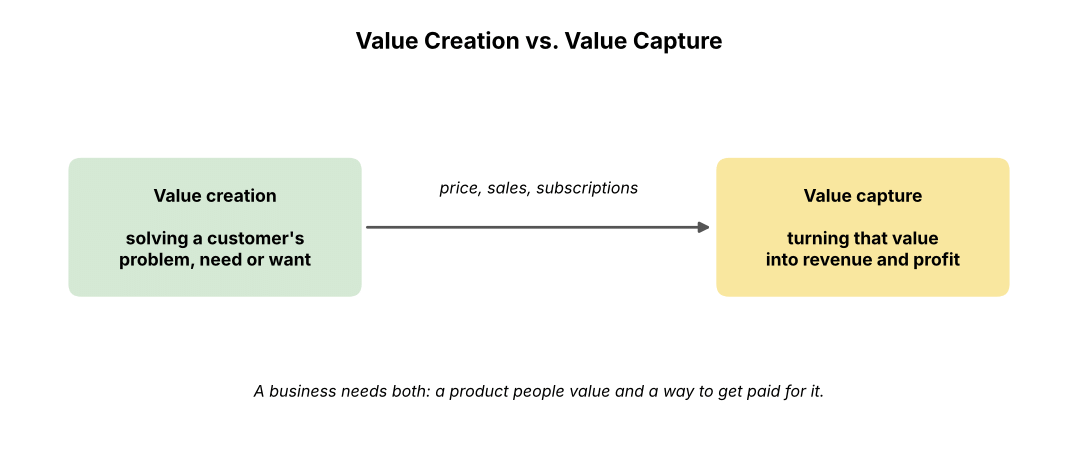
Why does this matter? Task 2 of your Business Canvas Project asks you to develop a plan to seek competitive advantage. Free-response questions reward plans that are tied to the specific market, not generic claims like “better quality.”
Test-Taking Strategies
Mnemonic Devices and Memory Shortcuts
For differentiation, remember “Quality Features Serve People Much”: Quality, unique Features, customer Service, lower Prices, and Marketing. For barriers to entry, list the five Ps and Ss: Patents, Policy (regulations), Suppliers, Startup costs, and Scale.
Cross-Topic Connections
- Topic 1.1: What Is a Business? explains the customer problems that competition revolves around.
- AP® Microeconomics Topic 2.6: Market Equilibrium shows the graph behind the prevailing market price.
- AP® Microeconomics Topic 3.7: Perfect Competition describes commodity-style markets in more depth.
- AP® Microeconomics Topic 4.2: Monopoly explores markets with a single seller.
Common Question Formats
- A description of a market asking how competitive it is and why.
- A business scenario asking which strategy best builds competitive advantage.
- A question asking you to identify a barrier to entry in a scenario.
Frequent Student Mistakes
- Recommending a price cut in a market where rivals can match it instantly.
- Calling any large company a monopoly. A monopoly has no competition at all.
- Drawing supply and demand graphs when the question asks for a written explanation.
Test-Day Shortcuts
Identify the market type first. Identical products point to efficiency and low price. Differentiated products point to quality, features, service, or marketing.
Time Management Tips
The AP Business with Personal Finance Exam on May 4, 2027, is fully digital in Bluebook. Free-response Questions 2 through 4 share 65 minutes, and Question 3 asks you to apply business concepts to a scenario in about 12 to 13 minutes. Practice writing a two-sentence competitive advantage plan that names the market type and one specific strategy.
Check for Understanding
Think you’ve got it? Complete the quiz below to make sure. Download your results at the end.