
Maximize your score with these resources:
- Albert.io AP® Business with Personal Finance question banks
- Free AP® Business with Personal Finance score calculator
An electric scooter company could have the best product in the world and still fail in the wrong city. A ban on sidewalk scooters, a hilly downtown, a snowy winter, or residents who rarely commute could each sink the idea before the first ride. The forces outside a business often matter as much as the product itself. Topic 1.3 gives you a six-part checklist, PESTEL, for sizing up those forces before a business commits money to a market.
This article covers Topic 1.3: PESTEL Factors and the Business Environment in Unit 1, Businesses, Competition, and New Ideas. The topic asks you to describe the six PESTEL factors, explain how they influence business viability and career opportunities, and apply the framework to judge a market’s attractiveness and risks.
By the end, you should be able to:
- Name and define all six PESTEL factors with examples of each.
- Explain how each factor can make a business more or less viable.
- Explain how PESTEL factors shape job and career opportunities in a place.
- Apply the PESTEL framework to a specific business idea and market.
The Six PESTEL Factors
PESTEL factors are the external forces that shape the business landscape and decide which kinds of businesses are viable in a market.
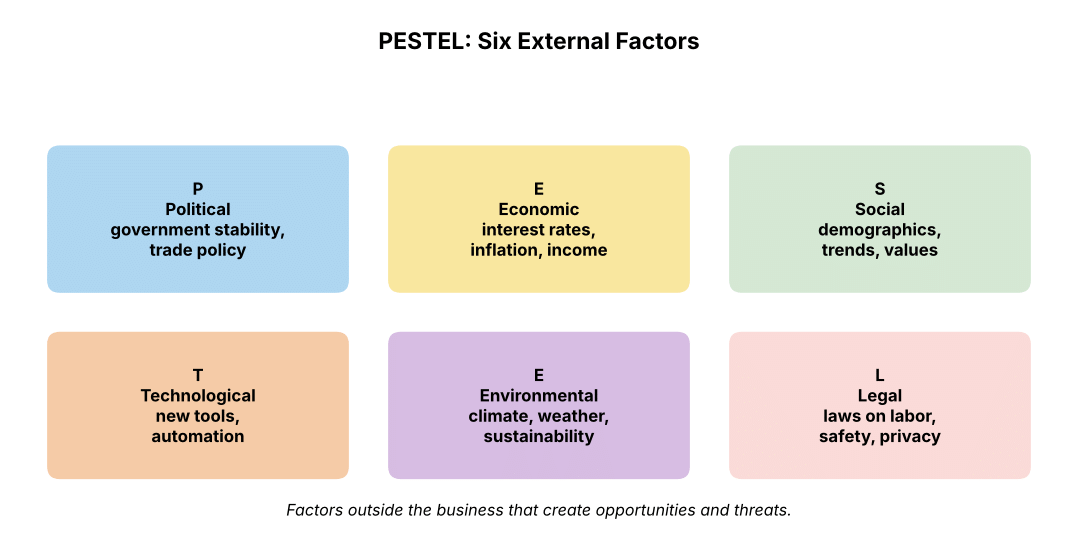
| Factor | What it covers | CED examples |
|---|---|---|
| Political | Policies and political dynamics | Trade policy, taxes and subsidies, mandates, bans, political stability |
| Economic | Conditions in the economy | Economic stability, household income, inflation, unemployment, interest rates |
| Social | Trends in society and culture | Demographics, cultural norms, lifestyle trends, population growth |
| Technological | Availability of technology | Internet access, automation, rate of innovation |
| Environmental | External environmental conditions | Geography, renewable and nonrenewable resources, waste policies, consumer environmental views |
| Legal | Specific laws and regulations | Employment, consumer protection, health and safety, environmental, intellectual property, and antitrust laws |
Political vs. legal is the pair students mix up most. Political factors are the broader policies and stability of the system, such as a new tariff or a subsidy for solar panels. Legal factors are the specific rules a business must follow, such as minimum wage laws or food safety codes.
How Each Factor Affects Business Viability
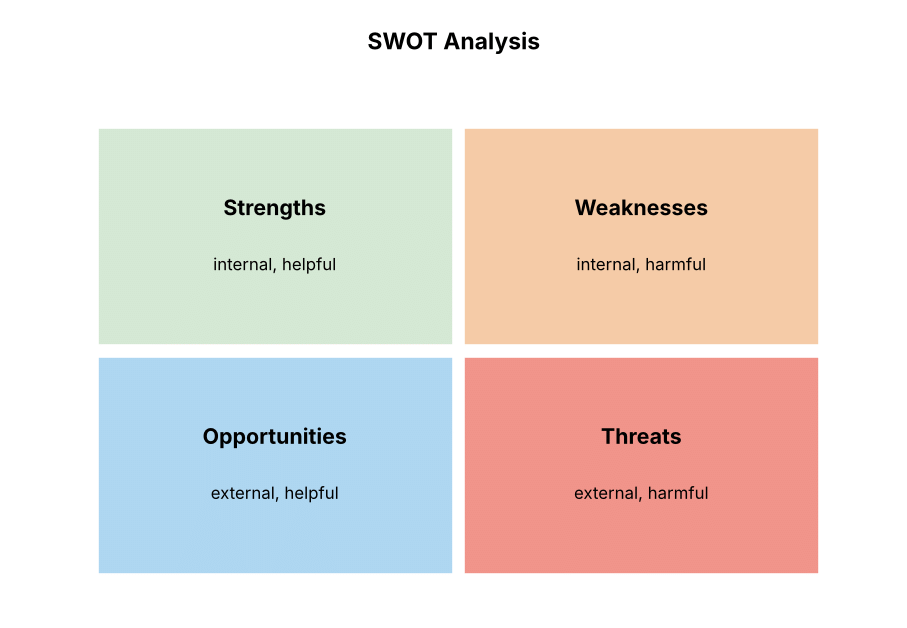
- Political: Subsidies and mandates support some business activities, bans limit others, and taxes fund government while sometimes discouraging specific activities.
- Economic: The economy’s stability shapes how much consumers, businesses, and government spend. Most businesses thrive in a strong economy, but some, like discount stores or repair shops, can thrive in a weak one.
- Social: Consumer-oriented businesses depend on meeting needs and wants shaped by demographics, norms, and trends.
- Technological: Production, distribution, and customer communication all depend on available technology.
- Environmental: Climate, resources, and natural disasters can limit production and distribution, and customers’ environmental views affect what they buy.
- Legal: Laws affect operating costs and whether some operations are allowed at all.
PESTEL and Your Career
The same forces that shape businesses shape jobs. Career opportunities in a place depend on which businesses are viable there. A region with cheap electricity and fast internet may attract data centers and tech jobs, while a coastal town may depend on fishing and tourism. When PESTEL factors change, jobs change too. During an economic downturn, for example, some employees face layoffs.
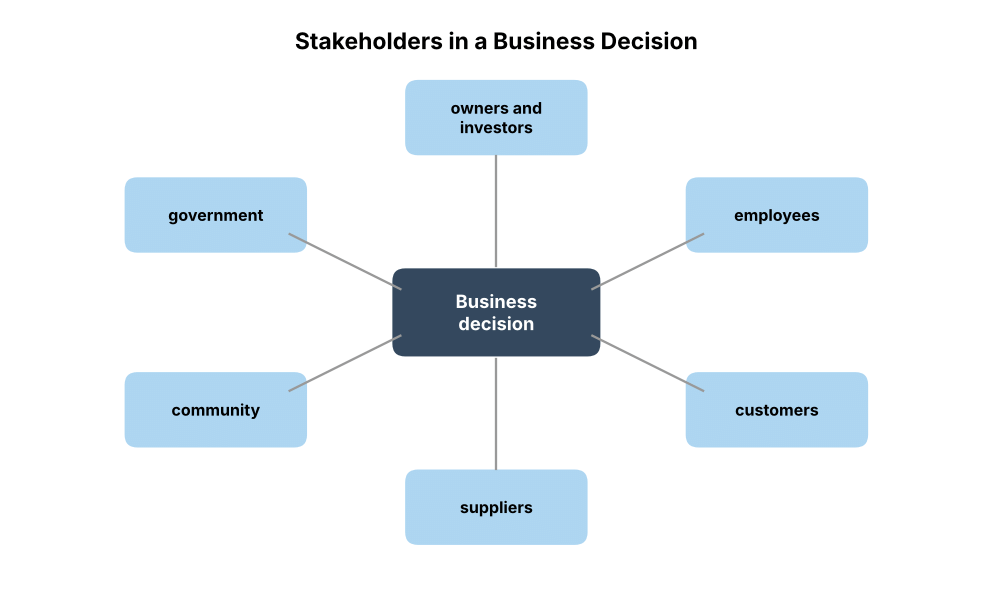
Why does this matter? The CED links this topic to personal finance: when you choose where to study or work, you are running your own PESTEL analysis on your future income.
Worked Example: Applying PESTEL to a Market
A business wants to open a farm-to-table restaurant in a mid-sized college town. Here is a quick PESTEL scan:
| Factor | Finding | Effect on the idea |
|---|---|---|
| Political | The city offers grants to businesses that buy from local farms | Attractive |
| Economic | Many residents are students with limited income | Risk: premium prices may limit customers |
| Social | Strong local interest in locally grown food | Attractive |
| Technological | Online ordering and reservation tools are widely used | Attractive for reaching customers |
| Environmental | Short growing season limits local produce in winter | Risk: menu and supply must adapt |
| Legal | Strict health inspections and liquor licensing rules | Risk: higher startup costs |
Conclusion: The market looks attractive overall because the social and political factors align with the business model. The main risks are economic and environmental, so the owners might add lower-priced lunch options and plan a seasonal menu. That is exactly what the CED means by evaluating attractiveness and risks, specific to the business idea.
Test-Taking Strategies
Mnemonic Devices and Memory Shortcuts
Spell it out: P-E-S-T-E-L, “People Expect Smart Teams to Explore Locations.” To separate the two P and L factors, remember: Political = policy direction, Legal = the rulebook.
Cross-Topic Connections
- Topic 1.2: Markets and Competitive Advantage covers the competition inside a market, while PESTEL covers the forces around it.
- Topic 1.1: What Is a Business? explains the customer needs that social factors shape.
- AP® Macroeconomics Topic 2.7: Business Cycles explains the economic downturns behind layoffs.
- AP® Microeconomics Topic 2.8: Government Intervention in Markets shows how taxes and subsidies change market outcomes.
Common Question Formats
- A scenario describing a change, asking which PESTEL factor it represents.
- A question asking how a change in one factor affects a specific business’s viability.
- A free-response prompt asking you to evaluate whether a business should enter a market.
Frequent Student Mistakes
- Labeling a specific law as a political factor. Specific laws and regulations are legal factors.
- Listing factors without explaining how each affects this business.
- Assuming a weak economy hurts every business equally.
Test-Day Shortcuts
When a scenario names a law, regulation, or code, label it legal. When it names a tax, subsidy, tariff, ban, or government stability, label it political.
Time Management Tips
The AP Business with Personal Finance Exam on May 4, 2027, is fully digital in Bluebook. Section I gives you 70 minutes for 60 multiple-choice questions. Classification questions like “which PESTEL factor is this?” should take about 30 seconds, leaving more time for scenario sets.
Check for Understanding
Think you’ve got it? Complete the quiz below to make sure. Download your results at the end.