
Maximize your score with these resources:
- Albert.io AP® Business with Personal Finance question banks
- Free AP® Business with Personal Finance score calculator
A sales manager learns that her team can hit its quarterly bonus target only if they tell customers a product ships next week, when it actually ships in a month. Nobody would find out until after the bonuses are paid. The rules of the incentive plan are pushing her toward a lie. Situations like this happen at every level of business, from new hires to CEOs. Topic 1.6 explains why unethical behavior happens, how businesses discourage it, and how leaders work through hard choices where good values pull in different directions.
This article covers Topic 1.6: Business Ethics in Unit 1, Businesses, Competition, and New Ideas. The topic asks you to explain how and why businesses encourage ethical behavior and how business leaders respond to ethical dilemmas.
By the end, you should be able to:
- Identify forms of unethical behavior and explain how incentives can encourage them.
- Describe four ways businesses encourage ethical behavior.
- Explain how ethics affects customers, employees, reputation, and profit.
- Define an ethical dilemma and use stakeholder analysis to recommend a response.
Why Unethical Behavior Happens
The CED gives examples of unethical behavior:
- Falsifying or concealing information, such as hiding a product defect.
- Misusing company property, such as using a company card for personal purchases.
- Causing harm to employees or customers, such as ignoring safety rules.
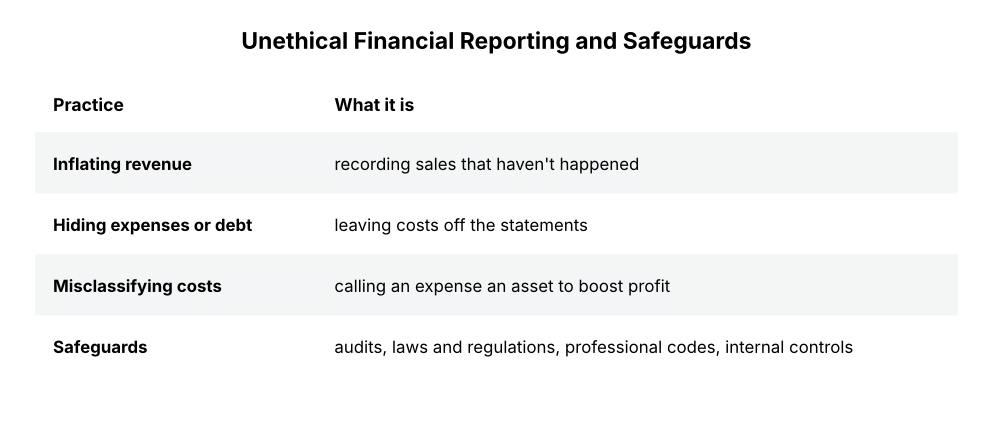
It can occur at all levels of a business. A key cause is incentive structures: when rewards depend on hitting a number, people may be tempted to reach it unethically to benefit themselves, as in the sales example above.
How Businesses Encourage Ethical Behavior
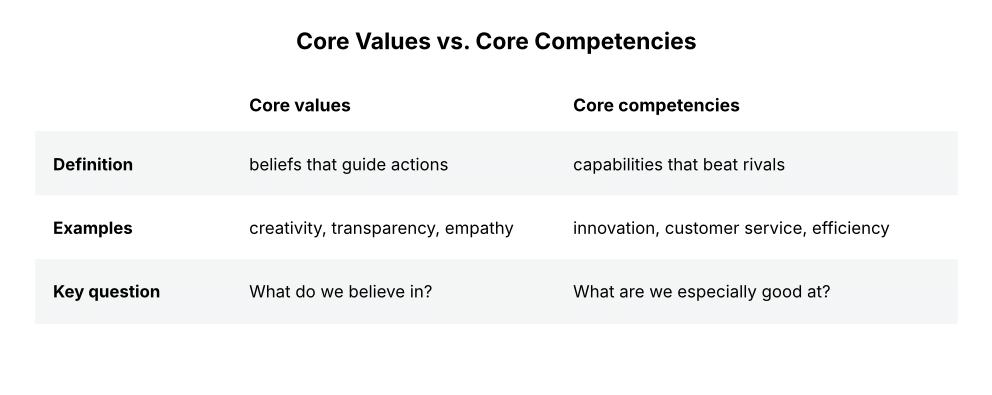
| Method | What it looks like |
|---|---|
| Codes of conduct | Written rules for acceptable behavior, such as a policy on accepting gifts from suppliers |
| Training | Teaching employees to follow ethical guidelines through workshops or case studies |
| Internal repercussions | Consequences for violations, from warnings to firing |
| Modeling | Leaders behaving ethically themselves, so employees see the standard in action |
Ethics is not only about avoiding trouble. The CED points out that ethical practices can attract customers and employees and build brand loyalty. How a business responds to unethical behavior or a dilemma can affect customer and employee relationships, public perception, and profitability.
Ethical Dilemmas and Stakeholders
An ethical dilemma exists when a core value, such as transparency, fairness, or empathy, conflicts with another core value or with a business goal or practice. Unlike an obvious wrong such as theft, a dilemma has reasonable arguments on more than one side.
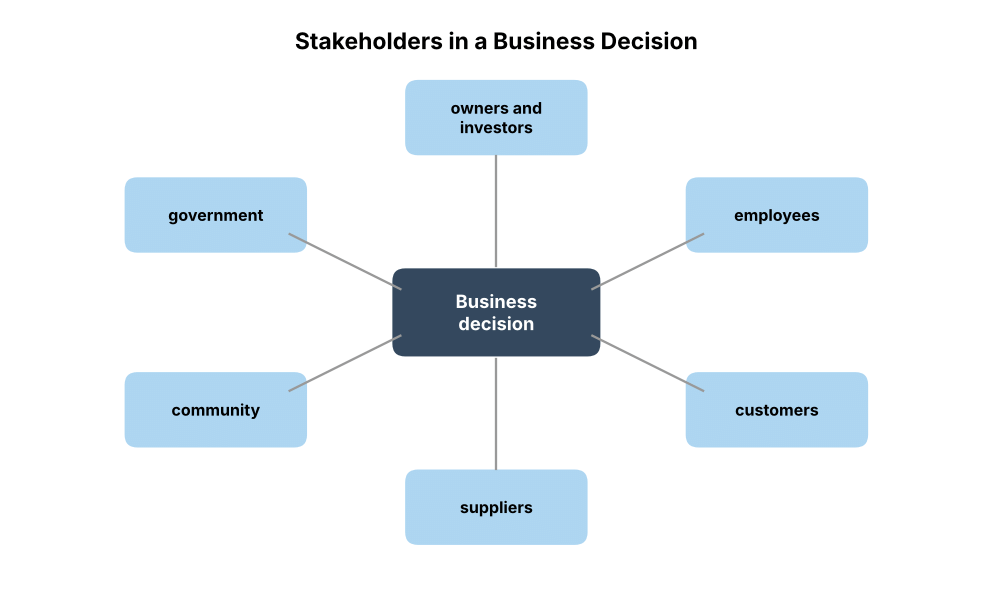
Leaders weigh how each possible response affects stakeholders, plus reputation and company culture.
| Stakeholder type | Definition | Examples |
|---|---|---|
| Internal | Directly involved in the business’s operations, decisions, and outcomes | Owners, managers, employees |
| External | Not employed by or directly involved in the business but with a vested interest in it | Customers, government agencies, community members |
The CED describes two ways to choose a response:
- Weigh benefits and costs for each stakeholder group and choose the action with the greatest total benefit or least total harm.
- Choose the action most consistent with the business’s vision or goals.
Worked Example: A Stakeholder Analysis
A toy company discovers that a small part on a popular toy could break off. No child has been hurt. A recall would cost $2 million. The values in conflict are transparency and customer safety versus the goal of profitability.
| Stakeholder | Option A: Quiet redesign, no recall | Option B: Public recall |
|---|---|---|
| Customers (external) | Children with old toys stay at risk | Risk removed; trust grows |
| Employees (internal) | May feel uneasy about hiding a risk | Extra work, but pride in the decision |
| Owners (internal) | Saves $2 million now; huge lawsuit and reputation risk later | Loses $2 million now; protects brand long term |
| Government (external) | Possible penalties if regulators find out | Cooperation with safety regulators |
Recommendation: Option B produces the least total harm and fits a value of transparency. Why does this matter? Free-response Question 4 asks you to compare two courses of action using financial and nonfinancial criteria and then recommend one. A stakeholder table like this is a fast way to organize that answer.
Test-Taking Strategies
Mnemonic Devices and Memory Shortcuts
For encouraging ethics, remember “Code, Coach, Consequence, Copy”: codes of conduct, training, repercussions, and leaders modeling behavior. For stakeholders, “Inside = runs it, Outside = affected by it.”
Cross-Topic Connections
- Topic 1.5: Vision covers the core values that ethical dilemmas put in conflict.
- Topic 1.3: PESTEL Factors includes consumer protection and safety laws, the legal side of ethics.
- Topic 1.1: What Is a Business? explains the customer relationships ethics protects.
- AP® Microeconomics Topic 6.2: Externalities shows how business decisions can impose costs on outside stakeholders.
Common Question Formats
- A scenario asking which action is an example of unethical behavior.
- A question asking whether a person is an internal or external stakeholder.
- A dilemma asking which response produces the least total harm.
Frequent Student Mistakes
- Calling customers internal stakeholders. They are external.
- Treating every ethics question as “right vs. wrong.” A dilemma involves two values or a value and a goal.
- Ignoring profit. The CED says ethical choices also affect profitability, so mention it.
Test-Day Shortcuts
When a question names an incentive like a bonus or quota, look for the answer that links the incentive to the unethical choice.
Time Management Tips
The AP Business with Personal Finance Exam on May 4, 2027, is fully digital in Bluebook. The College Board recommends about 40 minutes for free-response Question 4, including a 15-minute reading period. Use part of that reading time to sketch a quick stakeholder table before you write.
Check for Understanding
Think you’ve got it? Complete the quiz below to make sure. Download your results at the end.