
Maximize your score with these resources:
- Albert.io AP® Business with Personal Finance question banks
- Free AP® Business with Personal Finance score calculator
When Priya started baking custom cakes from her kitchen, she was the chef, the marketer, the delivery driver, and the bookkeeper. Five years later her bakery has 40 employees, and she cannot possibly do every job. She has a choice to make about how to organize the business legally and how to divide the work. Should she take on investors? Who handles payroll? Should she hire a delivery company instead of drivers? Topic 1.7 covers these structural choices and the trade-offs behind each one.
This article covers Topic 1.7: Organization, Roles, and Responsibilities in Unit 1, Businesses, Competition, and New Ideas. The topic asks you to compare the major types of business organization, describe the roles of owners, and explain how and why large businesses build specialized departments and outsource work.
By the end, you should be able to:
- Compare sole proprietorships, partnerships, LLCs, and corporations on control, liability, and funding.
- Describe the many roles that sole proprietors and partners play.
- Explain why growing businesses create specialized departments and when they outsource.
- Describe the purpose of six common business departments.
The Four Types of Business Organization
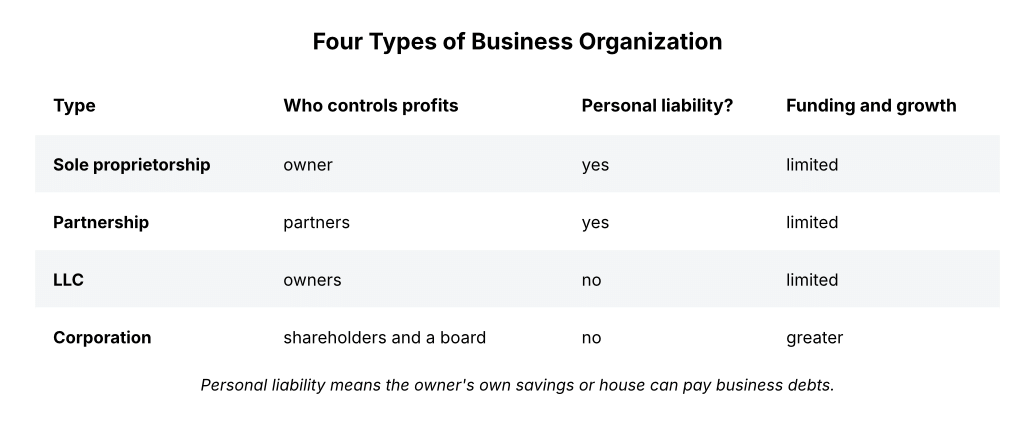
| Type | Control and profits | Personal liability for business debts | Access to funding and growth |
|---|---|---|---|
| Sole proprietorship | Owner keeps control and profits | Yes, owner is personally liable | Limited |
| Partnership | Partners keep control and profits | Yes, partners are personally liable | Limited |
| Limited liability company (LLC) | Owners keep control and profits | No, owners avoid personal liability | Limited |
| Corporation | Owners cede control to shareholders and an elected board of directors; the company controls profits | No, the company is liable | Greater access, more ability to grow |
Personal liability means the owner’s own savings, car, or house can be used to pay business debts. That is the big risk of sole proprietorships and partnerships, and the main reason owners form LLCs.
The trade-off is control vs. growth. Sole proprietorships, partnerships, and LLCs let owners keep decision-making power and profits, but they have less access to funding. Corporations can raise more money and grow faster, but owners give up control to shareholders and a board.
Roles of Sole Proprietors and Partners
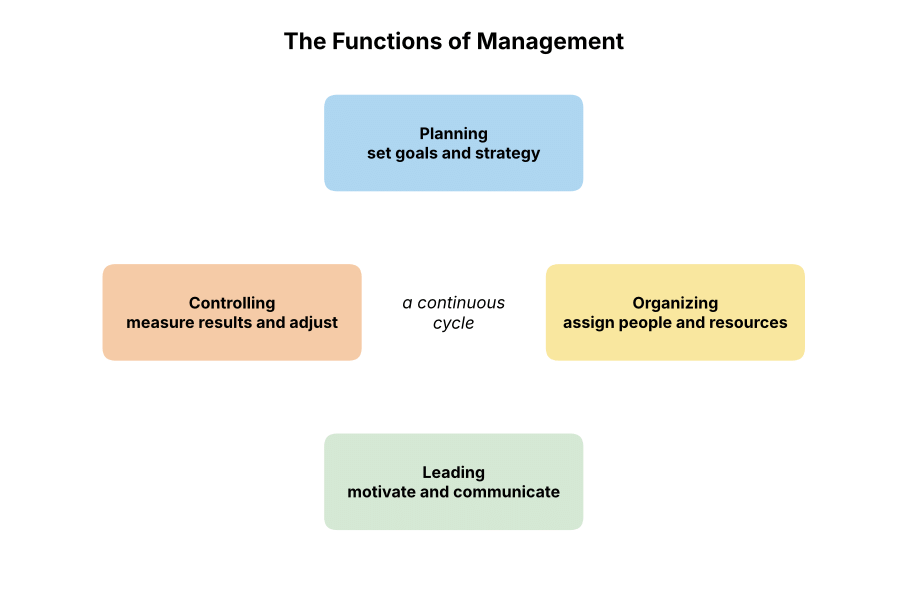
A sole proprietor has primary responsibility for everything and may play multiple roles: CEO, marketer, product developer, financial manager, and operations manager. Partners share that responsibility and usually divide roles by each partner’s strengths and interests. One partner might handle sales while the other manages the books.
Personal finance link: Owners of sole proprietorships, partnerships, and LLCs earn income from the business itself, unlike employees who earn a wage or salary. Their income rises and falls with the business’s profits.
How Large Businesses Organize Work
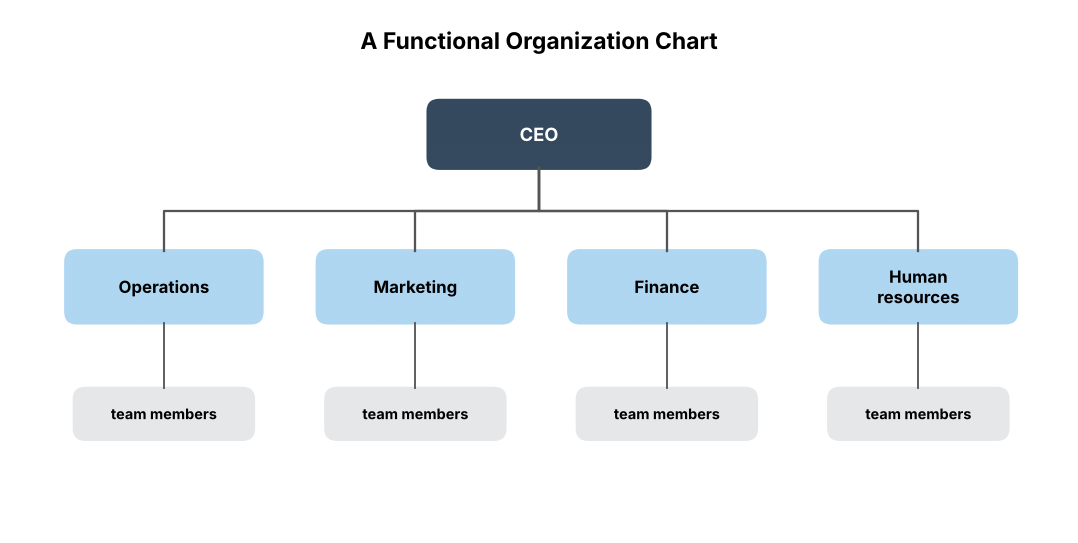
As a business grows, it needs more employees with specific skills. Many organize those employees into specialized departments. Executive leaders such as the CEO are responsible for overall vision, operations, strategy, and performance. Managers lead departments and report to executives. In a corporation, executives report to the board of directors and shareholders.
| Department | Main responsibilities |
|---|---|
| Sales and marketing | Market research, sales strategies, brand management, customer relationships |
| Research and development (R&D) | Innovating new and existing goods, services, and processes |
| Operations | Manufacturing goods or developing services and getting them to customers |
| Accounting | Tracking expenditures and earnings; preparing financial statements |
| Finance | Securing and managing funds; using data to recommend strategies |
| Human resources (HR) | Recruiting, training, and evaluating employees |
Accounting vs. finance is a common trap. Accounting records and reports what happened. Finance raises and manages money and plans what to do next.
Specialization builds expertise, which helps the business meet customer needs more efficiently and effectively. Sometimes, though, a business outsources a function to another company when that will increase efficiency or reduce costs, for example when it lacks employees with a needed skill or its own labor costs are high.
Worked Example: Priya’s Bakery
- Legal structure: A customer sues over a delivery accident. As a sole proprietor, Priya’s personal savings are at risk. Forming an LLC would protect her personal assets from future business claims while keeping her in control, though it cannot shield her from a claim that already exists.
- Growth decision: A national grocery chain wants her cakes in 200 stores, which requires $3 million in new equipment. Becoming a corporation could raise the money, but she would give up control to shareholders and a board.
- Departments: She creates an HR department to hire bakers and an accounting department to prepare financial statements.
- Outsourcing: Delivery drivers are expensive to employ, so she outsources delivery to a courier service to reduce costs.
Why does this matter? Free-response Question 4 often gives two courses of action with trade-offs like these. Naming the specific trade-off, such as control vs. funding, earns more credit than a general “it depends.”
Test-Taking Strategies
Mnemonic Devices and Memory Shortcuts
Remember “LLC = Limits Liability, keeps Control.” For corporations, “more Cash, less Control.” For accounting vs. finance: “Accounting looks back, Finance looks ahead.”
Cross-Topic Connections
- Topic 1.5: Vision explains the vision and strategy that executive leaders are responsible for.
- Topic 1.6: Business Ethics covers internal stakeholders like owners, managers, and employees.
- Topic 1.4: How Do Business Ideas Originate? covers the entrepreneurs who start as sole proprietors.
- AP® Microeconomics Topic 1.4: Comparative Advantage explains the logic behind specialization and outsourcing.
Common Question Formats
- A scenario asking which form of organization best fits an owner’s goals.
- A task asking which department is responsible for it.
- A question asking why a business would outsource a specific function.
Frequent Student Mistakes
- Saying LLC owners are personally liable. Avoiding that liability is the point of an LLC.
- Assuming corporation owners keep control. They cede it to shareholders and a board.
- Confusing accounting with finance.
Test-Day Shortcuts
Match the key word: “liability” points to LLC or corporation, “control” points to sole proprietorship, partnership, or LLC, and “growth” or “funding” points to corporation.
Time Management Tips
The AP Business with Personal Finance Exam on May 4, 2027, is fully digital in Bluebook. Unit 1 makes up 20 to 30% of the multiple-choice section, so comparison tables like the one above are worth reviewing until you can fill them in from memory.
Check for Understanding
Think you’ve got it? Complete the quiz below to make sure. Download your results at the end.