
Maximize your score with these resources:
- Albert.io AP® Business with Personal Finance question banks
- Free AP® Business with Personal Finance score calculator
Before a hoodie reaches your closet, cotton is grown on a farm, spun into thread at a mill, dyed, cut and sewn at a factory, shipped across an ocean, stored in a warehouse, and finally delivered to a store or your front door. A storm, a strike, or a supplier mistake at any one of those steps can leave store shelves empty. That chain of people and businesses is a supply chain, and how a company builds it says a lot about how it plans to compete. Topic 1.8 connects production, suppliers, and competitive strategy.
This article covers Topic 1.8: Supply Chains in Unit 1, Businesses, Competition, and New Ideas. The topic asks you to describe factors in designing a production process, develop or describe a supply chain plan, and explain how a competitive advantage strategy shapes supply chain decisions.
By the end, you should be able to:
- Compare artisan and mass-production processes and explain what drives the choice.
- Describe the stages of a supply chain for a good and for a service.
- Name the factors and risks businesses weigh when choosing suppliers.
- Match supply chain decisions to low-price, high-quality, and barrier-to-entry strategies.
Choosing a Production Process
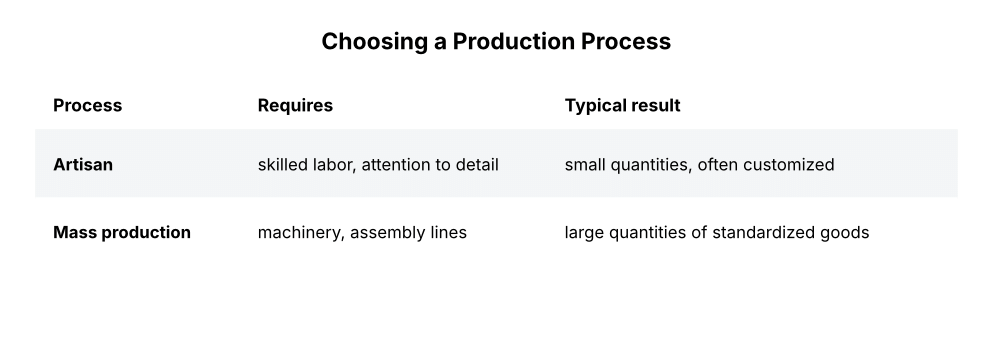
| Process | What it requires | Typical result |
|---|---|---|
| Artisan | Skilled labor and attention to detail | Smaller quantities, often customized or handmade |
| Mass production | Technology, assembly lines, and machinery | Larger quantities of standardized goods |
Businesses choose by weighing:
- Customer priorities such as quality, price, and customization.
- Their own core competencies.
- The competitive landscape, meaning what rivals already offer.
What a Supply Chain Is
A supply chain connects all the individuals and businesses involved in producing and distributing a product, from acquiring raw materials to final customer delivery. It can be local, regional, or global.
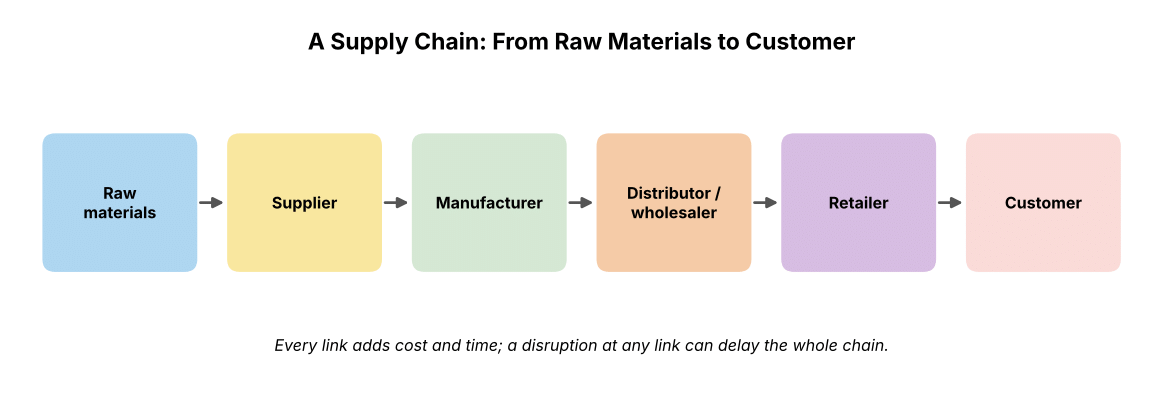
Supply chain for a good:
- Raw materials and component parts (such as computer chips) are acquired.
- They are transported to manufacturing facilities.
- Workers and equipment turn them into finished goods.
- Goods may go to a storage facility such as a warehouse.
- Goods move to a distribution center or retail store, then to customers.
Supply chain for a service: The business acquires the employees, resources, and delivery systems needed to provide the service in person or virtually. An online tutoring company’s supply chain includes tutors, scheduling software, and video platforms rather than factories and warehouses.
Choosing Suppliers and Managing Risk
Businesses weigh five factors when choosing suppliers: cost, quality, efficiency, convenience, and risk. The CED lists these risks:
| Risk | Example |
|---|---|
| Natural disasters | A flood shuts down a chip factory |
| Political instability | Unrest blocks exports from a supplier’s country |
| Resource shortages | A drought cuts the coffee harvest |
| Production errors | A batch of parts fails safety tests |
| Supplier reputation | A supplier is caught using unsafe labor practices |
Any of these can delay delivery or raise costs, which threatens competitive advantage and profit.
Strategy Drives the Supply Chain
| Competitive advantage strategy | Supply chain approach |
|---|---|
| Low prices | Mass production with a focus on cutting costs through cheaper resources and efficient processes. Some businesses scale operations, building bigger or more efficient supply chains so revenue grows faster than costs. |
| High quality | High-quality resources and production methods, using either artisan or mass production |
| Barriers to entry | Exclusive or restrictive agreements, such as stopping a supplier from selling parts to rivals or a retailer from carrying rival products |
Worked Example: Two Chocolate Makers
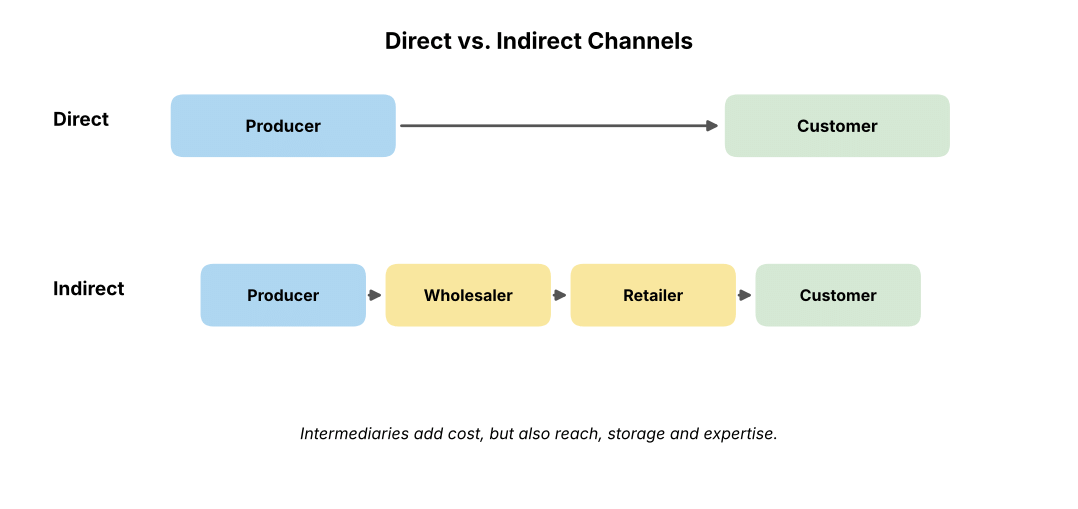
- Company A competes on low price. It mass-produces bars in one large factory, buys cocoa from the cheapest bulk suppliers, and ships by the truckload to discount stores.
- Company B competes on quality. It makes small artisan batches, buys premium cocoa directly from a few farms, and sells through specialty shops and its website.
- Risk check: Company B depends on a few farms. A bad harvest in one region could halt production. A sensible plan is to add a second high-quality supplier from a different region, even at a slightly higher cost.
Why does this matter? Task 7 of the Business Canvas Project asks you to develop a production process and supply chain plan. A strong plan explains how each choice supports your competitive advantage strategy, not just what the steps are.
Test-Taking Strategies
Mnemonic Devices and Memory Shortcuts
For supplier factors, remember “C-Q-E-C-R”: Can Quality Ever Cost Risk? (cost, quality, efficiency, convenience, risk). For strategy links: “Cheap = scale, Quality = premium inputs, Barriers = exclusive deals.”
Cross-Topic Connections
- Topic 1.2: Markets and Competitive Advantage introduces the three strategies that shape supply chains.
- Topic 1.7: Organization, Roles, and Responsibilities describes the operations department that runs production.
- Topic 1.3: PESTEL Factors covers the political and environmental forces behind supply chain risk.
- AP® Microeconomics Topic 3.3: Long-Run Production Costs explains economies of scale behind low-cost supply chains.
Common Question Formats
- A product description asking whether artisan or mass production fits better.
- A disruption scenario asking which supply chain risk it represents.
- A strategy asking which supply chain decision best supports it.
Frequent Student Mistakes
- Assuming high quality requires artisan production. Mass production can also deliver high quality.
- Forgetting that services have supply chains too.
- Choosing the cheapest supplier for a business that competes on quality.
Test-Day Shortcuts
Find the company’s competitive advantage strategy in the stem first. The correct supply chain answer will almost always support that strategy.
Time Management Tips
The AP Business with Personal Finance Exam on May 4, 2027, is fully digital in Bluebook. Many multiple-choice questions come in sets built around one business scenario. Read the scenario once carefully, note the strategy and key numbers, and then answer the whole set without rereading.
Check for Understanding
Think you’ve got it? Complete the quiz below to make sure. Download your results at the end.