
Maximize your score with these resources:
- Albert.io AP® Business with Personal Finance question banks
- Free AP® Business with Personal Finance score calculator
Opening a small coffee shop can take tens of thousands of dollars before the first latte is sold: permits, an espresso machine, a security deposit on the lease, a starting supply of beans and cups, and a sign out front. Then, once the doors open, the bills keep coming every month. Many new businesses fail not because the idea is bad but because the owners underestimated these costs. Topic 3.4 teaches you to sort business expenses into categories so you can plan for them.
This article covers Topic 3.4: Business Expenses in Unit 3, Part 2, Business Finance and Accounting. The topic asks you to determine the startup costs of launching a business or product and describe the expenses of operating one, including insurance.
By the end, you should be able to:
- Separate one-time expenditures from initial expenses in a startup budget.
- Classify recurring costs as direct or indirect and as fixed or variable.
- Explain cost of goods sold, cost of sales, and operating expenses.
- Explain why businesses and consumers buy insurance and how risk tolerance affects that choice.
Startup Costs
Startup costs are the one-time expenditures of launching a new business or product, plus the initial expenses of getting it established.
| Category | Examples | What happens after launch |
|---|---|---|
| One-time expenditures | Legal fees, incorporation and licensing fees, sometimes equipment purchases | Paid once |
| Initial expenses | Occupancy (rent), R&D, marketing, insurance, producing or buying initial inventory | Become ongoing expenses |
Classifying Recurring Costs
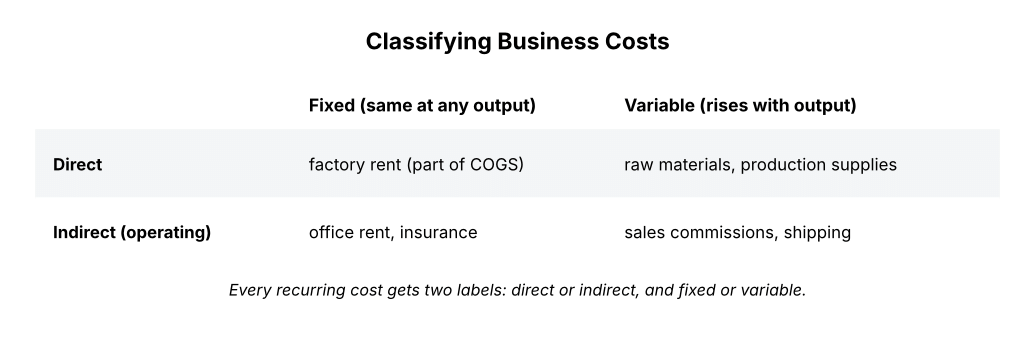
Once a business is running, it classifies recurring costs in two separate ways. Every cost gets both labels.
| Classification | Type | Definition |
|---|---|---|
| What the cost is tied to | Direct | Tied to producing or delivering specific goods or services |
| Indirect (operating expenses) | Costs of running the business overall | |
| How the cost behaves | Fixed | Does not change with production or service levels |
| Variable | Increases as production or service levels increase |
Direct costs have special names:
- Cost of goods sold (COGS), for businesses that make goods, includes raw materials, production supplies, production wages and benefits, and the cost of running manufacturing facilities. COGS can include both fixed costs (factory rent) and variable costs (raw materials).
- Cost of sales, for businesses that provide services, includes direct labor, travel, and materials used to deliver the service.
Operating expenses are recurring indirect costs that are usually fixed: occupancy, salaries and benefits for office and sales staff, marketing and advertising, supplies, utilities, maintenance, and insurance.
Insurance and Risk Tolerance
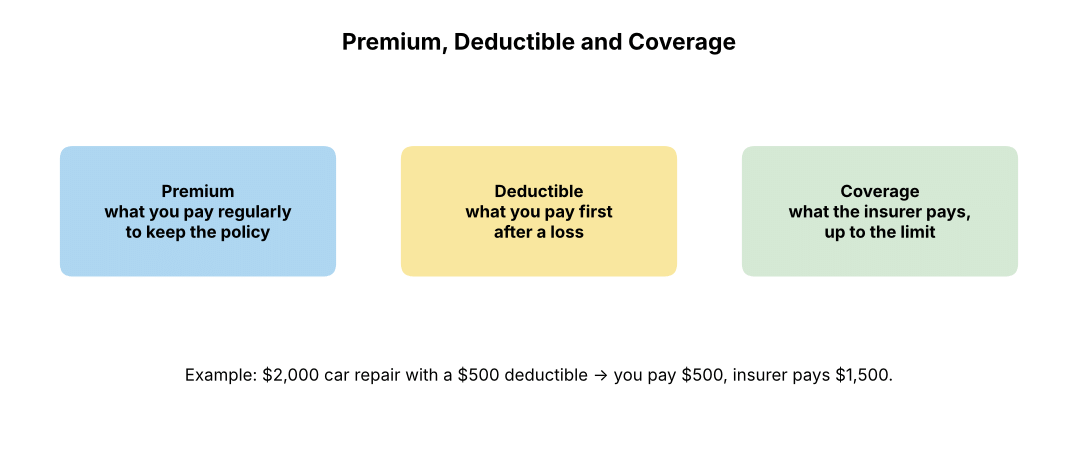
Businesses and consumers buy insurance to protect against financial losses from accidents, injuries, or property damage. Some insurance is required, such as workers’ compensation for businesses with employees. Much of it is optional, and people and businesses differ in how much risk they are willing to accept versus pay to reduce. A cautious owner may insure against every possible loss, while another may keep a cash cushion and buy only required coverage.
Worked Example: A T-Shirt Printing Business
Lena plans a screen-printing shop. Her startup list and first-month costs:
| Cost | Amount | Classification |
|---|---|---|
| Business license and LLC filing | $400 | One-time expenditure |
| Printing press | $6,000 | One-time expenditure (equipment) |
| Blank shirts and ink for first orders | $1,500 | Initial expense, then COGS (direct, variable) |
| Studio rent | $1,200 a month | Initial expense, then operating expense (indirect, fixed) |
| Wages for a part-time printer | $1,000 a month | COGS (direct production wages) |
| Liability insurance | $100 a month | Operating expense (indirect, fixed) |
Lena’s total startup budget for the first month is \(400+6{,}000+1{,}500+1{,}200+1{,}000+100=\$10{,}200\). If she doubles her orders, the shirts and ink will roughly double, but her rent and insurance will not change.
Why does this matter? Task 1 of Unit 3, Part 2 in the Business Canvas Project asks you to determine startup costs and initial expenses. These categories also feed straight into the income statement in Topic 3.6.
Test-Taking Strategies
Mnemonic Devices and Memory Shortcuts
Ask two questions about every cost: “Tied to the product?” (direct or indirect) and “Changes with output?” (variable or fixed). For direct costs: “Goods get COGS; Services get Sales.”
Cross-Topic Connections
- Topic 1.8: Supply Chains covers the production processes that generate COGS.
- Topic 2.5: Price explains why price must exceed per-unit cost.
- Topic 3.3: Accounting and Financial Management explains how these costs are recorded and reported.
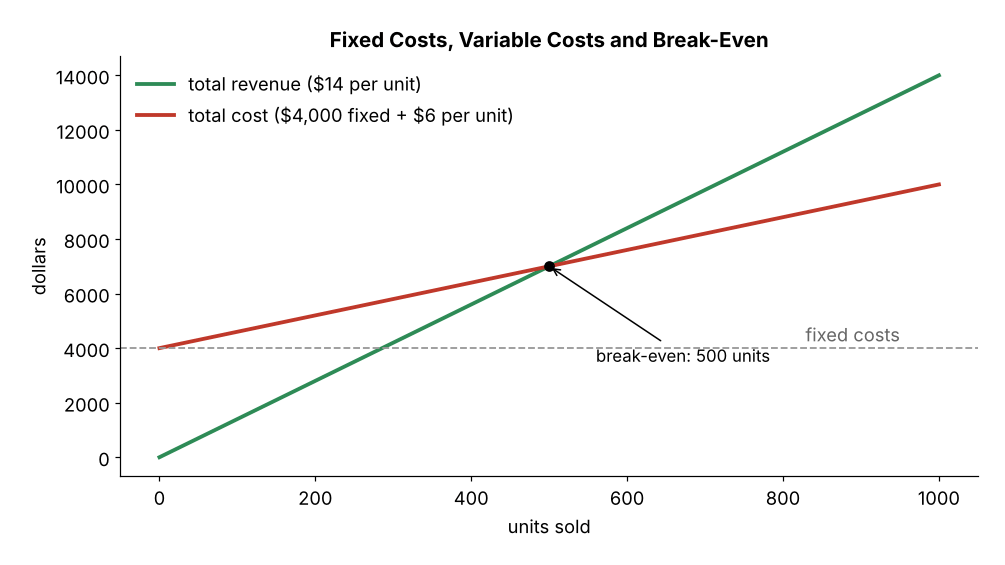
- AP® Microeconomics Topic 3.2: Short-Run Production Costs analyzes fixed and variable costs with graphs.
Common Question Formats
- A list of costs asking which are one-time startup expenditures.
- A single cost asking whether it is fixed or variable, direct or indirect.
- A scenario asking how total costs change when production rises.
Frequent Student Mistakes
- Assuming all direct costs are variable. Factory rent is part of COGS but fixed.
- Using “COGS” for a service business. Its direct costs are cost of sales.
- Forgetting that initial expenses like rent continue after launch.
Test-Day Shortcuts
If a cost would disappear when production stops, it is variable. If the business still pays it during a slow month, it is fixed.
Time Management Tips
The AP Business with Personal Finance Exam on May 4, 2027, is fully digital in Bluebook, and calculators are permitted. Cost classification questions are quick wins. Label each cost in a scratch note as you read so the totals are easy if the question asks for one.
Check for Understanding
Think you’ve got it? Complete the quiz below to make sure. Download your results at the end.