
Maximize your score with these resources:
- Albert.io AP® Business with Personal Finance question banks
- Free AP® Business with Personal Finance score calculator
Two friends each decide to invest $200 a month for retirement. One starts at 22. The other waits until 32. Both stop at 67. Assuming the same average return, the early starter ends up with roughly twice as much money, even though she contributed only $24,000 more. The secret is time. Long-term goals like college, a home, and retirement are too big to fund from a single paycheck. They require planning, the right mix of financial assets, and an early start. Topic 5.3 brings the course’s personal finance threads together around those big goals.
This article covers Topic 5.3: Saving and Investing for Education, Housing, and Retirement Goals in Unit 5, Personal Goals, Budgeting, and Investing. The topic asks you to explain how financial planning supports long-term goals, describe factors that affect investment returns, and recommend a saving and investing plan.
By the end, you should be able to:
- Describe how people plan and pay for education, housing, retirement, and charitable giving.
- Explain how compounding, risk, fees, taxes, inflation, and behavioral biases affect returns.
- Match an investment mix to a time horizon and risk tolerance.
- Explain diversification and how to choose a financial advisor.
Planning for Big Goals
| Goal | Key decisions | Typical funding |
|---|---|---|
| Postsecondary education | Where to attend and what to study, based on career goals and funding | Savings, student loans, scholarships, grants, work-study. Federal loans may have lower rates, better repayment terms, and government subsidies compared with private loans. |
| Housing | Where to live; rent or buy | A down payment from savings plus a mortgage. Payments depend on loan size, repayment period, and a fixed or adjustable interest rate. |
| Retirement | When to retire and where to live, based on preferences, health, and funds | Social Security, employer-sponsored retirement plans, personal investments, and continued earnings |
| Charitable giving | Which organizations and what type of gift: one-time, recurring, or legacy | Budgeted giving aligned with a nonprofit’s mission; may bring tax deductions |
Two planning tips from the CED: couples with combined finances reduce conflict by discussing and sharing long-term goals, and financial technology such as automated savings plans or payroll deductions for retirement helps overcome barriers to saving.
What Affects Investment Returns
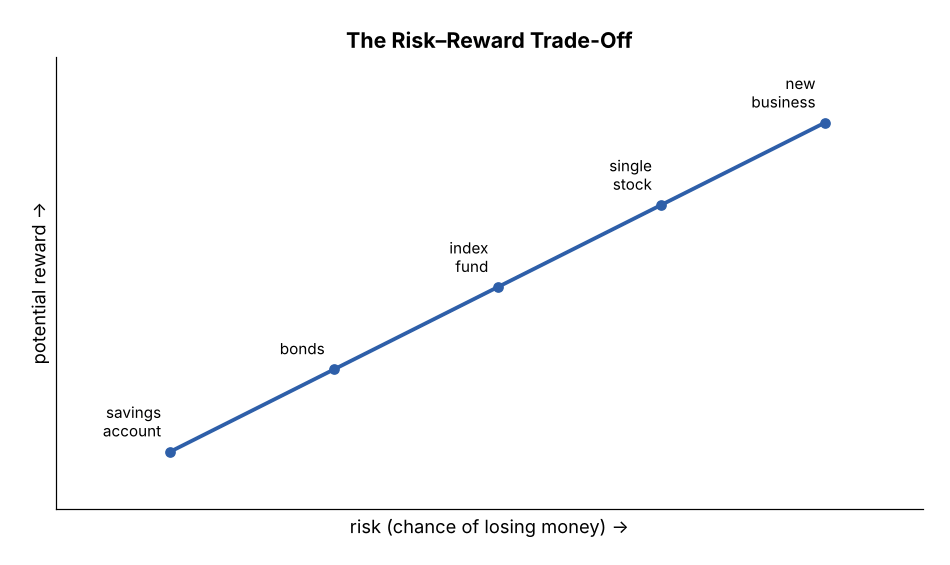
Savers can hold savings accounts and CDs, individual stocks and bonds, or mutual funds, which invest pooled money in stocks and bonds. Several factors shape what they actually earn:
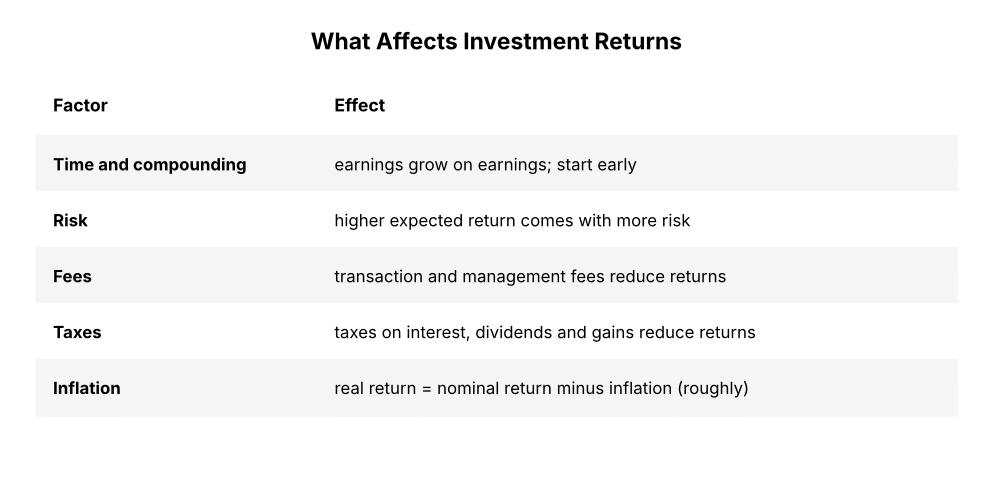
| Factor | Effect on return |
|---|---|
| Compounding and time | Starting young and holding long lets earnings grow on earnings, producing greater returns |
| Risk | Low-risk assets (insured or guaranteed income) have lower expected returns; higher-risk assets such as individual stocks have higher expected returns |
| Fees | Transaction, management, and advice fees reduce returns. Stocks and bonds require a broker; discount brokers charge less but advise less than full-service firms |
| Taxes | Taxes on interest, dividends, and capital gains reduce returns |
| Inflation | Reduces the real (inflation-adjusted) return compared with the nominal return |
| Behavioral biases | Overconfidence leads to unnecessary risk; loss aversion leads to selling too early at a loss |
Worked Example: The Power of Starting Early
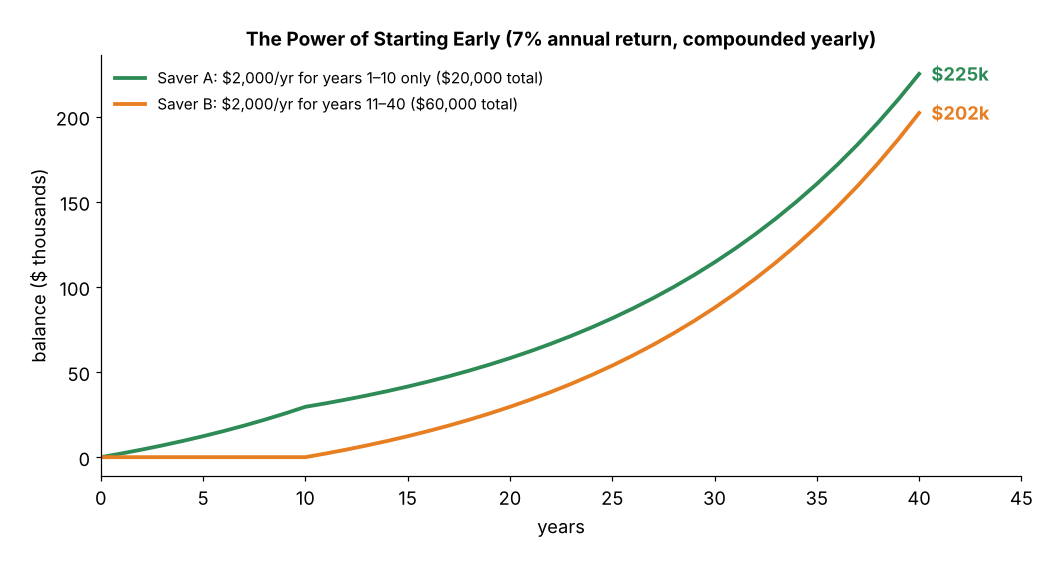
Assume both friends invest $2,400 a year ($200 a month) and earn an average of 7% a year, compounded annually. Real returns vary year to year, so this is an illustration, not a guarantee.
- Starts at 22, invests 45 years: contributes \(2{,}400\times 45=\$108{,}000\) and ends with about $686,000.
- Starts at 32, invests 35 years: contributes \(2{,}400\times 35=\$84{,}000\) and ends with about $332,000.
- Takeaway: An extra $24,000 of contributions produced about $354,000 more, because the early dollars had ten more years to compound.
Building a Plan
Allocating money among assets depends on how much the goal requires, how much can be saved each pay period, the time horizon, risk tolerance, and expected returns.
- Long time horizon (retirement decades away): more higher-risk, higher-return assets, because there is time to recover from downturns.
- Short time horizon (a down payment in two years): safer assets, because selling during a downturn could lock in losses.
- Low risk tolerance: federally insured savings accounts and CDs. Higher risk tolerance: stocks and mutual funds.
Financial advisors often recommend diversification, spreading money across assets with different risks and returns to seek higher long-term returns without excessive risk. When choosing an advisor, consider licensing, certifications, education, experience, and cost. Investors often compare performance against a benchmark, such as a stock or bond index.
Why does this matter? These decisions shape decades of financial life, and they use every personal finance idea in the course: saving, borrowing, risk, taxes, and budgeting.
Test-Taking Strategies
Mnemonic Devices and Memory Shortcuts
For what shrinks returns, remember “FIT B”: Fees, Inflation, Taxes, Biases. For plans, “Long time, more risk; short time, play safe.”
Cross-Topic Connections
- Topic 3.1: Saving for Future Purchases compares savings accounts, money market accounts, and CDs.
- Topic 3.5: Financial Capital explains stocks, bonds, dividends, and rate of return.
- Topic 3.2: Borrowing, Credit, and Debt covers the credit needed to qualify for student loans and mortgages.
- Topic 5.1: Taxes, Net Income, and Budgeting explains capital gains taxes and pretax retirement deductions.
Common Question Formats
- A household’s goal and time horizon asking which investment mix fits.
- An investor’s behavior asking which bias it shows.
- A question asking why starting to invest early leads to greater returns.
Frequent Student Mistakes
- Recommending stocks for money needed in a year or two.
- Ignoring fees and taxes when comparing returns.
- Confusing nominal and real returns.
Test-Day Shortcuts
Find the time horizon first. It usually decides the answer before risk tolerance even comes into play.
Time Management Tips
Unit 5 is not assessed on the AP Business with Personal Finance Exam on May 4, 2027. Its ideas still reinforce the 12 to 15 personal finance multiple-choice items spread across Units 1 through 4, so this review supports your exam prep as well as your future.
Check for Understanding
Think you’ve got it? Complete the quiz below to make sure. Download your results at the end.