
If 3 notebooks cost 7.50 dollars, what do 8 notebooks cost? If a map scale says 1 inch equals 25 miles, how far apart are two towns 4.2 inches apart on the map? Questions like these are solved with ratios, rates, and proportions, some of the most practical tools in all of Algebra 1.
This article covers Topic 2.6: Ratios, Rates, and Proportions in Unit 2, Linear Equations. The topic asks you to write ratios and unit rates, set up proportions from words, and solve proportions using cross products.
By the end, you should be able to:
- Write a ratio three ways and simplify it.
- Find and compare unit rates.
- Set up a proportion with matching units in matching positions.
- Solve proportions, including ones with variable expressions.
Ratios and Rates
A ratio compares two quantities by division. You can write the ratio of 12 girls to 8 boys three ways: \(12\) to \(8\), \(12:8\), or \(\frac{12}{8}\). Ratios simplify just like fractions, so this one becomes \(3:2\).
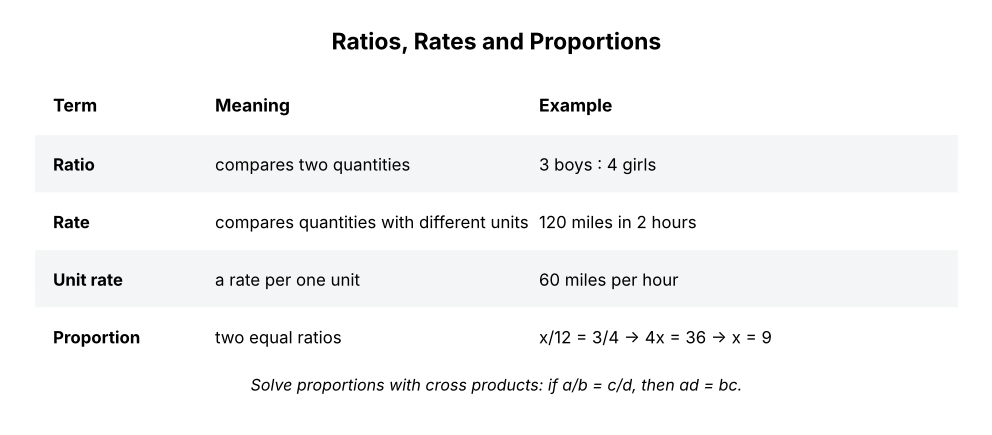
A rate is a ratio that compares quantities with different units, such as miles per hour or dollars per pound. A unit rate has a denominator of 1, which makes comparisons easy.
| Situation | Rate | Unit Rate |
|---|---|---|
| A car travels 186 miles in 3 hours. | \(\frac{186}{3}\) miles per hour | 62 miles per hour |
| A 12-ounce box of cereal costs 3.60 dollars. | \(\frac{3.60}{12}\) dollars per ounce | 0.30 dollars per ounce |
| A printer prints 90 pages in 5 minutes. | \(\frac{90}{5}\) pages per minute | 18 pages per minute |
Why does this matter? Unit rates are how you decide which deal is better. Comparing a 12-ounce box for 3.60 dollars with an 18-ounce box for 4.86 dollars is hard until you divide: 0.30 dollars per ounce versus 0.27 dollars per ounce. The larger box is the better buy. Unit rates also become the slope of a line later in the course.
Setting Up Proportions
A proportion is an equation stating that two ratios are equal, such as \(\frac{3}{7.50}=\frac{8}{c}\). The key to setting one up correctly is consistency: the same units must sit in the same positions on both sides.
- Label before you write. If the left fraction is notebooks over dollars, the right fraction must also be notebooks over dollars.
- Put the unknown where it belongs. The cost of 8 notebooks is unknown, so \(c\) sits in the dollars position next to the 8.
- Read scale problems carefully. For a map scale of 1 inch to 25 miles, write \(\frac{1}{25}=\frac{4.2}{d}\), with inches on top and miles on the bottom of both fractions.
- Check that the answer makes sense. More notebooks should cost more, and a longer map distance should mean more miles.
Solving Proportions
The cross products property says that if \(\frac{a}{b}=\frac{c}{d}\), then \(ad=bc\). Multiply diagonally, set the products equal, and solve the resulting equation.
Worked example 1: Solve \(\frac{3}{7.50}=\frac{8}{c}\).
- Cross multiply: \(3c=8(7.50)\).
- Simplify: \(3c=60\).
- Divide by 3: \(c=20\). Eight notebooks cost 20 dollars.
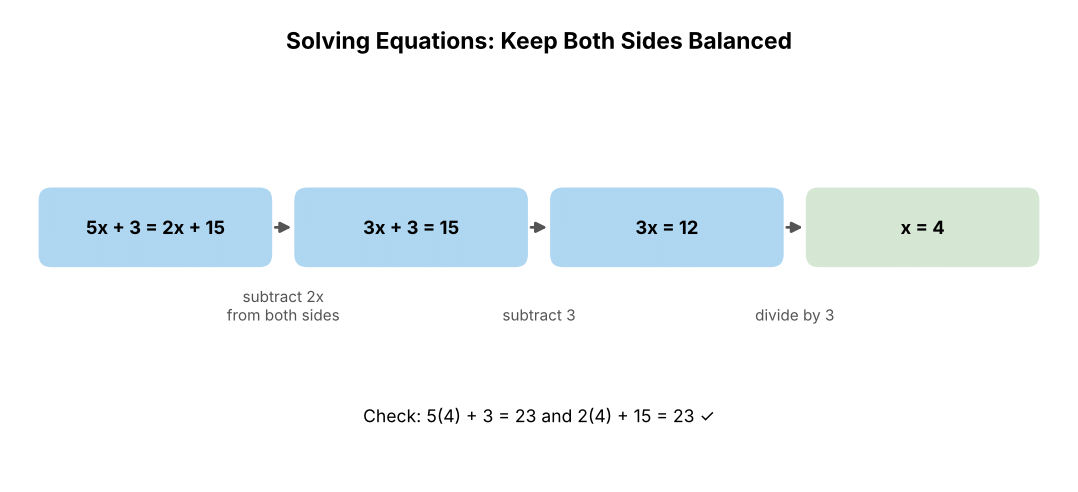
Worked example 2: Solve \(\frac{x+2}{5}=\frac{x-1}{2}\).
- Cross multiply: \(2(x+2)=5(x-1)\).
- Distribute: \(2x+4=5x-5\).
- Subtract \(2x\) from both sides: \(4=3x-5\).
- Add 5: \(9=3x\), so \(x=3\).
Why does this matter? Example 2 shows that cross multiplying can produce an equation with variables on both sides. The parentheses are essential. Writing \(2x+2\) instead of \(2(x+2)\) multiplies only part of the numerator and leads to the wrong answer.
Proportions also power percent problems. “What is 35 percent of 80?” becomes \(\frac{35}{100}=\frac{p}{80}\), which gives \(p=28\). Any time you see “part out of whole,” a proportion is a reliable setup.
Test-Taking Strategies
Mnemonic Devices and Memory Shortcuts
Say “Same over same” to keep units aligned: the same unit goes on top of both fractions. For percent proportions, remember “is over of equals percent over 100,” which turns a sentence directly into an equation.
Cross-Topic Connections
- Cross multiplying often produces Topic 2.4: Equations with Variables on Both Sides.
- Solving for one quantity in a formula uses the same reasoning as Topic 2.5: Solving Literal Equations.
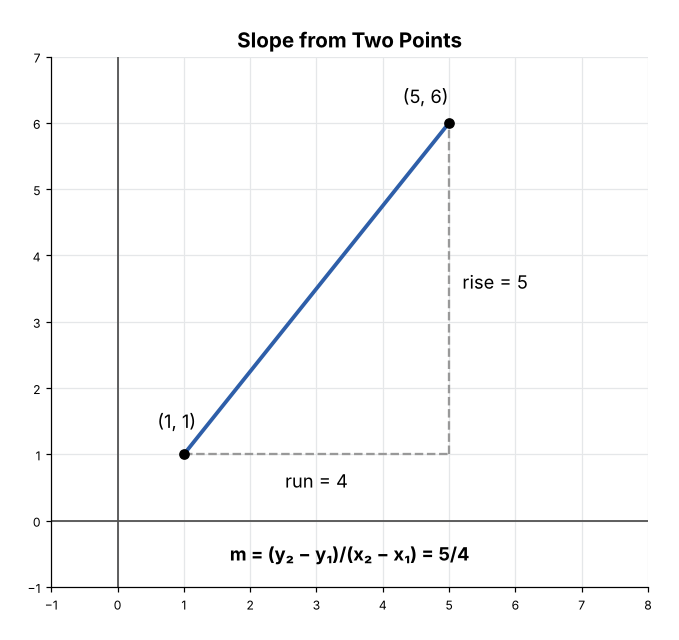
- A unit rate is the slope of a proportional relationship, as shown in Topic 5.1: How to Find Slope.
- Rates written as equations become lines through the origin in Topic 5.2: Slope-Intercept Form.
Common Question Formats
- Find a unit rate and use it to choose the better buy.
- Solve a proportion with a numeric or variable expression in one position.
- Use a scale drawing or map scale to find an actual length.
- Decide whether two ratios form a proportion by comparing cross products.
Frequent Student Mistakes
- Flipping one fraction, as in \(\frac{3}{7.50}=\frac{c}{8}\). Keep the units in matching positions.
- Forgetting parentheses when a numerator or denominator has two terms.
- Comparing total prices instead of unit prices when deciding which deal is better.
Test-Day Shortcuts
Look for a scale factor before cross multiplying. In \(\frac{4}{9}=\frac{12}{x}\), the numerator tripled, so the denominator triples too and \(x=27\). Mental scaling is faster and avoids large products.
Time Management Tips
Proportion problems on Algebra 1 unit tests and end-of-course exams usually take under two minutes. Spend most of that time on the setup, since the arithmetic is quick once the units line up. If your answer seems unreasonably large or small, check the setup before redoing the arithmetic.