
An equation usually has one answer, but an inequality usually has infinitely many. If you need at least 70 points to pass and you already have 52, any score of 18 or more works. Inequalities describe ranges like that, and solving them uses almost the same steps as solving equations, with one important twist.
This article covers Topic 3.1: Solving and Graphing Inequalities in Unit 3, Linear Inequalities. The topic asks you to solve one-variable linear inequalities, graph their solutions on a number line, and write inequalities from real-world situations.
By the end, you should be able to:
- Read and write the four inequality symbols correctly.
- Solve one-step and multi-step linear inequalities.
- Reverse the inequality symbol when multiplying or dividing by a negative.
- Graph a solution set using open and closed circles on a number line.
Inequality Symbols and Their Meanings
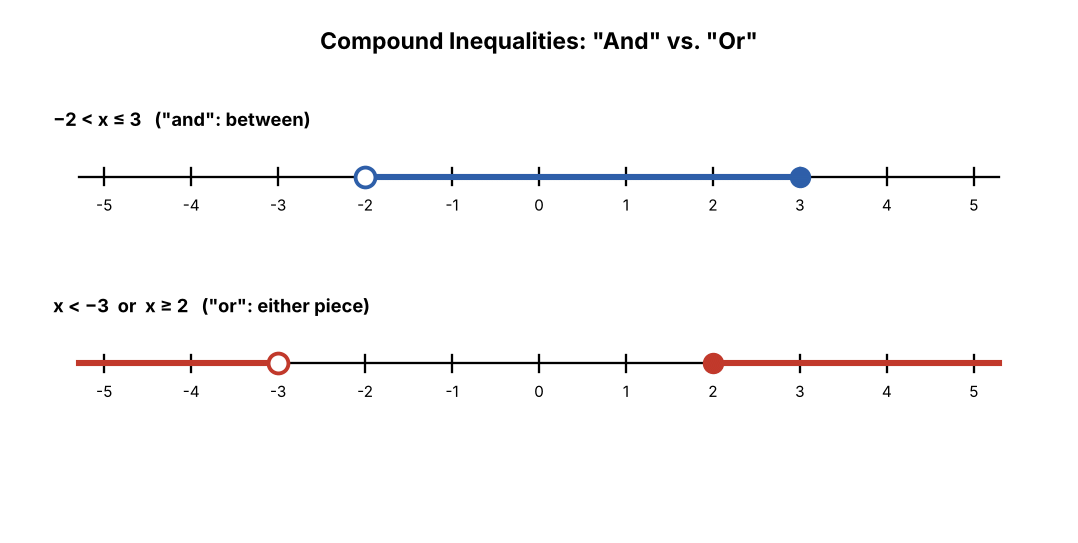
Each symbol describes a different kind of range. Pay close attention to whether the boundary value itself is included.
| Symbol | Meaning | Key Phrases | Graph Endpoint |
|---|---|---|---|
| \(\lt\) | less than | fewer than, below | Open circle |
| \(\gt\) | greater than | more than, above, exceeds | Open circle |
| \(\le\) | less than or equal to | at most, no more than, maximum | Closed circle |
| \(\ge\) | greater than or equal to | at least, no less than, minimum | Closed circle |
Why does this matter? Word problems hinge on these phrases. “At least 18” means 18 counts, so the symbol is \(\ge\) with a closed circle. “More than 18” excludes 18, so the symbol is \(\gt\) with an open circle. Choosing the wrong one changes both the answer and the graph.
Solving Linear Inequalities
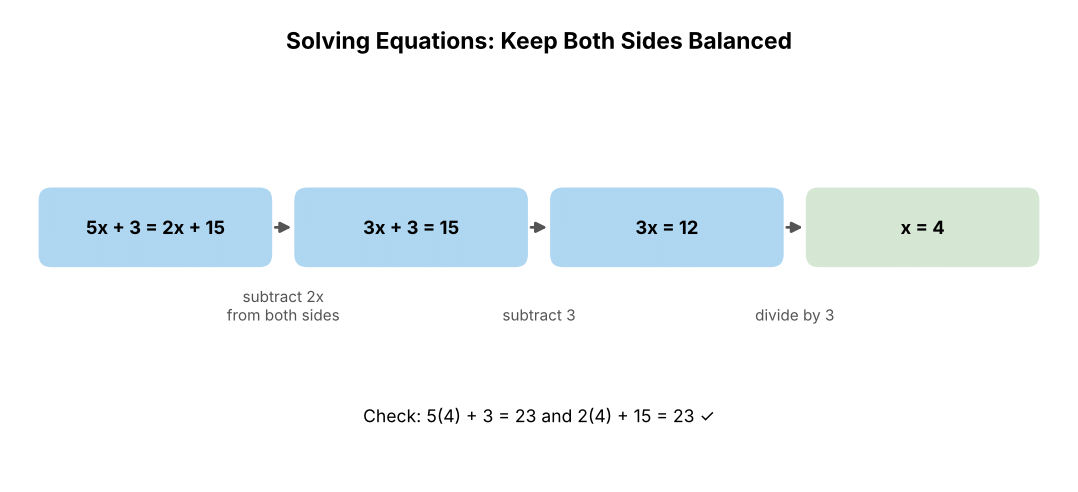
Solve inequalities with the same inverse operations you use for equations. Adding or subtracting the same number on both sides never changes the direction of the symbol. Multiplying or dividing by a positive number never changes it either.
The twist comes with negatives. When you multiply or divide both sides by a negative number, reverse the inequality symbol. To see why, start with the true statement \(2\lt 5\). Multiply both sides by \(-1\) to get \(-2\) and \(-5\). On the number line, \(-2\) is to the right of \(-5\), so \(-2\gt-5\). The order flipped, and the symbol must flip with it.
Worked example 1: Solve \(3x-7\ge 11\).
- Add 7 to both sides: \(3x\ge 18\).
- Divide by 3, a positive number, so the symbol stays: \(x\ge 6\).
Worked example 2: Solve \(10-4x\gt 26\).
- Subtract 10 from both sides: \(-4x\gt 16\).
- Divide by \(-4\) and reverse the symbol: \(x\lt-4\).
- Check with a test value such as \(x=-5\): \(10-4(-5)=30\), and 30 is greater than 26, so the solution is correct.
Worked example 3: Solve \(2(x+3)\le 5x-9\).
- Distribute: \(2x+6\le 5x-9\).
- Subtract \(2x\): \(6\le 3x-9\).
- Add 9: \(15\le 3x\).
- Divide by 3: \(5\le x\), which you can rewrite as \(x\ge 5\).
Why does this matter? Example 3 avoided dividing by a negative by moving the smaller variable term. That choice removes the most common error entirely. When you do end with \(5\le x\), flip the whole statement so the variable comes first, keeping the symbol pointing at the same number.
Graphing Solutions on a Number Line
A number line graph shows every solution at once. Follow three steps:
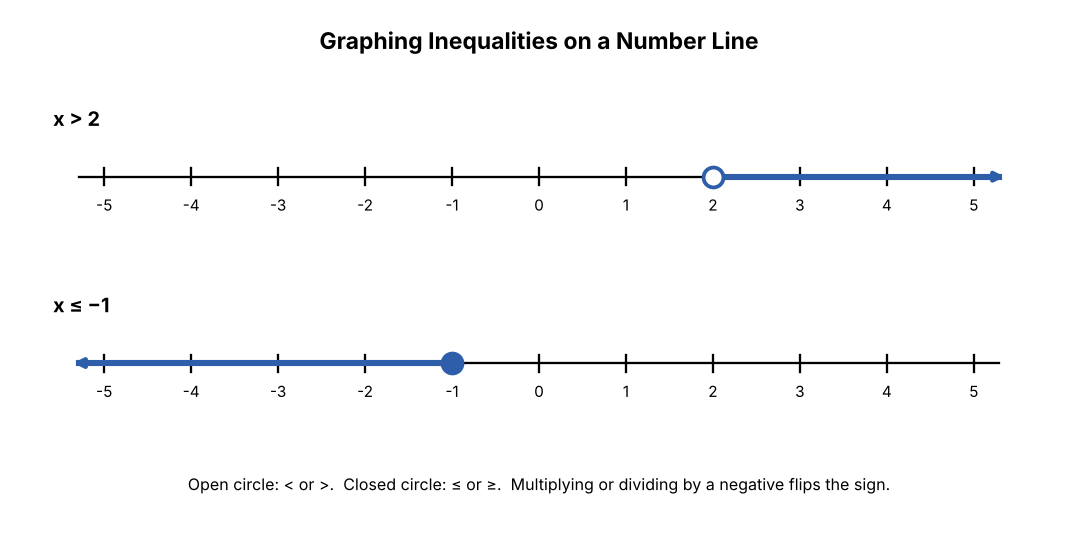
- Plot the boundary. Place a circle at the boundary value, such as 6 for \(x\ge 6\).
- Choose open or closed. Use a closed circle for \(\le\) or \(\ge\) and an open circle for \(\lt\) or \(\gt\).
- Shade the direction. Shade right for values greater than the boundary and left for values less than it, as long as the variable is written first.
Always test a point in the shaded region. For \(x\lt-4\), test \(x=-10\) in the original inequality. If the test value works, your shading is correct.
Context can also limit solutions. If \(x\) counts people or tickets, only whole numbers make sense, so a solution like \(x\ge 6\) really means 6, 7, 8, and so on.
Test-Taking Strategies
Mnemonic Devices and Memory Shortcuts
“Negative flips the sign” covers the reversal rule. For graphs, remember “line under, color in”: when the symbol has a line underneath, as in \(\le\), the circle is filled. When there is no line, the circle stays open.
Cross-Topic Connections
- The solving steps mirror Topic 2.2: Solving Two-Step Equations.
- Variables on both sides appear here just as in Topic 2.4: Equations with Variables on Both Sides.
- Two-variable inequalities extend this idea to the coordinate plane in Topic 6.5: Graphing Systems of Inequalities.
- Translating key phrases builds on Topic 1.1: Variables and Algebraic Expressions.
Common Question Formats
- Solve an inequality and choose the matching number line graph.
- Write an inequality for a budget, minimum score, or capacity limit.
- Decide whether a given value is a solution.
- Identify the error in a solution where the symbol was not reversed.
Frequent Student Mistakes
- Forgetting to reverse the symbol after dividing by a negative.
- Reversing the symbol when subtracting a negative or adding. Only multiplying or dividing by a negative flips it.
- Shading the wrong way when the variable is on the right, as in \(5\le x\). Rewrite it as \(x\ge 5\) before graphing.
Test-Day Shortcuts
Plug the boundary value and one test value into the original inequality. The boundary tells you open or closed, and the test value tells you which direction to shade. This check takes seconds and verifies the whole answer.
Time Management Tips
Inequality items on Algebra 1 unit tests and end-of-course exams typically take one to two minutes. Match-the-graph questions go fastest if you solve first, then scan the choices for the right endpoint and circle type. Save time by eliminating graphs with the wrong boundary value before checking shading.